Alibaba Collaborates with Apple, Baidu Teams Up with Samsung, ByteDance Joins Forces with ZTE: Unveiling the Motives Behind Tech Titans’ Alliances
 07/20 2026
 557
557
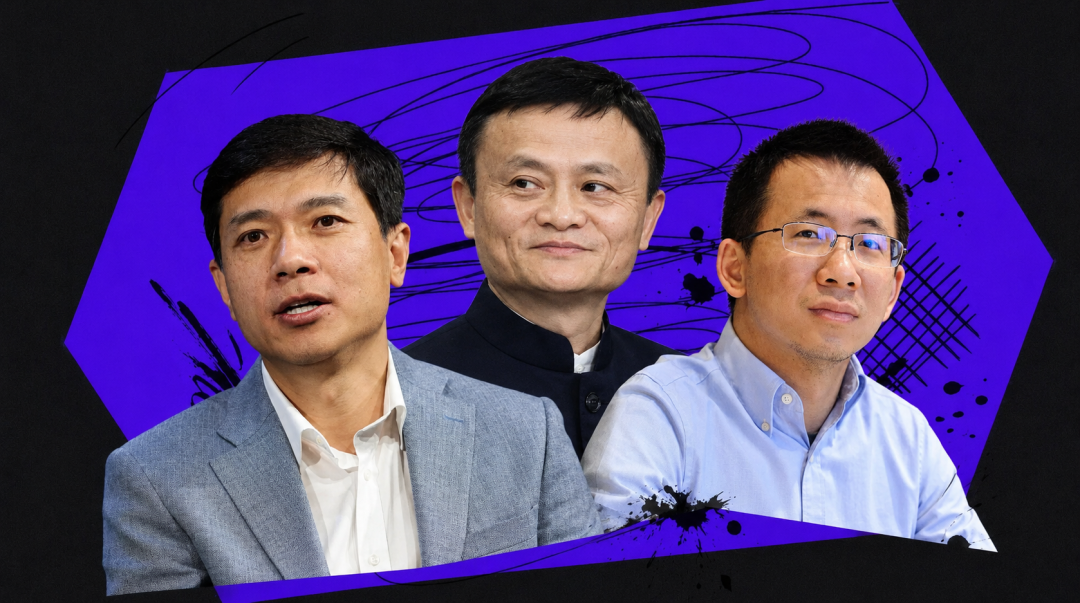 Image Source: AI Synthetic Rendering
In July 2026, the domestic mobile AI sector experienced a groundbreaking reshuffle.
Following the Cyberspace Administration of China’s announcement of seven generative AI service filings for mobile devices, prominent domestic and international terminal AI services, including those from Apple, Samsung, Huawei, OPPO, ZTE, and Xiaomi, officially commenced compliant operations. Beneath this seemingly routine policy filing lies a pivotal industry transformation: leading overseas mobile brands have entirely abandoned their independent AI development efforts and fully embraced China’s domestic large-scale models.
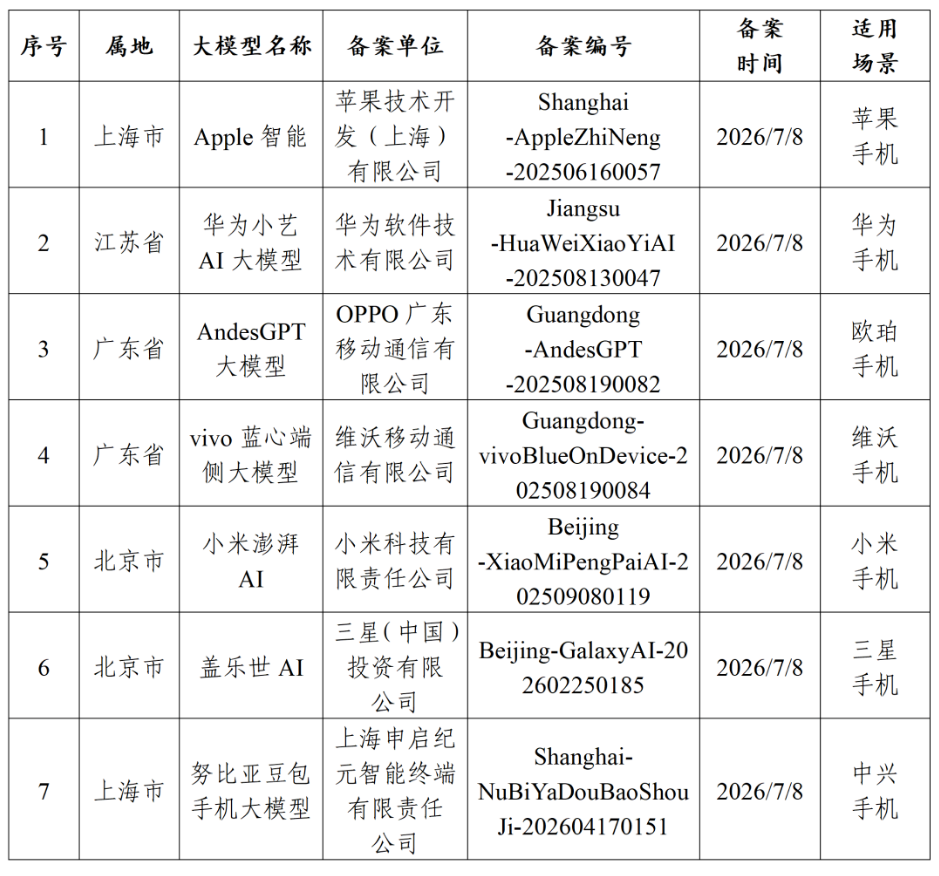 Image Source: Cyberspace Administration of China
A distinct competitive landscape has emerged: Alibaba is allied with Apple, Baidu with Samsung, and ByteDance with ZTE. These three domestic AI powerhouses have secured crucial entry points into the global terminal market. The domestic AI competition has transitioned from superficial “parameter wars” and “benchmark races” to an era of ecosystem positioning involving large models and hardware terminals, fundamentally reshaping the rules of China’s AI competition in the second half.
01 Apple’s Two-Year Wait Ends with Alibaba Partnership: Beyond Just Compliance
The AI features that Chinese iPhone users have eagerly anticipated for two years have finally materialized.
As early as the 2024 Apple event, Apple Intelligence made a splashy debut, with overseas users being the first to experience a comprehensive suite of features, including intelligent notification organization, text rewriting, and AI photo editing. However, due to domestic compliance requirements, core AI capabilities were notably absent from Chinese iPhone, iPad, and Mac devices, reducing these top-tier hardware offerings to a “feature-deficient” version—a source of disappointment for countless users.
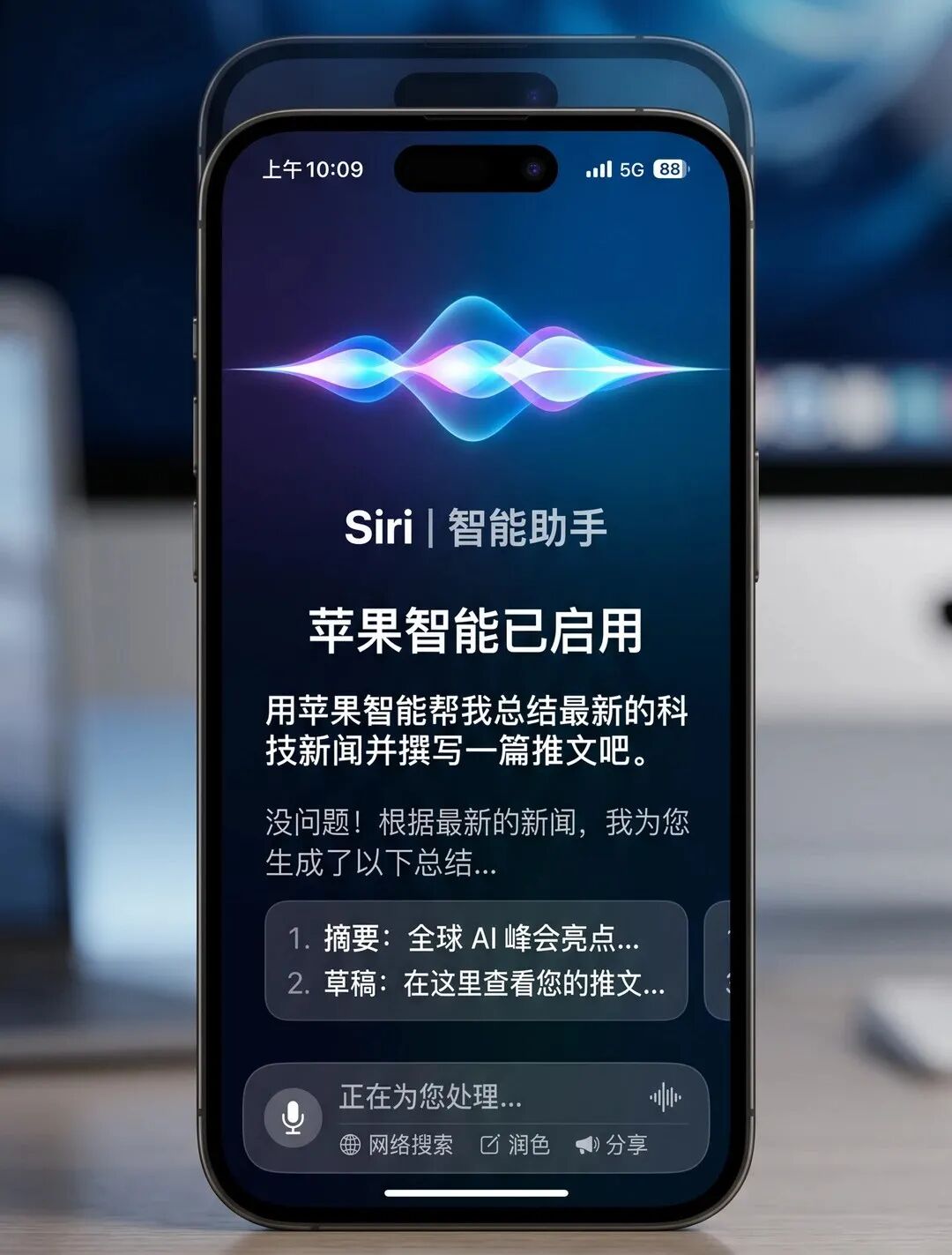 Image Source: Xiaohongshu
After two years of compliance negotiations, on July 15, Apple’s “Apple Intelligence” successfully completed domestic filing and officially launched in the Chinese mainland market. The cornerstone supporting AI capabilities across Apple’s entire lineup of Chinese devices is Alibaba’s Tongyi Qianwen.
 Image Source: X Social Platform
According to official information, Tongyi Qianwen will fully adapt to Apple’s four major operating systems, providing Chinese users with full-scenario services, including text understanding, image analysis, content generation, and intelligent office functions. The standout feature is that these capabilities do not require a standalone app but are directly embedded at the system level, seamlessly triggered in daily scenarios such as email, photos, files, and calendars, truly integrating AI into everyday use. Following the announcement, Alibaba’s U.S. stock price surged over 4% in pre-market trading. The capital markets have already recognized that this marks the first time a Chinese large-scale model has secured core influence in the global high-end hardware ecosystem.
Why did Apple, renowned for its extreme autonomy and stringent standards—having prioritized ChatGPT and Google Gemini overseas—choose Alibaba exclusively for the Chinese market? The answer lies not in model parameters but in system-level AI’s security, stability, and engineering implementation capabilities.
While ordinary AI apps can be restarted if they malfunction, system-level AI deeply accesses user privacy data. Any vulnerabilities, delays, or errors could trigger irreversible security and experience risks. Apple needed not just a high-performing model but a complete solution capable of supporting hundreds of millions of devices with low power consumption, high compliance, and long-term stable operation.
Since 2024, Apple has conducted multiple rounds of long-term testing with leading domestic AI firms, ultimately selecting Alibaba. On one hand, Tongyi Qianwen excels in Chinese contextual understanding and multimodal technology, perfectly aligning with domestic user habits. On the other hand, Alibaba Cloud, forged through extreme traffic challenges like Double 11, has mature capabilities in compute resource scheduling, engineering delivery, and content governance, sufficient to support Apple’s massive device ecosystem. Alibaba Group Chairman Joe Tsai also publicly confirmed that after multiple rounds of evaluation, Apple chose to deeply partner with Alibaba.
This collaboration holds far greater strategic value for Alibaba than short-term revenue. While the large model industry previously competed over app downloads and monthly active users, relying on user-initiated engagement, Alibaba has now secured system-level invocation rights on Apple devices, successfully breaking free from the traffic red ocean. In the future, countless Apple users who have never used the Qianwen app will frequently and seamlessly invoke its capabilities for office tasks, photo editing, and file organization, elevating Alibaba’s AI from a tool application to a core infrastructure for high-end smart devices.
02 Baidu’s Samsung Partnership: Safeguarding Search Dominance, Capturing High-End Android Market
While Alibaba leverages Apple to secure a global high-end ecosystem, Baidu has firmly defended its high-end Android AI position through its partnership with Samsung.
Among the approved services, Samsung’s core AI offering, “Galaxy AI,” passed the review, with Baidu Intelligent Cloud and its Wenxin large-scale model as its sole domestic technology provider. The two sides reached a strategic cooperation in early 2024, and after over a year of technical refinement and compliance adaptation, achieved full commercial deployment.
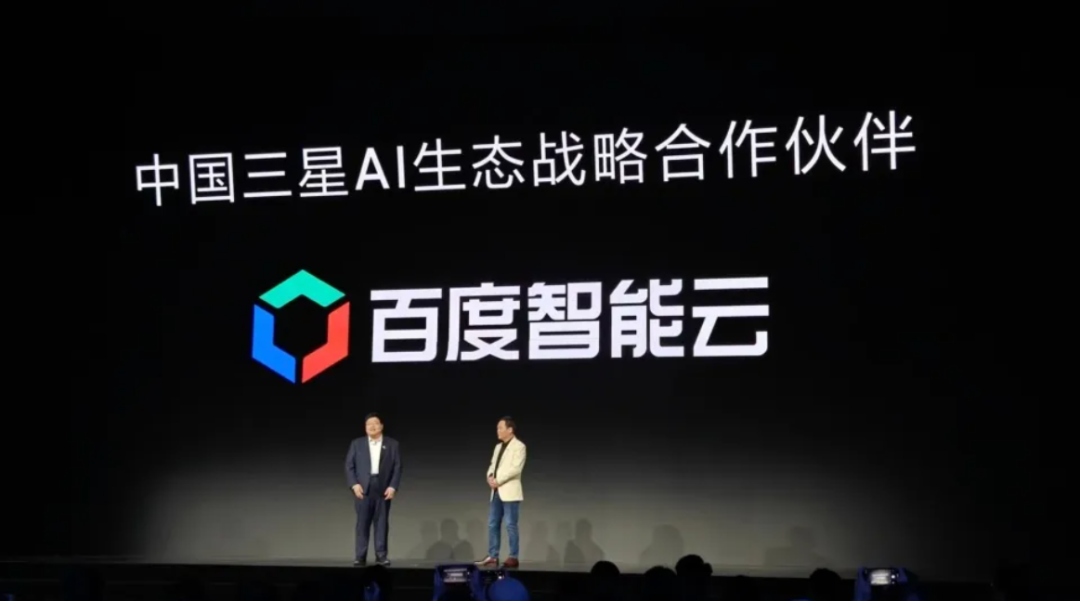 Image Source: Baidu Intelligent Cloud
Unlike Alibaba’s positioning as a universal AI foundation for all scenarios, Baidu has tailored a localized intelligent system for Samsung, focusing on four high-frequency, essential scenarios: intelligent search, visual recognition, voice interaction, and note-taking assistance. Leveraging Wenxin’s capabilities, Samsung flagship features like Circle to Search, Smart Summary, and Scene Recognition have been fully upgraded. The native Bixby voice assistant now integrates Baidu’s document parsing and web search capabilities, resolving the pain points of stiff Chinese interactions and poor localization in overseas AI systems.
This partnership precisely addresses Baidu’s core weakness. As mobile internet dividends fade, traditional web search traffic continues to decline, with system-level AI search emerging as the core traffic entry point for next-generation human-computer interaction. By partnering with Samsung—a global benchmark for high-end Android devices—Baidu has successfully penetrated the high-end terminal ecosystem, locked in core users in business and office sectors, shed its traditional search engine label, and upgraded to a provider of core interaction infrastructure for high-end smart terminals.
Amid intensifying domestic mobile AI competition and accelerated localization of overseas brands, the deep integration between Baidu and Samsung represents not only Samsung’s necessity to comply with domestic regulations but also Baidu’s key strategy to consolidate its AI foundation and achieve differentiated competition.
03 ByteDance’s ZTE Bet: Abandoning Homogenized Competition, Focusing on AI Agents of the Future
While Alibaba and Baidu deepen their presence in mature assistive on-device AI, ByteDance breaks free from internal competition to fully bet on AI agents—the future of the sector—with ZTE Nubia as its core hardware partner.
On July 16, ZTE Nubia unveiled the world’s first AI agent smartphone—the Nubia NaviX Ultra (Doubao Phone Second Generation), powered by ByteDance’s Doubao mobile assistant. As the industry’s first terminal product to implement a system-level AI agent, it has completed Cyberspace Administration filing and obtained full commercial qualifications.
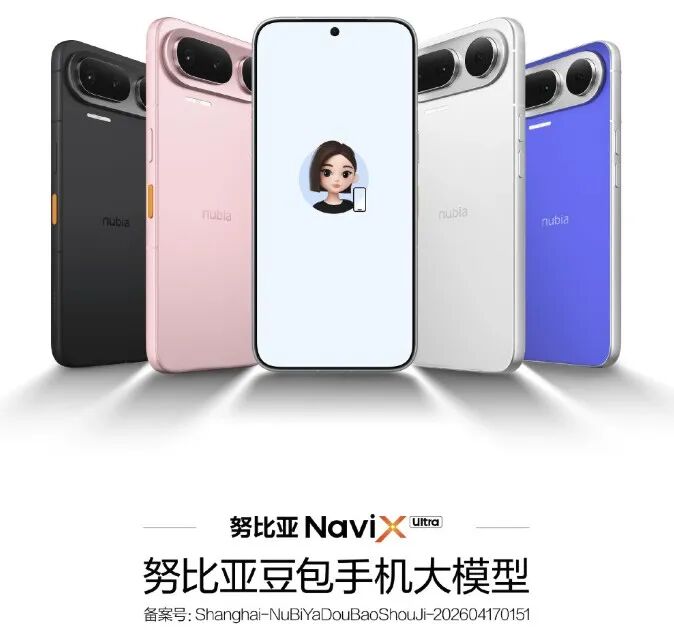 Image Source: Nubia Official Website
This new device completely revolutionizes traditional mobile AI interaction logic. While Apple and Samsung’s AI systems function as passive assistants requiring user commands, ByteDance’s Doubao AI agent features autonomous execution, cross-platform coordination, and proactive service capabilities. Users can complete complex cross-app tasks like price comparisons, guide organization, multi-platform logistics tracking, and batch file processing with a single voice command, requiring manual confirmation only for sensitive actions like payments—truly enabling AI to autonomously handle complex tasks for users.
Market acceptance of this new model is exceptionally high. The previous Doubao First Generation engineering machine, sold to a niche geek audience, maintained a premium on secondary platforms. Supply chain information reveals that while the Doubao Second Generation initially planned for million-unit component production, it ultimately adjusted to 200,000 units in overall inventory, with nearly 100,000 units prepared for the initial batch, reflecting the sector’s potential.
This disruptive innovation has sparked industry controversy, particularly regarding data security with Doubao’s cross-app autonomous operation mode. Pony Ma previously publicly questioned the security risks of cloud-based screen recording interactions, with many users expressing concerns over privacy leaks and misoperations. In response, the official has established a comprehensive protection system: mandatory manual confirmation for sensitive actions, user-controlled privacy permissions, traceable and deletable operation records, and end-side encryption with local storage for core data—eliminating security risks at the foundation.
ByteDance’s agent ecosystem continues to expand. Following ZTE, Honor has initiated deep discussions with ByteDance and is expected to become the second mainstream manufacturer to adopt Doubao AI agents. While Alibaba and Baidu focus on current AI functionality upgrades, ByteDance is betting on the human-computer interaction revolution of the next decade.
04 Tripartite Standoff Emerges: China’s AI Bids Farewell to Wild Growth
With three major partnerships established, the domestic consumer AI sector has ended its chaotic competition, forming a stable tripartite standoff among Alibaba, Baidu, and ByteDance, with each defending its core sector through differentiated competition.
Alibaba’s Tongyi Qianwen: King of High-End Ecosystems—Exclusively partnered with Apple across phones, tablets, computers, and spatial computing devices, it monopolizes the global high-end hardware ecosystem, focusing on full-scenario multimodal general AI for the premium consumer market.
Baidu’s Wenxin: King of Search Interaction—Partnered with Samsung’s high-end Android lineup, it focuses on essential scenarios like voice, search, and visual recognition, defending the core AI traffic entry point while deepening office and government-enterprise localization services.
ByteDance’s Doubao: King of Next-Gen Agents—Collaborating with ZTE and eyeing Honor, it leads in autonomous AI agents, breaking traditional human-computer interaction boundaries and seizing the technological high ground for future terminal AI.
The industry’s competitive logic has shifted: from comparing model parameters and feature counts to ecosystem binding, scenario occupation, and hardware positioning. According to Canalys data, AI phones accounted for just 16% of global shipments in 2024, with penetration expected to surge to 54% by 2028, signaling the imminent explosion of a trillion-dollar terminal AI market. By securing top-tier terminal sectors in advance, the three giants have secured core tickets to future AI hardware dividends.
Epilogue
With Apple addressing its AI shortcomings, Samsung achieving localization upgrades, and ZTE launching AI agents, these three terminal advancements reflect the comprehensive rise and overtaking of China’s domestic large-scale models. Once dominated by overseas AI technology, the domestic smart terminal market now sees leading Chinese AI firms secure core partnerships with global hardware giants through compliance capabilities, engineering strength, and localization advantages.
AI is no longer a lofty industry concept but a digital infrastructure permeating the lives of hundreds of millions of users. With Alibaba defending high-end ecosystems, Baidu securing essential demand, and ByteDance capturing the future, China’s AI tripartite standoff has taken shape. The new era of domestic AI has officially begun.
Disclaimer: This article is solely a financial commentary on major companies and does not constitute investment advice. All corporate data and regulatory events mentioned are from publicly available information and are for reference only, subject to official announcements. Image sources are from the internet; please contact us for copyright removal if needed.
-
Observation of AI Business Models: From Token-Based Payment to Outcome-Based Payment
-
Observations on AI Business Models: From Token-Based Payment to Outcome-Based Payment
-
SpaceX Market Insight: The $1 Trillion 'Fireworks' Fizzle Out, Marking the Start of the Super IPO Gamble
-
![]()
Car Prices on the Rise: Is It Wise to Postpone Your Purchase?
-
![]()
Foxconn's Electric Vehicle Venture Hits a Snag
-
![]()
How Did They Open the Door to Europe by Attacking the Century-Old Stronghold of the Automotive Industry?
-
![]()
Qwen Still Shows Hesitation
-
![]()
Qwen: Still a Bit Short on Confidence