1020 Exhibitors Swarm Shanghai: Unveiling China’s Next AI Horizon from the WAIC 2026 Exhibitor Roster
 07/20 2026
 472
472
Each summer, the World Artificial Intelligence Conference (WAIC) gathers China’s entire AI sector along Shanghai’s Huangpu Riverfront. This year’s event has set new benchmarks: 1020 exhibitors have registered across four key venues (the World Expo Exhibition & Convention Center, Zhangjiang Science Hall, West Bund International Art Center, and World Expo Center), displaying over 1,400 exhibits.
While product launches highlight what companies want the public to see, the exhibitor list offers a more authentic glimpse into where the industry is genuinely investing. Our data analysis of all 1,020 exhibitor profiles has unearthed insights more candid than any keynote address.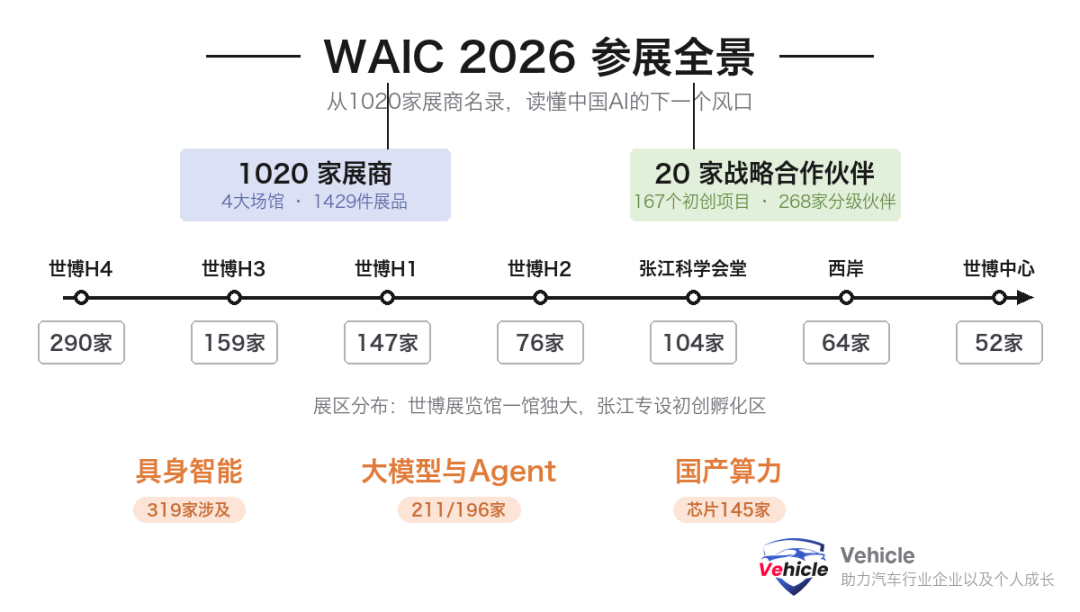
Who’s Present: National Teams, Tech Titans, and 167 Startups Take Center Stage
The elite lineup features 20 strategic partners representing China’s AI ‘All-Star Team’: Huawei, Tencent, Alibaba, Baidu, Ant Group, SenseTime, iFLYTEK, plus the three major telecom operators (China Telecom, China Mobile, China Unicom), two power grid giants (State Grid and China Southern Power Grid), and Bank of Communications—a rare convergence of tech giants, state-owned enterprises (SOEs), and financial institutions.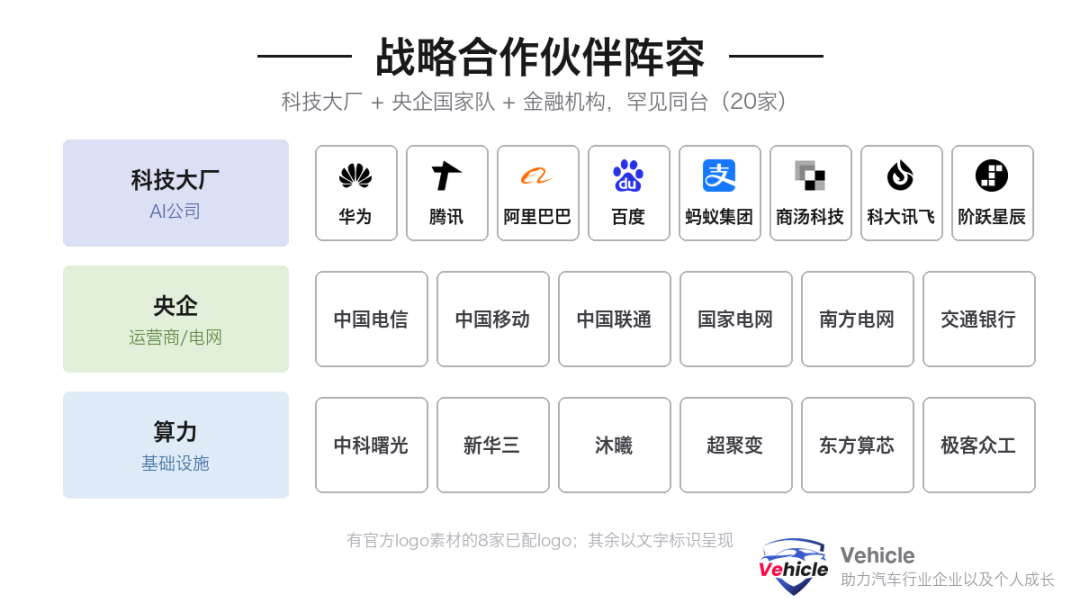
The next tier of 23 premier partners underscores the event’s core focus: nearly the entire domestic AI chip ecosystem is represented, including Illuvia, Enflame, Biren, Moore Threads, Kunlunxin, and Tsingmicro, along with elite partners like Sophgo, Cerebras, and Enyx. A total of 145 chip and semiconductor exhibitors are participating.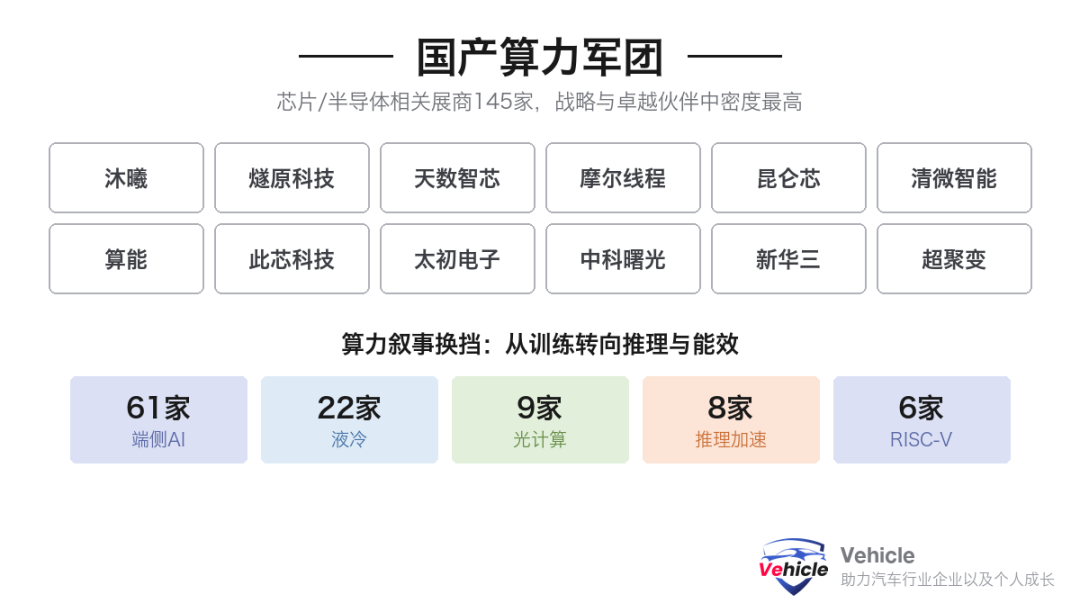
At the other end of the spectrum, activity abounds: 146 first-time (FT) startups and 21 other private capital (OPC) ventures (167 startups in total, comprising 16% of exhibitors) are present, including around 20 overseas-registered companies and contributions from Tsinghua iCenter and Peking University student innovation clubs. Zhangjiang Science Hall effectively transforms into a massive incubator pitch event.
Geographically, Shanghai leads with 278 exhibitors (leveraging its home-field advantage), followed by Beijing (157), Shenzhen (94), and Hangzhou (48)—mirroring China’s actual AI startup landscape.
What’s on Display: Robots Overtake Large Models as the Main Attraction
Keyword analysis of all 1,020 exhibitor profiles reveals surprising theme rankings:
Embodied AI/Robotics: 319
Large Models/Foundation Models: 211
Compute/Cloud/Data Centers: 208
AI Agents: 196
Healthcare: 181
Chips: 145
Fintech: 134
Automotive-related: 112 (46 in autonomous driving)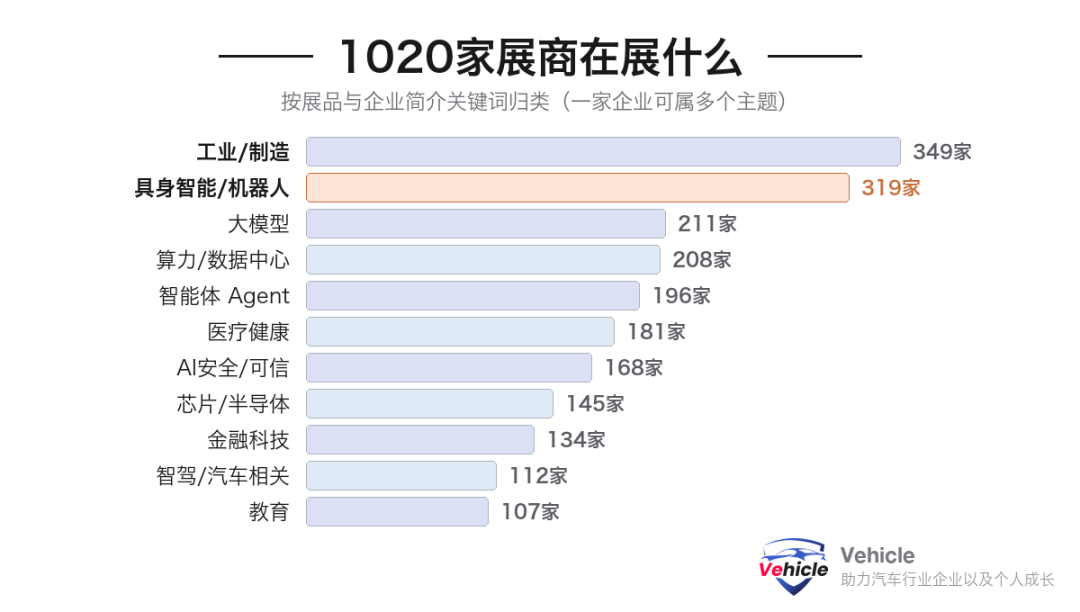
While ‘hundred-model battles’ dominated WAIC two years ago, embodied AI now claims the top spot. Critically, robots extend beyond prototypes: 102 exhibitors showcase complete humanoid robot systems, 38 specialize in dexterous hands, and 25 in quadruped robots. Upstream players like NIO-incubated Semidrive Technologies present its NX9031 high-compute chip for both autonomous driving and embodied AI, forming the first complete industrial chain display from ‘brain’ to ‘limbs’.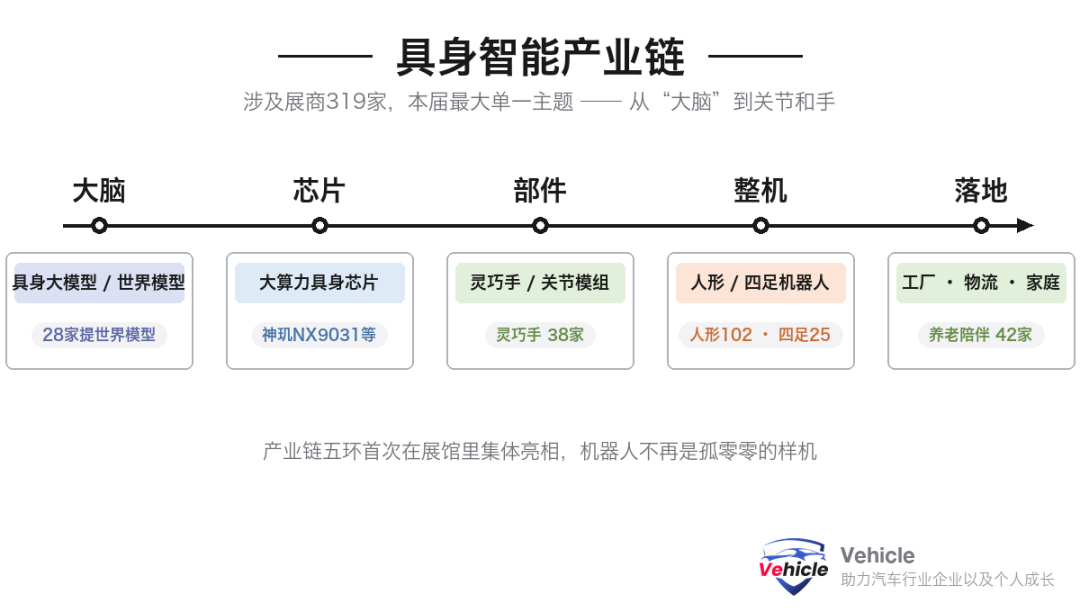
Large model developments are equally revealing. Foundation model companies like StepFun, Baichuan, MiniMax, and DeepSeek remain, but ‘AI Agents’ (196 mentions) nearly rival large models in prominence. China Southern Power Grid showcases its ‘DaWatt’ agent series, China Telecom debuts the ‘Stellar Super Agent’, and financial institutions demonstrate industry-specific agents—signaling an industry shift from ‘model creation’ to ‘model deployment’. On the cutting edge, 28 exhibitors mention world models, while 15 pursue spatial intelligence.
The compute sector reveals another pivot: beyond full domestic GPU participation, exhibits include 22 liquid cooling solutions, 61 edge/on-device AI players, 8 specialized inference acceleration firms, plus 9 optical computing and 6 RISC-V companies—shifting the narrative from ‘training compute stacking’ to ‘inference cost reduction and energy efficiency’.
Where It’s Headed: Factories and Homes—AI’s Dual Penetration
In application scenarios, industrial manufacturing leads (349 exhibitors) over chat or writing. Industrial giants like Siemens, Schneider, COSCOPLAT, and Baosight Software collectively exhibit AI quality inspection, industrial agents, and production line models as standard offerings.
At the other extreme, 42 exhibitors focus on elderly care, companionship, and emotional interaction; 12 on AI glasses (including iFLYTEK, Alibaba, JD, and even Li Auto); 12 on brain-computer interfaces; and 11 on quantum computing—demonstrating AI’s simultaneous penetration into factories and living rooms.
The automotive sector merits separate mention: among 54 vehicle-related exhibitors, WeRide debuts its Robotaxi GXR, Ninebot showcases autonomous delivery vehicles, while BYD and Li Auto appear in person. Automakers now prioritize autonomous driving chips, cockpit-driving integration, and driverless logistics over complete vehicles.
Five Key Trends
Our data reveals five clear signals from WAIC 2026:
Embodied AI officially succeeds large models as the top capital and industry priority, with a complete industrial chain taking shape and rapid industrialization deployment;
Agent deployment enters the harvest phase, with even conservative players like power grids and banks exhibiting self-developed agents;
Compute competition shifts from training to inference, with energy efficiency (liquid cooling, edge computing, optical computing) becoming the new battleground;
AI’s main battleground lies in the real economy, with manufacturing as the largest deployment scenario rather than consumer internet;
Shanghai’s ecosystem rises powerfully, with 278 local exhibitors + dedicated startup zones solidifying its positioning as ‘Model Capital + Embodied AI Hub’.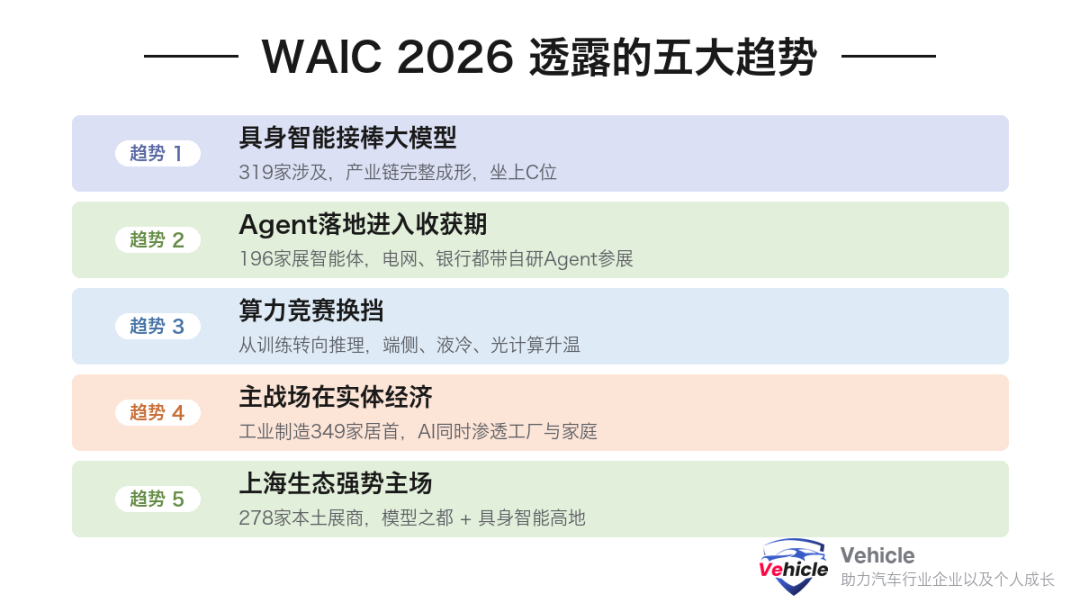
In Summary: WAIC 2026 marks China’s AI transition from ‘showcasing capabilities’ to ‘delivering results’. Large models recede to utility status (like electricity), while robots and agents handling physical tasks—moving boxes, monitoring production lines, performing surgeries, driving vehicles—take center stage.
*Strictly prohibited from reproduction or excerpting without permission*
-
Observation of AI Business Models: From Token-Based Payment to Outcome-Based Payment
-
Observations on AI Business Models: From Token-Based Payment to Outcome-Based Payment
-
SpaceX Market Insight: The $1 Trillion 'Fireworks' Fizzle Out, Marking the Start of the Super IPO Gamble
-
![]()
Car Prices on the Rise: Is It Wise to Postpone Your Purchase?
-
![]()
Foxconn's Electric Vehicle Venture Hits a Snag
-
![]()
How Did They Open the Door to Europe by Attacking the Century-Old Stronghold of the Automotive Industry?
-
![]()
Qwen Still Shows Hesitation
-
![]()
Qwen: Still a Bit Short on Confidence