Trillion-Yuan Chip Project of Domestic Computing Power Behemoth Collapses!
 08/18 2026
 362
362
In the Jiaoyi Bay region of Dongguan's Binhaiwan New District, a sprawling 258-acre plot of land has lain barren for close to six years.
On August 11, 2026, the Dongguan Municipal Natural Resources Bureau in Guangdong Province formally declared the cancellation of the state-owned construction land use right transfer agreements with Tsinghua Unigroup Herong and Tsinghua Unigroup Hechuang. The land was forfeited without any compensation.
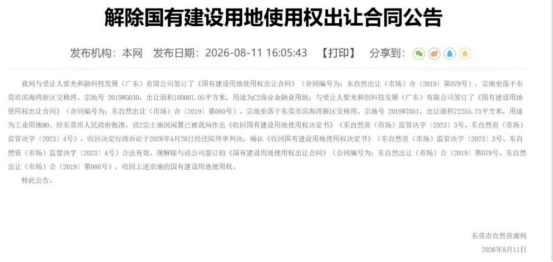
The companies had already paid in full, over 1.7 billion yuan, for the land. Now, not only has the money not been refunded, but the land has also been lost, and the companies are burdened with 344 million yuan in idle land fees.
The Dongguan Natural Resources Bureau's forfeiture of the land was upheld as legal and valid by the final court ruling. The entire process, encompassing the determination of idle land, the collection of idle land fees, the forfeiture without compensation, administrative reconsideration, and two rounds of litigation, has been concluded.
Rewinding to 2017, Tsinghua Unigroup was riding high and inked a strategic cooperation framework agreement with the Dongguan Municipal Government. It pledged to invest a staggering 100 billion yuan to construct the 'Tsinghua Unigroup Chip and Cloud Industrial City' in Dongguan and relocate its South China headquarters there. Dongguan hailed the project as the largest investment and most technologically advanced project ever brought to the city.
At that juncture, Tsinghua Unigroup had the audacity to make such grandiose claims. It stood as one of China's largest integrated circuit enterprises, the world's third-largest mobile phone chip company, and a major computing power supplier in the country. With a 100 billion yuan investment on the table, everyone believed Dongguan had struck gold.
In 2019, the two companies secured the land. Tsinghua Unigroup Herong Technology Development (Guangdong) Co., Ltd. shelled out 1.554 billion yuan for 150 acres of commercial and financial land, while Tsinghua Unigroup Hechuang Technology Development (Guangdong) Co., Ltd. paid 167 million yuan for 108 acres of new industrial land. Together, they promptly paid the full amount of 1.721 billion yuan.
Following the land acquisition, the first phase of the project kicked off with a groundbreaking ceremony, announcing a total investment of 62.1 billion yuan. The atmosphere was electric with excitement.
The tide turned in 2020. Tsinghua Unigroup found itself in financial turmoil, with its capital chain snapping and successive debt defaults. In 2021, the conglomerate entered bankruptcy reorganization. Naturally, the development of the Dongguan land ground to a halt, leaving it in a desolate state.
In reality, the relationship between Tsinghua Unigroup and the two project companies has been persistently misconstrued. The 100% controlling shareholder of Tsinghua Unigroup Herong is Tsinghua Unigroup Greater Bay Area Chip and Cloud Industrial Park Investment Development Co., Ltd., which ultimately traces its ownership to natural persons Long Tao and Zhang Xinyuan, with no shares held by Tsinghua Unigroup/New Tsinghua Unigroup. Zhao Weiguo, the former chairman of Tsinghua Unigroup, serves as a director of Tsinghua Unigroup Herong.
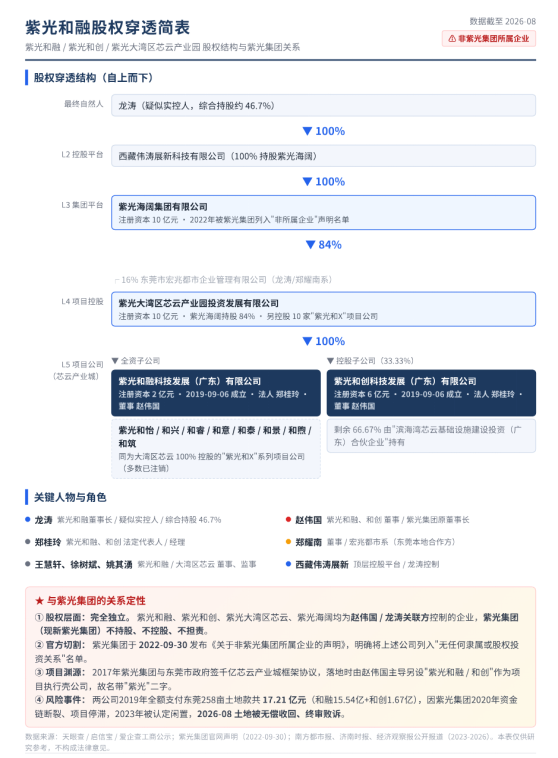
In essence, these two entities are shell companies established for project execution, not subsidiaries of Tsinghua Unigroup.
On September 30, 2022, Tsinghua Unigroup's official website issued a 'Statement on Enterprises Not Affiliated with Tsinghua Unigroup,' explicitly listing Tsinghua Unigroup Herong Technology Development (Guangdong) Co., Ltd. as not affiliated with Tsinghua Unigroup, clarifying that there is no affiliation or equity investment relationship.
In 2021, the year Tsinghua Unigroup entered bankruptcy reorganization, the Dongguan Natural Resources Bureau dispatched 'Idle Land Investigation Notices' to the two project companies. The notices pointed out that the two plots had not commenced construction as stipulated in the contracts and were suspected of being idle. The companies acknowledged this but cited four reasons: the pandemic at the beginning of the year hampered progress; design plans underwent repeated revisions and failed to secure approval; design teams were unable to visit the site due to the pandemic; and the delayed supply of land for the second phase held up the first phase.
The Natural Resources Bureau remained unconvinced. More than a year later, the bureau issued 'Idle Land Determination Letters,' classifying all 258 acres as idle land, with the start date set as April 17, 2021. It clearly stated that the failure to commence construction was attributable to the companies' own shortcomings.
In March 2023, decisive action was taken. The Natural Resources Bureau imposed 344 million yuan in idle land fees and issued a 'Decision to Forfeit State-Owned Construction Land Use Rights,' announcing the forfeiture of the 258 acres without compensation.
The companies, understandably, disagreed. They initially applied for administrative reconsideration, which was rejected, and then sued the Natural Resources Bureau and the Dongguan Municipal Government. In January 2025, the Dongguan First People's Court ruled against the companies in the first instance. They appealed, and on April 28, 2026, the final court ruling upheld the original decision, confirming the forfeiture as legal.
The person in charge of the project company lamented to the media in September 2025, 'We paid over 1.7 billion yuan in full for the land, yet the government announced it would forfeit it all without compensation and impose over 300 million yuan in fines. In our 20-plus years of real estate development, we've never encountered such a situation.'
The Dongguan Natural Resources Bureau stated that forfeiting similar idle land without compensation is not an isolated incident in Dongguan and that all actions were taken in strict accordance with the law.
One side feels aggrieved, while the other asserts compliance. Despite their differing stances, the legal process has reached its conclusion, with the former emerging as the loser.
From the high-profile signing in 2017 to the contract termination and land forfeiture in 2026, this so-called trillion-yuan chip and cloud industrial city came to an abrupt halt on a vacant plot in Jiaoyi Bay in less than a decade.
Many can't help but wonder: With the money already paid, how can the land still be taken away? The answer lies in the 'Measures for the Disposal of Idle Land.' If state-owned construction land is not developed as scheduled and remains idle for two years, the government has the authority to forfeit it without compensation. Initial investment plans and promises carry no weight in this regard.
-
Can the Elephant Turn Around? Volkswagen Takes Only Three Years to Reshape Its 'Soul'
-
![]()
DeepSeek Hikes Prices as 'Price Butcher' Liang Wenfeng 'Retreats'
-
![]()
Starting at 1799 yuan! Dimensity 7500 with 10,000mAh battery, who is the iQOO Z11S for?
-
![]()
BMW 5 Series Price Plummets to 280,000 Yuan: Early BMW Owners Lament 'Significant Losses'; BMW Dealers Offer 285,000 Yuan for Base Model, Financing Deals More Affordable Than Full Payment
-
![]()
Geely's Strategic Shift: Unpacking a Key Question and a Major Anticipation Post Li Shufu's Departure
-
![]()
Starting at 3399 Yuan! iQOO Neo11 Supreme Edition Launched: Featuring the Dimensity 9500M and Exceptional Battery Life
-
![]()
Live Streaming Reservation丨Avnet Ecosystem Technology Forum: Jointly Exploring New Frontiers in the AI Industry
-
![]()
FAW, in Its Third Year with a New Chairman, Anticipates Returns on Multi-Billion Yuan Investments