What Enlightenment Does the Successfully Verified Trillion-Dollar Anthropic Bring to SaaS Enterprises?
 05/26 2026
 684
684
The impact of AI on SaaS is far more complex than simply 'who replaces whom.'
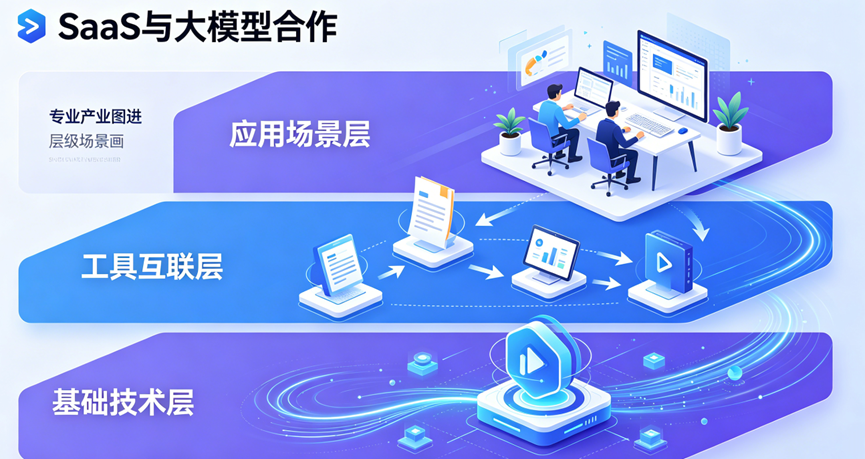
The real change is not that AI is killing SaaS, but that AI is redefining the rules of the game in the SaaS industry. The future enterprise software market will form a three-tier structure:
Bottom Layer: Basic Model Providers, represented by foundational model vendors
Middle Layer: Connectivity and Capability Layers, composed of leading SaaS enterprises and AI startups
Top Layer: Application Layer, consisting of solutions for various vertical industries
Author | Pi Ye
Produced by | Industry Insight
In May 2026, a highly symbolic scene unfolded on the stage of SaaStr AI Annual in San Francisco: Eleanor Dorfman, the industry lead at Anthropic, had just stepped down, and Sherif Mansour, the AI lead at Atlassian, immediately took the podium. One is an AI upstart founded just five years ago, and the other is a veteran deeply rooted in the SaaS industry for 17 years.
Two back-to-back speeches reached almost identical conclusions.
This was no coincidence. It was the most profound signal of transformation happening across the entire enterprise AI industry.
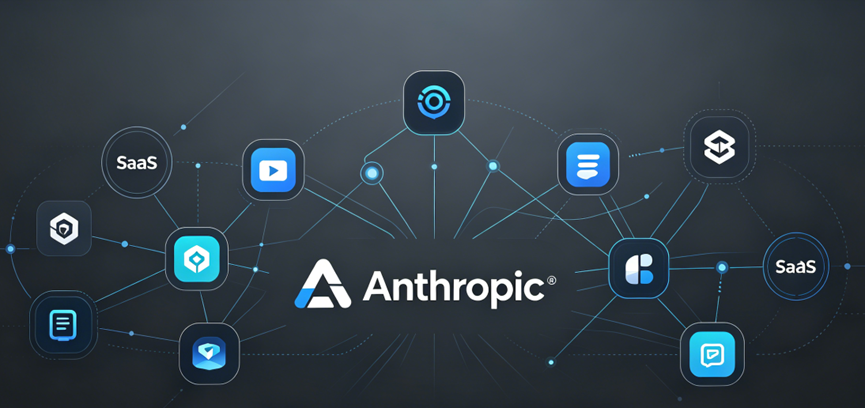
While everyone was discussing OpenAI's super apps and Google's multimodal large models, Anthropic was quietly completing a more fundamental revolution. It did not attempt to create a super portal to replace all SaaS, nor did it compete with its own customers for business. Instead, it chose to become the 'intelligent infrastructure' of the SaaS ecosystem, using Claude to connect isolated tools into an organic whole.
This is the true endgame of enterprise AI. It is not about AI killing SaaS, but about AI reshaping the value logic of SaaS. Anthropic has already proven this with its own practice, and the path it has taken is exactly the path all SaaS enterprises must follow in the next decade.
I. The Misunderstood Anthropic: It Has Never Been OpenAI's Shadow
For a long time, Anthropic has been labeled as 'OpenAI's biggest competitor.' People always compare it with OpenAI, discussing whose model is smarter, whose parameters are larger, and whose users are more numerous. But this is precisely the biggest misunderstanding of Anthropic.
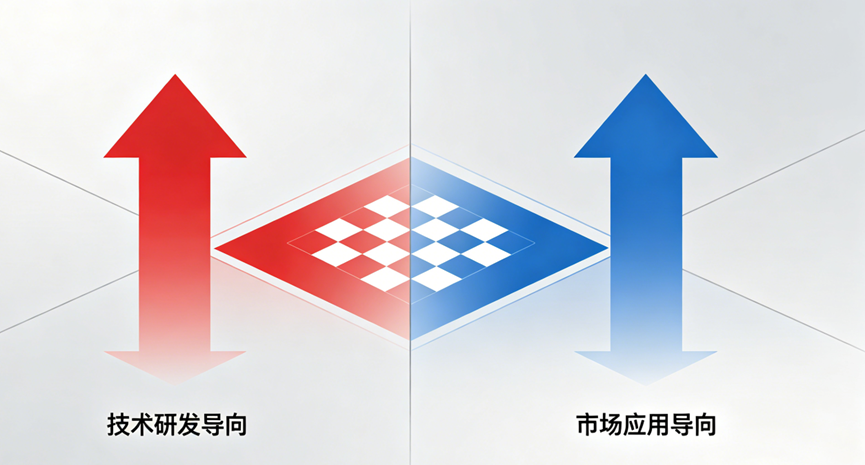
OpenAI follows a 'top-down' path: first build a general artificial intelligence, then use it to disrupt all industries. Anthropic, on the other hand, follows a 'bottom-up' path: first deeply understand the real needs of enterprises, then use AI to solve those needs.
Neither path is right or wrong, but for the enterprise market, Anthropic's path is clearly more grounded and has more vitality.
From its first day, Anthropic has engraved 'safety' into its DNA. Many people believe this is just a marketing gimmick by Anthropic to differentiate itself from OpenAI. But in the enterprise market, safety is never an added bonus; it is the most basic entry ticket.
Large enterprises, especially those in finance, law, healthcare, and other industries, have Almost strict (jīnhū kēkè - nearly harsh) requirements for data security. They would rather sacrifice a bit of model performance than entrust their core data to an untrustworthy third party.
Anthropic has seized this point by launching a series of enterprise-grade safety features: data isolation, private deployment, compliance certification, and explainability. These features have allowed Anthropic to establish a strong moat in industries where OpenAI struggles to penetrate.
The CIO of JPMorgan Chase once said a classic line: 'We can accept that Claude is a bit slower than GPT, but we absolutely cannot accept our trading data appearing in ChatGPT's training set.'
This sentence echoes the sentiments of countless enterprise CIOs.
Furthermore, Anthropic's smartest move is its clear announcement that it will not directly develop SaaS applications for end-users. This stands in sharp contrast to OpenAI.
After launching ChatGPT, OpenAI successively introduced Code Interpreter, DALL·E, GPTs, and other products, gradually extending into the application layer. This has made many SaaS enterprises panic: If OpenAI builds these features itself, what value do we have left?
Anthropic, on the other hand, repeatedly emphasizes: 'Our goal is to be the best partner for SaaS enterprises, not their competitors.' It positions itself as a pure foundational model provider, with all revenue coming from APIs and enterprise services, without competing with its own customers for end-users.
This strategic positioning has won the trust of the entire SaaS industry. From industry giants like Salesforce and Slack to unicorns like Notion and Zoom, and countless small and medium-sized SaaS vendors in vertical fields, all have chosen to partner with Anthropic. As of the first quarter of 2026, more than 70 of the world's top 100 SaaS enterprises have integrated the Claude model.
If Anthropic were just a company selling APIs, it would be underestimating its potential. Anthropic's true ambition is to become the operating system of the enterprise AI era.
In the traditional IT era, the operating systems were Windows and Linux, managing hardware resources and providing a runtime environment for upper-layer applications. In the cloud era, the operating systems are AWS and Azure, managing computing resources and providing infrastructure for upper-layer applications. In the AI era, the operating system will be large models, managing intelligent resources and providing AI capabilities for upper-layer applications.
Anthropic is working toward this direction. It not only provides basic model APIs but also launched a series of products such as Claude Workbench, Claude Skills, and Claude Agents, building a complete AI development and runtime platform. SaaS enterprises can quickly develop, deploy, and run their own AI applications on this platform without worrying about the underlying model details.
This is Anthropic's true moat. As more and more SaaS enterprises build their AI capabilities based on Anthropic's platform, Anthropic will become the de facto standard in the enterprise AI era.
II. Enterprise AI: The Trillion-Dollar AI Business Model Validated by Anthropic
Many people are asking: How do large model companies make money? This question already has a clear answer in 2026. Anthropic has validated four successful enterprise AI business models through its own practice, which have not only brought in over $2 billion in annual revenue for Anthropic but also pointed the way to commercialization for the entire industry.
Basic API subscription is Anthropic's core business model and the most stable source of revenue. Enterprise customers pay fees based on their usage, and Anthropic provides models of different performance and prices for customers to choose from.
The advantages of this model are:
Predictable revenue
Over 80% of enterprise customers sign annual contracts, providing Anthropic with stable recurring revenue
Significant economies of scale
As the number of customers and usage increases, marginal costs continue to decrease, and gross margins continuously improve (tíshēng - continuously improve)
High customer stickiness
Once enterprises deeply integrate the Claude model into their products, the switching cost becomes very high
As of the first quarter of 2026, Anthropic's API revenue has exceeded $1.5 billion, with a year-over-year increase of over 350%. Among them, SaaS enterprises are the largest customer group, contributing over 65% of API revenue.
Secondly, for leading SaaS enterprises, Anthropic adopts a model of joint product development and revenue sharing. In this model, Anthropic not only provides model capabilities but also sends dedicated teams to participate in the product design and development process, working with SaaS enterprises to build AI-native features.
In return, Anthropic receives a 20%-40% share of the revenue generated by these AI features. This model allows Anthropic to share in the growth dividends of SaaS enterprises while enabling SaaS enterprises to launch AI features with lower risk and cost.
The most successful case is undoubtedly Anthropic's partnership with Notion. Notion AI, as a paid plugin costing $10 per month, currently has over 18 million paying users. According to the partnership agreement, Anthropic receives about 30% of the revenue from Notion AI, generating over $600 million in annual revenue for Anthropic alone.
Meanwhile, for vertical industries such as finance, law, and healthcare, Anthropic has launched customized industry solutions. In this model, Anthropic fine-tunes the Claude model according to the specific needs of the industry and develops dedicated tools and features.
Industry solutions typically adopt a 'subscription + service' charging model, where enterprise customers pay not only model usage fees but also custom development and technical support fees. This model has extremely high average revenue per user, usually ranging from hundreds of thousands to millions of dollars per year.
For example, Anthropic's Claude Legal solution for the legal industry can handle complex legal tasks such as contract review, legal research, and case analysis. Among the top 100 global law firms, over 65 have adopted this solution, with an average annual revenue per user exceeding $1 million.
In addition, for large enterprises and government agencies with extremely high data security requirements, Anthropic provides private deployment and managed services. In this model, the Claude model is deployed in the enterprise's own private cloud or on-premises data center, with the enterprise having full control over its data and model.
Private deployment services are usually charged on an annual subscription basis, with fees depending on the deployment scale and service level. Although the number of customers for this model is relatively small, the average revenue per user is extremely high, usually exceeding several million dollars per year.
Top-tier clients such as the U.S. Department of Defense, JPMorgan Chase, and Goldman Sachs have all adopted Anthropic's private deployment services. Among them, the U.S. Department of Defense's contract exceeds $1 billion, making it Anthropic's largest single contract to date.
III. The Three-Tier Cooperation Logic Between Anthropic and SaaS
Many people worry that AI will replace SaaS, but Anthropic's practice tells us: AI will not replace SaaS but will coexist with SaaS. The cooperation between Anthropic and SaaS enterprises is not simply 'you use my model, and I make money from you' but a deep value co-creation.
This cooperation can be divided into three levels, each representing a different way of value creation.
The first level is feature enhancement, making SaaS smarter. This is the most basic and common level of cooperation. SaaS enterprises embed the capabilities of the Claude model into their products to provide users with more intelligent features and experiences.
At this level, AI's role is to 'enhance' rather than 'replace.' It does not change the core logic of SaaS products but only makes their functions more powerful. For example:
Adding intelligent writing and summary generation features to document editors
Adding intelligent reply and email classification features to email clients
Adding intelligent Q&A and ticket auto-processing features to customer service systems
Adding task auto-assignment and progress prediction features to project management tools
Although feature enhancement is simple, its effects are very significant. Data shows that SaaS products integrated with the Claude model have seen an average 35% increase in user activity, a 28% increase in user retention, and a 42% increase in ARPU.
The second level is workflow reconstruction, making AI the core of the workflow. This is a deeper level of cooperation. At this level, AI is no longer just an additional feature but becomes the core of the entire workflow. It redefines how users work, making the workflow more automated and intelligent.
Anthropic's own sales organization is the best example. Instead of discarding the GTM tool stack it has used for years, Anthropic uses Claude to connect these tools, forming a complete, intelligent customer journey:
Clay (lead enrichment) → LeanData (lead routing) → Salesforce (opportunity creation) → Gong (call coaching) → Ironclad (contract review) → Slack (deal notification)
In this workflow, Claude is responsible for passing context between various tools and automatically completing most repetitive tasks. Humans only need to make decisions at key nodes. As a result, Anthropic has achieved 54% self-service deal closures among enterprise customers, reducing sales proposal generation time from 45 minutes to 4 minutes.
Atlassian is doing the same thing. It added a RovoAgent node to Jira Automation, allowing users to orchestrate complex workflows using natural language. Customers have come up with countless use cases that Atlassian never thought of: a ticket triggers a marketing agent to generate Canva materials, which are then published by a social media publishing agent.
The third level is ecosystem co-construction, building the operating system of enterprise AI. This is the highest level of cooperation. At this level, Anthropic and SaaS enterprises are no longer simply client and vendor but ecosystem partners. They jointly build an open enterprise AI ecosystem to provide complete AI solutions for enterprise customers.
Anthropic's Claude Skills and Claude Agents were designed for this purpose. SaaS enterprises can encapsulate their product capabilities as Skills for Claude Agents to invoke. In this way, Claude can complete various complex tasks by invoking different Skills.
For instance, when a user says, "Help me prepare for tomorrow's client meeting," Claude can call on the Salesforce Skill to retrieve client information, the Gong Skill to access historical call records, the Google Calendar Skill to schedule the meeting time, the Notion Skill to generate the meeting agenda, and finally the Slack Skill to send the meeting invitation to relevant personnel.
In this ecosystem, Anthropic is responsible for providing foundational intelligent capabilities, while SaaS companies provide specialized industry capabilities. The strengths of both sides complement each other, jointly creating value for users. This is the true future of enterprise AI.
IV. Evolution Guide for SaaS Companies: What to Learn from Anthropic
Anthropic's success offers a vivid lesson for all SaaS companies. In the AI era, the traditional SaaS model has reached its limits. SaaS companies that only offer single-point functionality, lack workflow depth, and have no data accumulation will be ruthlessly eliminated by AI.
In contrast, SaaS companies that successfully embrace AI and evolve will unlock a much broader market. Here are five key lessons SaaS companies can learn from Anthropic.
First, don’t start from scratch—connect everything.
Many SaaS companies’ first reaction to AI is: “I’m done. I need to rebuild my product from scratch to make it AI-native.” This is a huge mistake.
Both Anthropic and Atlassian have shown through their practices: don’t discard your tool stack, don’t rebuild your product. The products and workflows that companies have spent years or even decades refining are their greatest assets, not burdens.
The value of AI lies not in creating new tools but in connecting existing ones. The goal isn’t to reinvent the wheel but to use AI to assemble those wheels into a car.
For existing SaaS products, the best strategy is to “bolt-on first, then iterate.” Start by adding AI nodes to existing workflows, letting users adopt them first to accumulate data and feedback. Then, gradually optimize and refactor (restructure) the product based on user behavior.
Second, value shifts from the tools themselves to the connections between them.
This is the most profound value shift in the AI era. In the traditional SaaS era, value primarily resided in the tools themselves. The company with the more powerful features and visually appealing interface won the market.
In the AI era, value is shifting from the tools themselves to the connections between them. Users no longer care whether a tool is easy to use; they care whether their work can flow seamlessly without jumping between five tabs.
Whoever becomes the thread connecting tools, people, and work will control the customer experience and win the future.
For SaaS companies, this means no longer focusing solely on their product’s internals but on its position in the user’s entire workflow: How can my product integrate better with others? How can I provide better interfaces for AI? How can I become an indispensable node in the AI connection layer?
Third, encode best practices into Skills—this is the new moat.
Anthropic’s most valuable innovation isn’t the Claude model itself but the concept of “Skills.” By encoding the best practices of top AEs into Skills, Anthropic established a baseline for everyone, instantly raising the organization’s capability floor.
This applies equally to SaaS companies. The moat is no longer just “feature leadership” or “large data volume.” The new moat is: How many of your client workflow’s best practices are encoded into AI-executable Skills?
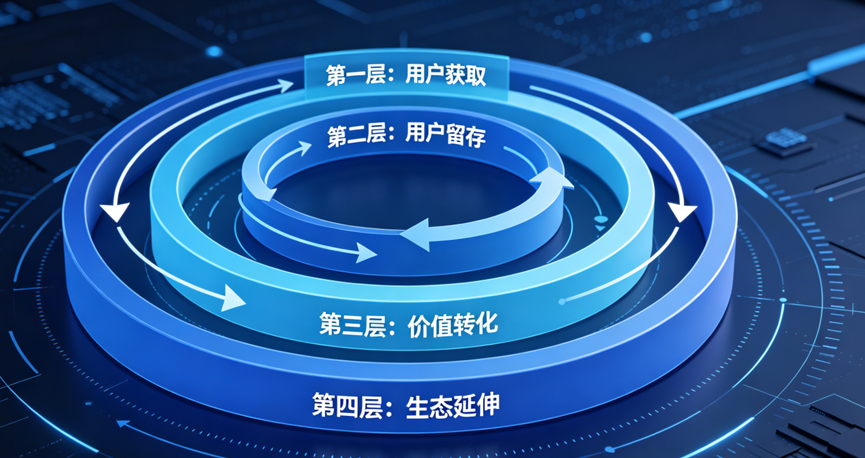
The more, finer, and more industry-specific these Skills are, the harder they are for competitors to replicate. Because the inputs behind Skills aren’t just code but also client usage data, industry experience, and process design—things that take time and scale to accumulate.
Fourth, AI has dramatically raised the ceiling for self-serve.
Anthropic’s 54% enterprise self-serve conversion rate is a groundbreaking figure. It shatters the 15-year iron law of enterprise SaaS: Enterprise plans must go through salespeople.
With AI, the boundaries of self-serve are far wider than we thought. Claude, combined with appropriate process design, can already cover a significant portion of the purchase journey nodes that “used to require an AE”: answering security questions, drafting contract terms, and guiding onboarding.
This doesn’t mean AEs are obsolete. It means AEs should be freed up for higher-leverage tasks rather than being trapped in repetitive processes. Only deals where “the seller can change the outcome” should be routed to AEs.
For SaaS companies, this presents a massive GTM (go-to-market) efficiency leap. Companies should re-examine their sales funnel, identify link (segments) that don’t actually need human involvement, and automate them with AI. This will significantly boost profitability.
Finally, build an AI-native organization—not just hire a few AI engineers.
AI transformation isn’t just about technology and products; it’s about organizational and cultural transformation. Many SaaS companies think that hiring a few AI engineers and integrating large model APIs into their products completes the AI transformation. This is far from enough.
Atlassian’s experience shows: AI makes “doing” faster, but “figuring out what to do” becomes scarcer. After AI goes live, engineers’ output speed explodes, and PMs’ experience shifts from 1:20 to 1:30 or even 1:40. Engineers run too fast and keep asking, “What’s next? Is this right?”
So, SaaS companies must adjust their organizational structure accordingly. Atlassian’s approach: Hire more junior employees and top-tier senior employees while reducing middle layers. Junior employees bring new tools and techniques, while senior employees ensure quality control and directional judgment.
V. Final Verdict: The Future of Enterprise AI Belongs to Connectors
AI’s impact on SaaS is far more complex than “who replaces whom.”
The real change isn’t that AI kills SaaS but that AI is redefining the rules of the SaaS industry. In the past, every SaaS tool wanted to be the protagonist, to keep users engaged the longest. Now, users care less about the protagonist—they care about results.
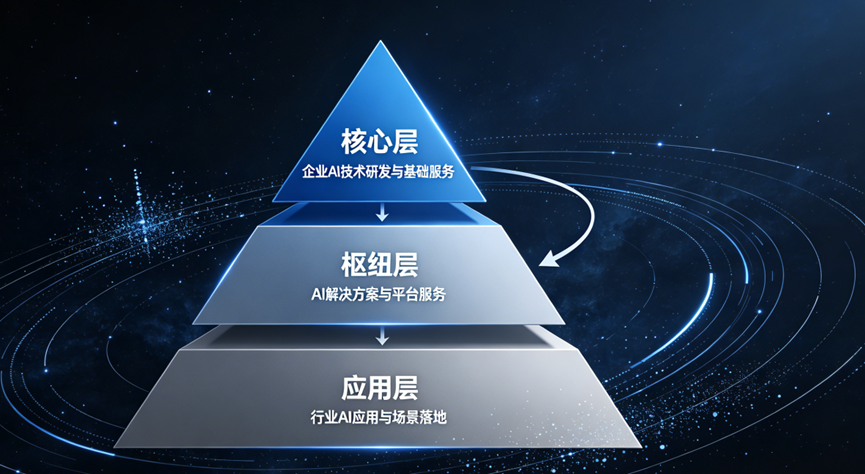
The future enterprise software market will form a three-tier structure:
Bottom layer: Foundation model providers, represented by foundation model companies.
Middle layer: Connection and capability layers, composed of leading SaaS companies and AI startups.
Top layer: Application layer, consisting of vertical industry solutions.
In this structure, the most valuable part isn’t the bottom foundation models or the top applications but the middle connection layer. Whoever becomes the hub connecting everything will control the ecosystem’s narrative.
Anthropic is striving to be that hub. It uses Claude to connect all SaaS tools, all workflows, and all people. SaaS companies that can deeply collaborate with Anthropic to co-build this connection layer will also secure a place in the future market.
For all SaaS companies, the most critical task now isn’t to panic or blindly follow trends but to answer one question: In the future enterprise AI ecosystem, where is my position? What value can I contribute to this ecosystem?
This is the brutal truth of the enterprise AI era—and also what makes it most exciting.
-
![]()
AI Giants Start Borrowing to Fuel Computing Power Race
-
ByteDance Initiates Largest B2B Structural Adjustment, This Time It's Truly Different
-
![]()
Let's Talk About Kingsoft Office's Mid-Year Outlook and the True Strength of Its AI-Powered Office Solutions
-
Despite 150 Million Users, Struggles Persist: AIShige Faces Tough Competition from Seedance and Kling in AI Video Monetization
-
![]()
Ensuring Safe Gear Shifting in the Automotive Industry: Transitioning from 'Product Oversight' to 'Full-Chain Governance'
-
![]()
Net Profit Soars to $133.7 Billion! Azure Revenue Tops $100 Billion, with AI Fueling Microsoft's Growth
-
![]()
Before 6G Hits the Market, the U.S. Forges a 'Rules Alliance': What Challenges Await Chinese IoT Enterprises?
-
![]()
Intelligent Driving's 'Little Blue Light' Faces Ban: Night Glare and Cut-in Risks Prompt Official Action