Before 6G Hits the Market, the U.S. Forges a 'Rules Alliance': What Challenges Await Chinese IoT Enterprises?
 07/30 2026
 475
475
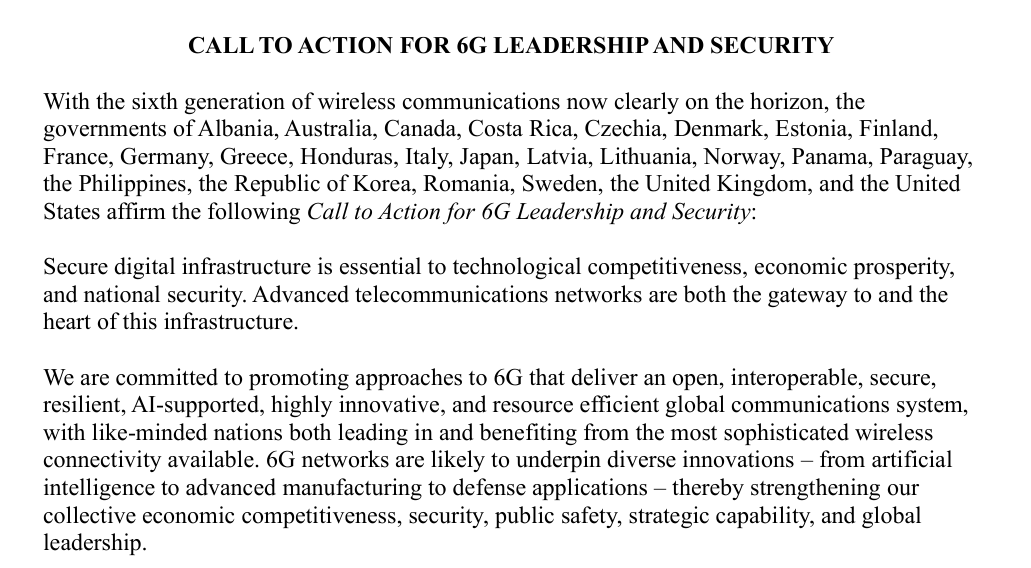
On July 27 (local time), the U.S. National Telecommunications and Information Administration (NTIA) revealed that the United States is set to collaborate with 24 nations, including the United Kingdom, Germany, Japan, Australia, Canada, and France, on a global initiative. This initiative aims to expedite the development of secure 6G wireless networks and pave the way for their future commercial deployment.
Participants have reached a consensus that future 6G networks must embody openness, interoperability, security, resilience, and AI integration. Countries will also establish communication channels to share technical insights, harmonize policies, and foster cooperation in areas such as standardization, research and development, market access, security, and spectrum management.
From a timing standpoint, this initiative has been launched quite prematurely. Currently, 6G is still in the phase of standard and technical solution development. The International Telecommunication Union (ITU) has established the IMT-2030 framework, and 3GPP's 6G standardization work has just commenced. However, it will take several years before the complete standards are finalized and large-scale commercialization occurs. According to industry projections, 6G is expected to enter the commercialization phase around 2030.
So, why is the United States eager to form this 'group' now?
A closer look at several details of this initiative reveals that the initiator is a government department, not a corporate alliance; the timing is when 6G standards are still being formulated, not before product launch; and the scope of cooperation extends beyond laboratories to market access. It becomes evident that this is not a typical research and development collaboration but a premeditated strategic move for rule-setting.
More Than a Research Alliance: A Systematic Pre-Test of Rules
Over the past few decades, the mobile communications industry has generally followed a clear trajectory: Companies invest in research and development, submit proposals to standardization organizations like 3GPP, and once standards are finalized, the industrial chain follows suit. Operators then proceed with commercial deployments, with governments primarily playing a regulatory role.
This time, the United States has chosen a different path.
The reason is not hard to fathom. In traditional telecommunications equipment, the United States lacks a domestic systems-level vendor capable of directly competing with Huawei, Ericsson, and Nokia—a vulnerability fully exposed during the 5G era. As we transition to 6G, rather than attempting to catch up at the equipment level, the U.S. seeks to redefine the competitive landscape. By leveraging chips, software, AI, satellite communications, and allied markets, it aims to coordinate policy positions and industrial ecosystems before standards are set.
From a content perspective, this cooperation endeavors to establish a comprehensive chain: joint research and development—standard collaboration—spectrum coordination—security certification—market access.
Standard Collaboration: While communication standards are ostensibly determined by technical performance, they also reflect industrial support capabilities. If 24 countries coordinate their 6G visions and technical principles in advance, their companies will find it easier to present a united front in international organizations like ITU and 3GPP. A proposal backed by the policies and markets of 24 countries is inherently more likely to be valued for global deployment.
Spectrum Coordination: Determining the frequency bands for 6G is not merely a technical issue; it also involves existing national spectrum arrangements, regulatory policies, and the interests of military and public safety sectors. If alliance members adopt similar spectrum plans, chips, modules, and terminals can form a larger unified market, directly accelerating industrial maturity and reducing costs. Spectrum coordination lays the foundation for future ecological advantages.
Security and Market Access: If the alliance promotes mutual recognition of security certifications, it could establish common supply chain requirements for government procurement, operator tenders, and infrastructure construction. Ultimately, certification, standards, and spectrum coordination will determine whether companies can enter the markets of member countries—acting as a 'ticket' for market access.
The basic unit of 6G competition is evolving from individual companies to an ecosystem encompassing governments, standardization organizations, industrial chains, and markets.
An 'Open' 6G Could Also Redefine Industrial Boundaries
It is worth noting that while this initiative repeatedly emphasizes the need for 6G to be 'open' and 'interoperable,' it also underscores 'security,' 'trustworthiness,' and cooperation among allies. There is a notable tension between these two sets of keywords.
Technical openness does not necessarily equate to market openness for all companies. The 'openness' referred to here is more likely to point toward software-defined, modular, and multi-vendor interoperability. Networks will no longer be highly reliant on closed hardware and software systems from a single vendor. Instead, equipment and software from different companies can be combined through standard interfaces, enhancing supply chain resilience. However, even if a company meets technical interface requirements, it may not automatically gain market access; its products may still need to pass security reviews, supply chain assessments, and data compliance certifications, demonstrating that software origins, vulnerability management, and long-term maintenance capabilities meet requirements.
Similar trends are already evident in the existing IoT security landscape. In recent years, the United States, European Union, Japan, Singapore, and other countries and regions have promoted IoT security labeling or conformity assessment systems and sought mutual recognition among different certification frameworks. Some nominally voluntary certification programs, once adopted by government procurement agencies, leading retailers, and mainstream platforms, gradually become de facto market entry thresholds for products.
If the 6G alliance further promotes mutual recognition of security certifications and market rules, it could amplify this effect, leading to a market structure of 'one set of foundational standards, multiple trust systems': Devices may be technically interoperable but require entry into specific certification and supply chain systems for commercial access.
These Rules Will Ultimately Impact Every IoT Terminal
If standards, spectrum, and security principles represent the upper-level design of 6G rule competition, then IoT terminals are where these rules ultimately materialize.
Compared to previous generations of mobile communications, 6G will expand its connection targets more profoundly from 'people' to 'things.' Industrial modules, robots, autonomous vehicles, drones, satellite terminals, and passive sensing tags will constitute the largest group of connected devices in 6G networks, far surpassing mobile phones in quantity and type.
As previously proposed by the IoT Think Tank, IoT terminals in the 6G era will no longer be merely connected devices but will evolve into intelligent nodes integrating communication, sensing, computing, and AI capabilities, capable of local reasoning and decision-making.
This also means the security consequences of 6G terminals will be fundamentally different from before. A hacked surveillance camera may lead to privacy breaches; a hacked industrial robot or autonomous vehicle could directly impact physical safety and production. With the development of embodied AI, industrial agents, and other applications, decisions made by terminals will increasingly affect production equipment, transportation systems, and urban infrastructure, with security consequences far exceeding those of traditional internet devices.
Against this backdrop, the outline of future 6G terminal access rules is gradually becoming clear:
Device Identity and Hardware Trustworthiness: Each terminal must have a unique, verifiable identity, with chip-level trust roots ensuring the integrity of critical programs and preventing large-scale network access by counterfeit terminals.
Software Lifecycle Management: Manufacturers must specify security update periods, terminals must support secure OTA upgrades, and software component origins must be traceable. The security maintenance responsibility for IoT devices, which may have lifecycles exceeding a decade, cannot end at shipment.
AI Model and Data Governance: For terminals with reasoning capabilities, model update sources must be trustworthy, sensor data usage must be transparent, cross-border data transfers must comply with data protection requirements, and responsibility must be clearly assigned when erroneous decisions occur.
Certification Mutual Recognition: Products must not only prove '6G connectivity' but also pass testing by laboratories recognized in target markets, obtaining certifications or labels accepted by alliance member countries.
While communication capabilities determine whether a product can connect to the network, rule compliance determines whether it can enter the market. In the 6G era, these two factors will carry roughly equal weight.
Chinese IoT Enterprises Must Address More Than Just Upgrading to 6G Modules
Faced with this situation, China's IoT industry has both strengths and real challenges.
The strengths are concrete. China leads globally in the scale of IoT connections, with industrial internet, smart grids, connected vehicles, low-altitude economy, and smart city deployments that are difficult to replicate in scope and complexity worldwide. The large-scale commercialization experience with NB-IoT, RedCap, passive IoT, and satellite IoT (IoT-NTN) represents genuine technical and scenario-based accumulation. In 3GPP, Chinese companies' patent contributions and standard participation are now significant.
The challenges are equally concrete.
First, shifting from 'standard tracking' to 'defining standards through scenarios.'
The cost, power consumption, coverage, security, and operational issues accumulated in the aforementioned scenarios themselves serve as important bases for standard-setting. Chinese companies need to translate scenario requirements into technical proposals and demonstrate solution feasibility through large-scale applications, rather than simply adapting products after standards are finalized.
Second, integrating security compliance into the product design phase.
In the past, some companies treated security certification as an add-on after product completion. In the 6G era, device identity, data protection, remote upgrades, and vulnerability management are likely to become foundational product capabilities, requiring clear responsibility assignments during chip, module, operating system, and platform design. For IoT companies planning to go global, security capabilities are not just a cost item but a core competitiveness (competitive advantage) for market access.
Third, building international certification capabilities.
As IoT security regulations and labeling systems continue to be implemented globally, companies' overseas costs will no longer come solely from hardware development but also from security testing, data compliance, supply chain documentation, and long-term software maintenance. Large enterprises should participate early in international standard and certification system development; SMEs will need to leverage industry alliances, public testing platforms, and third-party institutions to reduce compliance costs, avoiding scenarios where products have price and performance advantages but cannot enter target markets due to certification issues.
Fourth, transforming industrial chain advantages into ecological organization capabilities.
6G competition will not hinge solely on patent quantities but also require coordination among chips, equipment, operators, terminal companies, testing agencies, and application industries. A technology with only standard proposals but no chip and product support will struggle to become mainstream; a product with advanced technology but unable to meet overseas certification and operator requirements will likewise fail to scale. China already possesses a relatively complete IoT industrial chain; the next step is to enhance the ability to organize technology, standards, testing, certification, and industry applications.
In Conclusion
The U.S. collaboration with 24 countries on 6G aims not merely to accelerate laboratory progress for a specific technology but to complete a systematic layout of standard positions, spectrum coordination, security certifications, and market access before 6G rules are finalized.
It is too early to conclude that the global 6G market will definitely fragment. 3GPP continues to maintain a single-standard framework, and most major economies still prioritize interoperability over closed ecosystems. However, the likelihood of different 'trust domains' forming around security certifications, supply chain origins, and market access is rising. This is not alarmism but a structural variable that needs to be factored into strategic planning early.
The real test in the future 6G race will not just be who can build faster networks but who can embed their technology into standards, turn standards into rules, and ensure terminals complying with these rules can access global markets.
This competition has already begun.
-
![]()
AI Giants Start Borrowing to Fuel Computing Power Race
-
ByteDance Initiates Largest B2B Structural Adjustment, This Time It's Truly Different
-
![]()
Let's Talk About Kingsoft Office's Mid-Year Outlook and the True Strength of Its AI-Powered Office Solutions
-
Despite 150 Million Users, Struggles Persist: AIShige Faces Tough Competition from Seedance and Kling in AI Video Monetization
-
![]()
Ensuring Safe Gear Shifting in the Automotive Industry: Transitioning from 'Product Oversight' to 'Full-Chain Governance'
-
![]()
Net Profit Soars to $133.7 Billion! Azure Revenue Tops $100 Billion, with AI Fueling Microsoft's Growth
-
![]()
Before 6G Hits the Market, the U.S. Forges a 'Rules Alliance': What Challenges Await Chinese IoT Enterprises?
-
![]()
Intelligent Driving's 'Little Blue Light' Faces Ban: Night Glare and Cut-in Risks Prompt Official Action