The AI Cloud Computing Era: Tencent 'Chasing Profits', Alibaba 'Investing Heavily', Baidu 'Climbing New Heights'
 05/29 2026
 501
501
Editor: Liu Zhicheng
Reviewer: Xu Xu
Recently, Wu Hongsheng, the former core leader of Tencent Cloud, criticized his old employer on WeChat Moments.
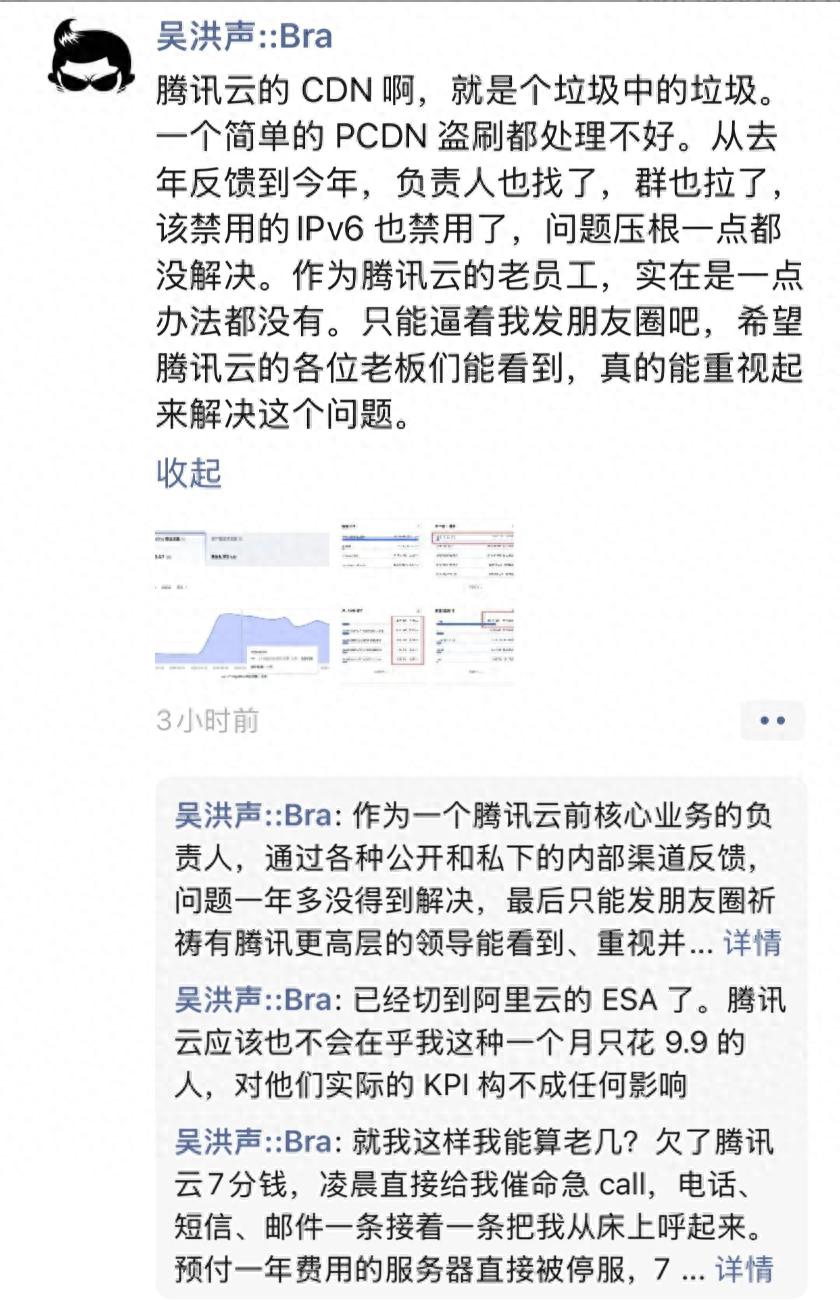
Most of the issues Wu Hongsheng criticized were related to products and services. These problems are not new and may not even be considered major issues.
Other cloud computing providers may also face similar problems. For example, Alibaba also urges payment of overdue fees but may not suspend services to users as quickly as Tencent.
Nevertheless, it was somewhat disrespectful for Tencent Cloud's former core leader to publicly criticize the company on WeChat Moments.
Should Tencent Cloud change from the inside out in the AI era?
From a product and service perspective, Tencent Cloud has room for improvement.
For instance, could the overdue fee threshold be raised, and could the methods for urging payment be more user-friendly? There is indeed room for improvement in these product and service details. Moreover, as the demand for cloud computing services becomes increasingly essential, adjusting service strategies may not necessarily impact the company's profits.
However, for Tencent, these issues may not be a priority.
From Tencent's perspective, the subpar product and service quality is somewhat understandable.
First, Tencent Cloud grew out of the internal needs of the WeChat ecosystem, with serving internal needs taking precedence over external ones.
AI is currently one of Tencent's key strategies, and the cloud business department holds a unique ecological niche.
AI has become a battleground for tech giants, with Alibaba Cloud and Baidu Cloud shouldering the important mission of implementing the group's AI strategy. For these giants, prioritizing the implementation of the group's AI strategy seems far more important than investing resources in serving small and medium-sized clients.
Moreover, Tencent set commercialization goals for its cloud business early on and achieved full-year scaled profitability by 2025.
Being intolerant of overdue fees makes financial sense, especially as computing power prices continue to rise. Each additional day that overdue users occupy computing resources means Tencent Cloud's revenue bears more opportunity costs. Under a profit-first strategy, even a decline in market share may be acceptable.
Second, Tencent Cloud has never lacked users.
Leveraging the WeChat ecosystem, Tencent Cloud now reaches over 130 million enterprise users and has a healthy revenue structure. In the second half of 2025, its cloud-based enterprise services business achieved a 22% growth rate.
Ultimately, Tencent Cloud's business growth is driven by efficiency rather than scale.
Dowson Tong has also emphasized business operational efficiency, cost structure, and profit levels. Therefore, Tencent Cloud's focus in IaaS and PaaS development has always been on profitability, while the core goal for SaaS is commercial success.
Among cloud computing providers, only Tencent Cloud has achieved a gross margin of around 50%. At the commercialization level, Tencent Cloud is the most stable.
This explains why Wu Hongsheng received urgent payment reminders over a mere 7 cents in overdue fees.
Simply put, one of Tencent Cloud's core KPIs in the past was to make money.
There's nothing wrong with making money, but in today's AI-driven competition, being overly focused on efficiency and profit may not be the best approach.
The reason is not complicated: Tencent Cloud may not have many advantages in AI infrastructure.
In the AI era, the competitive landscape of cloud computing has changed.
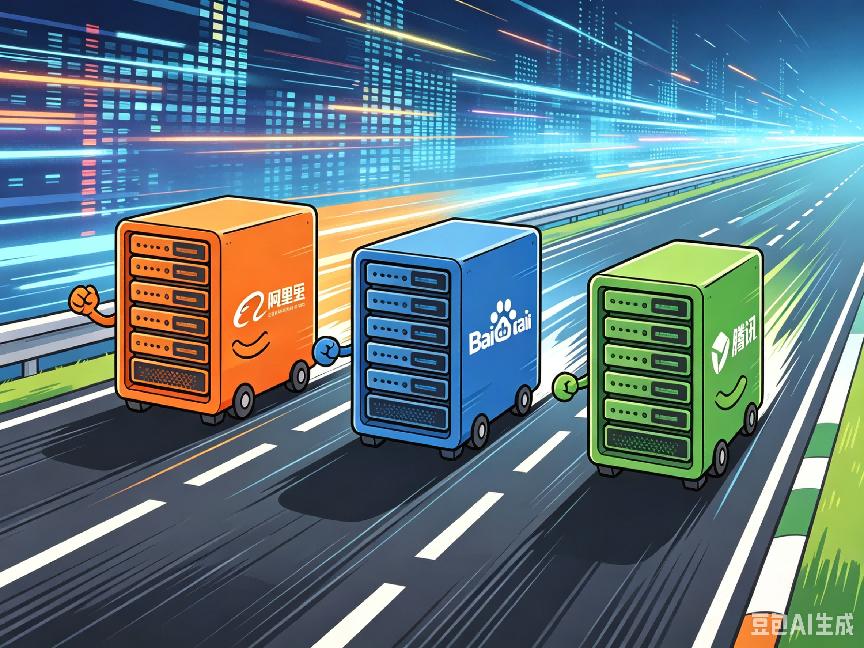
In the past, competition revolved around IaaS, PaaS, and SaaS services and product pricing. Today, it's about AI-native and Agent-native capabilities. The competition among cloud providers is essentially a comprehensive competition in model capabilities and service systems.
This is one of the significant challenges Tencent Cloud must face.
The pursuit of profit and a solid user base have resulted in Tencent Cloud's market share in IaaS and PaaS being squeezed by competitors, especially given tight budgets. In the AI cloud market, Tencent may not yet have a clear competitive advantage over Alibaba Intelligent Cloud, Baidu Intelligent Cloud, or even Volcano Engine.
Therefore, the Hunyuan large model team has been accelerating model version upgrades and continuously improving AI capabilities to achieve further breakthroughs in the AI cloud market.
According to Omdia's statistics, in the 2025 AI cloud market share, Alibaba Cloud ranked first with 38%, Volcano Engine ranked second, Baidu Intelligent Cloud ranked third, and Tencent Cloud ranked fourth.
In terms of AI capabilities, Tencent Yuanbao may still lag behind Doubao and Qianwen.
The stronger the AI capabilities, the greater the demand for Tokens from clients, which may further drive demand for cloud services. This is also one of the reasons for changes in the AI cloud market landscape.
For Tencent Cloud, since its strength does not lie in AI models, should it consider focusing on services?
From this perspective, Wu Hongsheng's comments on WeChat Moments may be worth Dowson Tong's attention.
This may expose Tencent Cloud's weakness: inadequate external service capabilities.
While profitability is an advantage, declining market share, growth dependent on specific sectors like finance, and insufficient penetration in emerging fields are all issues Tencent Cloud needs to address.
Does Tencent lack money? No.
In my view, Tencent lacks conviction in AI and the courage to invest continuously. In the current AI trend, Tencent Cloud should not abandon growth opportunities in pursuit of short-term profits.
Next, can Hunyuan AI surpass Qianwen and Doubao in product capabilities to gain greater industry influence? For example, can the growth brought by Tencent's AI product WorKBuddy in the market lead to growth in the cloud market for small and medium-sized enterprises and even individuals?
These are all questions Dowson Tong needs to reflect on.
Simply put, Tencent Cloud's future success cannot always rely on internal resources or the WeChat ecosystem; it must also seek external growth opportunities.
In the past, Tencent Cloud's growth was inward-focused, but future growth in cloud computing will undoubtedly come from outside Tencent's ecosystem.
Beyond WeChat, how can Tencent create another AI infrastructure? This is a question Tencent's AI business will inevitably face. At that point, how should Tencent Cloud grow externally and synergize with Tencent's AI strategy implementation?
This may be the mission of Tencent Cloud in the next phase.
Alibaba Cloud is following a similar path to Tencent Cloud
Alibaba Cloud and Tencent Cloud represent two extremes. From the beginning, Alibaba Cloud has been outward-focused.
While Tencent focuses too much on efficiency and profit, Alibaba places too much emphasis on scale and investment.
Alibaba Cloud is the market leader, with a core strategy of consolidating its leadership through scale advantages and full-stack technological capabilities, especially in the AI wave, by aggressively investing to gain absolute market share.
For a long time, profitability has not been Alibaba Cloud's top priority. Wu Yongming even stated that Alibaba would invest over 380 billion yuan in AI infrastructure over the next three years.
Alibaba's investments have yielded results.
Under IDC's AI public cloud statistics, Alibaba Cloud tied with Baidu Intelligent Cloud for first place with a 24.6% share. In Omdia's annual AI cloud statistics, Alibaba Cloud's market share exceeded the sum of the second to fourth places. In its financial report, Alibaba Cloud's AI-related revenue accounted for over 30% for the first time, reaching 8.971 billion yuan in a single quarter.
Experience in the internet business tells us that scale advantages are often achieved through significant financial investment.
In Alibaba's financial report, capital expenditures for the 2026 fiscal year totaled 126.063 billion yuan, primarily for cloud infrastructure construction and instant retail investments.
Despite this massive investment, the profitability of the cloud business has not changed significantly.
According to Morgan Stanley's research report, Alibaba Cloud's EBITA profit margin is approximately 8%-9%. Since the additional revenue generated by new computing power is offset by depreciation costs, the actual improvement in Alibaba Cloud's EBITA profit margin seems unimpressive.
The path ahead for Alibaba Cloud is clear: it must follow the profit-first approach that Tencent Cloud once took.
Wu Yongming also set the tone in a financial report conference call, stating, Alibaba's full-stack AI technology investment has officially moved beyond the initial cultivation stage and entered a positive cycle of scaled commercial returns.
How should Alibaba Intelligent Cloud enter the next phase of commercial returns?
The answer likely lies in AI models and chips.
First, let's talk about AI models.
The stronger the model capabilities, the easier it may be to acquire clients.
This primarily involves Qianwen AI and the implementation of Alibaba's full-stack AI capabilities. In fact, the faster AI solutions are implemented, the faster user demand for Tokens will grow, boosting Alibaba Intelligent Cloud's business demand.
Objectively speaking, while the Qianwen model may not be the top in the industry, Alibaba's ability to serve clients is strong.
Currently, Alibaba Cloud has clients from various industries, including finance and manufacturing, and has also expanded overseas to clients like the NBA and Marriott. The next step is to further tap into these users' Token demands and convert Alibaba Cloud's clients into AI solution clients, which is a crucial task.
Second, chips and computing power.
For Alibaba Cloud, another key to commercialization lies in cost reduction, such as further increasing the deployment ratio of self-developed chips and implementing core domestic substitution solutions for large model training and inference.
Currently, T-Head has established a complete chip product system integrating edge and cloud, but it is primarily positioned as an inference mainstay and training supplement, collaboration deployed with NVIDIA GPUs.
What does this mean?
High-end NVIDIA GPUs remain the first choice for large-scale pre-training. The further application and deployment of Zhenwu PPUs for training and inference, as well as whether production capacity can keep up, will be critical.
Currently, the performance of T-Head's Zhenwu M890 chip has improved by 3 times, with cumulative shipments of 560,000 units, which may still be far from sufficient. The next question is whether core low-cost computing power can be commercialized on a large scale.
This issue is worth pondering.
Beyond AI models and chips, another challenge for Alibaba Cloud is internal personnel changes.
In March 2026, Lin Junyang, the key figure behind Tongyi Qianwen, left the company. Outsiders believe this indicates internal disagreements over AI strategy. Personnel changes can be seen as strategic adjustments or, worse, talent loss. The stability of core technical personnel may impact the business.
After all, stable core personnel ensure stable technical products.
Over the years, Alibaba Cloud has experienced several outages, such as payment and order failures on Alipay, Taobao, and Xianyu in December last year, and a service interruption at the Hong Kong data center in June last year.
During the critical period of AI implementation, the tolerance for similar Tier 0 faults is decreasing. How to improve service stability and quality is also crucial.
Beyond Alibaba and Tencent, Baidu Intelligent Cloud faces the toughest path
Compared to Tencent Cloud and Alibaba Cloud, Baidu Intelligent Cloud faces a more complex situation.
Among all Chinese cloud providers, Baidu Intelligent Cloud was the earliest to validate its route and has the deepest technical accumulation, but it is also in the most delicate position.
While most peers were still selling IaaS computing power, Baidu had already anchored its Cloud-AI Integrated strategy, packaging its self-developed Kunlun chips, PaddlePaddle deep learning framework, and ERNIE large model into a full-stack AI solution.
Baidu Cloud caught onto the industry's biggest trend early: AI, allowing Baidu Intelligent Cloud to occupy a cognitive high ground in the AI cloud services market for a long time.
No one expected that while Baidu validated the direction of AI cloud, Alibaba and Tencent would reap the benefits.
Today, Baidu Intelligent Cloud's biggest dilemma may be the loss of AI scarcity.
First, at the model level, the first-mover advantage has been leveled or even surpassed.
In C-end applications, Doubao's monthly active users doubled to 226 million, ranking first by a wide margin; DeepSeek ranked second with a peak of 187 million; Tencent Yuanbao, leveraging the WeChat ecosystem, sat firmly in third place. Baidu's ERNIE is struggling to catch up.
After AI democratization, the impact on Baidu Intelligent Cloud's business cannot be ignored. Although the ERNIE large model, Kunlun chips, and Baige platform still enjoy strong recognition among enterprise clients, Baidu's AI cloud revenue for the year was approximately 30 billion yuan.
In contrast, Alibaba Cloud's quarterly revenue reached 41.6 billion yuan.
Second, full-stack AI is no longer exclusive to Baidu. Huawei and Alibaba are catching up.
Full-stack self-research was once Baidu Intelligent Cloud's most differentiated label, but today, the full-stack self-developed AI technology system and Kunlun chip capabilities seem to be losing their scarcity.
Baidu has Kunlun chips, but Huawei has Ascend, and Alibaba has T-Head. In 2024, Huawei Ascend held about 23% of China's AI chip market, ranking first domestically, while Kunlun chips held over 8% of the domestic market.
Additionally, Alibaba is also developing full-stack AI.
Alibaba's Tongyunge system is replicating Baidu's Cloud-AI Integrated path. In the AI cloud niche, Baidu now faces Alibaba as a competitor.
Moreover, the rise of Doubao has given Volcano Engine new opportunities.
Volcano Engine's strategy is clear: use ultra-low prices to stimulate Token usage, scale up Token distribution, and thereby drive computing power consumption and cloud infrastructure revenue. This approach of selling Tokens rather than servers is also bringing new competitive pressure.
Therefore, the only card Baidu Intelligent Cloud can play may be Kunlun chips.
According to Tianyancha APP information, Kunlun chips are valued at approximately 13 billion yuan after their Series D financing.
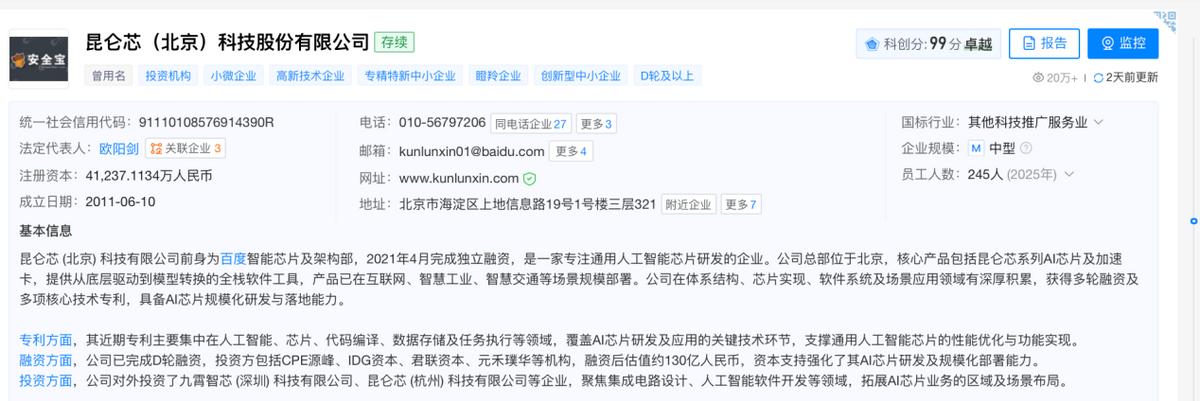
Currently, Alibaba and Tencent still rely on imported computing power chips, while Kunlun chips have released their third-generation product, the P800, and successfully lit up China's first fully self-developed 30,000-card cluster.
In the AI era, computing power is the anchor of cloud computing, just as NVIDIA became the world's most valuable tech company with its GPUs. With Kunlun chips, Baidu has a structural computing power cost advantage.
The anchor of cloud computing is essentially computing power.
Compared to Alibaba and Tencent, Baidu has a computing power advantage, and Kunlun chips have always been highly valued. However, the real leader in the domestic computing power field is Huawei.
When domestic large models like DeepSeek truly run on domestic chips, they use Huawei's Ascend chips and CANN architecture. The difference in ecological influence is real.
The issue with Kunlun is that the delivery schedule of the P800 may still be constrained. If Huawei cannot solve this problem, neither Kunlun nor T-Head may be able to either.
Therefore, facing increasingly fierce market competition, Baidu Intelligent Cloud may not have many true advantages. Next, the technological imagination of full-stack AI seems insufficient. Whether it can achieve breakthroughs in models and chips within the narrowing window of opportunity is crucial.
Whether it's Tencent, Alibaba, or Baidu,
After going through the three stages of IaaS resourceization, PaaS servitization, and SaaS applicationization, the AI era is reshaping the cloud computing business model into a brand-new form.
The cloud computing industry is no longer about selling resources, hard drives, or loans but about selling Tokens.
It's not a 'wholesale' business, but more like a retail business of Tokens. In the end, what this business really comes down to is cost and the price advantage per unit Token.
In this business arena, who can go further? Let's wait and see.
Disclaimer: This article is based on the company's statutory disclosures and publicly available information for commentary, but the author does not guarantee the completeness or timeliness of this information. Additionally, the stock market involves risks, and caution is advised when entering. This article does not constitute investment advice, and investors must make their own judgments regarding whether to invest.
-
![]()
AI Giants Start Borrowing to Fuel Computing Power Race
-
ByteDance Initiates Largest B2B Structural Adjustment, This Time It's Truly Different
-
![]()
Let's Talk About Kingsoft Office's Mid-Year Outlook and the True Strength of Its AI-Powered Office Solutions
-
Despite 150 Million Users, Struggles Persist: AIShige Faces Tough Competition from Seedance and Kling in AI Video Monetization
-
![]()
Ensuring Safe Gear Shifting in the Automotive Industry: Transitioning from 'Product Oversight' to 'Full-Chain Governance'
-
![]()
Net Profit Soars to $133.7 Billion! Azure Revenue Tops $100 Billion, with AI Fueling Microsoft's Growth
-
![]()
Before 6G Hits the Market, the U.S. Forges a 'Rules Alliance': What Challenges Await Chinese IoT Enterprises?
-
![]()
Intelligent Driving's 'Little Blue Light' Faces Ban: Night Glare and Cut-in Risks Prompt Official Action