Computing Power is Moving into Homes
 05/29 2026
 545
545
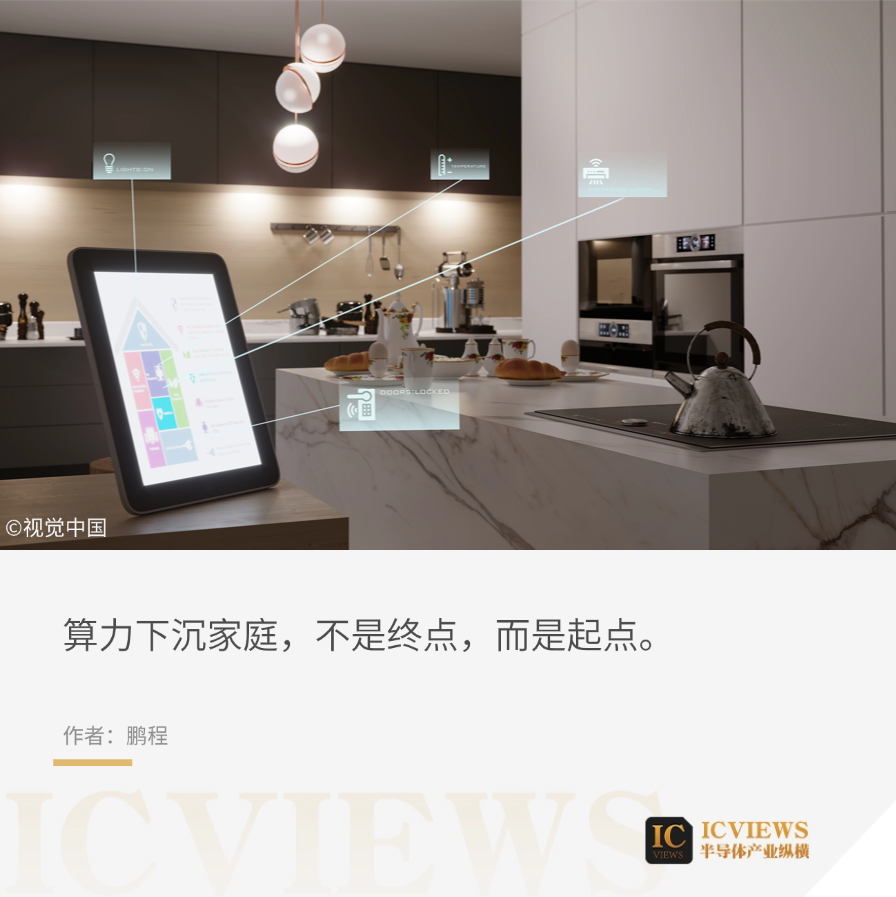
Over the past decade, we have witnessed a complete cycle of 'storage decentralization.' From SAN arrays in corporate data centers to file servers in offices and then to NAS servers in living rooms, data ownership has gradually returned to individuals. The fundamental driver of this process has been the trade-off between cost and form factor. When hard drives became cheap enough, devices quiet enough, and power consumption low enough, no one wanted to store family photos on a public cloud that could shut down at any moment.
If storage can return home, why can't computing power? Today, AI computing power is undergoing the exact same inflection point as storage did a decade ago. In 2024, Synology released its first NAS equipped with a dedicated NPU. This was not an isolated event: almost all mainstream NAS vendors, including QNAP, Jispace, and UGREEN, included 'local AI' in their product roadmaps by 2025. The NAS, once just a box for 'storing things,' is now becoming a 'brain for thinking.' This is the embryonic form of the 'home computing hub.'
01
Why Do We Need a 'Home Brain'?
Sixty years ago, the IBM 360 mainframe occupied an entire room, and computing was a privilege for a select few. Thirty years ago, PCs entered households, democratizing general-purpose computing. Today, as AI agents need to be online 24/7, as large model inference requires tens of GB of VRAM, and as families refuse to let private data pass through the cloud—AI computing power is undergoing a decentralization movement from data centers to living rooms. The home is becoming the ultimate edge node for AI deployment.
First is privacy. The home environment aggregates highly sensitive user data and personalized habits, from family photos and videos to health records and daily consumption preferences and routines. This data is often non-transferable. However, most existing devices either rely on the cloud and struggle to handle complex local tasks independently or focus on general-purpose computing while lacking continuously online, proactive intelligence.
Beyond privacy, economics is key. Mainstream cloud AI services today generally adopt a subscription model. For a household with multiple members, devices, and agents, the monthly 'AI tax' of hundreds of yuan can accumulate to the point where, in two years, one could purchase a local computing device. A home AI hub, however, can run local large models 24/7, providing lifetime computing power ownership with a one-time investment.
What truly transforms the home computing hub from a 'nice-to-have' to a 'must-have' is the impending AI agent era. AI agents are not search engines or simple 'you-ask-I-answer' dialog boxes. True agents are continuously online, proactively perceptive, and autonomously executing digital entities. Many home scenarios demand extremely low latency and high reliability. Even a hundred-millisecond delay in cloud solutions is 'sluggish' in the agent context; network outages are fatal. Only local computing power can provide true real-time responsiveness and offline autonomy.
Today's home network architecture is essentially 'each device with its own brain': phones have NPUs, computers have GPUs, and smart speakers have dedicated voice chips. This is like having a separate air conditioner in every room in the early days—inefficient and uncoordinated. The goal of the home computing hub is to create the 'central air conditioning' of the AI era: a powerful unified computing core that provides 'intelligence on demand' to all terminal devices via the home LAN. Technologically, there are no insurmountable barriers; the real challenges lie in cost, form factor, and ecosystem.
02
The Many Possibilities of Home Computing Hubs
What should a home computing hub look like? The market has already evolved multiple routes, representing different understandings of 'home AI.'
First is the NAS, which is increasingly resembling a server. NAS vendors were among the first to sense the wind. Since 2025, UGREEN, Jispace, and QNAP have labeled almost all their new products as 'AI-enabled.'
The advantage of AI NAS lies in the fact that users already have data storage needs, and computing power is provided 'incidentally,' with minimal migration costs. However, the bottleneck is clear: traditional NAS CPUs (such as Intel N305, N355) have limited AI computing power, typically only capable of smoothly running small models under 7B. They often struggle with practical models above 30B.
Another form is the mini PC/AI BOX. Unlike the 'storage-first' mindset of NAS, mini PCs/AI BOXes prioritize computing power. The global shortage of the Apple M4 Mac mini in early 2026 marked a symbolic moment for computing decentralization into homes. The developer community discovered that this ¥3,000-class mini PC, with its 38 TOPS NPU computing power, 16-32GB unified memory architecture, and ultra-low standby power consumption, became an ideal carrier for running local AI agents. Additionally, the Ryzen AI Max+ 395 (codenamed 'Strix Halo') is AMD's heavyweight bomb for the home computing hub. With a 16-core Zen5 CPU, 40-unit RDNA3.5 GPU, 50 TOPS NPU, and up to 128GB unified memory—of which up to 96GB can be exclusively allocated to the GPU as VRAM—this palm-sized machine can locally run trillion-parameter models like Llama 3.1 70B-Q8 and GPT-OSS-120B. The advantage of mini PCs lies in their pure computing density and architectural sophistication, but their disadvantages include generally weaker storage expandability than NAS and the need for users to build their own software ecosystems.
Another possibility is the AI-native hub. On May 18, 2026, Moore Threads released the MTT AICUBE. It does not define itself as a NAS or a PC but as a 'home AI hub.' The AICUBE is powered by its self-developed 'Yangtze' intelligent SoC, which integrates an all-large-core CPU, a full-featured GPU, and a dual-core NPU, providing 50TOPS of heterogeneous AI computing power and 32GB of high-speed unified memory (bandwidth 120GB/s). The AICUBE's ambition lies in ecosystem closure: from the chip (Yangtze SoC) to the system (MTT AIOS) to the agent (Xiaomai) to storage (all-flash AI NAS), everything is self-developed. This vertical integration allows it to deliver experiences that traditional PC vendors cannot—such as the 'two-dimensional topological memory system,' which enables true long-term and short-term memory fusion for AI, allowing it to increasingly understand family members' preferences.
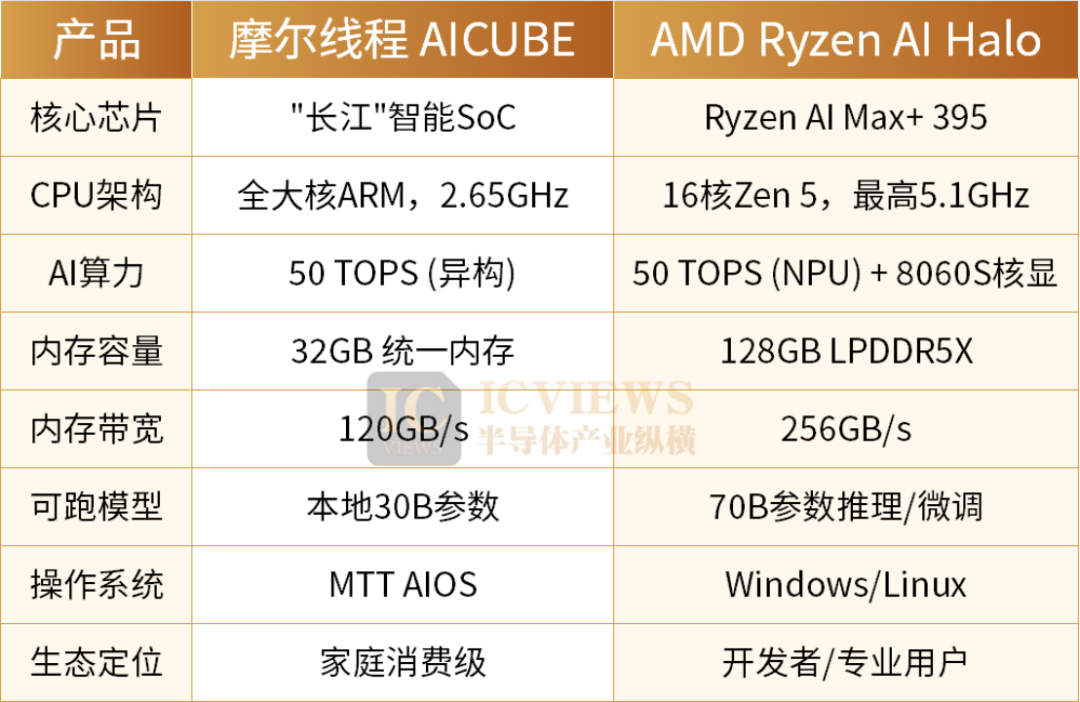
The fundamental divergence among the three routes is this: AI NAS believes 'data is core, computing power is ancillary'; mini PCs believe 'computing power is core, storage can be external'; while AICUBE believes 'agents are core, and computing power and storage are merely the limbs and stomach of agents.'
03
Unified Memory Architecture Might Be the Ultimate Answer
The bottleneck to the popularization of home computing hubs has never been CPU frequency but the memory wall. In traditional PC architectures, the CPU has its own DDR memory, and the GPU has its own GDDR VRAM, with communication between them via the PCIe bus. During large model inference, data must be frequently transferred between memory and VRAM, consuming not only bandwidth but also power and time. More critically, for large models with billions of parameters, VRAM capacity directly determines the maximum model size that can be run. Consumer-grade discrete GPUs typically have only 8-16GB of VRAM, which may be insufficient for running models like Stable Diffusion 3.5 Large.
The unified memory architecture (UMA) is the key to breaking down this wall. UMA (Unified Memory Architecture) allows the CPU, GPU, and NPU to share a single physical memory pool, with resources dynamically allocated via high-speed on-chip interconnects. This brings multiple advantages: first is zero-copy communication, where data preprocessed by the CPU can be directly read by the GPU without needing to be 'transferred' via PCIe; second is elastic VRAM expansion, where system memory can be dynamically allocated to the GPU, enabling the loading of larger models; finally, bandwidth efficiency soars.
Currently, the three major chip vendors are all pushing for the adoption of unified memory architecture in the consumer market. AMD's Strix Halo brings this logic to consumer-grade products. With 128GB of LPDDR5X-8000 unified memory, it allows the GPU to directly access system memory via GTT (Graphics Translation Table), with approximately 96GB allocatable for AI inference. This makes it the first consumer-grade processor capable of running a 70B full-precision model on a single machine. NVIDIA's DGX Spark, equipped with the GB10 chip, also features 128GB of unified memory with a bandwidth of 273GB/s, with approximately 100GB allocatable as VRAM. However, this product is currently more targeted at professional AI developers. Apple's M4 Max has the highest unified memory bandwidth, exceeding 500GB/s. However, Apple's closed ecosystem means you cannot freely install models, expand hardware, or choose your operating system. For scenarios like home computing hubs, which require long-term iteration and flexible deployment, closedness is a fatal flaw.
04
From 'Storage Sharing' to 'Memory Sharing'
The ultimate value of the home computing hub lies not in how large a model it can run but in its ability to solve a persistent issue in the current AI ecosystem: amnesia.
Today's AI devices are all 'intelligent islands.' The assistant on your phone doesn't know the documents on your PC, the speaker doesn't know your TV's viewing history, and each device must relearn your preferences. The disruptive significance of the home computing hub is that it can become the unified memory layer for the entire household, with all devices connecting to the same computing hub via the local network, enabling true semantic-level memory sharing—not just the simple 'sync folders' of cloud accounts. Moore Threads' 'Xiaomai' agent has already demonstrated this possibility: its two-dimensional topological memory system deeply fuses short-term and long-term memory, enabling precise associations between people, events, past, and present.
To achieve this true 'family memory,' a three-tier architectural system must be built:
The first layer is the unified vector database. All unstructured data in the home—photos, documents, chat logs, health data—is converted into vector embeddings and centrally stored on the hub. Any AI request from a device first queries this 'family knowledge base.'
The second layer is cross-device agent collaboration. The phone handles collection (photos, recordings), the PC handles production (writing, programming), the TV handles display (albums, videos), and the speaker handles interaction (voice interface). They do not run AI independently but process perception tasks locally, delegate inference tasks to the hub, and return results to the end device for presentation.
The third layer is contextual inheritance. Through identity recognition on the home LAN (who is in which room, using which device), the hub maintains a continuous dialogue state. A question started in the living room can be continued in the bedroom—because the 'memory' resides in the hub, not the devices.
This model also has a byproduct: local agent computing power supply. Current AI agents either run in the cloud or on local PCs. The home computing hub provides an intermediate state: sufficiently powerful local computing (70B model + vector database), sufficiently low latency (millisecond-level over LAN), and sufficiently high privacy (data never leaves the home). The computing hub makes 'private agent ownership' transition from a geek experiment to a household standard.
The future of home digital infrastructure will consist of three foundations:
The network foundation: routers (already ubiquitous); the storage foundation: NAS or local servers (currently being adopted); the computing foundation: home AI hubs (about to be adopted).
Combined, these three form the ultimate manifestation of the 'home edge node.' It knows the preferences of your entire family, manages all your data, drives all your smart devices, and never needs to entrust your privacy to the cloud.
From mainframes to PCs, from switches to routers, from enterprise storage to NAS—history has repeatedly proven that the ultimate destination of computing power is not distant data centers but within reach of users. Computing power is officially moving into homes. This is not just a technological migration but the return of digital sovereignty.
-
![]()
AI Giants Start Borrowing to Fuel Computing Power Race
-
ByteDance Initiates Largest B2B Structural Adjustment, This Time It's Truly Different
-
![]()
Let's Talk About Kingsoft Office's Mid-Year Outlook and the True Strength of Its AI-Powered Office Solutions
-
Despite 150 Million Users, Struggles Persist: AIShige Faces Tough Competition from Seedance and Kling in AI Video Monetization
-
![]()
Ensuring Safe Gear Shifting in the Automotive Industry: Transitioning from 'Product Oversight' to 'Full-Chain Governance'
-
![]()
Net Profit Soars to $133.7 Billion! Azure Revenue Tops $100 Billion, with AI Fueling Microsoft's Growth
-
![]()
Before 6G Hits the Market, the U.S. Forges a 'Rules Alliance': What Challenges Await Chinese IoT Enterprises?
-
![]()
Intelligent Driving's 'Little Blue Light' Faces Ban: Night Glare and Cut-in Risks Prompt Official Action