Computex 2026 | Marvell: How to Connect Data Centers in the AI Era?
 06/03 2026
 478
478
Produced by Zhineng Technology
Matt Murphy, CEO of Marvell, has never delivered a keynote at Computex before.
As a company that started with storage controllers, Marvell’s story over the past decade has gone largely unnoticed—until now.
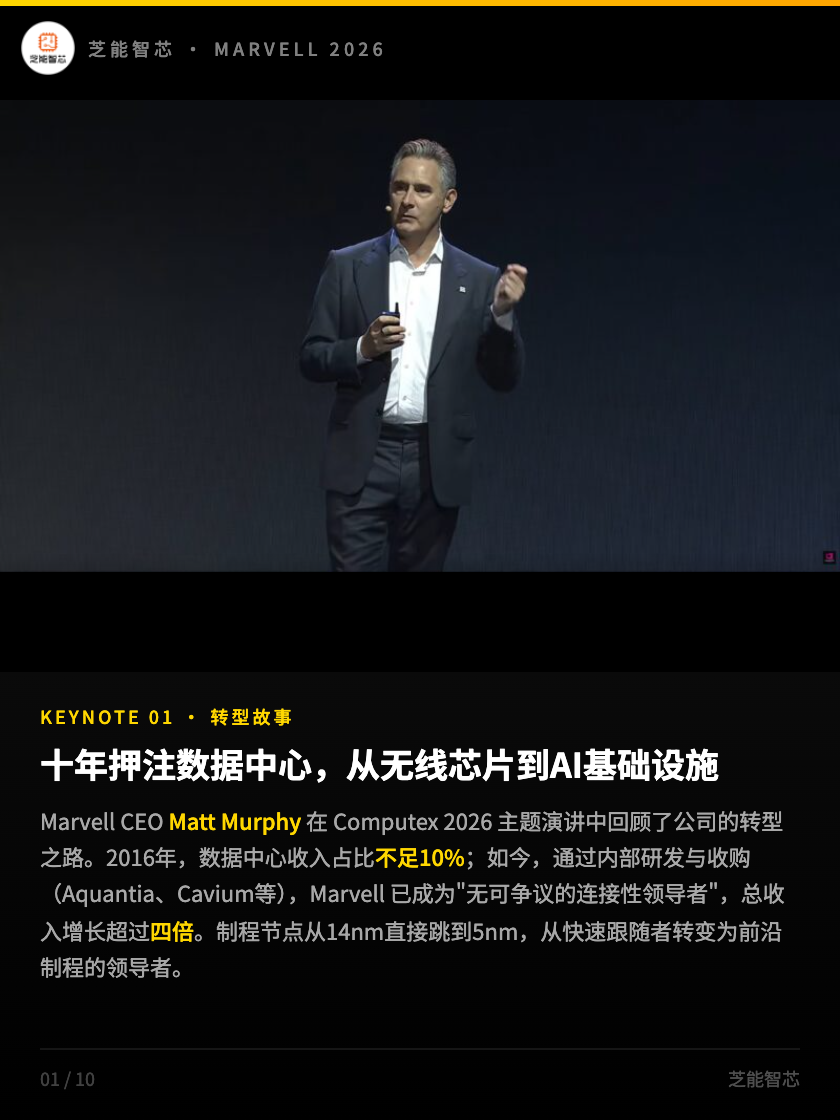
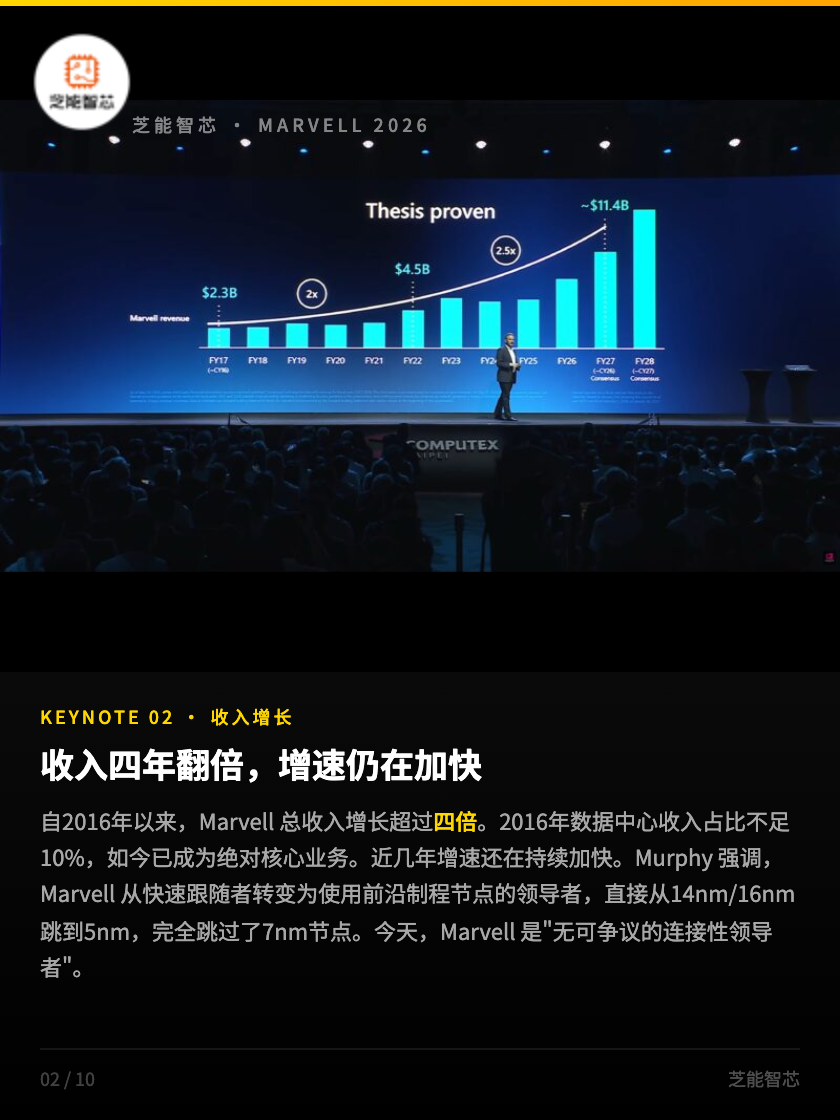
A decade ago, when Murphy took over, data center revenue accounted for less than 10% of Marvell’s total. Today, that figure stands at 75%. The company’s total revenue has grown more than fourfold since 2016.
A decade, 4x growth, and a 65% shift in business focus—a near-perfect strategic transformation for a company.
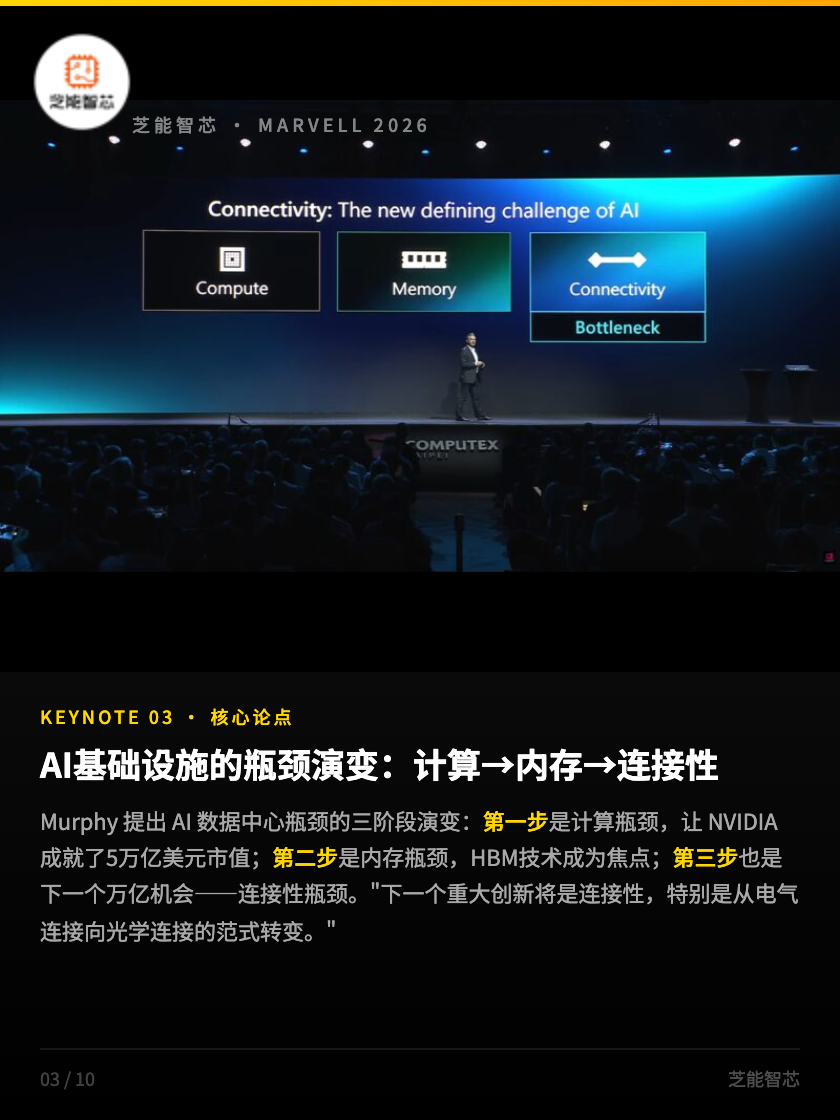
Murphy unveiled the keynote theme: “The Future of AI Scaling Depends on Connectivity,” shifting the spotlight from compute chips to connectivity chips.
01 From “Edge Player” to “Connectivity King”
The world’s highest-valued chip company handles both compute and connectivity. NVIDIA builds GPUs but also focuses on NVLink, the CUDA ecosystem, connectivity, and orchestration. Broadcom specializes in networking chips. Marvell is the only chip company whose revenue primarily comes from connectivity rather than compute.
We are the Switzerland of the industry. We work with everybody.
When Murphy said this, NVIDIA, AMD, Intel, Google, Microsoft, Amazon—all AI chip giants are Marvell’s customers. Marvell is “building roads” for their AI infrastructure, a path to AGI.
Murphy revealed the answer: approximately $36 billion invested in data infrastructure platforms. Since 2016, Marvell has completed multiple strategic acquisitions: Aquantia (market share leader), Cavium (multi-core processors), Celestial AI (optoelectronic hybrid), and XConn (SerDes).
Marvell completely skipped the 7nm process, jumping directly from 14nm/16nm to 5nm.
This was an aggressive, even risky, decision—but one that established its process leadership in AI data center connectivity.
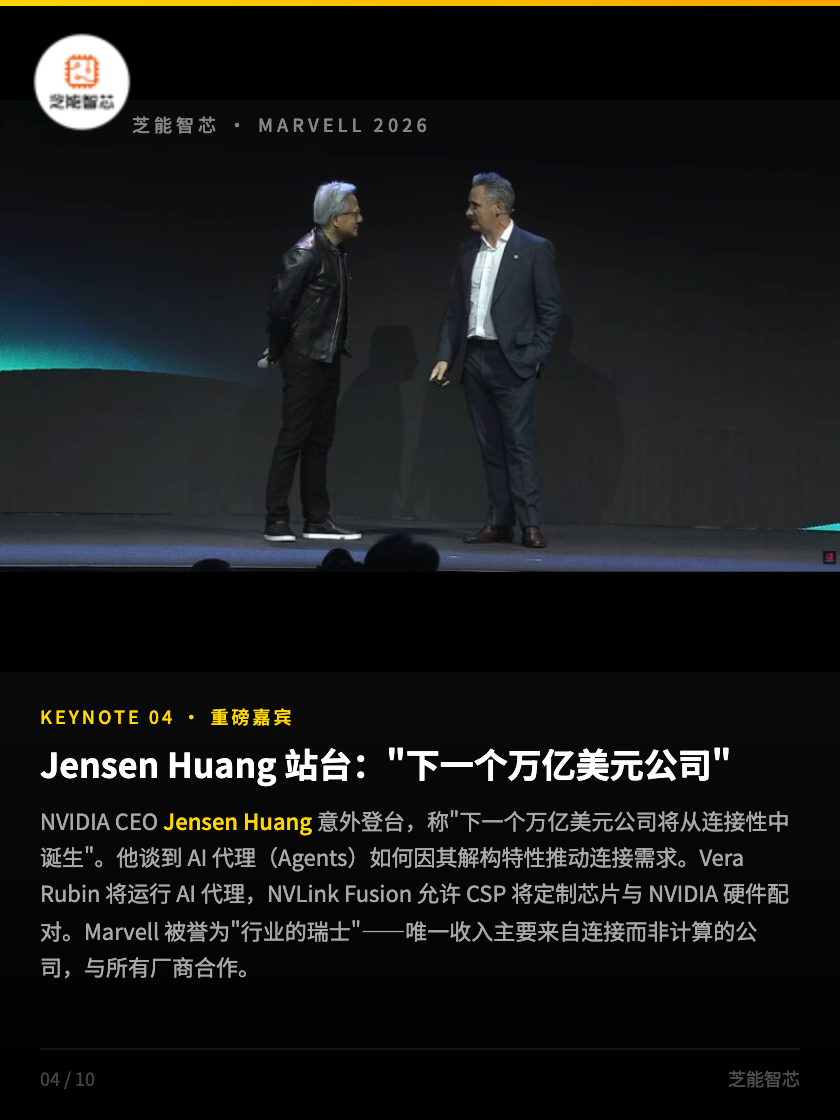
In March, Marvell joined the NVLink Fusion partner ecosystem. In May, NVIDIA invested $2 billion in Marvell. What happened in just two months?
The next trillion-dollar company, ladies and gentlemen.
Jensen opened with these words. He wasn’t talking about NVIDIA—he was talking about Marvell. Connectivity will become the next major battleground for AI infrastructure, and Marvell has been chosen. Agentic AI is transforming how data centers operate.
Traditional AI follows a “question-answer” model: a request comes in, a response goes out. Agentic AI is different—a single request can trigger dozens or hundreds of internal connections, each transmitting data.
The demand for bandwidth has never been greater.
Vera Rubin will run AI agents. What do agents need? Connectivity. Lots of it. The value of NVLink Fusion lies in allowing cloud service providers (CSPs) to pair custom/semi-custom chips with NVIDIA hardware.
This is about copper vs. optics: Scale up with copper as you can. Scale up with optics where you must. Use copper where possible, optics where necessary. Behind these words lies a supply chain restructuring worth hundreds of billions of dollars.
02 T100 and COLORZ—A Full-Distance Technology Stack
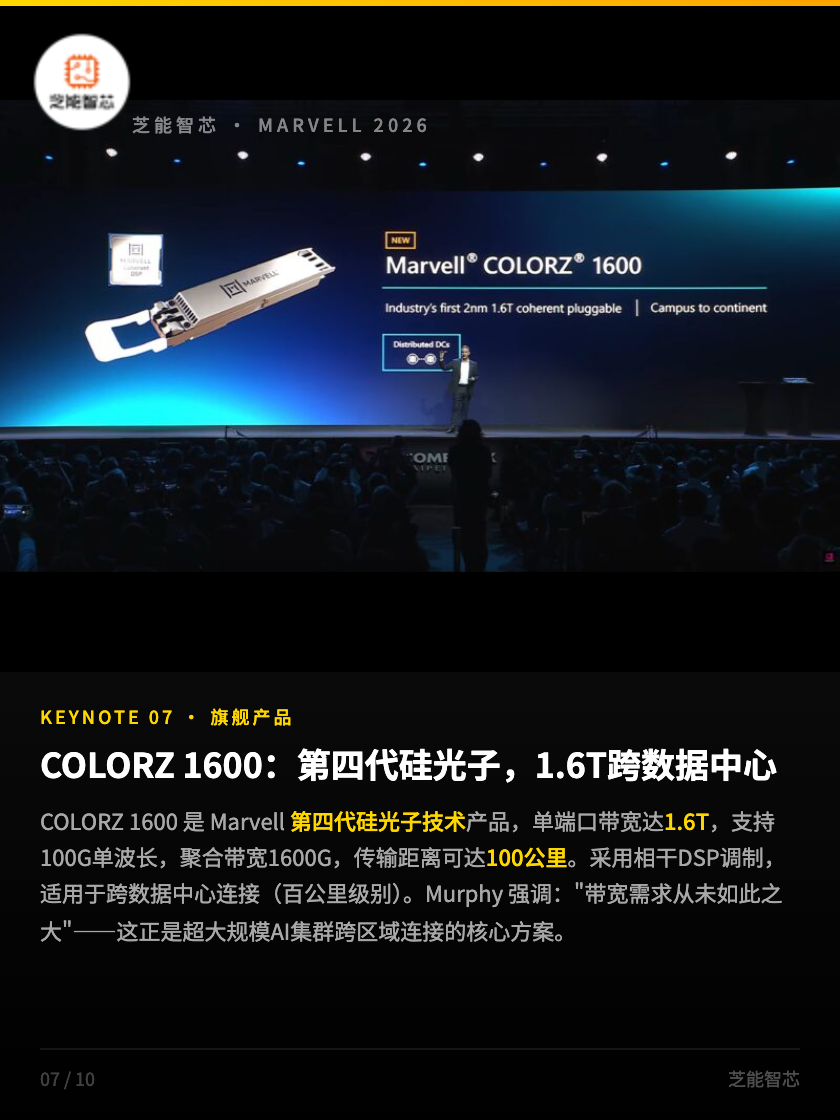
NVIDIA sets the direction; Marvell fills in the gaps.
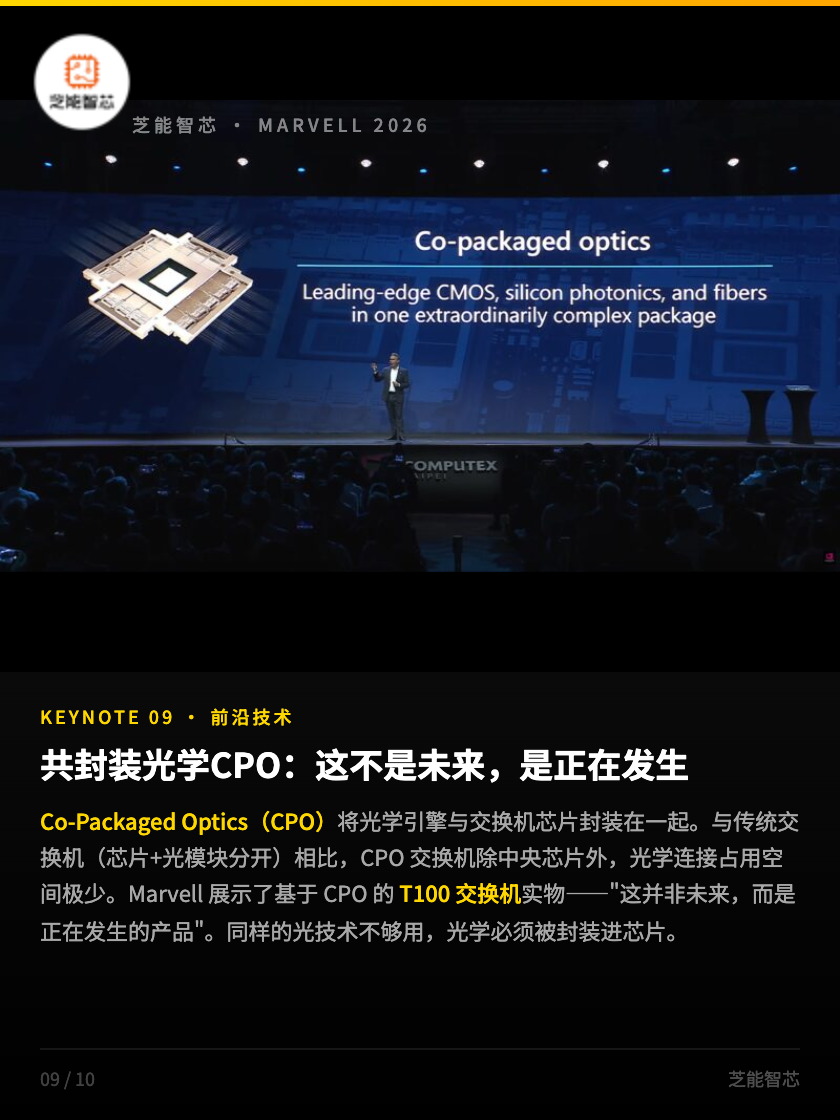
New product: T100 Teralink Switch—100T bandwidth, the next engine for scaling inside data centers.
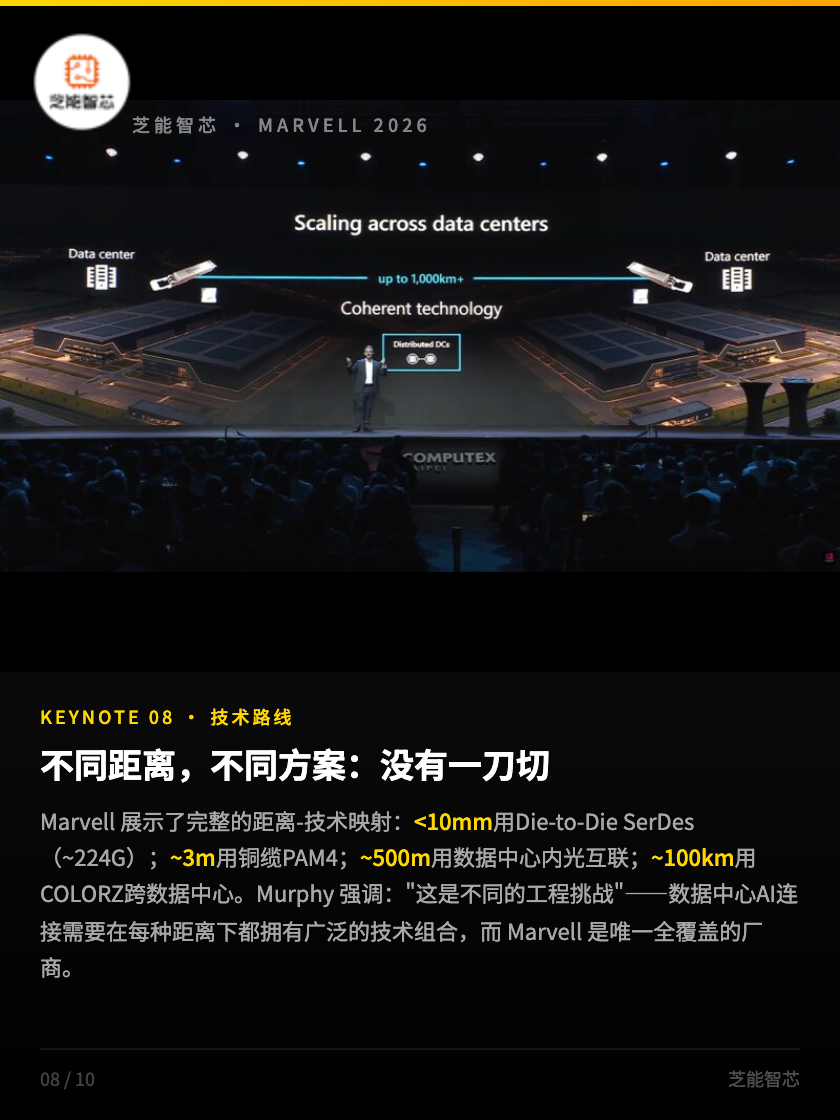
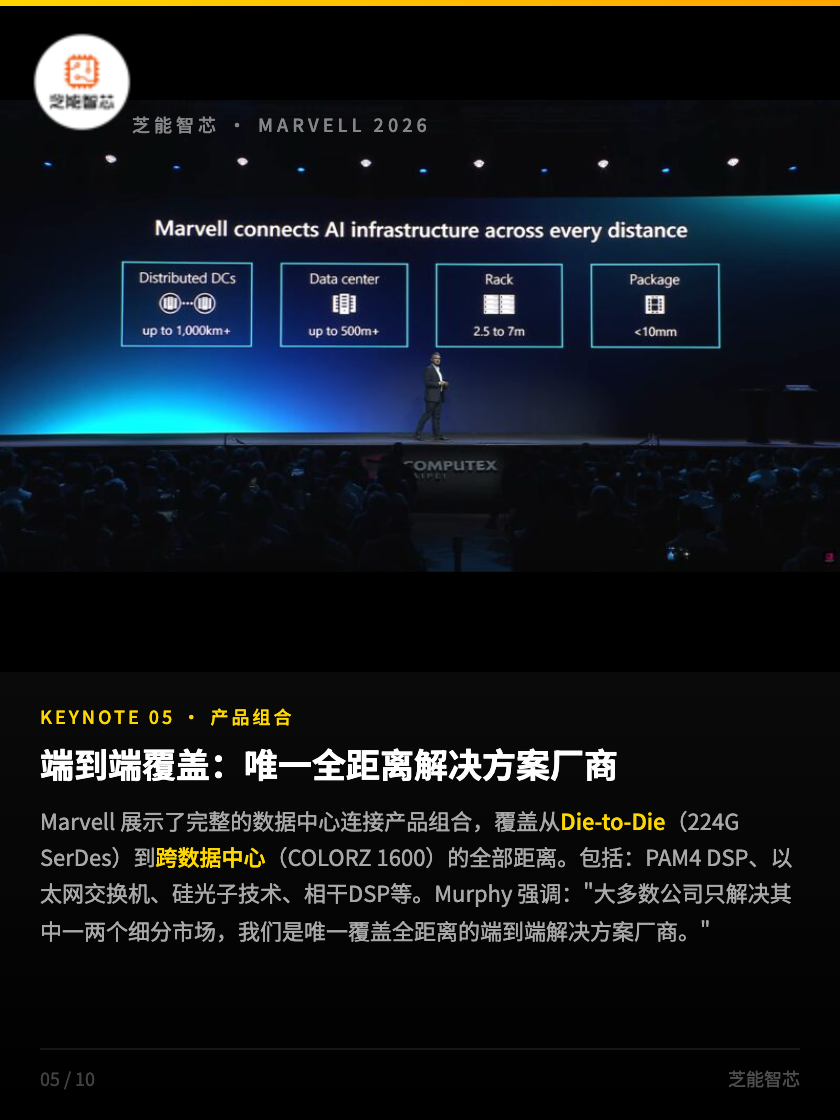
Marvell showcased a technology stack covering all distances:
◎ Inter-data center (hundreds to thousands of kilometers): COLORZ 1600, 4th-gen silicon photonics, coherent DSP
◎ Intra-data center (up to 500m): PAM4 modulation, power-optimized
◎ Extended networks (2.5m-7m): Copper SerDes
◎ Chip-level (Die-to-Die): Ultra-short-reach SerDes
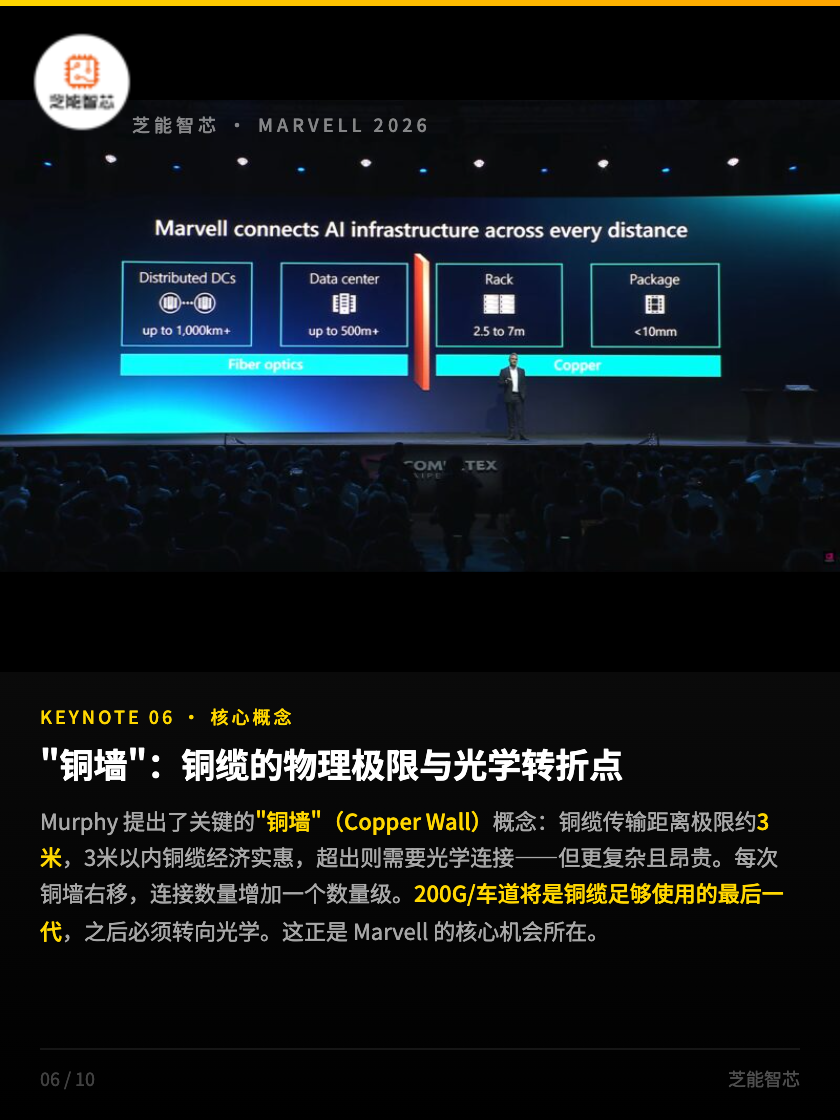
The “Copper Wall” is the central concept of this keynote—the maximum physical distance copper cabling can handle. Beyond this limit, optical connections become necessary—more complex, more expensive, but far more capable. 200G per channel will be the last generation where copper can keep up.
Every time that wall moves to the right, the number of connections goes up by an order of magnitude.
Each shift of the “wall” to the right increases connection counts by an order of magnitude. This gap represents an order-of-magnitude opportunity. Rack-scale connectivity supports up to 144 XPUs.
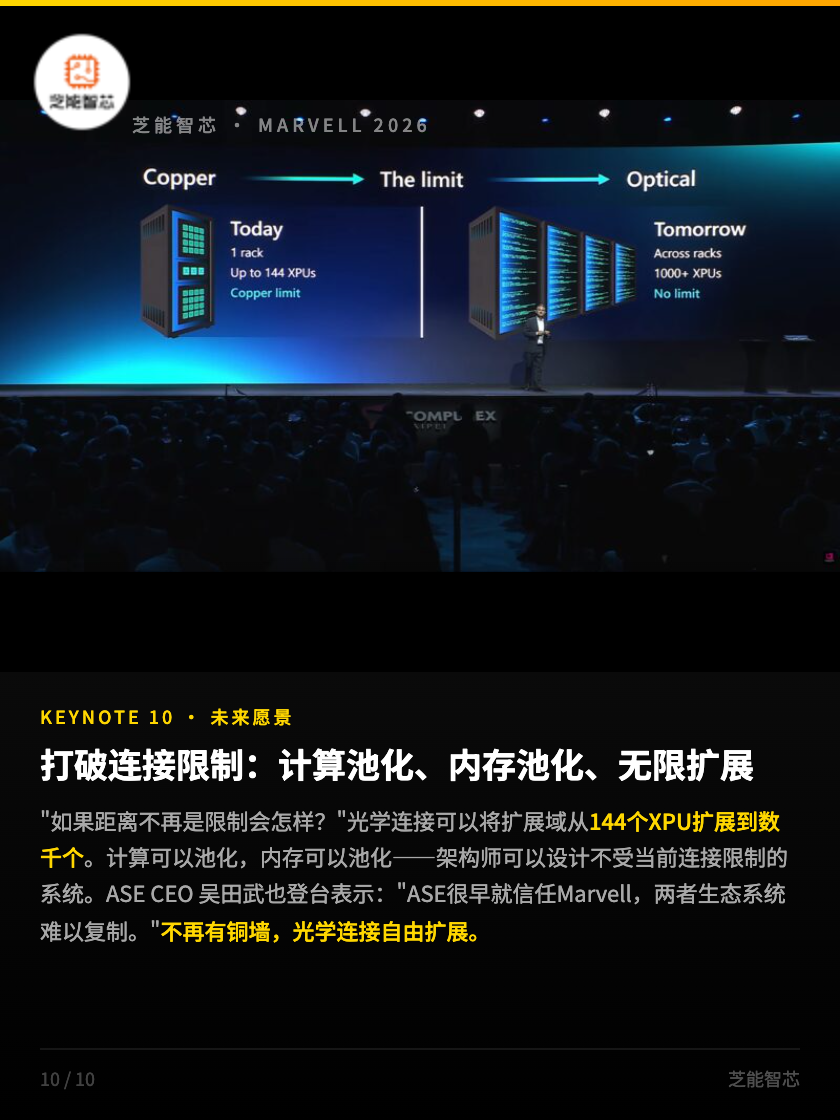
The optical era? Scalable to thousands, with distance no longer a limitation. CPUs, XPUs, and memory reside in separate systems, no longer built to predefined ratios across trays and systems. Compute can be pooled, memory can be pooled.
Summary
The entire industry is shifting:
Phase 1: Compute was the bottleneck → NVIDIA rose ($5 trillion market cap)
Phase 2: Memory became the bottleneck → HBM emerged as the focus
Phase 3: Connectivity is the bottleneck → ?
As AI’s center of gravity (focus) shifts, the chip industry must keep pace.
-
![]()
AI Giants Start Borrowing to Fuel Computing Power Race
-
ByteDance Initiates Largest B2B Structural Adjustment, This Time It's Truly Different
-
![]()
Let's Talk About Kingsoft Office's Mid-Year Outlook and the True Strength of Its AI-Powered Office Solutions
-
Despite 150 Million Users, Struggles Persist: AIShige Faces Tough Competition from Seedance and Kling in AI Video Monetization
-
![]()
Ensuring Safe Gear Shifting in the Automotive Industry: Transitioning from 'Product Oversight' to 'Full-Chain Governance'
-
![]()
Net Profit Soars to $133.7 Billion! Azure Revenue Tops $100 Billion, with AI Fueling Microsoft's Growth
-
![]()
Before 6G Hits the Market, the U.S. Forges a 'Rules Alliance': What Challenges Await Chinese IoT Enterprises?
-
![]()
Intelligent Driving's 'Little Blue Light' Faces Ban: Night Glare and Cut-in Risks Prompt Official Action