Vanishing Humans: Is AI Taking Over the Internet?", "AI Traffic, Human Traffic, Web Access, Advertising Value, Content Ecosystem
 07/07 2026
 547
547
Initially, you were simply asked to type a few wavy letters or solve a basic arithmetic problem. Then, the challenge evolved to identifying traffic lights that were barely visible. Next, you were tasked with picking out all squares containing bicycles from a grid or rotating objects to the correct orientation.
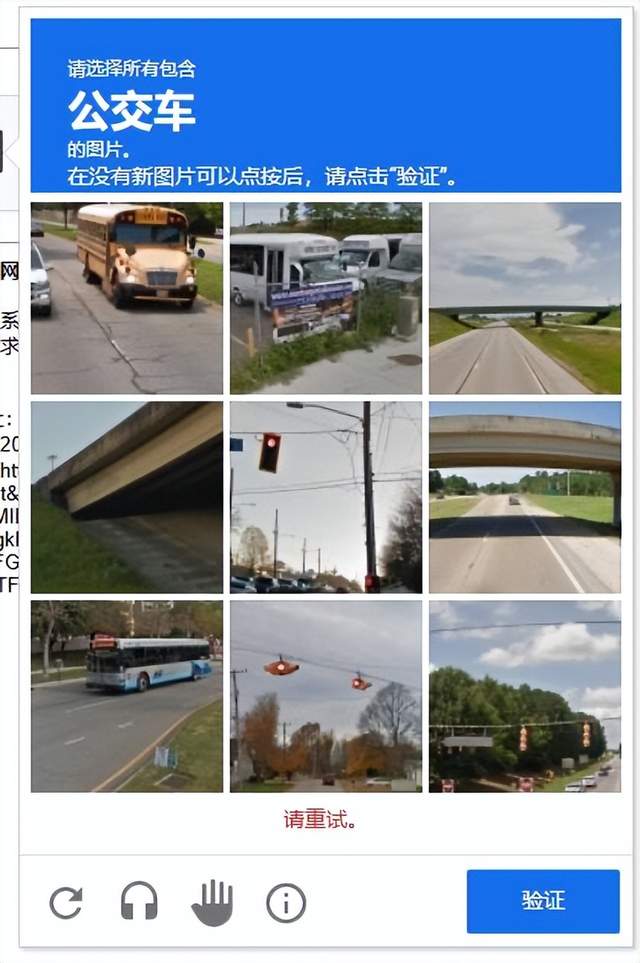
Some of these questions are so challenging that many netizens claim to have failed multiple times, while others have developed strategies to pass them.

Why, when it's clear I'm human, are there so many diverse and seemingly endless ways to verify 'I am human'?
On June 6, 2026, Cloudflare, a cloud network security service company, released a set of data. Among all web access requests received by websites it hosts, approximately 57.4% came from artificial intelligence and automated programs, while only 42.6% were from actual humans. This marked the first time in internet history that the number of web access requests from humans was surpassed by machines.
Meanwhile, research by Graphite shows that by May 2025, the proportion of AI-generated content had climbed to 52%. According to Reuters' digital media report, 71% of images on social media in 2026 were already AI-generated, with the remainder likely consisting mostly of human-machine collaborative content, and purely human-created text becoming increasingly rare.
These seemingly small differences signify a major turning point in an era: humans are no longer the main players in the online world. Every time we open a webpage, click a link, or submit a form, we may be sharing the same digital space with machines. In certain corners and at certain times, 'real humans' have even become an absolute minority.
So, why is the human internet starting to be dominated by AI, from traffic access to content generation? What exactly is AI doing online?

To understand this figure, we must first clarify one thing: what exactly constitutes that 57.4% of machine traffic?
Many people, upon hearing about robot traffic, first think of hackers, cyberattacks, and spam—programs with malicious intent seeking to cause harm. Indeed, such traffic has always existed and in significant quantities. However, this time, it is not these malicious robots that have pushed machine traffic into the majority.
In fact, the main portion of today's online machine traffic comes from the most cutting-edge technological applications. The artificial intelligence and automated programs in Cloudflare's statistics cover a far broader range than just 'malicious robots.' Reducing this data to simply malicious programs would cause us to overlook more important facts.
To understand the composition of this 57.4%, we need to look in several different directions.
The most common category is AI training and inference. AI large models require massive amounts of data for training. Models like GPT-4, Claude, and Llama often need trillions of characters of training corpus. Where does this corpus come from? From the internet. Every public webpage, blog post, comment, and image that can be scraped may become training material.
This has led to a significant increase in magnitude. Traditional search engine crawlers, while constantly scraping webpages, do so at a measured frequency. To stay ahead in technology, major AI companies are frantically collecting the latest and most comprehensive data. They scrape today and will scrape again tomorrow because models are continuously improving, and a larger corpus is always better.
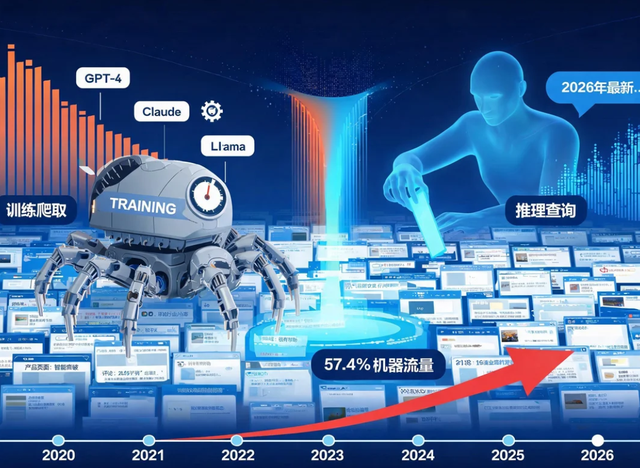
Moreover, the inference stage of AI also generates a significant amount of web access. You may use AI every day without realizing it is 'running errands' for you. When you ask ChatGPT a question, it doesn't rely solely on its internal knowledge to answer but searches the internet in real-time for the latest information. Each such search is an automated web access. AI programs rapidly shuttle between countless websites, scraping information, reading content, and integrating data. Thus, the growth of AI traffic is intense at both ends: training requires scraping data, and inference requires querying data. Both ends rely on the internet and continuously generate machine traffic.
Let us now turn our attention to another direction: AI Agents. In the past, we did everything ourselves: opening a browser, entering a URL, clicking a link, filling out a form. Each click left a mark of human access in the internet's logs. Now, we delegate tasks like booking tickets, shopping, and price comparisons to Agents.
The result is: the demand is yours, the consumption is yours, but the online footprint becomes that of machines. You want to buy running shoes, and AI does the shopping for you. You want to book a flight, and AI handles the reservation. You issue commands online, while AI programs become increasingly active. From the server's perspective, throughout the process, your human-generated web requests may only be the initial instruction and the final confirmation. The dozens or even hundreds of accesses generated by opening webpages, searching for products, clicking filters, and reading reviews are all machine traffic.
Besides these two categories of traffic directly related to cutting-edge AI technologies, there is another longstanding and still steadily expanding field worth mentioning: industrialized automated operational accounts.

You may have encountered the term 'robot water army' in the news. Thousands of phone motherboards are removed and neatly arranged on custom racks, each running dozens of social media accounts that automatically like, comment, and repost. These devices do not need rest and can operate 24/7 to generate buzz on various platforms. Their existence is for monetizing traffic.
In live streaming rooms, tens of thousands of online viewers may only have a few hundred real people, with the rest being these automated accounts padding the numbers. Five-star reviews on e-commerce platforms may be half generated and published by programs. Discussions among netizens on forums like Moltbook may have only one person truly typing from start to finish.
The operational logic of these industrialized robot water armies also relies on automated programs and is included in that 57.4% of machine traffic. They converge with the aforementioned AI training crawlers and AI agent programs, jointly creating a fact: visitors in cyberspace are being systematically occupied by machines.

Seeing this, you may wonder: in modern society, everyone is inseparable from their phones. I spend all day watching videos and playing games. On the subway, it is hard to find someone not looking down at their phone. While AI is expanding, human web browsing behavior has not decreased. Where has the disappeared human traffic gone?
Yes, our time online has not decreased but continued to increase. According to statistics from multiple institutions, the average daily internet usage time of global netizens has grown from about 6.5 hours in 2020 to over 7.8 hours in 2026. Short videos, live streaming, social media, shopping, gaming... We are spending more and more time online, not less.
The reason for the disappearance of human traffic lies in this: we are staying online longer, but clicking less.
One of the most obvious changes is the shift from browsing to asking. Five years ago, if you wanted to learn about something, you might open a search engine, enter keywords, and then click through search results one by one. Now? You directly open an AI assistant and enter a question. A few seconds later, you receive an integrated answer. It combines information from different webpages, presenting it in a clear and organized manner.
You read the answer, close the dialog box, and the process ends. You have obtained information, but you have only generated one web request. AI, to answer you, crawls websites and sends requests in the background, with all that traffic credited to machines. We have shifted from 'browsing' the internet to 'asking' the internet. When browsing, human footprints were everywhere; when asking, humans only appear at the starting point and endpoint, with machines running the long stretch in between.
Another easily overlooked factor is the walled-garden nature of the internet. Twenty years ago, most content was on open webpages. You wanted to read news, open a news website; you wanted to shop, open an e-commerce website; you wanted to look up information, open an encyclopedia website. All activities took place within the same open Web system, where traffic was visible and statistically trackable.

Nowadays, more and more time online is spent within closed super apps. WeChat, Douyin, Xiaohongshu, and other apps constitute walled gardens. Data generated by browsing moments, watching short videos, and chatting with friends within these apps is mostly not openly accessible. From a traffic statistics perspective, most content is transmitted internally within the app, making it difficult for third-party web analytics tools to capture. When traffic statistics are primarily based on the open Web, human presence within these 'walled gardens' is systematically overlooked.
It can be said that the influx of machines and changes in human internet usage patterns have pulled the proportion of human traffic down to a historical low of 42.6%.

Having said all this, when more than half of web access requests come from machines, what does this change really mean?
Most people may dismiss it, thinking that requests and results are still ultimately executed by humans, so does the fact that machine traffic surpasses human traffic essentially just mean AI has become humanity's servant? Is it nothing to be alarmed about?
Not quite. From content to commerce to social interaction, this seemingly small gap is quietly changing every corner of the internet in ways you may not have noticed.
Let us start with a most practical issue: money. The freemium model of the internet is built on the basic premise that 'traffic can be monetized.' Websites provide free content to attract user visits and then earn money by displaying ads. Advertisers are willing to pay because they believe the traffic represents real individuals with purchasing power. When more than half of visitors become machines, this logic begins to crumble.
Robots do not click on ads, do not get 'recommended' (influenced to buy) by watching a video, and do not place orders after being moved by a brand in the comment section. They consume server bandwidth and occupy computing resources without generating any advertising value.

According to estimates by the World Federation of Advertisers (WFA), by 2025, annual losses due to invalid traffic will exceed $50 billion. Invalid traffic refers to traffic from non-human sources such as known crawlers, robots, and data center IPs, or traffic that appears to be generated by humans but is actually simulated by automated scripts or generated by malware. Advertisers are increasingly unwilling to pay for these invisible machines, while traffic providers are finding it increasingly difficult to prove their traffic is 'human traffic.' The expansion of machine traffic dilutes the commercial value of human internet advertising.
Now, let us talk about the content ecosystem. As mentioned earlier, not only traffic but also AI-generated text, images, and other content have surpassed human-generated content in quantity. Besides users' own AIGC creation behaviors, content farms are also a phenomenon worth noting.
A standard fully automated content production process looks like this: an operator inputs a keyword, such as 'the most popular women's fashion styles in summer 2026.' AI generates a thousand-word article in seconds, with a complete structure, fluent language, and even AI-generated model images. Then, the same system automatically generates dozens of 'user comments' below the article: 'So practical,' 'I'm sold,' 'Thanks for sharing, blogger.' Next, these comments are liked and replied to by other AI programs, creating a lively discussion atmosphere.
From a data perspective, this is a high-traffic page: high view count, high interaction rate, and long dwell time. But in reality, the article is written by AI, the images are drawn by AI, the comments are posted by AI, and the likes are given by AI. Except for the initial prompt instruction, no real human is involved in the entire page. The mass production of machine content is forming a self-cycling content ecosystem: AI generates content, AI consumes content, AI evaluates content... The entire process does not require any human participation. The internet has become a vast, self-sufficient machine system.

This sense of uncertainty is quietly changing everyone's online behavior. Some people have initiated cyber witch-hunt activities due to AI identification, resulting in large-scale online violence; others have been defrauded of tens of thousands of dollars due to blindly trusting AI-generated advertising videos.
This is the internet in 2026. Machine traffic has surpassed that of humans, machine-generated content is drowning out human voices, and machine accounts are filling up human comment sections. We once believed that the internet was an extension of human civilization, a space created by and belonging to humans. But now, this web is turning into a jungle inhabited by both humans and machines, with humans slowly becoming the minority.

Of course, at this pivotal juncture where machine-generated traffic eclipses human traffic for the first time, we are neither unprepared nor mere passive observers. To safeguard the position of 'humans' in this ever-more-congested digital wilderness, we may need to pursue efforts in two directions simultaneously.
One direction is outward, focusing on technological and regulatory advancements. Given that AI traffic and behavior can be identified, mandating AI to disclose its identity should become a digital norm. Whether it's AI-generated text, images, or network access initiated by AI agents, they should all bear unalterable 'digital watermarks' or clear identifiers. Currently, the EU's AI Act already mandates the labeling of deep-synthesized content, and China has also issued the Interim Measures for the Administration of Generative Artificial Intelligence Services, requiring providers to take responsibility for identification. Although implementing these regulations is undoubtedly challenging, and the technological cat-and-mouse game will persist, establishing the principle that 'machines must prove their identity' is, in itself, rebuilding the most fundamental order for the chaotic online world.

The other direction is inward, targeting our individual cognition and mindset. In an era where machines increasingly resemble humans, maintaining a healthy dose of skepticism is a necessary survival skill. However, this does not mean we should become overly suspicious, constantly anxious about whether 'the other side is human.' Instead, we should learn to approach online information more cautiously: not blindly trusting one-sided statements, not following popular comments without question, and for important, emotionally charged content, we might as well ask, 'Is this true?' At the same time, we should also cherish those qualities unique to humans. Pauses, hesitations, and other 'flaws' that machines might view as imperfections are precisely the most precious markers of our humanity.
Of course, just as with the rise of computers and mobile phones, AI will certainly not vanish. But after all, the internet is a product created by humans to connect with one another. When machines become the majority, we need to consciously protect those authentic human connections and creations.
When the screen is flooded with efficient and seamless AI-generated content, human voices—flawed, warm, and brimming with genuine emotions—will become the scarcest resources. Instead of fretting over how AI will transform the internet, we might as well start now by valuing authenticity: seeing people, hearing people, and being willing to make space for real humans. This may be the industry consensus and action direction we should embrace in the AI era.
-
![]()
The Surprisingly Significant Impact Difference Between Quiet and Noisy Cars!
-
![]()
Breaking Through Storage Cycle Barriers: How AI Large Models and Coding Technology Synergize to Drive Transformation in the Security Industry
-
Facilitating the Slimming of Camera Modules! O-film Obtains Utility Model Patent for Periscope-Type Reflective Component
-
![]()
Hikvision Raytine’s Millimeter-Wave Body Imaging Security Inspection Device Achieves ECAC SSc Category A Standard Level 2.1 Certification for European Civil Aviation
-
![]()
Global Market Share for Security Windows Hits 26%! This Optical 'Little Giant' Makes Its Debut on NEEQ
-
![]()
The Evolutionary Path of Agent Engineering: From Prompt to Harness by Zhang Yutao, Co-founder of Moonshot AI
-
![]()
Profits and stock prices are both declining, so why are executives from these auto companies increasing their purchases?
-
![]()
Burning Tens of Billions of Dollars, Yet No Unified Definition for World Models