DeepSeek v4’s Official Release is Still Pending, but Kimi k3 is Already Giving Open AI a Run for Its Money
 07/27 2026
 346
346
Source | Yuan Media Group
Kimi is simply too formidable.
In mid-July, the much-anticipated official version of DeepSeek V4 had yet to materialize, but its rival, Kimi K3, stole the limelight instead.
On the morning of July 17th, Kimi officially launched the K3 model, hailed as its most powerful yet. Boasting 2.8 trillion parameters and a context window of 1 million Tokens, it set a new benchmark for global open-source models.
On its launch day, K3 dominated tech headlines worldwide. Esteemed U.S. tech journalist Robert Scoble lamented on social media, "My feed is all Kimi K3 news."
The excitement wasn't confined to international shores; domestic social media also buzzed with intense discussions. Some users even speculated they were seeing advertisements, highlighting the immense hype surrounding K3.
Just two days later, on the evening of July 19th, Kimi announced a computing power shortage and suspended new member subscriptions. The reason was straightforward: K3 had performed so exceptionally in the past 48 hours that to maintain a quality experience for existing subscribers, new access had to be temporarily halted.
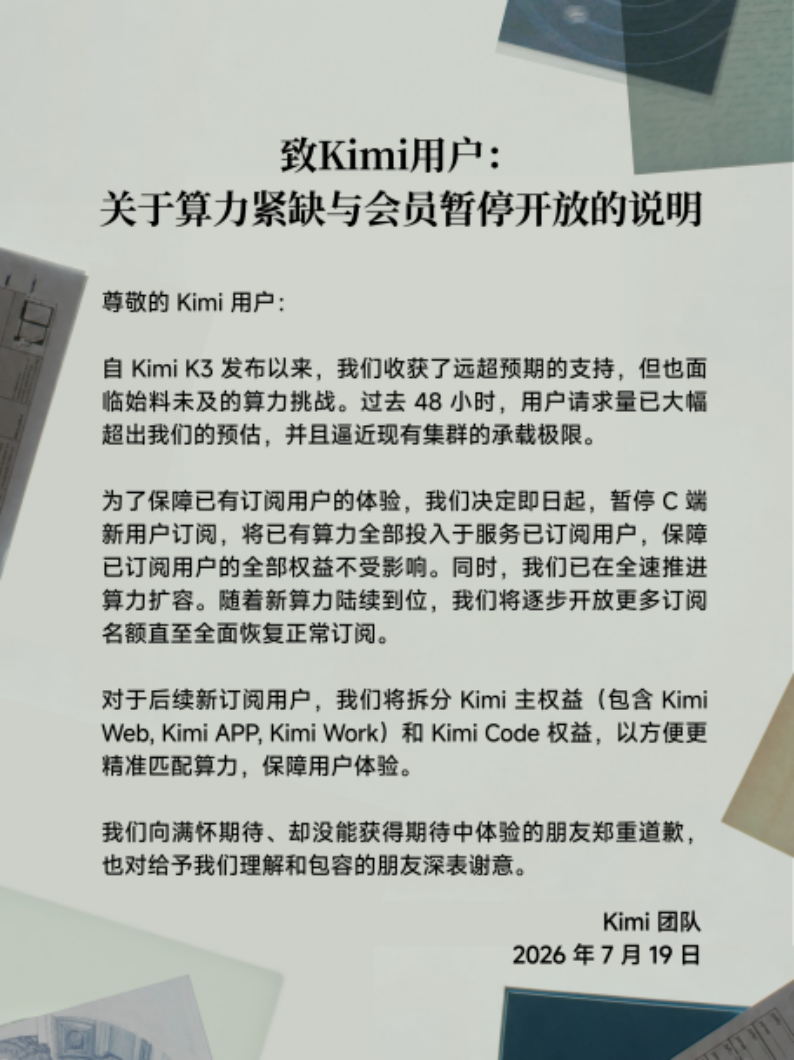
Image source: Kimi announcement
However, soon after the subscription portal closed, public attention swiftly shifted to another issue—pricing. The primary grievance from users about this model, which had voluntarily ceased sales due to overwhelming demand, was its high cost.
According to the pricing structure, K3 costs 100 yuan for every million Token outputs, nearly four times that of its predecessor. Despite the steep price, investors clearly favor such monetization strategies.
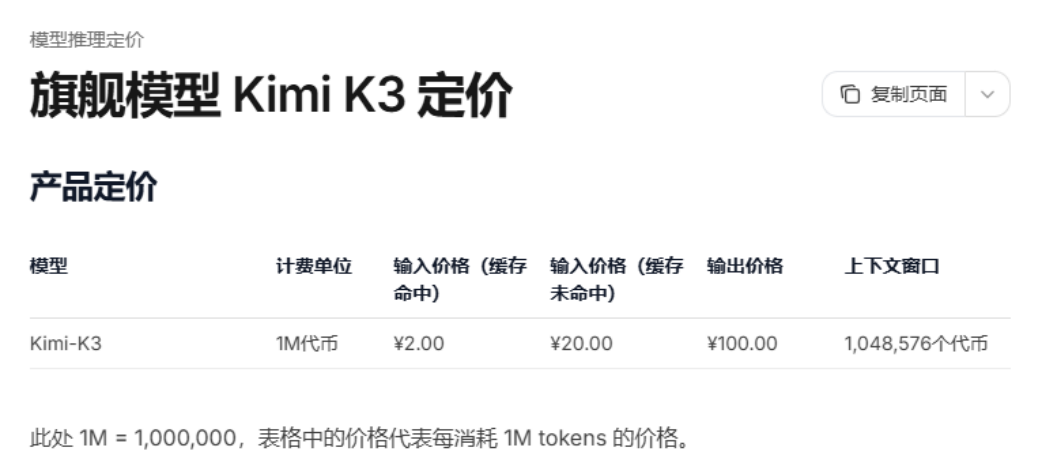
Image source: Kimi official website
On July 22nd, comprehensive reports indicated that Yuezhi Anmian plans to initiate its final pre-IPO funding round in August, targeting a pre-investment valuation of $50 billion. The company could potentially list on the Hong Kong Stock Exchange within six months.
With technology advancing rapidly and capital flowing freely, Kimi's narrative this week extends far beyond mere "overwhelming sales."
01.
K3 Shines a Spotlight on Open-Source Models
On Arena.ai's front-end code competition leaderboard, Kimi K3 claimed the top spot globally with 1679 points, outperforming Claude Fable 5 (1631 points) and GPT-5.6 Sol (1618 points). Across seven front-end subcategories, K3 secured six first-place finishes, only trailing in gaming.
The leaderboard's credibility is high, as it is based on blind votes from real developers rather than laboratory data.
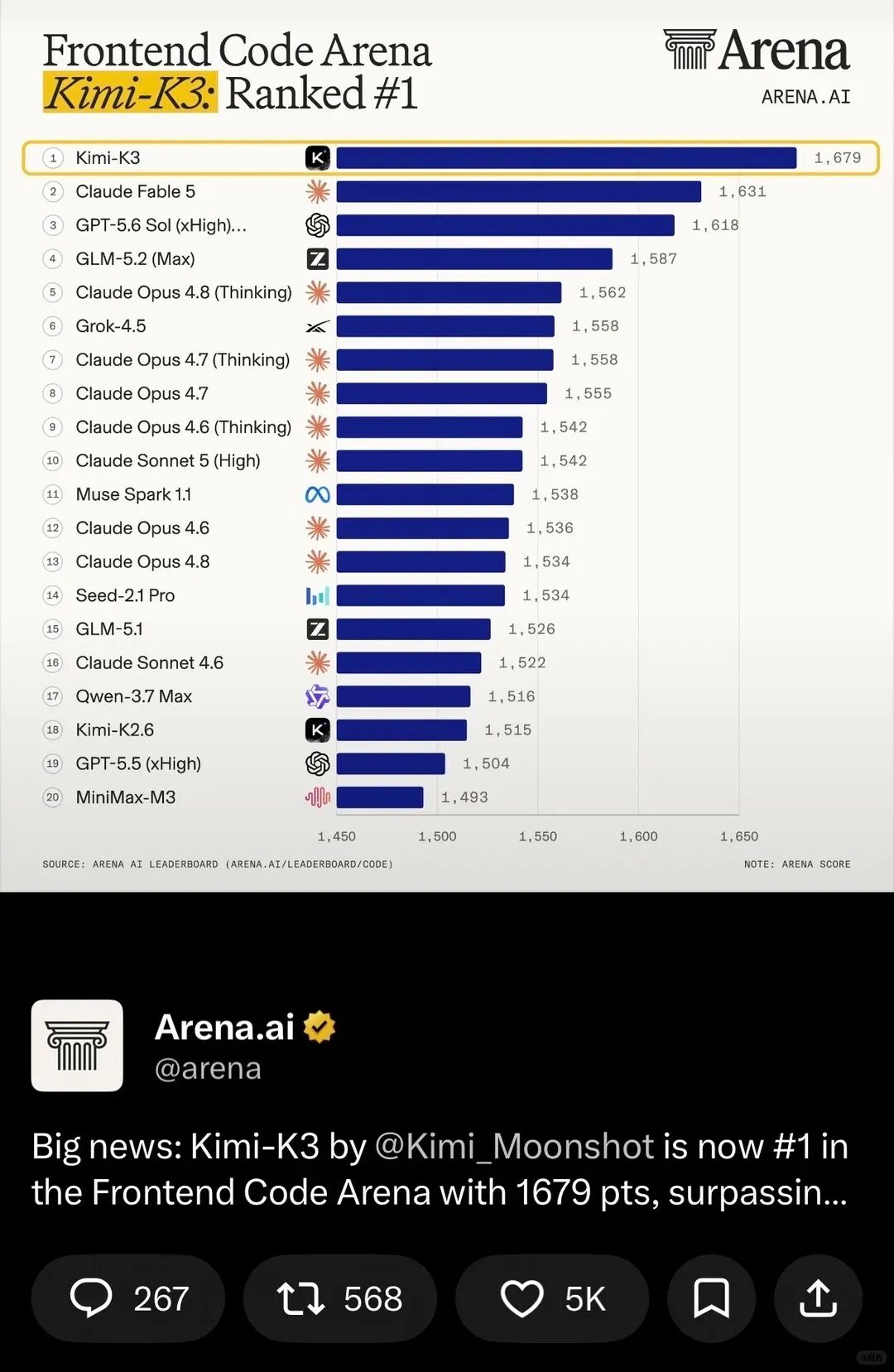
Image source: Zhang Yutong's Xiaohongshu
Vercel founder Guillermo Rauch confirmed that K3 ranked first in Next.js engineering evaluations. He described it as "the first time an open-source model has surpassed all closed-source models."
On Text Arena's comprehensive leaderboard, K3 ranked ninth with 1486 points, becoming the first open-source model to enter the global top ten. The previous generation, Kimi K2.6, ranked 38th, marking a significant 30-place leap.
Strategic research from China Merchants Securities noted that among previous open-source models, the highest-ranked, Tongyi Qianwen 3.7-max-preview, placed 18th. K3's emergence signifies that open-source models have, for the first time, reached the same level as global top-tier closed-source models in comprehensive text evaluations.
Professor Ion Stoica, a pioneer in modern AI and big data infrastructure, assessed that the industry had previously estimated a 6- to 9-month gap between Chinese open-source models and global leaders, now narrowed to 2 to 3 months.
Russ Salakhutdinov, Kimi founder Yang Zhilin's Ph.D. advisor and a prominent figure at CMU, praised the new Kimi version as a significant victory for the open-source community on social media.
Even leading international investment banks like Goldman Sachs and Morgan Stanley issued multiple research reports commending Kimi.
The attention K3 garnered extended from the tech community to global influencers.
On July 17th, Elon Musk commented "Impressive" under related evaluation reports. This marked his second public endorsement of Kimi. In March, he shared Kimi's paper on improving ResNet, praising it as "Impressive work."
However, praise is one aspect, and business competition is another.
On July 18th, Musk announced that xAI's new 2 trillion-parameter model, Grok 4.6, currently in training, would complete initial training the following week, claiming it "might surpass Kimi."
In response to this public challenge from the Silicon Valley maverick, Yuezhi Anmian simply replied, "Welcome to the 2 trillion+ club."
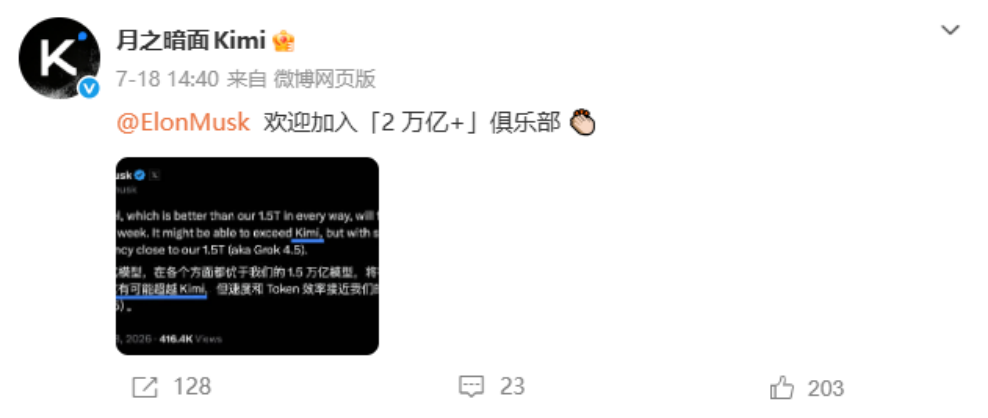
Image source: Yuezhi Anmian's official Weibo
02.
Pushing OpenAI Executives to Their Limits
Where there is praise, there is also criticism.
Dean W. Ball, OpenAI's Head of Strategic Futures and former White House science and technology policy advisor, published a lengthy commentary on social media.
He initially acknowledged that Kimi K3 "is a very excellent model," whose capabilities "cannot be simply attributed to distillation," and that it approaches the best public models from Q1 2026 in Agentic Coding scenarios.
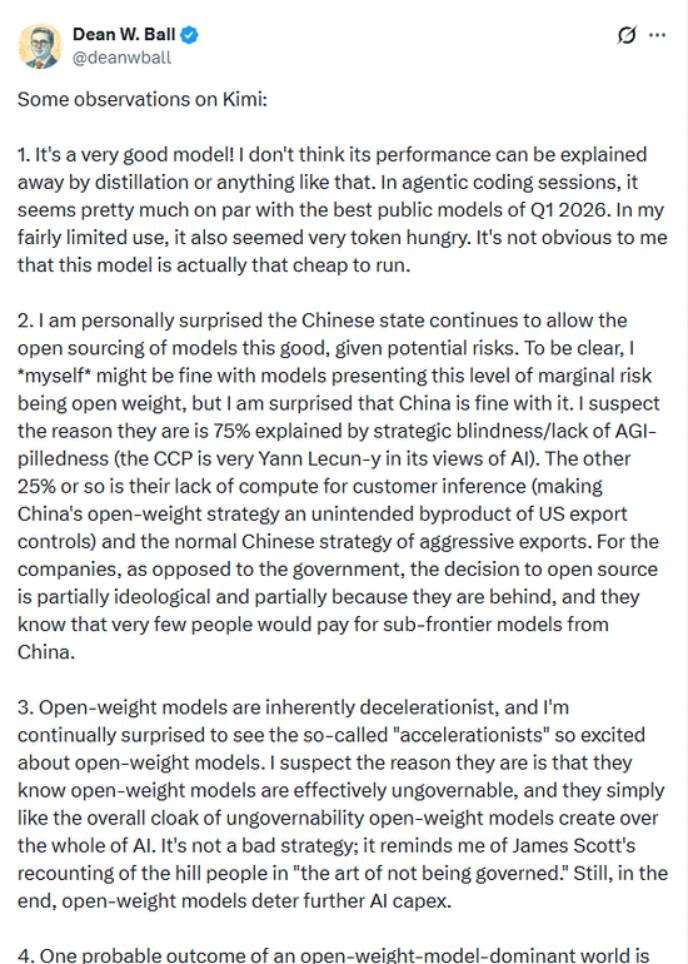
Image source: Screenshot of media-cited report
However, he then argued that open-weight models would undermine commercial returns for frontier models, reducing corporate motivation to invest hundreds of billions in training next-generation models, thus asserting that "open-weight models are inherently a decelerationist force." He even labeled this trend "AI communism."
Even more outrageously, he publicly claimed that the U.S. government "doesn't need evidence" and could simply issue soft regulations from agencies stating "Chinese models may have backdoors" to create regulatory panic and suppress competitors.
These remarks not only failed to salvage OpenAI's reputation but also drew widespread criticism on overseas social media.
Some analysts suggested that Kimi K3 could represent a significant turning point in AI industry development, "potentially negatively impacting Anthropic and OpenAI while being beneficial for almost every other company worldwide."
Notably, K3's popularity directly contradicted earlier predictions by Goldman Sachs. Goldman partner Rich Privorotsky had argued that a Chinese lab unable to match Western pre-training compute scales had rapidly closed the gap with top U.S. models through architectural innovation, warning that "scaling is no longer the only path to victory."
Yet K3's voluntary sales halt due to overwhelming demand proves that no matter how efficient the architecture, computing power remains a hard constraint when demand explodes.
However, some market voices argue that computing resource constraints are not unique to Kimi but a common challenge across the current large model industry.
Additionally, Yuezhi Anmian president Zhang Yutong disclosed that K3's release led to a multiple-fold increase in enterprise ARR.
03.
Raising the Bar to Unprecedented Heights
As Kimi K3 caused a stir, the market again turned its attention to the long-delayed official release of DeepSeek V4.
DeepSeek had previously announced that V4's official version would launch in mid-July but has yet to do so. However, gray testing for DeepSeek V4 (GA) has reportedly opened to some users, available in Flash and Pro versions.
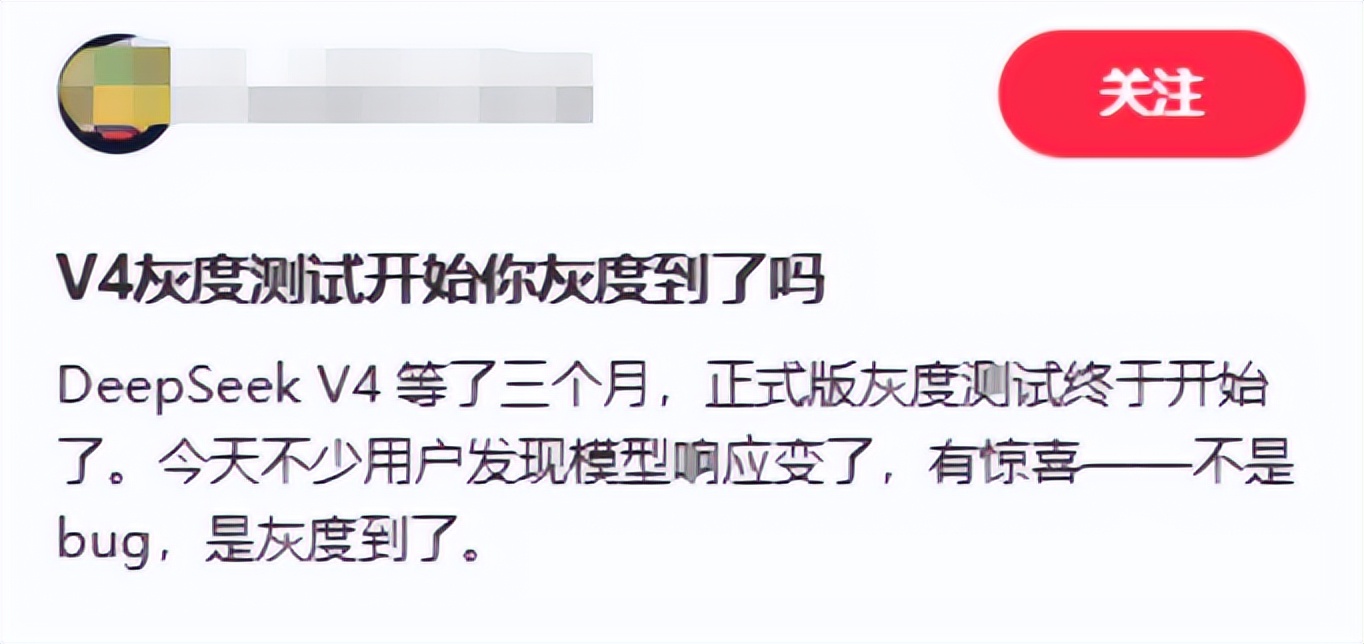
Image source: Xiaohongshu
As two leading domestic models, DeepSeek and Kimi have now taken two entirely divergent competitive paths.
Kimi K3 chose to directly compete with overseas closed-source models on programming leaderboards, using capability ceilings as its core selling point; DeepSeek V4 compresses Opus-level capabilities to one-seventh the price, leveraging cost advantages to penetrate the market. The former competes on capability ceilings, the latter on price thresholds.
The price gap is indeed staggering. K3's hybrid API is priced at $2.3 per million Tokens, while DeepSeek V4 Pro costs just $0.18.
Goldman Sachs believes that while DeepSeek previously represented a cost-efficiency shock, K3 now represents an attempt at high-end intelligence and pricing power. If Chinese model companies rely solely on price wars, their valuations will struggle to stabilize. Only by establishing capability gaps in coding, Agent, and multimodal domains can commercialization shift from traffic stories to revenue quality.
Now, K3 has pushed competition to a new stage, with the focus extending from cost efficiency to intelligence levels and API pricing power.
From topping global code leaderboards to Elon Musk's two endorsements, from CMU titans' praise to OpenAI executives' frantic "attacks," to being forced to suspend new user subscriptions due to overwhelming popularity and then hurriedly planning Pre-IPO funding—in less than a week, Kimi K3 has staged a comeback story of Chinese AI evolving from a chaser to a rule-definer.
However, this AI table stakes game has only just begun.
Note: Article materials are sourced from official reports and public information. Views are for reference only. Some images are sourced from the internet; please notify us for removal if infringement occurs.
-
![]()
Half-Year Revenue Outstrips Last Year’s Total! Zhongrun Optics Forecasts 80.2% H1 Revenue Growth
-
![]()
Why Does AI Competition Start with Computing Power?
-
![]()
Apple AI Finally Makes Its Debut in China, Yet iPhone's 'AI Autonomy' Faces Uncertainty
-
![]()
Apple AI and QianWen Make Up Lessons: Alibaba Has Its Own 'Doubao Phone'
-
![]()
QianWen Joins Apple, Signal for Large Models to ‘Fade into the Background’
-
![]()
The ‘Anchor’ Strategy of Google Hidden Behind the Bleeding Financial Report
-
![]()
DeepSeek v4’s Official Release is Still Pending, but Kimi k3 is Already Giving Open AI a Run for Its Money
-
![]()
Why is Kimi in a hurry to go public after K3?