Doing the Math for Kuaishou and Kling
 08/25 2026
 342
342

Nowadays, 'Is higher CapEx always better in AI?'
This is a question the industry has been reflecting on recently.
CapEx has never represented a company's AI capabilities but rather its determination in this arms race. The market implicitly assumes that such investment will equate to future returns and market share.
The same metric can undergo subtle changes across different times and stages.
As AI moves past its most intense investment phase, it can no longer be viewed solely through the lens of CapEx. Instead, the most valuable parts of the AI value chain are now those with a truly paying user base and proven business models.
From this perspective, let's re-examine Kuaishou and Kling—how they balance input and revenue in AI's prolonged battle and whether they have truly secured a sustainable 'ticket.'
▌1. Securing a Ticket for 40 Billion Yuan: Not Expensive
Currently, there are only two definitive 'tickets' in the AI industry: Coding and video generation models.
The significance of these tickets lies in simultaneously achieving 'consumer mindshare' and 'commercial success.' By these standards, conversational Chat models and AI Work office intelligence models have not yet secured their tickets.
The cost Kuaishou has paid for Kling's ticket is currently around 40 billion yuan.
Kuaishou recently released its first-half financial report, showing cash used for investment activities in the second quarter at 8.7 billion yuan, with CapEx (property, equipment, and intangible assets) at 5.9 billion yuan. The first quarter was higher, at 12.1 billion yuan under the same metric.
In other words, Kuaishou's total CapEx for the first half of the year was 18 billion yuan.
Earlier this year, during Kuaishou's 2025 financial results conference call, CFO Jin Bing mentioned that CapEx for 2026 is expected to reach 26 billion yuan, an increase of about 11 billion yuan from 2025, which was disclosed at 14.9 billion yuan.
From these data points, we can observe:
First, Kuaishou's CapEx for 2026 has significantly increased compared to 2025, nearly doubling;
Second, a substantial portion of this year's CapEx has already been spent;
Third, a rough calculation shows that from the second half of 2024 (CapEx around 7.1 billion yuan) to now, approximately 40 billion yuan has been spent.
Not to mention companies like OpenAI and Google, which spend tens of billions of dollars annually, or domestic giants like Tencent and Alibaba, whose quarterly CapEx exceeds Kuaishou's annual total.
In the past, the market generally believed that higher CapEx was better.
However, Meta's failure in the AI competition, along with OpenAI and Google's high CapEx and low returns, has caused market concerns about CapEx.
Conversely, Kuaishou has secured a ticket in the AI era through Kling.
By our standards, in terms of consumer mindshare, Kling reached 100 million users in June this year, a 67% increase from 60 million at the end of 2025, entering the club of hundred-million-user platforms.
In terms of commercial success, Kling's revenue in the second quarter of this year reached 850 million yuan, a 200% year-on-year increase, with nearly 50,000 enterprise clients.
Thus, Kuaishou has achieved 100 million users and a leading global video generation model with around 40 billion yuan in spending over two years. This achievement might have been overlooked under the previous 'CapEx-only' perspective but should be re-evaluated in today's AI environment.
Recently, there have been signs that AI competition is shifting towards contend for (zhēngduó, competing for) paid users and scenarios.
Two AI mergers and acquisitions occurred in the past two weeks.
One is Cursor's acquisition by SpaceX for 60 billion USD, equivalent to over 400 billion RMB; the other is OpenRouter's acquisition by Stripe for 7 billion USD, equivalent to 47.3 billion RMB.
The commonality of these two high-premium acquisitions is their strong paid scenarios.
Cursor dominates the Coding field, where developers have strong payment propensities; OpenRouter's Token gateway attributes also control key AI payment channels.
▌2. The Prolonged AI Battle: Balancing 'Resources' and 'Combat Power'
The success of Kling has often overlooked its commercialization.
This is extremely rare.
Sora is a landmark product in the video production track (sàidào, track , field), triggering follow-up from numerous giants after its launch. However, Sora itself was eventually shut down due to high costs.
Kling, from the outset, has performed well commercially and continues to grow rapidly.
AI competition is destined to be a prolonged battle. Every player should consider from the start how to join this battle with the right posture and rhythm.
If we compare AI competition to a war, two crucial factors to consider are 'resources' and 'combat power.'
Kuaishou's rhythm is quite interesting. In fact, Kuaishou has launched multiple large models, including a general language model, a text-to-image model, and Kling, which officially launched in June 2024.
However, amidst the highly competitive 'Hundred Models Battle,' Kuaishou strategically abandoned the text-to-image and general models relatively early. Instead, its last-launched video large model, leveraging Kuaishou's ecological advantages and technological accumulation, became a leading domestic and global video large model.
We believe that funding, or 'resources,' is one of the non-negligible reasons.
Looking back now, if Kuaishou had invested its main AI resources into a general model + text-to-image + Coding instead of Kling, it would have resulted in:
First, a significant increase in capital expenditure; based on the financing amounts of several mid-tier large model platforms, Kuaishou would have had to spend at least 50 billion yuan more.
Second, dispersed 'combat power';
Third, its most adept video model would have struggled in competition.
Of course, if Kuaishou had pursued a full-stack AI strategy, Kling might not have emerged successfully.
So, to some extent, it wasn't Kuaishou that chose the video model; rather, the video model chose Kuaishou.
Additionally, Kuaishou has protected its core business in this AI competition.
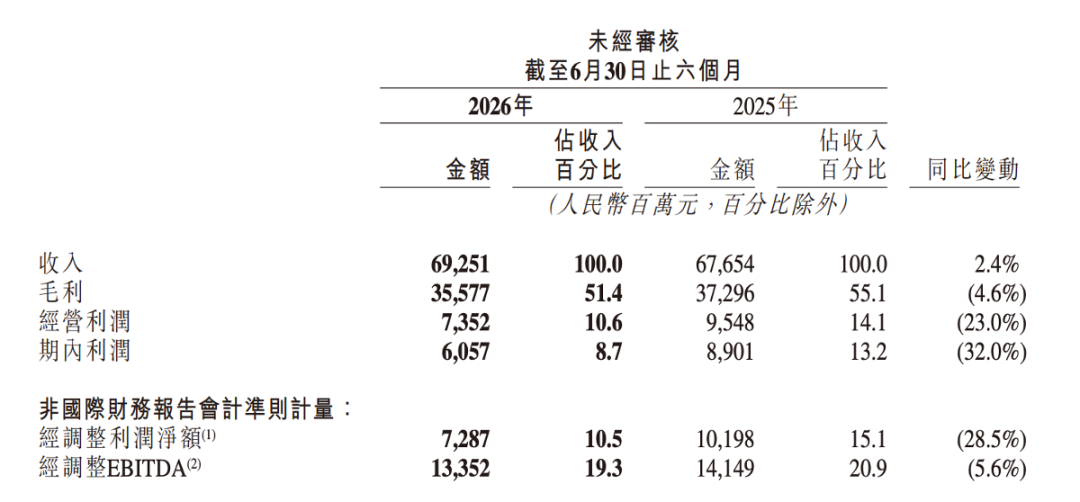
(Kuaishou's performance growth in the first half of 2026)
In terms of revenue, Kuaishou has maintained growth for nine consecutive years.
Financial report data shows that revenue in the second quarter was 35.5 billion yuan, a 1.4% year-on-year increase. In the first half of this year, Kuaishou's revenue was 69.3 billion yuan, a 2.4% year-on-year increase. Notably, live streaming has continued to decline due to overall industry impact, meaning Kuaishou's actual revenue growth is much stronger than the reported figures.
In terms of profit, Kuaishou has maintained positive cash flow and profitability, sustaining growth despite massive AI investments. In 2024 and 2025, profit attributable to shareholders was 15.335 billion yuan and 18.617 billion yuan, respectively.
Therefore, we believe Kuaishou has been underestimated.
Financial report data shows that as of the end of June 2026, the total available funds were 121.3 billion yuan, with a current price-to-book ratio of 1.57.
Kling completed 3 billion USD in financing in early July this year, with a post-investment valuation reaching 18 billion USD, nearly equivalent to Kuaishou's market value.
This is also one of the main motivations for Kling's spin-off. After the spin-off, the financial valuation models for both Kuaishou and Kling become clearer.
▌3. How Much Room Does Kling Have to Grow?
Kling is the most closely watched segment in Kuaishou's financial report.
Rational judgments on short-term sentiment and long-term potential are crucial factors in the market's valuation of Kuaishou and Kling. We believe that after Coding, the long-term potential of video large models will gradually unfold.
Multiple industries are showing market potential for AI video production.
The first is the advertising and marketing industry, where AI penetration is currently high.
Many noticed that during the recent World Cup, multiple football stars' endorsements were actually AI-generated. This marked the first time video large models demonstrated advantages in advertising and marketing production. Compared to traditional advertising shooting methods, AI can save significant communication and production costs, and even achieve better results than traditional ads.
The second market that may see large-scale application in the future is professional film and television production.
Currently, some large-scale productions have already used AI large models to supplement certain scenes and visuals. For example, familiar virtual scenes and visual effects in 'Tai Ping Nian,' and multiple complex war scenes in the Hollywood TV series 'David Dynasty' were produced with Kling AI.
We believe that the involvement of video large models in film and television production has not yet fully begun. This penetration rate will further increase as production barriers decrease and video production participation rises.
To draw a comparable example, novel writing was once considered a relatively high-barrier industry. However, with the explosion of online literature, more professional players entered the ecosystem. In 2022, a set of data shocked the industry: China's online literature authors reached 23.78 million.
Moreover, the online literature boom drove an IP explosion in film, television, and animation.
Advances in productivity tools may rapidly lower the production barriers for professional content, and this group of people is precisely the future cohort for video models to produce professional content.
Third, speaking of online literature, we must mention animation.
The emergence of excellent Chinese-style animations in recent years has made the market truly feel the rise and growth of the domestic animation market. A relatively reliable statistic shows that from 2017 to 2021, the 'erciyuan' (subculture) content industry grew at a compound annual rate of 25.7%, with a user base of 460 million.
It is estimated that by 2024, the 'erciyuan' content industry market size will reach 87.76 billion yuan, with a 'pan-erciyuan' user base of 500 million.
Speaking of animation, the next step is gaming... and so on. These are all industries closely related to video generation models.
Interestingly, this year's ChinaJoy theme is exactly 'Exploring with AI.'
CITIC Securities released a report this year, predicting that Kling's revenue compound annual growth rate from 2025 to 2030 will reach 104%, with revenue expected to approach 40 billion yuan by 2030.
Meanwhile, with the shutdown of Sora's overseas business and slowed iteration of Veo, Kling is poised to further expand its market share.
At this point, it must be mentioned that professional film, television, animation, gaming, and other industries have not yet deeply adopted video large models. The biggest obstacle is that video large models have not yet reached industrial-grade application standards, only able to gradually attempt from marginal areas, in small quantities and batches, from auxiliary roles to workflow integration.
This also raises the question of the future development direction of video large models. Only industrial-grade video large model production capabilities can truly align with the future AI-driven content industry.
- The End -
-
How AI Changes the Flow of Money: Budget, Self-Development, and the Last Mile
-
![]()
SAIC Volkswagen’s Bold “Self-Revolution”: ID.ERA 5S Targets the Heart of the Fuel-Powered Family Sedan Market
-
![]()
Beyond APIs: Future-Oriented Strategies for AI Global Expansion
-
![]()
Behind the Daily Average of 140 Trillion Token Calls: Who Will Become China's Future New Three Major Operators?
-
![]()
How Many Zhipu Members Were Wrongly Banned?
-
![]()
Leapmotor Revises Profit Goal to 3 Billion Yuan: Targets 400,000 Overseas Sales in the Coming Year, Forges Symbiotic Alliance with FAW | MINGJINGpro
-
![]()
Behind the 140 Trillion Token Calls Per Day: Who Will Become China's New Big Three Operators in the Future?
-
![]()
DPCA Technology Launched, Pioneering a New Era for Joint Ventures: Taking 'Chinese Heritage' Global