The New Era of Universal Imaging: 2025 China Household Sports Camera Industry Development Report
 03/05 2026
 495
495
In 2025, China's sports camera market has undergone a transformation from 'professional sports equipment' to a 'universal creative tool' amid the deepening of short-form video and live-streaming formats, officially entering a new phase of universal imaging creation. While the industry is experiencing rapid growth, its development logic has shifted from isolated competition over hardware specifications to a new, multidimensional competitive landscape centered around AI, fortified by ecosystems, and defined by diverse application scenarios.
Industry Trends: Market Expansion and Demand Diversification Drive the Arrival of the Universal Imaging Era
In 2025, China's online sports camera market continues its rapid growth trajectory. According to online monitoring data from AVC (All View Cloud), the total online retail volume of household sports cameras in China (including JD.com, Tmall, Suning, Douyin, and Kuaishou) reached 4.78 million units in 2025, marking a year-on-year increase of 232%. Retail revenue hit RMB 9.71 billion, up 223% year-on-year. This growth is not a fleeting trend but the inevitable result of multiple overlapping factors. 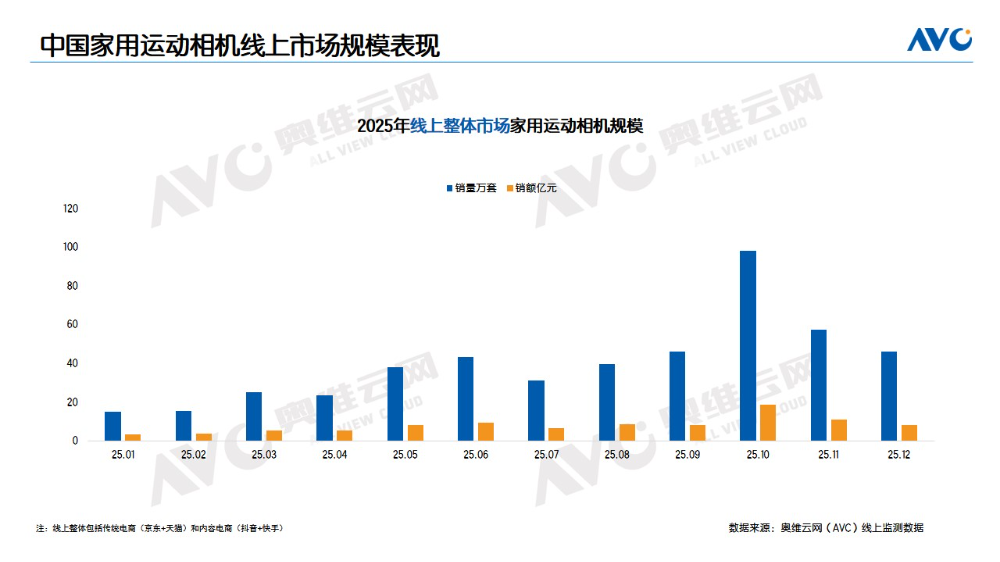
First, the democratization of content creation has become a core driving force. As short-form video platforms dominate as mainstream information channels, imaging creation is no longer the exclusive domain of professional institutions but a daily necessity for hundreds of millions of ordinary users. Sports cameras, with their extreme portability, exceptional stabilization performance, and hassle-free shooting experience, have successfully penetrated high-frequency scenarios such as Vlog creation, travel documentation, and lifestyle exploration, becoming the most important personal imaging device outside of smartphones. Their 'first-person perspective' delivers an immersive experience that precisely meets users' core demands for personalized expression and authentic documentation.
Second, application scenarios are expanding in 'two directions.' Horizontally, scenarios are broadening rapidly from traditional activities like skiing, diving, and cycling to everyday life situations such as pet tracking, parenting documentation, and daily commuting. Vertically, scenarios are penetrating professional fields, such as serving as close-up cameras in live-stream e-commerce, enabling VR property tours in real estate, and facilitating first-person instructional demonstrations in education and training. This parallel expansion of 'lifestyle and professional' applications continues to drive market growth.
Finally, price reductions are fueling consumption stratification. In the mid-to-low-end market (below RMB 2,000), domestic brands attract large numbers of entry-level users with cost-effective products, rapidly increasing industry market penetration. The high-end market maintains product premium capabilities through core technological innovation and holistic ecosystem experiences.
However, the industry also faces numerous challenges amid rapid growth:
Intensified homogeneous competition, particularly in the entry-level market, where numerous brands blindly imitate leading products in appearance and core functions, trapping the industry in price wars and continuously compressing corporate profit margins.
Deeply fragmented user demands: Extreme sports enthusiasts prioritize ultimate reliability (waterproofing, impact resistance, cold resistance); professional creators focus on image quality, color science, and post-production workflow compatibility; while mass-market users value ease of operation, intelligent editing features, and cost-effectiveness. Precisely positioning and satisfying these segmented demands has become a common challenge for all manufacturers.
Technological Trends: AI Becomes the Core Lever, Pushing Performance Boundaries
In 2025, technological breakthroughs in sports cameras focus on 'intelligence' and 'performance optimization.' AI technology is no longer confined to basic functions but deeply integrated throughout the creative workflow:
AI Scene Recognition and Optimization: Cameras can automatically identify diverse scenarios such as skiing, diving, running, pets, and human faces, dynamically adjusting exposure, color, and white balance strategies to significantly lower user operational barriers.
AI Advanced Stabilization: Stabilization technology has entered the 'AI perception stage,' using algorithms to predict camera movement trajectories for more precise electronic compensation, ensuring silky-smooth footage even in extreme turbulence.
AI Smart Editing: As a key feature lowering creative barriers, cameras or accompanying apps can analyze video content via AI (e.g., recognizing smiles, highlight moments, and scene transitions) to automatically generate short videos with transitions, background music, and rhythmic cuts, revolutionizing the 'shoot-and-share' experience.
Core performance continues to advance, with improvements in waterproof ratings, battery life, and wireless transmission. The image quality competition has entered a new phase, with 8K recording becoming standard in high-end models and evolving toward smoother high-frame-rate experiences.
Brand Competition Dynamics: Ecosystem-Driven and Differentiated Strategies
Insta360, the global leader in panoramic imaging, has defined the 'panoramic sports imaging' creation paradigm and built core barriers through full-stack self-developed technologies. The company has heavily invested in AI and R&D, with 2025 R&D spending reaching RMB 1.649 billion—exceeding the total of the previous three years—focusing on core areas like custom chip development to continuously strengthen its technological moat. Insta360 has accumulated nearly a thousand domestic and international patents, with self-developed technologies like panoramic real-time stitching algorithms and FlowState stabilization effectively addressing industry pain points such as shaky footage and stitching artifacts in sports shooting. Facing high industry barriers in panoramic imaging algorithms, computing power, and hardware-software coupling, its long-term accumulation in panoramic algorithms and post-production reconstruction technologies forms a technical foundation that new entrants cannot replicate shortly, making it an industry-recognized technological benchmark. Compared to traditional sports cameras, Insta360's innovative 'shoot-first, frame-later' logic resolves the conflict between immersive experience and documentation, transforming traditional content creation methods and enabling ordinary users without camera operation skills to easily capture impactful visuals. Rooted in a creator-friendly philosophy, Insta360 has deeply embedded itself in creators' minds, fostering a highly recognizable panoramic visual language through unique creative playing method (playful features) that generate massive UGC hits on domestic and international platforms, triggering spontaneous user propagation and forming a strong word-of-mouth effect.
DJI leverages its imaging algorithms and hardware R&D experience accumulated in the drone sector, with multiple core products becoming bestsellers and leading domestic online sales, demonstrating strong product competitiveness. The brand has built a full-scenario imaging product matrix of 'sports cameras + drones + smartphone gimbals' around imaging creation scenarios. Through the unified DJI Mimo software platform, it achieves ecosystem synergy across multiple devices, providing professional creators with highly efficient and adaptable creative solutions and forming its differentiated competitive edge.
Overall, Insta360 and DJI have emerged as the twin leaders of the sports camera market, representing the industry's core through their differentiated technological paths and ecological layouts, jointly shaping its development direction.
As the pioneer of the sports camera category, GoPro retains strong brand loyalty and deep technological heritage among its core user base. However, facing increasingly fierce domestic market competition, GoPro's innovation has stalled, and its closed ecosystem struggles to compete with other manufacturers, leading to continuous erosion of its market share.
Future Trends: AI-Driven Intelligence, Ecosystem Convergence, and Industrial Penetration
AI will drive comprehensive intelligence in user experiences: AI will evolve from auxiliary features into the product's 'brain.' We will see more powerful AI voice interaction, AI-powered subject recognition and tracking, and personalized creative recommendations based on user habits. Sports cameras will increasingly become intelligent creative partners that understand users' intentions.
Ecosystem competition will intensify, breaking down device silos: Sports cameras will no longer be standalone hardware but crucial nodes in personal or professional imaging IoT networks. Their integration with smartphones, smartwatches, AR/VR devices, and even automobiles will deepen. Brands capable of building open or powerful closed-loop ecosystems will seize the initiative in future markets.
Application scenarios will deeply penetrate industrial-level markets: Beyond consumer electronics, sports cameras are accelerating their entry into the vast landscape of industrial internet thanks to their miniaturization, ruggedness, and high performance. In B2B scenarios such as security inspections, medical surgery documentation, event live-streaming, sports training analysis, and real estate VR modeling, sports cameras will play vital roles, opening up new, high-potential growth avenues for the industry.
In 2025, the sports camera industry stands at a new historical turning point. Technological democratization has made universal imaging creation a reality, while fierce market competition is propelling the industry toward higher-dimensional competition. For companies, relying solely on hardware specifications or price wars is no longer sufficient. Future core competitiveness lies in user-centric continuous innovation capabilities, AI-centric software algorithm strength, and the strategic vision to build cross-device ecosystems. Only by mastering these key elements can companies ride the waves of the universal imaging era.
-
![]()
Hardware is the skeleton, AI is the soul, and data integrates the two
-
![]()
China’s AI Industry: A Unified Pivot Towards Monetization?
-
![]()
New Progress! Infineon Completes Acquisition of ams OSRAM's Non-Optical Sensor Business
-
![]()
35 Million Bet on an Optical Future! Tengjing Technology Makes a Move in AR
-
![]()
Why World Models Get Stuck on Construction Roads in Autonomous Driving Applications
-
Alibaba Initiates Cultural Transformation: Is Jack Ma Making a Strategic Comeback?
-
Tianfeng Heads to Hong Kong for IPO with RMB 3.8 Billion in Funds: Xingyu's Cross-Border Foray into Embodied AI Faces Uncertain Future
-
![]()
Mengshi Auto’s High-End Aspirations Dashed: Huawei Partnership Fails to Revive Sales, New Model’s Entry Price Dips Below 300,000 Yuan