Dreame Challenges Ecovacs Head-On, Turning Covert Rivalry into Open Confrontation
 03/11 2026
 640
640
From patent courts to public opinion battlefields, from technological competition to marketing clashes, the rivalry between Ecovacs and Dreame, two leading companies in the robot vacuum industry, is transitioning from 'covert operations' to 'open warfare.'
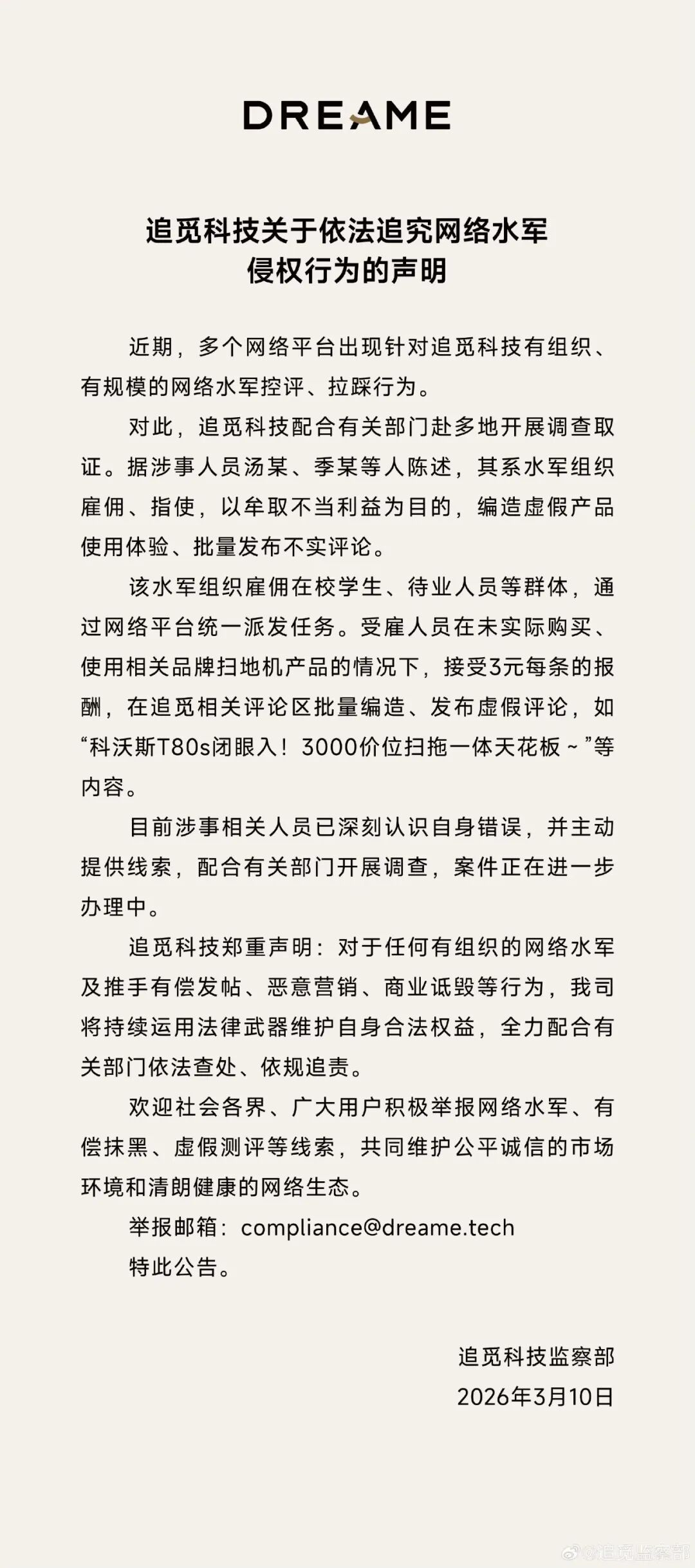
On March 10, Dreame's Supervisory Department issued a statement alleging infringement, directly accusing organized online troll armies of malicious smear campaigns, once again pointing the finger at Ecovacs. This marked the third public clash between the two companies over 'troll marketing' this year.
This public opinion dispute is an extension of Dreame's 2025 patent infringement lawsuit victory against Ecovacs and an inevitable result of fierce market share competition among leading companies.
Ecovacs maintains its position as the industry leader by leveraging its local advantages, while Dreame accelerates its counterattack in the domestic market with its strong overseas performance. Their differentiated competition in market layout (strategic deployment), technological approaches, and profit models has intensified as industry concentration rises.
This multi-dimensional confrontation not only reflects the fierce competition in the robot vacuum industry but will also profoundly influence the global smart cleaning equipment market landscape.

Frequent Disputes Over Online Trolls
A March 10 statement on Dreame's Supervisory Department's official Weibo account escalated the public opinion clash between Ecovacs and Dreame, fully exposing the fierce competition among top players in the robot vacuum industry.
Dreame disclosed detailed investigation progress in the statement: After cooperating with relevant authorities in multiple regions to collect evidence, it confirmed that individuals such as Tang and Ji, hired by online troll organizations, posted false promotional and malicious smear content—such as 'Ecovacs T80s is a no-brainer purchase! The best 3000-yuan sweeping and mopping combo (sweeping and mopping all-in-one) model'—in Dreame's product review sections and on related social media platforms at a rate of 3 yuan per post, without actually purchasing or using the products.
This was not Dreame's first accusation against Ecovacs regarding 'troll marketing.'
On January 30, Dreame founder Yu Hao took to his personal Weibo account to publicly accuse Ecovacs of extensively hiring online trolls to flood Dreame's livestreams with smear comments and publish negative articles across major platforms. He revealed that the IP addresses of involved trolls were traced to 16 provinces nationwide, with evidence already secured.
In response, Ecovacs (603486.SH) issued a solemn statement on February 11 denying the allegations, calling them 'baseless and slanderous.' As a listed company, Ecovacs emphasized its commitment to compliant operations, stating that its legal department had completed evidence collection and reserved the right to pursue legal action against relevant parties. It also called for the industry to refocus on product and technological innovation, uphold fair competition, and maintain healthy market order.
As of now, Ecovacs has not responded to Dreame's latest statement.
Notably, the recurring disputes over online trolls represent an extension and escalation of technological competition between the two sides. In 2025, Dreame sued Ecovacs for patent infringement and won the first-instance trial, with Ecovacs ordered to pay approximately 8.869 million yuan in damages. This verdict brought their technological rivalry to the surface and served as a critical backdrop for subsequent public opinion clashes.
From technological competition in patent litigation to marketing clashes over online trolls, the expanding dimensions of confrontation between the two sides reflect their fierce struggle for market share.

Counterattacking the Domestic Market
The competitive landscape between Ecovacs and Dreame stems from their vastly different development paths and strategic layout (deployments).
Ecovacs is a domestic robot vacuum leader with deep local roots, while Dreame is an emerging industry player consolidating its overseas market before launching a high-profile counterattack in China.
In 2025, overseas revenue accounted for nearly 80% of Dreame's total, with its robot vacuums ranking first in market share across 30 countries and regions globally, nearing industry-leading competitors in Europe.
IDC's *2025 Global Household Intelligent Cleaning Robot Market Tracking Report* shows Dreame's overseas market share reached 12%-14% in 2025, higher than its 10.5% global market share, highlighting its weak competitiveness in the domestic market.
Since 2026, Dreame's brand influence has surged, driven by founder Yu Hao's high-profile remarks and the brand's appearance on CCTV's Spring Festival Gala—a dual marketing offensive likely to significantly reshape China's robot vacuum market landscape.
These branding efforts mark Dreame's strategic counterattack in the domestic market. During the 2026 CCTV Spring Festival Gala, Dreame became the first tech brand to showcase a complete smart ecosystem, achieving phenomenal exposure through this national-level event.
Data shows that after the gala's broadcast, Dreame's online search popularity soared to 35 times the industry average, driving a surge in orders on domestic e-commerce platforms. Its core products, including robot vacuums and floor washers, quickly topped sales charts across major platforms, catapulting brand awareness to new heights.
This year, Dreame is clearly ramping up efforts across multiple fronts: leveraging the Spring Festival Gala for traffic generation, continuously upgrading products, building the founder's personal IP to enhance brand recognition, and deploying a full-scenario smart ecosystem to diversify its product portfolio.
All signs indicate that after solidifying its overseas position, Dreame aims not just to compete for domestic market share but to disrupt the existing industry hierarchy through technological advantages and brand accumulation. After all, founder Yu Hao's 'trillion-dollar' ambition, as stated on Weibo, is no small feat.
Strengths and Weaknesses
Despite Dreame's high-profile domestic counterattack, authoritative data reveals significant gaps between the two companies in market layout (strategic deployment) and scale.
As the pioneer and leader of China's robot vacuum industry, Ecovacs' core strength lies in its deep local roots and stable market foundation.
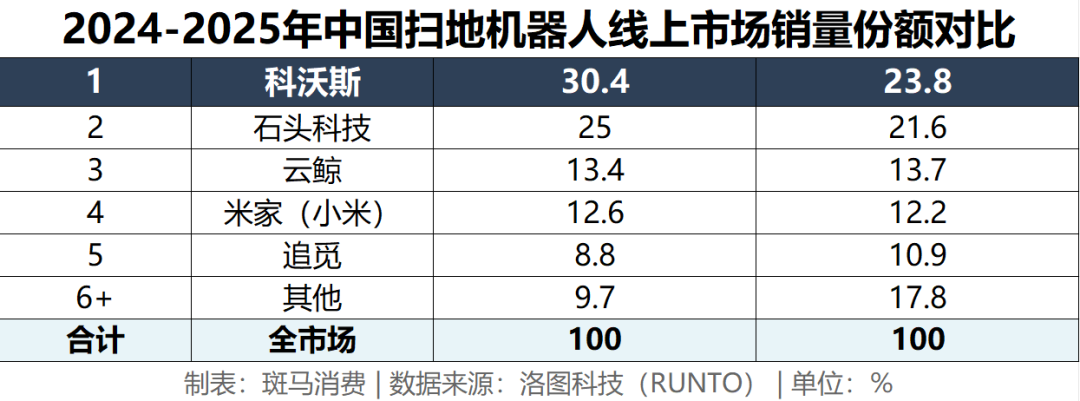
E-commerce is the primary sales channel for robot vacuums. RUNTO's 2025 monitoring data on China's online robot vacuum market shows Ecovacs leading the industry with a 30.4% online share, up 6.6 percentage points year-on-year. In contrast, Dreame's domestic online share stood at just 8.8%, with a year-on-year decline, highlighting a stark gap in domestic market influence.
Globally, Ecovacs maintains a leading position in terms of layout (deployment) and shipment volume. IDC data shows Ecovacs shipped 4.7 million units globally in 2025, capturing a 14.3% market share, with domestic shipments accounting for 68%-72% (approximately 3.2-3.4 million units). Strong local demand provides a stable growth foundation.
Even amid intensifying industry competition and declining gross margins for major players, Ecovacs demonstrated strong profitability with 60% of its products in the high-end segment. In 2025, the company expected to achieve net profit attributable to shareholders of 1.7-1.8 billion yuan, up 110.90%-123.30% year-on-year.
However, insufficient overseas market penetration remains a major bottleneck for Ecovacs' sustained growth. Industry monitoring data shows Ecovacs' overseas market share stood at just 8%-10% in 2025, significantly lower than its global market share. Although the company is advancing overseas localization through a Mexico factory, expanding its global footprint will take time.
Unlike Ecovacs, Dreame's core market lies overseas. IDC data shows Dreame shipped 3.4 million units globally in 2025, trailing Ecovacs but with overseas shipments accounting for over 60% of the total, offering greater market diversification and resilience against single-market fluctuations.
Yet Dreame's weaknesses are equally apparent, particularly its weak domestic market competitiveness and lack of brand premium.
In 2025, Dreame's domestic shipments reached only 1.2-1.4 million units, less than half of Ecovacs'. Insufficient offline channel penetration and low brand recognition among local consumers remain key barriers to domestic market breakthroughs—reasons behind Dreame's intensified branding and public opinion efforts in 2026.
The open confrontation between Ecovacs and Dreame reflects the robot vacuum industry's maturation and a comprehensive competition among top players for market share, technological dominance, and brand influence. As both sides rapidly penetrate each other's core markets, clashes will only intensify.
-
![]()
Hardware is the skeleton, AI is the soul, and data integrates the two
-
![]()
China’s AI Industry: A Unified Pivot Towards Monetization?
-
![]()
New Progress! Infineon Completes Acquisition of ams OSRAM's Non-Optical Sensor Business
-
![]()
35 Million Bet on an Optical Future! Tengjing Technology Makes a Move in AR
-
![]()
Why World Models Get Stuck on Construction Roads in Autonomous Driving Applications
-
Alibaba Initiates Cultural Transformation: Is Jack Ma Making a Strategic Comeback?
-
Tianfeng Heads to Hong Kong for IPO with RMB 3.8 Billion in Funds: Xingyu's Cross-Border Foray into Embodied AI Faces Uncertain Future
-
![]()
Mengshi Auto’s High-End Aspirations Dashed: Huawei Partnership Fails to Revive Sales, New Model’s Entry Price Dips Below 300,000 Yuan