Trend Analysis of Robot Vacuum Products in 2026: Insights Based on New Product Features in Q1
 04/08 2026
 607
607
Article Introduction
From the dual growth in volume and value in 2025 to technological breakthroughs in 2026, the release of numerous trend-setting new products suggests that the robot vacuum industry is moving away from 'wild growth' and entering a new phase of 'value competition' driven by technology, experience, and ecosystems.
Industry players need to grasp the three product directions—3D space operation, implementation of embodied intelligence, and advancement in cleaning technology—to build differentiated advantages.
In the first quarter of 2026, leading robot vacuum brands such as Roborock, Ecovacs, Dreame, Narwal, Xiaomi, MOVA, iRobot, Haier, and EZVIZ collectively released over 25 major new products.
The new products showcased three core upgrade directions: 3D space operation, implementation of embodied intelligence, and advancement in cleaning technology. These developments have allowed Chinese robot vacuum brands to redefine the boundaries of home cleaning and laid a technological foundation for robot vacuums to enter broader home scenarios.
New Product Information from Key Brands in the Chinese Robot Vacuum Market in Q1 2026


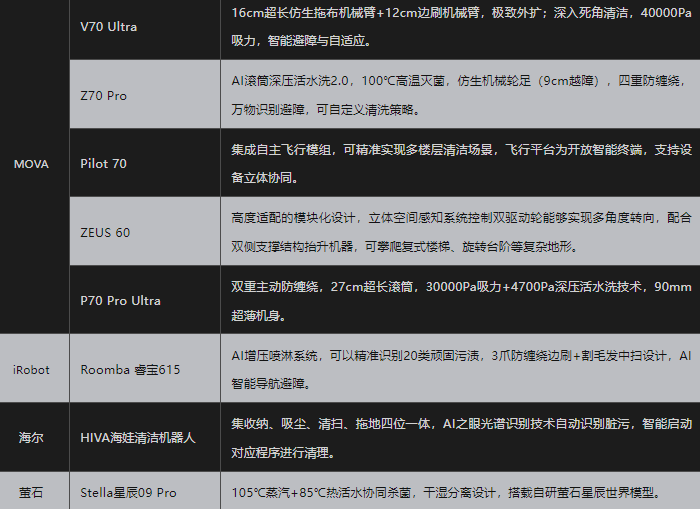
Source: RUNTO, compiled from publicly available information
From a pricing perspective, in the first quarter of 2026, all publicly announced new robot vacuum models were priced above the 4,000 yuan threshold, indicating that mainstream brands are relying on technological innovation to build product premiums and escape the industry's homogeneous competition.
In fact, the 4,000 yuan-plus price segment has also been a key focus for major brands over the past two years. According to RUNTO's online data, in the first two months of 2026 in China's online full-channel market, sales of robot vacuums in the 4,000 yuan-plus price segment increased by 11.7%, accounting for 26.6% of the market share, far ahead of other price segments.
Changes in Sales Share and Scale in China's Online Full-Channel Robot Vacuum Market (2025-2026)
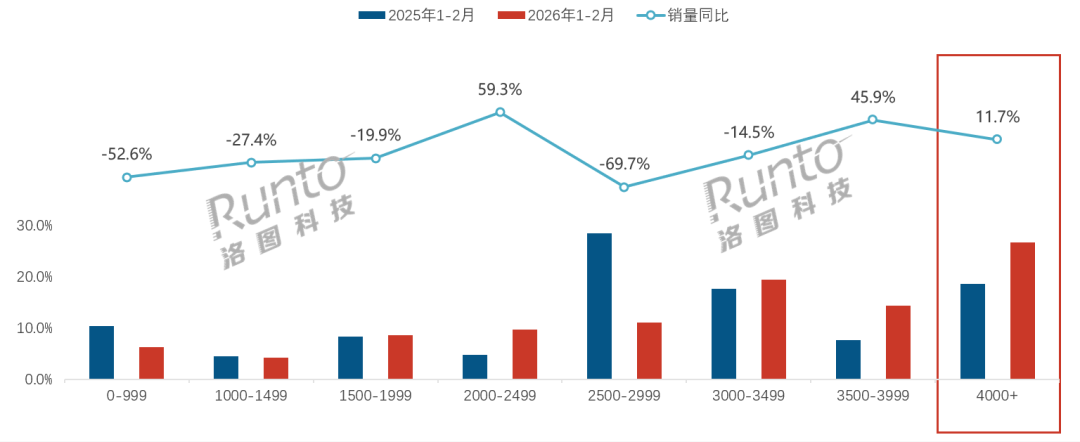
Data Source: RUNTO online full-channel data, unit: %
Technological Breakthroughs: From '2D Cleaning' to '3D All-Round'
If 2025 was the 'year of technological consolidation' for the industry, then the new products showcased in 2026 mark the industry's entry into the 'year of innovation implementation,' with core breakthroughs concentrated in three directions:
Trend 1: 3D Space Operation, Addressing Pain Points in Multi-Level Homes
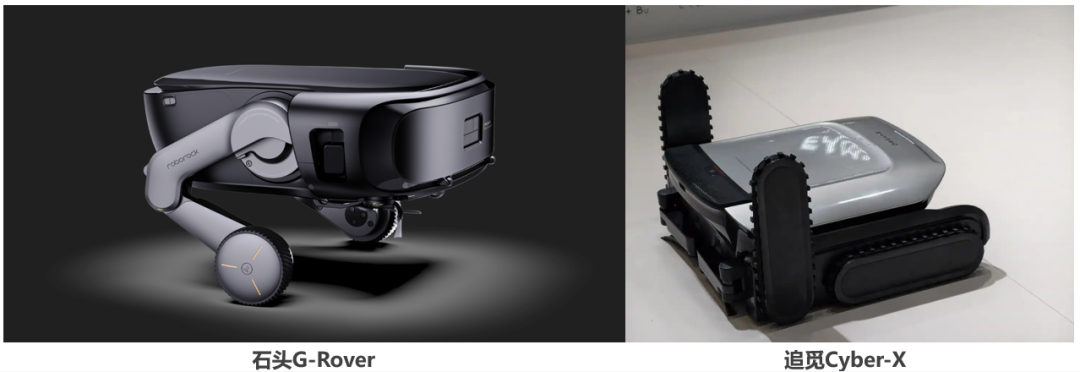
Roborock's wheeled-leg robot vacuum G-Rover, featuring a dual-wheel-leg structure, enables composite wheeled-leg movement, allowing it to autonomously navigate stairs and high thresholds for full-floor automatic cleaning. Dreame's bionic hexapod tracked stair-climbing robot vacuum Cyber-X, with its unique hexapod tracked structure, uses coordinated actions of front-leg active climbing, rear-leg power propulsion, and continuous tracked rolling to stably climb straight stairs, curved spiral stairs, and steps made of wood, stone, and carpet.
Trend 2: Implementation of Embodied Intelligence, Transitioning from 'Cleaning' to 'Household Management'
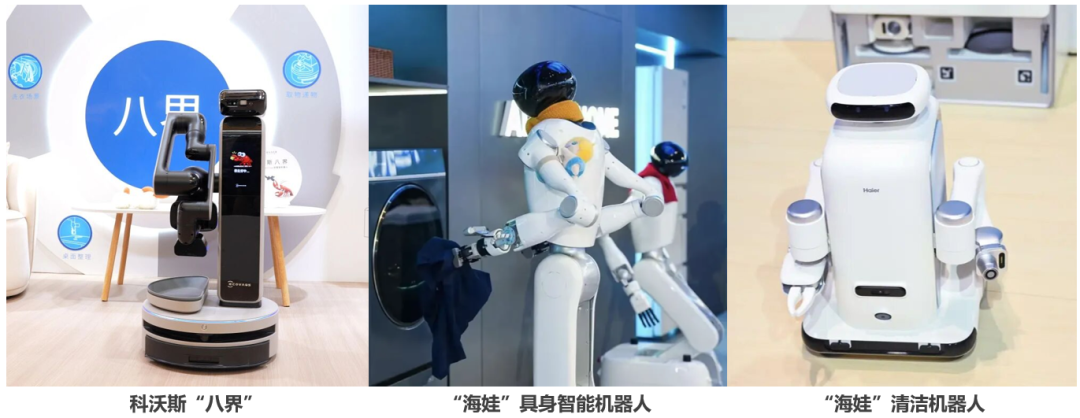
In recent years, 'embodied intelligence' has become a key industry term, with robot vacuums no longer limited to floor cleaning but beginning to transform into 'all-round household assistants.' Giants like Ecovacs and Haier have launched household service robots equipped with robotic arms. Ecovacs' 'Bajie' can pick up toys, organize desks, handle package deliveries, and even automatically call for help if it detects an elderly person has fallen; Haier's 'Haiwa' can autonomously sort food ingredients, sort laundry, and provide full-scenario services for kitchen and wardrobe organization.
RUNTO observes that the core driver of this transformation is the deep integration of AI large models with multi-sensors. Currently, high-end models from leading brands are widely equipped with multimodal AI large models, supporting natural language multi-round dialogue, accurately understanding vague instructions, and achieving a closed loop of 'perception-thinking-action,' enabling robots to truly 'understand human language' and provide proactive services rather than passively executing commands.
Trend 3: Advancement in Cleaning Technology, Continuous Optimization of Detailed Experiences
In terms of basic cleaning capabilities, the industry has shifted from 'suction-only focus' to 'precise and efficient cleaning.' In 2025, roller live-water mopping technology became mainstream, addressing the pain point of traditional mopping 'using dirty water to clean' through a closed loop of 'clean water spraying + instant scrubbing + wastewater recovery.' According to RUNTO's online data, from January to February 2026, in China's online full-channel market, Ecovacs dominated the roller live-water mopping robot vacuum segment with a 75.8% sales share, showing a significant advantage; additionally, brands like Roborock, Dreame, Narwal, Xiaomi, MOVA, and EZVIZ are also developing products with live-water mopping technology.
Three Core Predictions for the Industry in 2026
Based on the new product trends in Q1 2026, RUNTO makes three key predictions for the robot vacuum industry:
First, with the commercialization of technologies like 3D cleaning and embodied intelligence, product experiences will continue to upgrade, and the mid-to-high-end market, along with emerging e-commerce platforms leveraging scenario-based live streaming, are expected to become new growth drivers, boosting sales.
Second, the leading brand landscape will further solidify, with technological barriers becoming the core competitiveness (competitive edge). Leading brands continue to increase R&D investment, and in the future, brands with core technologies, full-scenario layouts, and comprehensive ecosystems will continue to capture market share, while smaller brands may gradually exit the market.
Third, product forms will diversify, with 'cleaning + companionship + services' becoming the new direction. Robot vacuums will gradually move beyond single cleaning functions to evolve into multi-scenario service robots, with new forms like wheeled-leg and robotic-arm models gradually coming to market; at the same time, deeper integration with whole-home smart ecosystems will enable proactive perception and services, making them a core entry point for smart homes.
Thank you for reading. If you found this insightful, please like, share, and follow.
-
![]()
Smartphone Prices Surge Amid Manufacturer Anxiety
-
![]()
Orbbec Soars to Record Heights, Eyes Further Capital Influx of 980 Million!
-
![]()
Tongding Interconnect Sets Up Shop in Shaoguan with 800 Million Yuan in Registered Capital
-
![]()
Before Kimi’s A-Share Debut, Zhipu Aims to Secure More 'Strategic Funding'
-
![]()
Innovative Leap | Fiber-Pluggable 1470nm Laser Source: Revolutionizing Precision Laser Weeding
-
![]()
73-Day Rapid Listing: Where Does Unitree's Wang Xingxing's 'Sense of Urgency' Come From?
-
![]()
AI Project Mindverse, Backed by Meituan, Faces Data Inflation Allegations Over Its Macaron Product
-
![]()
3000-word In-Depth Analysis | What Makes Physical AI So Magnetic? It Has Captivated Masayoshi Son, Jensen Huang, and Justin Sun All at Once