Q1 Color TV Summary: Five Major Trends Propel the Industry Towards High-Quality Development and Transformation
 04/28 2026
 573
573
In the first quarter of 2026, China's national economy achieved a solid start, with the gross domestic product (GDP) reaching RMB 33.42 trillion, a year-on-year increase of 5.0%, and the growth rate accelerating by 0.5 percentage points compared to the fourth quarter of the previous year, laying a solid foundation for the recovery of the consumer market. The consumer market as a whole showed a steady recovery trend, with total retail sales of consumer goods increasing by 2.4% year-on-year. The home appliance sector benefited from the large-scale consumer goods trade-in policy, allowing individual consumers to enjoy subsidies of up to 15% when purchasing six categories of home appliances, including TVs, effectively releasing some consumer demand and promoting the optimization of the industry's demand structure. However, it should be noted that the consumer market still exhibits structural differentiation, with the growth rate of service retail sales significantly higher than that of commodity retail sales. Resident consumption remains rational, and the recovery pace of traditional home appliance consumption is relatively slow. These multiple factors collectively form the macroeconomic backdrop for the operation of the color TV market in the first quarter and directly impact the overall performance of the market size.
Market Performance: Declines in Both Volume and Value, but the Rate of Decline Narrows
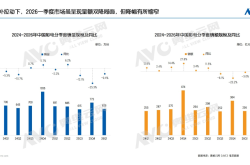
In the first quarter of 2026, the Chinese color TV market exhibited the Stage characteristics (phased characteristic) of "declines in both volume and value, but the rate of decline narrows," indicating that the industry is in a critical transition period from scale growth to quality improvement. According to data from Aowei Cloud Network (AVC), color TV market sales volume reached 6.26 million units in the first quarter, a year-on-year decrease of 9.4%; sales value reached RMB 25.6 billion, a year-on-year decrease of 3.0%. Notably, with the assistance of the new round of national consumer goods trade-in subsidy policies, the market decline has significantly narrowed compared to the previous period. The policy dividends continue to be released, injecting strong momentum into the industry's transformation. The five major trends—large screens, the popularization of Mini LED technology, high refresh rate parameter upgrades, the rise of art TVs, and intensive efforts in AI development—are becoming the core engines driving the color TV industry towards high-quality development, leading the industry to break away from homogeneous competition and move towards high-end, scenario-based, diversified, and intelligent directions. 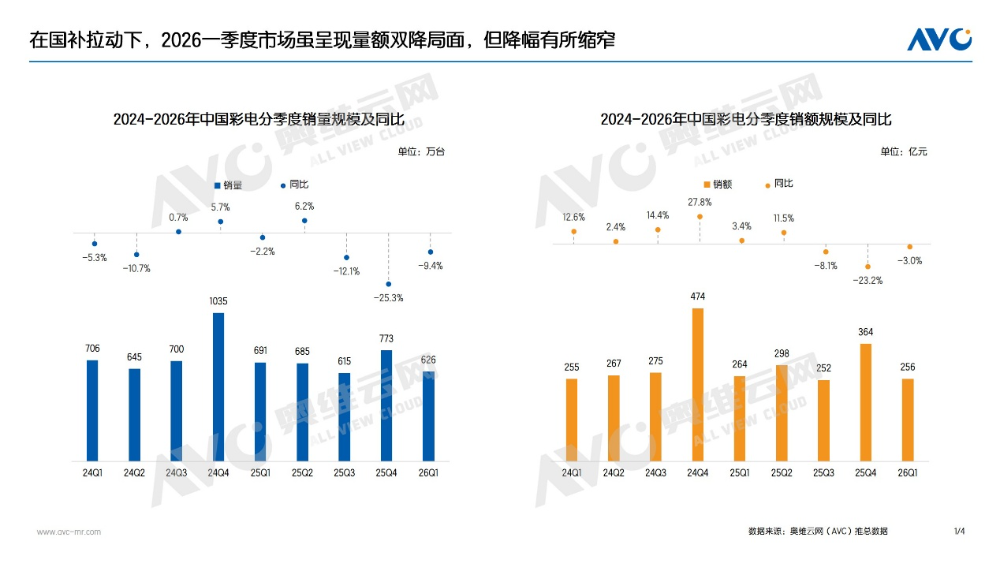
Five Major Product Trends
Trend 1: Large Screens Continue to Penetrate, Becoming the Mainstream of Market Consumption
The size landscape of the color TV market is undergoing profound changes, with small screens continuing to shrink and large screens accelerating their expansion, becoming an irreversible core trend in the industry. Consumer demand for immersive large-screen experiences has completely reshaped the market structure. According to data from Aowei Cloud Network (AVC), in the first quarter of 2026, the sales volume shares of traditional small-size products such as 32-inch and 43-inch models decreased by 1.2 and 2.8 percentage points year-on-year, respectively, with the market share of small-screen entry-level products continuing to shrink. In stark contrast, the shares of large-size products such as 75-inch, 85-inch, 98-inch, and 100-inch models have comprehensively increased, with the penetration rate of large screens far exceeding market expectations. Among them, the 85-inch segment performed the most brilliantly, with its sales volume share increasing by 3.6 percentage points year-on-year, becoming the first growth pole driving market expansion. The share of 85-inch models in offline channels surged by 4 percentage points, highlighting the high recognition of large-screen products in high-end consumption scenarios. Data from both online and offline channels simultaneously show that when selecting TVs, consumers are no longer limited to basic viewing needs but are increasingly focusing on the immersive experience and visual impact of home theater audio-visuals, making large-screen TVs the core choice for upgrading family living rooms. 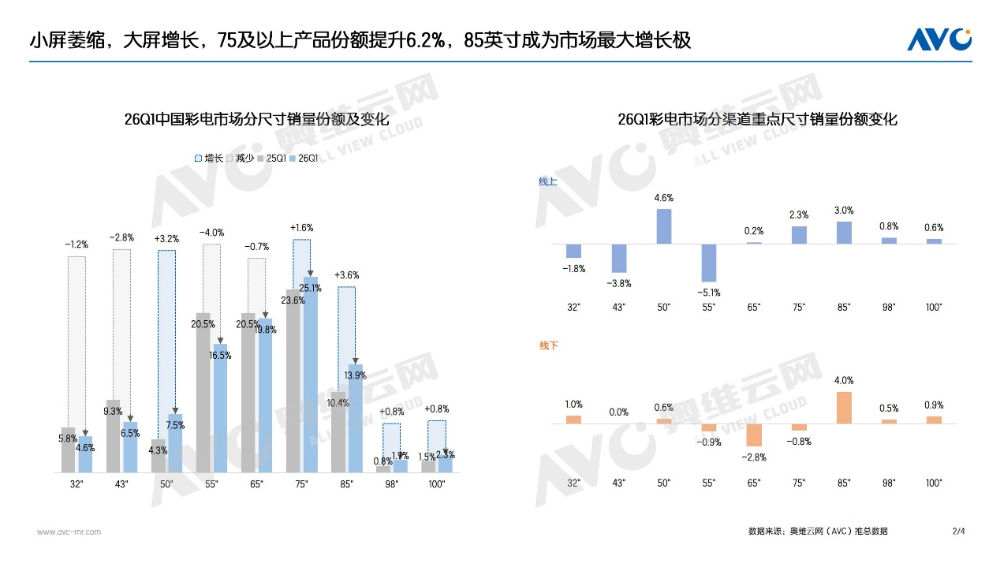
Trend 2: Mini LED Technology Accelerates Its Popularization, Leading Display Technology Iteration
In recent years, TV products represented by Mini LED technology have rapidly risen, not only marking a significant technological iteration in the display industry but also serving as a vivid reflection of the upgrading of consumer demand. The reason why Mini LED technology has quickly become a market focus lies in its finding a crucial balance between display performance and cost control. Compared to traditional LED backlights, Mini LED achieves more precise local dimming through smaller-sized light beads, significantly improving contrast, brightness, and color performance, aligning with current consumers' dual pursuit of quality and practicality. According to data from Aowei Cloud Network (AVC), in the first quarter of 2026, Mini LED TV sales volume in the Chinese color TV market reached 2.25 million units, a year-on-year increase of 30.4%, leading a new round of display technology revolution. From the perspective of penetration rate, in the first quarter of 2026, Mini LED TVs accounted for 36.0% of sales volume and 59.4% of sales value across all channels. This trend not only reflects consumers' high recognition of Mini LED TVs but also means that the industry's competitive focus is shifting towards value, with Mini LED TVs becoming the core carrier for the high-end upgrading of the color TV industry and refactor (reconstructing) the value of home displays.
As one of the high-end display technologies in the advanced direction of liquid crystal displays, RGB-Mini LED experienced explosive growth in the first quarter. Monitoring data from Aowei Cloud Network (AVC) across all channels (offline channels, professional e-commerce, platform e-commerce, content e-commerce) showed that the monthly average sales volume in the first quarter of 2026 reached 329% of the monthly average sales volume after March 2025, with Hisense ranking first in sales volume share. As the leader in the RGB-Mini LED track, Hisense launched a new product this year—the Xiaomo E5S Pro, which has also been upgraded to the latest RGB-Mini LED technology, upgrading from single-color light beads to three-color light beads, achieving more vivid and true colors while also being more eye-friendly and reducing power consumption by 30% for greater green energy efficiency. At the same time, its use of Mo Jing screen effectively resists reflection and glare, solving the pain point of reflection when watching movies in the living room from the root, truly bringing consumers a cinema-like home viewing experience. The display upgrade of Hisense's E5 series has popularized this high-end display technology, RGB-Mini LED, to the comfort zone of mass consumption, leading RGB-Mini LED TVs into the era of mass affordability. 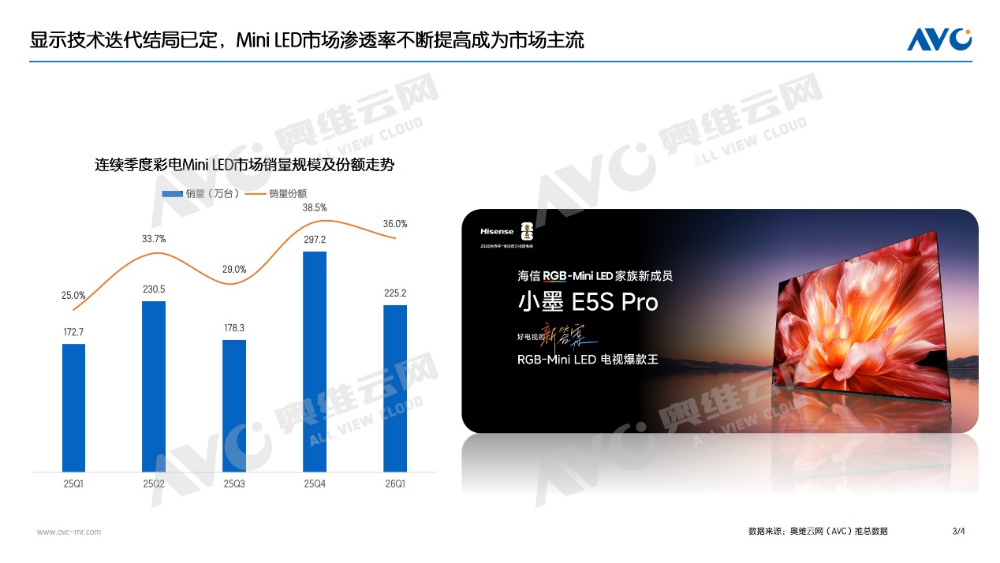
Trend 3: High Refresh Rate Parameters Continue to Upgrade, Adapting to Full-Scenario Entertainment Needs
The high refresh rate track in the color TV industry has completed a hierarchical leap from quantitative to qualitative change. This marks that the entire color TV industry has officially bid farewell to the initial stage dominated by entry-level 120Hz high refresh rates and is now fully entering a new high refresh rate era marked by "over 144Hz." In this process, technological iteration and upgrading have undeniably become the core engine driving the value enhancement of color TV products and reshaping the market competition landscape. According to data from Aowei Cloud Network (AVC), in the first quarter of 2026, high refresh rate products with a refresh rate of over 144Hz in the Chinese color TV market achieved a remarkable and substantial increase in sales volume share, expanding from 14.2% in the same period last year to 34.8%, with a rapid growth momentum and a significantly expanded market share. High refresh rates, once a unique selling point and differentiated competitive tool in niche markets, are now rapidly transforming into a Universal standard technology (popular standard technology) for mid-to-high-end TV products at an unprecedented speed, gradually rewriting the competitive landscape and value positioning of high refresh rate products in the entire TV market.
Trend 4: Art TVs Break Through, Expanding New Value in Home Scenarios
With the upgrading of living spaces and the awakening of aesthetic consciousness, TVs are no longer just tools for viewing but have become an important part of the overall home atmosphere. Especially with the popularity of modern minimalist, light luxury, and other home styles, a TV that is ultra-thin, frameless, and can blend into the wall, or an art TV that can transform into famous paintings, photos, or even electronic wallpapers when turned off, is becoming a new choice for many families. When home aesthetics become a core dimension of consumption upgrading, TVs have officially upgraded to home art pieces that integrate into the space. Survey data shows that 50.2% of consumers prioritize matching their TV with their home decor style when making a purchase, preferring more aesthetically pleasing and better-fitting models when performance and price are similar; 26.6% of consumers place great importance on Design appearance (external design) and are willing to pay a premium for products with high looks (appearance) and high Home integration degree (home integration). As an important growth point in the niche track, art TVs continued to make efforts in the first quarter, breaking away from the traditional color TV's positioning (positioning) as a "single viewing terminal" and becoming an important carrier connecting home aesthetics with audio-visual entertainment. Monitoring data from Aowei Cloud Network (AVC) showed that in the first quarter of 2026, the niche segment (niche track) of seamless wall-mounted TVs experienced explosive growth against the trend, with retail volume reaching 172,000 units, a year-on-year surge of 123.6%, and market penetration also increasing by 3.2 percentage points compared to the same period last year. As the leader in the art TV track, Skyworth ranked first in sales volume share, continuously leading the industry's development direction.
Behind this design philosophy is a profound understanding of modern home aesthetics. Skyworth's wallpaper TV design philosophy revolves around "techno-humanism." Taking the 2026 new model Skyworth A7H Pro as an example, it achieves an ultra-thin seamless wall-mounting of 3.9 centimeters. With the upgrade of Matte Screen Display Pro technology, it is closer to real art paintings in both appearance and display effects. In addition, the A7H Pro solves the dilemma of coexistence of high brightness and high color gamut in MiniLED TVs. Through 10mm ultra-micro distance light control technology, it achieves an ultra-thin appearance while improving color gamut and brightness. Driven by both art and technology, it not only solves consumers' core pain points in picture quality performance but also addresses long-standing trouble (issues) in product form and home integration, bringing a "1+1>2" solution. 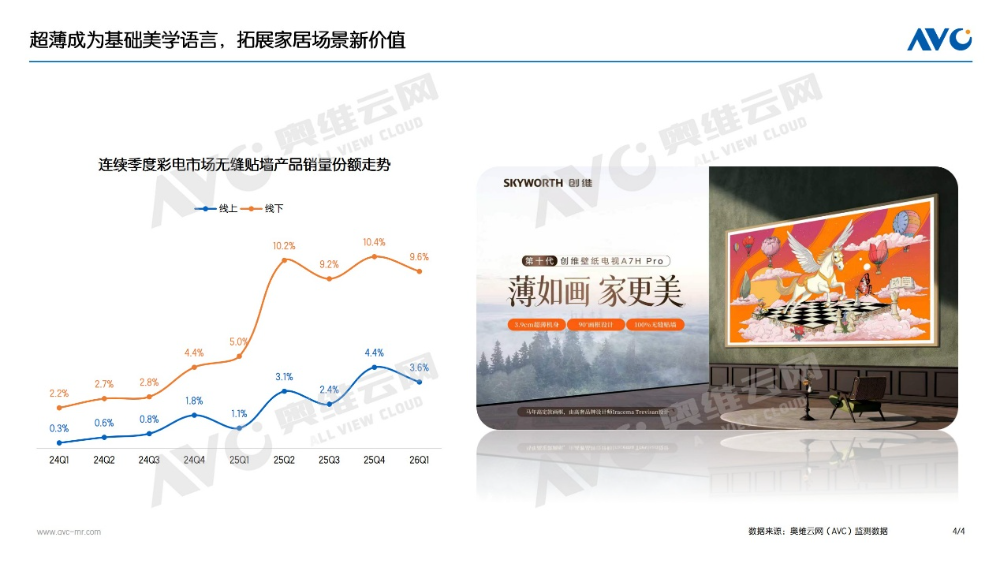
Trend 5: AI TVs Intensively Develop, Reshaping Full-Scenario Intelligent Experiences
The all-dimensional penetration of generative AI technology has enabled the color TV industry to complete a leapfrog upgrade from passively executing instructions to actively providing services, officially entering the "high-speed rail era" of AI-native technology, with intelligence becoming the core main storyline (theme) of industry development. Reviewing the industry's intelligence journey, generative AI opened a new era in 2022, domestic large models emerged in 2023, vertical large models deeply penetrated in 2024, AI Agents achieved autonomous task execution in 2025, and 2026 fully entered the AI-native era, with products achieving deep intelligent integration and active services. Monitoring data from Aowei Cloud Network (AVC) showed that the sales volume share of color TV products with built-in AI large models continued to rise both online and offline, reaching 35.8% online in March 2026 and climbing to 36.4% offline. AI functions are gradually transforming from marketing differentiators to standard product features.
Conclusion
Overall, although the color TV market in the first quarter of 2026 faced pressure from declines in both volume and value, positive signals from the macroeconomic environment and four major industry trends worked together to effectively alleviate the market downturn and lay a solid foundation for industry transformation. The five major trends are driving the industry to accelerate its escape from homogeneous competition and price war dilemmas and move towards a high-quality development and transformation period. Based on current consumer demand trends and industry operation status, it is predicted that the color TV 618 promotion market in 2026 will still face pressure, with estimated sales volume of 3.82 million units, a year-on-year decrease of 6.1%, and sales value of RMB 15.5 billion, a year-on-year decrease of 10.4%. In the long run, with continuous technological iteration and macroeconomic policy support, the color TV industry will further focus on high-end, scenario-based, diversified, and intelligent development, achieving a fundamental transformation from scale growth to value growth.
Original article from Aowei Cloud Network. Unauthorized reproduction or scraping of this content by any organization or individual for purposes such as training AI large models is prohibited.
-
![]()
Behind Anyu Aixin’s Funding Success: The Dawn of the ‘Photoacoustic Fusion’ Era!
-
![]()
Domestic Automotive-Grade Chips: Navigating the Challenges of Advanced Integration
-
![]()
Q1 Color TV Summary: Five Major Trends Propel the Industry Towards High-Quality Development and Transformation
-
![]()
Revenue Hits 3.4 Billion, Non-Recurring Profit Rockets 52%! Yutong Optics Embarks on Its Second Growth Phase
-
![]()
Labubu Fridge Falls Short of Best-Seller Status
-
![]()
Large Models in Vehicles: Consumers Show Indifference
-
![]()
Seven Ways to Start a One-Person Company in the AI Entrepreneurship Era
-
![]()
400 Billion Market Cap Reversal: The Twilight of the AI Four Little Dragons and the Dawn of New Large Model Contenders