Gree and Xiaomi Executives Clash Again, This Time Over 'Vacuum Pumping'
 07/07 2026
 511
511
Produced by Leadar Finance | Written by Ding Yu | Edited by Meng Shuai
A war of words over 'vacuum pumping' services has once again thrust Xiaomi and Gree, long-time rivals, into the spotlight.
On July 3, Shan Lianyu, General Manager of Xiaomi Group's Home Appliances Division, publicly responded to Gree executives' veiled criticism of Xiaomi's air conditioners.
Behind this clash lies Xiaomi's rapidly expanding air conditioning business, which poses a sustained threat to Gree's core market.
In 2025, Xiaomi shipped over 8.5 million air conditioning units, representing a year-on-year increase of over 24%. During the same period, Gree's consumer appliances business, which includes air conditioners, reported revenue of RMB 133.055 billion, down 10.44% year-on-year.
In the first quarter of this year, Gree sounded the counterattack horn, with its overall operating revenue and net profit attributable to shareholders increasing by 3.52% and 3.01%, respectively. In contrast, Xiaomi's IoT and lifestyle consumer products business saw a 23.68% year-on-year decline in revenue during the same period.
However, the domestic air conditioning market has remained sluggish this year. Meanwhile, a 'glitch-exploiting' portable split air conditioner from Midea has become a hot seller in Europe, with supply struggling to meet demand. Observing their competitor's overseas success, Gree and Xiaomi have both shifted their focus to international markets.
Tianyancha data shows that Gree Electric Appliances went public on the Shenzhen Stock Exchange in 1996, while Xiaomi listed on the Hong Kong Stock Exchange in 2018.
As of the market close on July 6, Gree Electric's stock price stood at RMB 39 per share, with a total market capitalization of approximately RMB 218.5 billion. Xiaomi Group's stock price was HKD 23.28 per share, with a total market capitalization of around HKD 600.3 billion.
Gree and Xiaomi Executives Clash Again
The current dispute between Gree and Xiaomi can be traced back to June this year. According to Sina Technology, Zhu Lei, CMO of Gree Electric, stated in an interview that 'vacuum pumping for 15 minutes is actually a national standard and a basic operation in the air conditioning industry.'
Zhu Lei further explained that the refrigerant pipelines of outdoor units are already evacuated and sealed before leaving the factory. During installation, the internal unit's pipelines and connecting pipes need to be evacuated to the standard megapascal level to create an optimal environment for refrigerant entry. Therefore, the national standard recommends a 15-minute evacuation to ensure pipeline cleanliness. As long as the corresponding vacuum level is achieved, it constitutes an ideal environment. Gree has consistently adhered to national standards and even stricter corporate installation standards.
Zhu Lei emphasized that whether the evacuation takes 15 minutes or two hours, the durability and performance of the product ultimately depend on its quality. 'If the product quality is poor, even two hours of evacuation won't help,' he stated.
Although Zhu Lei did not mention Xiaomi by name, many in the industry believe his comments were directly aimed at Xiaomi's 'Digital Vacuum Pumping' service.
Public information reveals that 'Digital Vacuum Pumping' is a digital monitoring system introduced by Xiaomi for air conditioner installation services. Leveraging the internet and AI, it aims to address challenges in service process supervision and achieve transparency in operations.
According to data released by Xiaomi Service, the number of service orders for Mijia air conditioners' 'Digital Vacuum Pumping' exceeded 1 million in June, with a service satisfaction rate of over 99% and a nationwide service network coverage of 100%.
In response to the veiled criticism from competitors, Shan Lianyu, General Manager of Xiaomi Group's Home Appliances Division, stated in a post on July 5 that Xiaomi had remained silent thus far not only due to being preoccupied with market research and development but also based on two considerations.
On one hand, he believes that the continuous innovation and development of the industry require a clear environment rather than verbal disputes. Xiaomi has chosen to focus on improving its products and services to benefit consumers.
On the other hand, Shan Lianyu argued that the air conditioning industry is no longer an era where leading players can arbitrarily label newcomers. 'The power lies in the hands of consumers. Products speak for themselves, and users will vote with their feet,' he said.
Regarding the controversy surrounding Xiaomi's 'Digital Vacuum Pumping' service, Shan Lianyu responded, 'Strict vacuum pumping is a national standard recommendation. Xiaomi implements it thoroughly to ensure transparency for consumers. I don't see this as particularly remarkable or deserving of special praise; we're simply doing what we should be doing.'
Notably, Shan Lianyu also mentioned Gree in his response, acknowledging that Gree was the first to offer a '10-year warranty' on certain models. 'This demonstrates confidence in their products and has set an industry standard. Xiaomi air conditioners can learn from this example,' he said.
Shan Lianyu stated that Xiaomi is firmly committed to making the '10-year warranty' a mandatory service for all its air conditioner models, not just select ones.
Regarding claims by some competitors that 'even established enterprises dare not easily Promise (commit to) a 10-year warranty,' Shan Lianyu retorted, 'Are they lacking confidence in their product quality or determination to ensure quality?'
He further emphasized that a '10-year warranty' meets genuine consumer needs and is a fundamental requirement for the industry's development and the long-term success of enterprises. Only by fulfilling these requirements can companies truly achieve sustainable growth.
On the same day, Xu Jieyun, Special Assistant to the Chairman of Xiaomi Group and Deputy General Manager of the Strategic Marketing Department, reposted and paraphrased Shan Lianyu's original statement to show support.
Long-Time Rivals with a History of Clashes
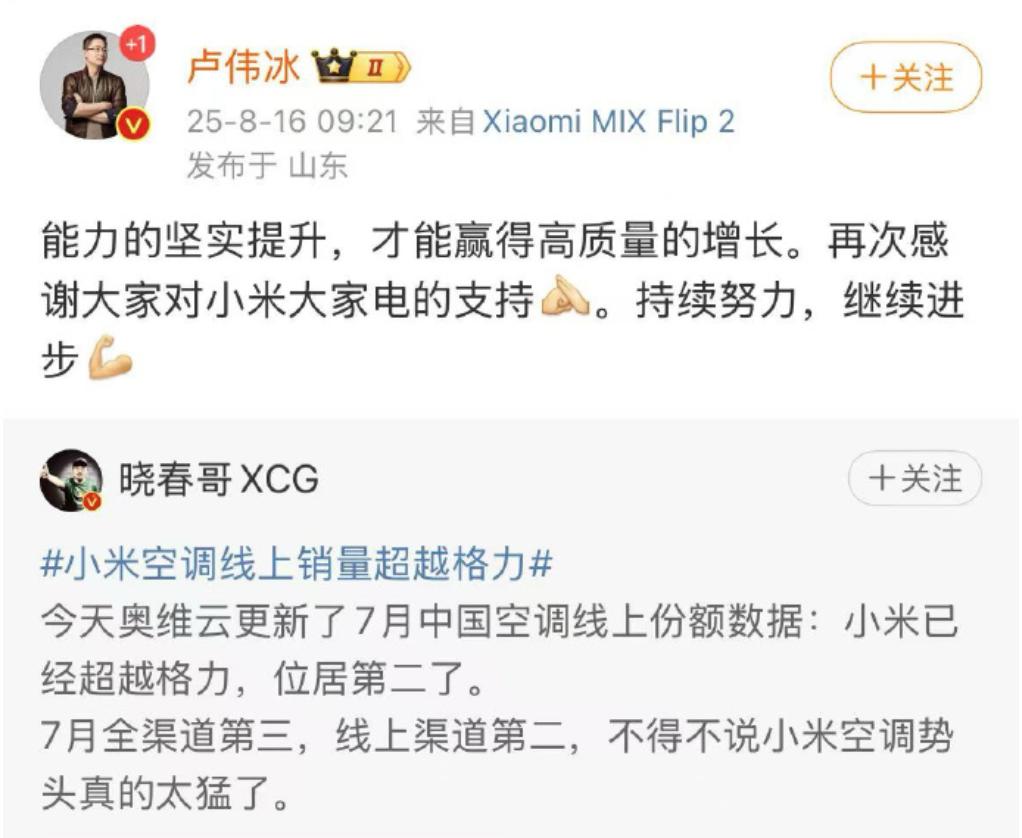
This is not the first time Gree and Xiaomi have engaged in a public dispute. The timeline goes back to August 16 last year when Lu Weibing reposted a Weibo post from another blogger, which stated that Xiaomi had surpassed Gree in online market share for air conditioners in China in July, ranking second in the industry.
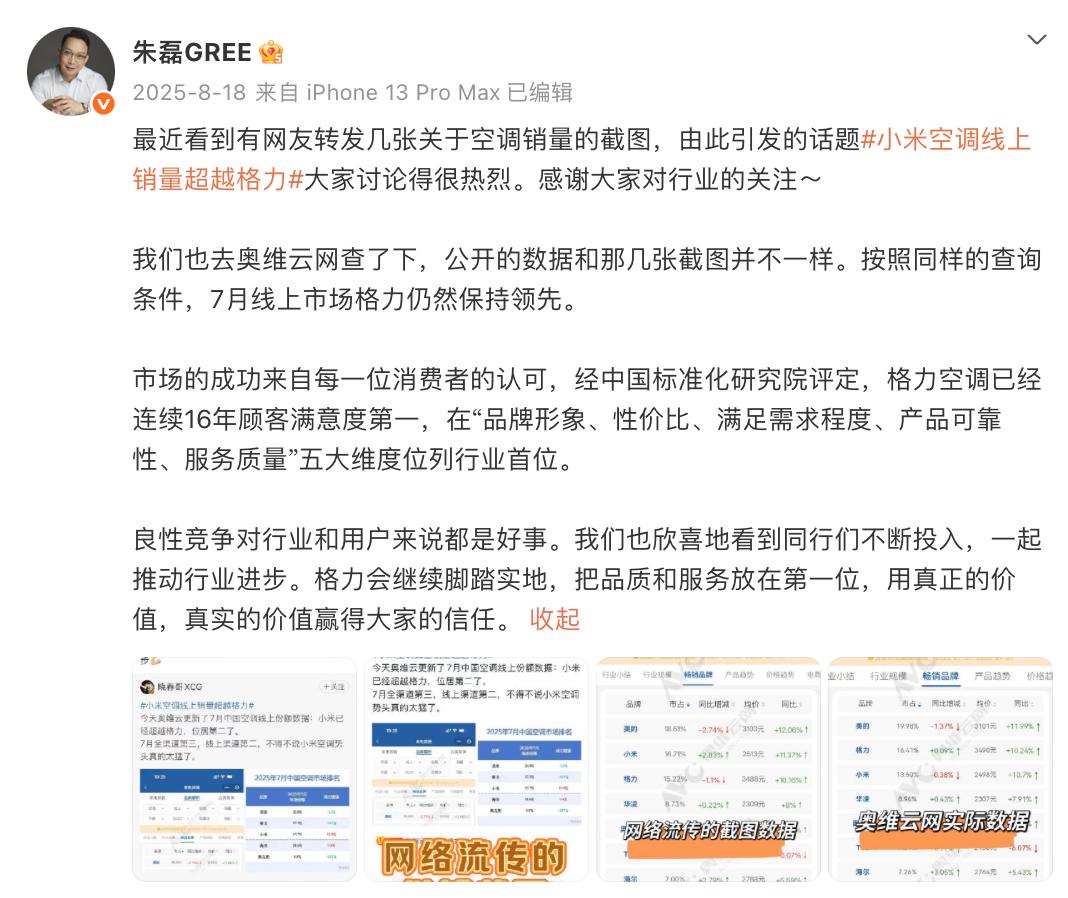
Two days later, Zhu Lei posted on Weibo that while there had been much discussion recently about 'Xiaomi surpassing Gree in online air conditioner sales,' his own research under the same conditions showed that Gree remained the leader in the online market in July. Screenshots shared by Zhu Lei indicated that Gree's online market share for air conditioners in July was 16.41%, while Xiaomi's was 13.5%, failing to surpass Gree.
On August 25 of the same year, Zhu Lei published a lengthy post revisiting the 'sales controversy.' He agreed with Lu Weibing's sentiment that short-term sales rankings are unimportant and that long-term quality determines success. Victory, he argued, ultimately favors those who uphold industry integrity and offer the highest quality products.
At the time, Zhu Lei also highlighted that Gree was the only leading enterprise in China's home appliance industry bold enough to Promise (commit to) a '10-year free warranty' for all its home air conditioner series, emphasizing the word 'only.'
Zhu Lei pointed out that when other competitors made similar claims, they often included a small asterisk and explained the warranty models or conditions in fine print in an inconspicuous place.
In Zhu Lei's view, 'a 10-year free warranty shifts the competitive focus back to product quality and service essence.' He also called on Xiaomi and other industry peers to join Gree in offering a '10-year free warranty.'
Nearly a month later, on September 19, Lu Weibing, President of Xiaomi Group, announced during a livestream that in response to competitors' calls, Xiaomi air conditioners would officially launch a '10-year free warranty' service starting that day. Additionally, all 7.5 million Xiaomi air conditioners sold in 2025 would be upgraded to include this warranty.
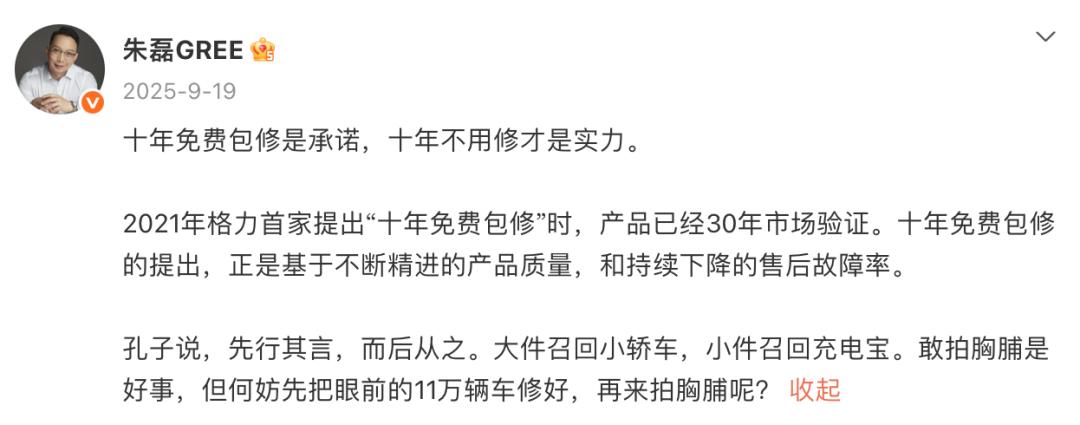
That evening, Zhu Lei posted again, stating, 'A 10-year free warranty is a promise, but going 10 years without needing repairs is true strength.'
Zhu Lei explained that when Gree first introduced the '10-year free warranty' in 2021, its products had already undergone 30 years of market validation. The warranty was based on continuously improving product quality and declining after-sales failure rates.
At the end of his Weibo post, Zhu Lei seemed to take a veiled swipe at competitors, saying, 'Large-item recalls involve cars; small-item recalls involve power banks. It's good to have confidence, but why not fix the 110,000 vehicles first before boasting?'
Furthermore, at the Gree Power Innovation Technology and Major New Product Launch Event during AWE2026 in March this year, Zhu Lei addressed the industry's recent hot topic of 'aluminum replacing copper.' He stated that Gree had chosen not to adopt 'aluminum replacing copper' temporarily due to its '10-year free warranty' policy and its commitment to consumer responsibility, refusing to compromise simply for cost reduction.
Intensifying Domestic Competition Drives Manufacturers to Expand Overseas
Behind the back-and-forth exchanges between industry peers lies Xiaomi's remarkable growth as a newcomer in the home appliance sector in recent years.
According to Xiaomi Group's financial report, in 2025, the company's revenue from smart home appliances reached a record high, increasing by 23.1% year-on-year. Among them, air conditioner shipments exceeded 8.5 million units, with a year-on-year growth rate of over 24%.
During the same period, Gree Electric Appliances reported total revenue of RMB 170.447 billion, down 9.89% year-on-year. Its net profit attributable to shareholders was RMB 29.003 billion, also down 9.89% year-on-year.
Specifically, Gree's consumer appliances business, which includes air conditioners, reported revenue of RMB 133.055 billion, a 10.44% year-on-year decline, accounting for 78.06% of the company's total revenue.
However, the situation reversed in 2026. In the first quarter, Xiaomi's IoT and lifestyle consumer products business reported revenue of RMB 24.681 billion, a 23.68% year-on-year decrease.
Although Xiaomi did not disclose specific sales or revenue figures for its air conditioning business, the company's cost of sales for other related businesses decreased by 6.8% year-on-year to RMB 900 million during the period, influenced by factors such as reduced sales of air conditioner installation services.
In contrast, Gree Electric reported revenue of RMB 42.966 billion in the first quarter, up 3.52% year-on-year. Its net profit attributable to shareholders reached RMB 6.082 billion, a 3.01% year-on-year increase.
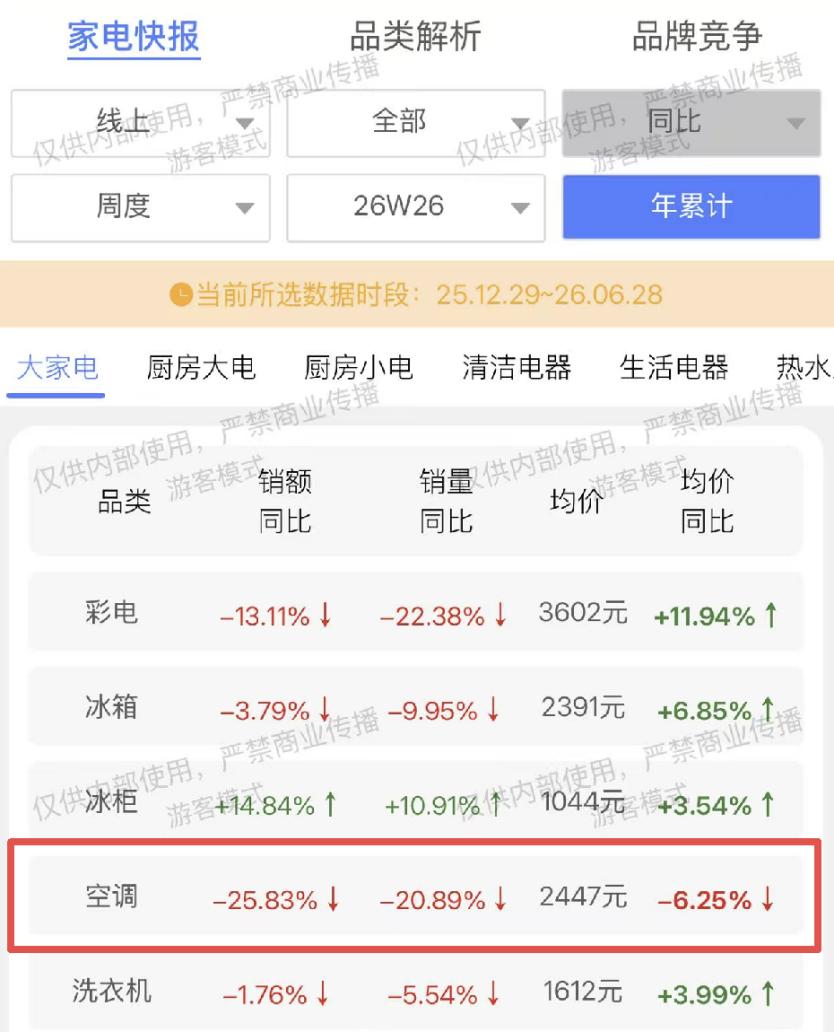
Overall, however, the domestic air conditioning market has not fared well this year. Data for the first half of the year, ending June 28, shows that online sales of air conditioners in China declined by 25.83% year-on-year in terms of value and by 20.89% in terms of volume. The average selling price fell by 6.25% year-on-year.
Entering the traditional summer sales period, the industry's production and sales rhythm has not shown significant recovery. PSI monitoring data from Aowei Cloud Network indicates that in July 2026, domestic air conditioner production schedules declined by 15.6% year-on-year, with overall production schedules down by 12.8%.
From a retail perspective, Aowei Cloud Network's aggregated data shows that in May 2026, total retail sales of air conditioners across all channels declined by 10.3% year-on-year. Online channels (including sink (lower-tier) markets) saw an 8.7% decline, while offline channels experienced a 12.2% drop.
In stark contrast to the sluggish domestic market, air conditioners are selling like hotcakes overseas. Since June this year, multiple European countries have been plagued by heatwaves, leading to a surge in demand for air conditioners among local consumers.
Midea, which had previously established a strong overseas presence, has reaped the benefits. Its PortaSplit air conditioner, custom-designed for Europe, has sold out, with second-hand prices being inflated by scalpers to over RMB 30,000.
Meanwhile, Gree and Xiaomi, who have been 'fighting' domestically, have also turned their attention to international markets.
In a Weibo post on July 3, Shan Lianyu noted that the recent heatwave has made the air conditioning industry particularly active, with many overseas users expressing strong interest in and recognition of Chinese home appliances. Many competitors have worked hard to achieve this, and Xiaomi is progressing alongside the industry. He expressed hope that Chinese home appliances would reach broader global markets.
At Gree's annual shareholders' meeting on June 30, Dong Mingzhu straightforward (bluntly stated) that 'the company hasn't performed well in exports' and further explained that this was due to both objective factors like the Middle East conflict and issues with the company's own export model.
Dong Mingzhu also emphasized the urgency of transforming the company's overseas sales channels. 'Going forward, Gree will significantly overhaul and transform its export model. From a market perspective, the company has tremendous potential overseas since its product range has expanded beyond air conditioners to multiple categories,' she said.
How will the competitive landscape in the fiercely contested air conditioning and home appliance sectors evolve in the future? Leadar Finance will continue to monitor developments.
-
![]()
The Surprisingly Significant Impact Difference Between Quiet and Noisy Cars!
-
![]()
Breaking Through Storage Cycle Barriers: How AI Large Models and Coding Technology Synergize to Drive Transformation in the Security Industry
-
Facilitating the Slimming of Camera Modules! O-film Obtains Utility Model Patent for Periscope-Type Reflective Component
-
![]()
Hikvision Raytine’s Millimeter-Wave Body Imaging Security Inspection Device Achieves ECAC SSc Category A Standard Level 2.1 Certification for European Civil Aviation
-
![]()
Global Market Share for Security Windows Hits 26%! This Optical 'Little Giant' Makes Its Debut on NEEQ
-
![]()
The Evolutionary Path of Agent Engineering: From Prompt to Harness by Zhang Yutao, Co-founder of Moonshot AI
-
![]()
Profits and stock prices are both declining, so why are executives from these auto companies increasing their purchases?
-
![]()
Burning Tens of Billions of Dollars, Yet No Unified Definition for World Models