Can Apple AI Succeed in China?
 07/20 2026
 334
334
▲ All images in this article are sourced from the internet. Please contact us for removal if there is any infringement.
Apple Siri AI: Reborn Through a New Shell

This article was first published in Shadow Memo by Mo Yingsheng.
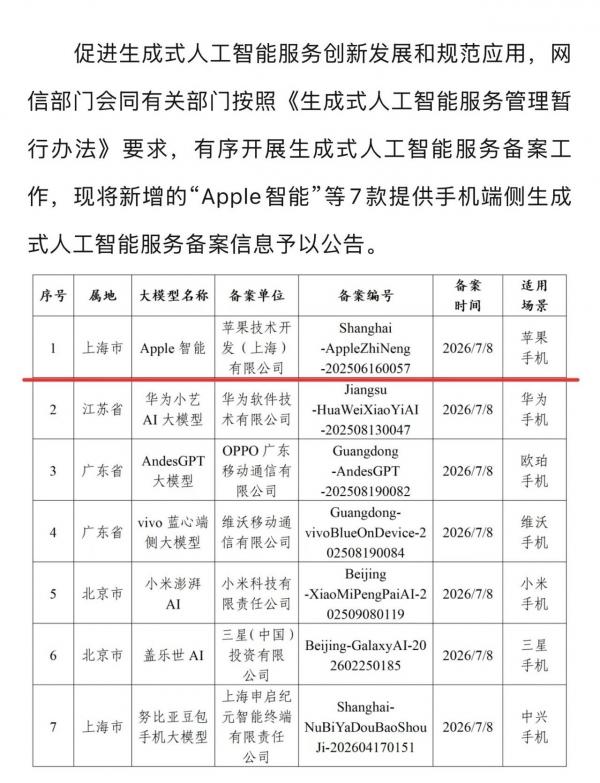
On July 15, 2026, the WeChat official account 'Cyberspace China' released an announcement stating that seven generative AI services for mobile devices had completed their filings.
Among the list, 'Apple Intelligence' stood out alongside Huawei Xiaoyi AI, OPPO AndesGPT, vivo BlueLM, Xiaomi HyperMind, Samsung Galaxy AI, and Nubia Doubao Mobile LLM.
For hundreds of millions of iPhone users in China, this day had been two years in the making.
Since Apple first unveiled Apple Intelligence at WWDC in June 2024, Chinese iPhone users have been unable to access this AI capability, which Apple had high hopes for.
At WWDC in June 2026, Apple announced a revamped Siri AI capable of understanding on-screen content, remembering conversation context, and performing cross-app tasks. However, Craig Federighi, Apple's senior vice president of software engineering, stated on the spot that users in mainland China would not have access in the short term.
Just a month later, the filing was approved. But with this 'ticket' in hand, can Apple truly carve out a path in China's AI smartphone market?

From 'Most Intelligent' to 'Artificial Idiot'
Rewind to 2011, when the iPhone 4S was released, and Siri made a stunning debut as a 'smart voice assistant.'
At the time, it was a novelty that tech enthusiasts worldwide rushed to try out, capable of natural language conversations, checking the weather, setting alarms, and sending texts. In an era when smartphones were still limited to 'tapping and swiping,' Siri seemed like a product from the future.
However, over a decade later, Siri's image among Chinese users has shifted from 'most intelligent' to the opposite extreme.
For many users within the Apple ecosystem, Siri is now synonymous with 'artificial idiot.' This is not user harshness but a genuine feedback accumulated from long-term experience.
The primary reasons, according to the industry, are as follows:
Language and cultural mismatch. Siri's underlying semantic understanding is built around English, making it difficult to handle the nuances, colloquial expressions, and internet slang prevalent in Chinese contexts.
When domestic voice assistants can understand 'help me edit this photo,' Siri might still be puzzled by what 'p' stands for.
Lack of localized services. While Siri can interact with Apple's native apps, its integration with third-party apps commonly used by Chinese users—such as WeChat, Alipay, Meituan, and Gaode Maps—is far from adequate.
A voice assistant that cannot help order food, hail a ride, make payments, or book tickets is destined (doomed) to remain a 'half-baked product' in China's highly developed mobile internet market.
Severe lag in functional updates. While domestic smartphone manufacturers have long made AI-powered features like object removal, document summarization, and real-time translation standard, Apple's Apple Intelligence only passed its Chinese filing in July 2026. A two-year gap is enough to reshape user habits entirely.
Some media outlets have bluntly stated that Siri now feels more like a simple voice remote control, far from a true 'intelligent assistant.'
When users have grown accustomed to generating meeting minutes with a single sentence, removing passersby from photos with one tap, and translating foreign web pages in real-time on domestic smartphones, Siri's 'set an alarm' feels particularly underwhelming.
News of the filing approval sparked cheers among Chinese iPhone users. However, upon closer inspection, this 'ticket' may not deliver the Siri AI everyone is hoping for.
The Siri AI showcased by Apple at WWDC in June 2026 is powered by a new model developed in collaboration with Google, derived from Gemini.
It can understand what is displayed on the phone screen, remember who the user has recently chatted with, and perform multi-step operations like writing emails, browsing old photos, and organizing itineraries. This is what Apple defines as its 'next-generation' intelligent assistant.
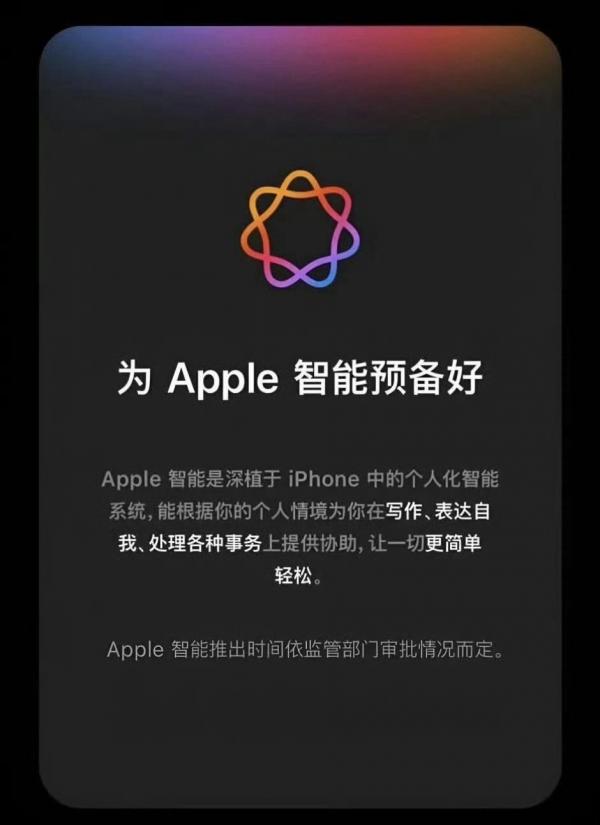
However, the 'Apple Intelligence' that passed the filing is likely still the version first unveiled in 2024, featuring text rewriting, content summarization, image generation, and basic cross-app operations. The truly 'next-generation' Siri AI may not yet be ready.
Media reports suggest that the filing addresses compliance eligibility rather than product readiness.
Some sources indicate that certain image recognition features in Apple Intelligence currently rely on Google's reverse image search, which is unavailable in mainland China. This technical dependency requires further localization, leaving Apple with a list of engineering tasks to complete.
In other words, Apple AI's entry into China may come with an 'old ticket'—it can enter, but not necessarily into the latest venue.

Handing Over the 'Soul' to Alibaba and Baidu
The overseas version of Apple Intelligence integrates ChatGPT and Gemini, both unavailable in China. Apple had to find local partners.
As early as 2023, Apple began testing various AI models from Chinese developers. In March 2024, reports emerged that Apple was in talks with Baidu.
Subsequently, Tencent, Alibaba, ByteDance, Baichuan Intelligence, DeepSeek, and other companies were rumored to be in discussions.
Apple initially chose Baidu as its primary partner, but the collaboration fell through due to shortcomings in Baidu's Wenxin model's responsiveness and Baidu's desire to retain and analyze user data, which conflicted with Apple's strict privacy stance.
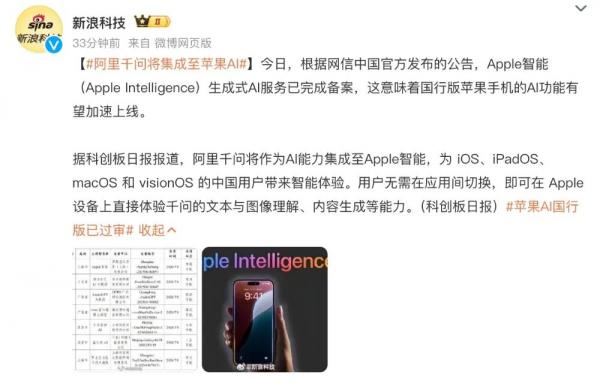
Ultimately, Apple settled on a combined solution with Alibaba and Baidu.
According to publicly available information, the division of labor is roughly as follows: Alibaba's QianWen handles general multimodal capabilities, providing text understanding, image understanding, and content generation; Baidu is responsible for Siri's voice assistant and visual intelligence, handling AI search and information retrieval.
Foreign media reports suggest that QianWen leads, handling about 65% of tasks, while Baidu's Wenxin assists with the remaining 35%.
Apple has adopted a 'dual-track' collaboration model for AI implementation in China, meeting domestic regulatory requirements for data security while leveraging the strengths of local models in Chinese language processing and localized scenarios.
However, this raises a question: Has Apple handed over the 'soul' of its AI?
In overseas markets, Apple's partnerships with OpenAI and Google are essentially 'plug-in' integrations, where ChatGPT and Gemini serve as external capabilities, with Apple's self-developed on-device models and private clouds remaining central.
In China, however, Alibaba's QianWen and Baidu's Wenxin provide the underlying model capabilities, significantly diminishing the presence of Apple's self-developed models. Apple has ceded the AI's foundational model capabilities to local partners in exchange for market entry.
Is this a shrewd business compromise or a dangerous strategic concession?
From Apple's perspective, it may be the best solution under the circumstances. With its self-developed large model falling behind schedule and the delayed rollout of Apple Intelligence since its 2024 WWDC unveiling, Apple has adjusted its AI strategy to actively engage external large model providers.
In China, where AI regulatory barriers are high, Apple has even greater incentive to choose local suppliers.
Rapidly integrating leading local model services can address Apple AI's technical shortcomings, retain users, and enable Apple to compete in the AI terminal entry point battle.
However, Apple has not lowered its guard entirely. Tim Cook maintains a firm grip on the 'body' of Apple AI—Siri remains the sole system-level gateway to the Apple ecosystem, with app invocation permissions, user data loops, and service distribution rules still under Apple's control. Alibaba and Baidu's models are merely part of Apple's vast supply chain.
For Alibaba and Baidu, this is not just a simple technology supply deal. Gaining access to Apple's top-tier hardware ecosystem means their AI capabilities are upgraded from ordinary AI application services to core system-level infrastructure—a strategic breakthrough difficult to achieve through C-end promotion alone.
A mutually beneficial transaction is reshaping the power dynamics of China's AI smartphone market.

Apple Faces Multiple Challenges
Apple AI's entry into China is not into a blank market but a mature one already well-served by domestic players.
The seven products approved in the same batch include Huawei Xiaoyi AI, OPPO AndesGPT, vivo BlueLM, Xiaomi HyperMind, Samsung Galaxy AI, and Nubia Doubao Mobile LLM—encompassing nearly all the most competitive players in the current smartphone market.
Domestic smartphone manufacturers have been offering AI-powered features like object removal, document summarization, and real-time translation as standard since 2024.
Counterpoint predicts that by 2026, 45% of global smartphone shipments will feature generative AI capabilities. As AI evolves from a flagship differentiator to an industry baseline, competition will shift from 'having AI' to 'how deep AI can go.'
Apple faces competition not just from smartphone manufacturers.
QuestMobile data shows that as of June 2026, AI applications from terminal manufacturers reached 755 million monthly active users, surpassing the 499 million for AI-native apps.
However, terminal manufacturers' AI apps averaged 51.4 monthly uses and 9.8 minutes per session, far below the 92.7 uses and 183 minutes for AI-native apps—nearly double the frequency and 18.7 times the duration.
This indicates that users engage far less deeply with built-in phone AI, preferring native AI apps like Doubao and DeepSeek for complex tasks.
Apple is not just vying for Huawei and Xiaomi users but also competing with superapps like Doubao, WeChat, and Alipay for the next generation of service entry points.
Apple's hardware-software integration advantage remains. AI capabilities spanning iPhone, iPad, and Mac, with stronger conversational abilities, screen perception, personal context understanding, and cross-app task execution, could address Apple's shortcomings in the generative AI wave of the past two years.
However, domestic manufacturers' on-device AI iteration speed has exceeded expectations. Features like meeting minutes, AI assistants, and system-level intelligent scheduling have made AI a fundamental user expectation rather than a bonus.
If Apple continues to lag, it risks losing high-end users and seeing Apple OS marginalized by AIOS.
Returning to the original question: Can Apple AI succeed in China?
There is no simple 'yes' or 'no.' Success depends on three levels.
First is the technological level. Can Apple quickly upgrade from an 'old ticket' to a 'new one'? If the approved Apple Intelligence is merely the 'entry-level' version from two years ago while the true Siri AI remains unavailable, user disappointment will spread rapidly.
More critically, will the integration of Alibaba's QianWen and Baidu's Wenxin be smooth? Can core functions like cross-app invocation and screen perception be realized in the Chinese market? These are real technological challenges.
Second is the ecological level. Apple's hardware-software integration is its core moat, but in the AI era, this moat is eroding. Domestic manufacturers have embedded large models into their operating systems, deeply connecting with payment, travel, e-commerce, and office applications.
Can Apple establish a similarly deep third-party app ecosystem in China? If not, Siri AI, no matter how powerful, will remain an 'Apple native app assistant' rather than a 'daily assistant for Chinese users.'
Finally is the user level—the most crucial variable. Chinese users are already accustomed to domestic smartphones' AI experiences, generating meeting minutes with one sentence, removing photo passersby with one tap, and translating foreign web pages in real-time.
When Apple AI finally arrives, users will vote with their feet: Will they stick with familiar domestic AI or adapt to a 'Apple-style AI' that arrived two years late? Once domestic users grow accustomed to native AI interactions on Chinese smartphones, the cost of switching back to Apple AI could become a brand liability.
Some analysts argue that by ceding its AI 'soul,' Apple is essentially stopping losses. It compromises on the model layer to gain a compliance window and maintain user experience continuity. But stopping losses does not equal winning.
In the AI smartphone war, Apple is already two steps behind—first announced in 2024, only securing Chinese market entry in 2026, while domestic manufacturers have already completed several rounds of AI iteration.
"Being late" itself is not fatal. What is truly fatal is "remaining mediocre after being late."

In Closing
Apple's AI entry into China is a mirror.
It reflects Apple's anxiety in the AI era—namely, that the progress of its self-developed large models has fallen short of expectations, forcing it to rely on external collaborations.
It reveals the uniqueness of the Chinese market, where a globally uniform product logic no longer works in the AI era, and localization is an unavoidable threshold. It also highlights the rise of China's AI industry, transitioning from being merely "suppliers" chosen by others to becoming "partners" actively sought by giants like Apple.
Alibaba co-founder Joe Tsai publicly stated in 2025: "Apple has always been very picky. They engaged with multiple Chinese companies and ultimately chose us as their partner. We feel incredibly fortunate and honored to collaborate with such a great company."
These words carry both humility and confidence. There was a time when Chinese companies lined up hoping to join Apple's supply chain; now, Apple is actively seeking collaboration with Chinese AI firms. The tide of the times has indeed shifted direction.
But for Apple, collaboration is just the beginning.
Entrusting the "soul" of AI to Alibaba and Baidu may secure a "ticket" to the Chinese market, but it won't guarantee "votes" from users.
Ultimately, what determines the success of Apple's AI in China is not the announcement of regulatory approval or the headline news of partnering with a large model vendor, but rather the experience felt by every iPhone user in the first second after turning on the screen and awakening Siri.
Is it user-friendly, or difficult to use? Is it a pleasant surprise, or a disappointment?
Is it "finally here," or just "this is it?"
The answer lies in the hands of the users.
-
DRAM, A Disruptive Technological Breakthrough!
-
Robot Army Mobilizes for Action
-
![]()
Electric Vehicle Penetration Soars Past 60%, Yet Seven of Top Ten Brands Hail from Traditional Fuel Vehicle Sector, Casting Doubt on Their Longevity
-
![]()
Conant Optics Clinches R&D and Procurement Framework Deals with Top Tech Firms!
-
![]()
Over 87% Surge in Net Profit for H1 Anticipated! Dongtian Micro Leads in AI Optical Communication
-
![]()
Tech Titans Offload AI Ventures, Tencent Shifts Stakes to Capitalize on Artificial Intelligence Surge
-
![]()
WAIC 2026 Observations: Mapless, Brain-Powered, and Task-Ready—Is Physical AI Taking Off?
-
![]()
Self-driving Technology Hits the Road: NVIDIA's Structural Adjustment, the Emergence of a First Mover... The Second Half of the Autonomous Driving Race Begins