Opinion | Apple's Leasing Move Suggests AI Hardware Should Also Offer Consumers an Exit
 07/30 2026
 414
414

Author|Peng Kunfang
Editor|Lv Xinyi
Produced by|AI Chaos
Apple is quietly changing a long-standing default rule in the consumer electronics industry: purchasing an electronic device no longer necessarily means consumers must own it permanently.
On July 28, 2026, Apple officially launched the Apple Upgrade device leasing service in the United States, covering its main product lines including iPhone, iPad, Mac, and Apple Watch. Users can lease devices for 12 to 36 months by making monthly payments, with the flexibility to return the device, buy it outright, or upgrade to a newer model upon lease expiration.

According to publicly available information, under the basic plan, monthly leasing for iPhones starts at $17.99, for Apple Watches and select iPads at $11.99, and for Macs at $24.99. This service, developed in collaboration with fintech company Klarna, replaces the previous iPhone Upgrade Program and certain installment payment options, extending the leasing model to nearly Apple's entire product lineup. This marks a significant shift for Apple from the traditional “sell-outright” sales model to a more flexible “usage rights + lifecycle management” approach.
The move quickly drew media attention. However, many analysts directly linked it to recent hardware cost increases. Since 2026, driven by explosive growth in global AI infrastructure construction, prices for key memory components like DRAM (Dynamic Random-Access Memory) and NAND flash have remained under pressure. These components now account for a significantly larger share of the BOM (Bill of Materials) costs for smartphones, tablets, and notebooks. Even Apple, with its strong supply chain bargaining power, faces real pressure from shrinking profit margins. Many Apple products have seen noticeable price hikes as a result.
An undeniable fact is that, according to Counterpoint Research, global smartphone shipments are expected to decline by nearly 14% year-on-year in 2026, with consumer replacement cycles extending beyond 36 months. Similarly, IDC forecasts a 13.9% drop in smartphone shipments, stating that if the iPhone 18 series sees relatively limited upgrades and significant price increases, the decline in demand will be even more pronounced.
However, attributing Apple's leasing service launch solely to “fears that consumers can't afford hardware after price hikes” seems overly simplistic. Apple already offers various financial tools, including installment plans, trade-ins, and annual upgrade programs. The deeper question is why Apple is redesigning a comprehensive leasing system covering four major product lines, explicitly allowing users to return devices at the end of their lease.
The answer may lie in Apple's desire to change not just how transactions are paid for, but the long-term relationship between consumers and the brand after a device is sold. Rather than focusing on the leasing format itself, we should pay more attention to the implications of the leasing model for the entire hardware product lifecycle and ecosystem development.

Apple's business logic has long surpassed mere hardware sales.
By the end of 2025, its active device installed base exceeded 2.5 billion units, forming a solid foundation for its services business. In the second quarter of fiscal 2026, Apple's total revenue reached $111.2 billion, up 17% year-on-year.
Every Apple device entering the market is no longer an isolated hardware product but an entry point connecting to the App Store, iCloud storage, Apple Music, Apple TV+, AppleCare insurance, payment services, and future subscription businesses. The device itself serves as a traffic gateway, with user activity and retention periods being the core drivers of high-margin revenue within the ecosystem.
As the smartphone market reaches maturity, the annual performance upgrades have diminishing effects on stimulating consumer replacement intention (willingness to replace devices). Many users can comfortably use an iPhone or Mac for three years or even longer. For Apple, this means a growing disconnect between its new product launch schedules and actual consumer replacement cycles. The traditional model of relying on “proactive upgrades” is increasingly unable to precisely manage the installed base and ecosystem engagement.
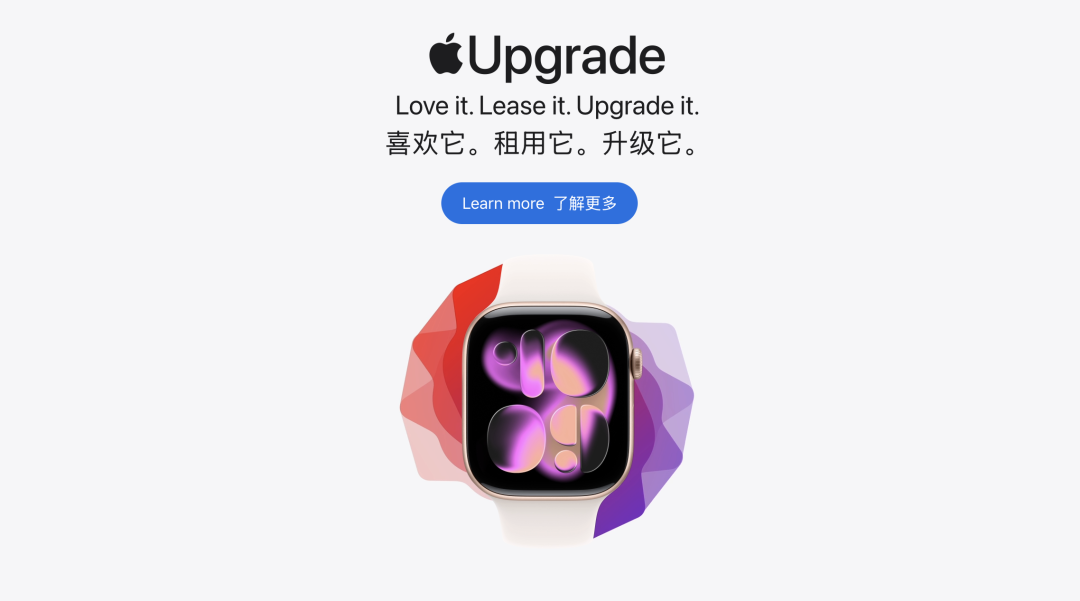
The Apple Upgrade service offers a structured solution. It eliminates the need for consumers to spontaneously decide to replace their devices one day by clearly defining replacement nodes within contract cycles. At lease expiration, users naturally return to Apple's decision-making interface, facing choices to “continue using, buy outright, or upgrade.” This effectively transforms a sporadic, unpredictable replacement behavior into a predictable, manageable periodic interaction.
More importantly, this system significantly reduces decision resistance for users to remain within Apple's ecosystem. When old devices near expiration, upgrading to the next generation is often smoother and more cost-effective than completely exiting the ecosystem and adapting to another brand. While consumers lease a specific device, Apple manages an ongoing, stable ecosystem relationship.
Thus, the “return device” option is the most innovative aspect of Apple Upgrade, explicitly providing an “end-of-lease return” exit.
Combined with Apple's mature official recycling, testing, repair, refurbishment, and resale systems, along with relatively stable residual values in the secondary market, a device returned by its first user can be refurbished for secondary market resale or disassembled for material recovery. This allows the same hardware to generate economic value multiple times throughout its lifecycle, contrasting sharply with the traditional sell-outright model where “the device is out of control once sold.”
In summary, while rising storage costs may have accelerated the launch of Apple Upgrade, the deeper driver is Apple's strategic adjustment of its business model. It is attempting to shift from “one-time device sales” to “long-term device lifecycle management.” New product launches, leasing, end-of-lease upgrades, recycling, refurbishment, and re-entry into the market form an efficient cycle within Apple's ecosystem, rather than a one-way path from factory to consumer. This transformation not only helps address short-term cost pressures but may also strengthen Apple's ecosystem dominance in consumer electronics over the long term.

Unlike the mature smartphone market, AI hardware is in its early, rapidly evolving stages, with consumers facing far greater hesitation and uncertainty. When purchasing a traditional smartphone, users generally know it will meet stable needs for communication, photography, navigation, payment, and entertainment. Even if some new features underperform, the device doesn't completely lose value. Thus, the core pain points in traditional markets are primarily payment capacity and replacement willingness.
AI hardware faces a different kind of uncertainty. Before purchasing AI smart glasses, consumers struggle to predict whether they'll want to wear them daily for extended periods. Before buying AI recording devices or meeting assistants, they can't be sure if automatic summarization, transcription, and knowledge management features will truly integrate into their workflows. When purchasing AI wearables, health monitoring hardware, or earbuds, they can't determine from launch demo videos alone whether these will be long-term productivity tools or just novelty items providing brief (short-lived) freshness.
The true value of many AI hardware products only becomes apparent after weeks or even months of continuous use in real-life scenarios, revealing issues like comfort, battery life, AI model capabilities, interaction habits, and privacy protection—far beyond what parameter lists, brief store trials, or online videos can fully convey.
Facing consumer hesitation, AI hardware vendors currently respond primarily by “lowering initial purchase barriers” through new product launch discounts, platform subsidies, free membership extensions, and low-cost crowdfunding. These measures reduce financial pressure for first-time buyers but remain essentially “buy-outright” models. Once purchased, all risk transfers to consumers. For example, an AI device originally priced at $3,000 but sold for $1,999 after promotions may still end up collecting dust if it doesn't suit the user, representing a failed consumption experience and sunk cost.
The leasing model offers a fundamentally different value proposition. Users need not commit to a product's three-year viability on purchase day but only pay for the next few months of usage rights. If the product proves useful and habits form, they can renew, upgrade, or buy outright; if not, they can easily return it at contract end.
This “exit right” is particularly valuable for AI hardware. It drastically reduces consumer regret costs and decision risks. While smartphone leasing primarily addresses high-cost product payment plans, AI hardware leasing first tackles “trust-building”—consumers' reluctance to pay large sums upfront for unknown experiences.
Moreover, rapid iteration in AI hardware further diminishes the appeal of traditional ownership models. While traditional consumer electronics update quickly, core functions and form factors remain relatively stable. AI hardware is simultaneously undergoing dramatic changes in model capabilities, chip architectures, sensor technologies, and interaction paradigms. A newly purchased device may face superior competitors with stronger capabilities, smaller sizes, better battery life, or more natural interactions within months.
Complicating matters, AI hardware value isn't solely determined by the hardware itself. Whether backend model services continue updating, third-party ecosystem interfaces remain open, cloud inference costs stay sustainable, and manufacturers keep investing in operations—these software and service-layer factors directly impact long-term user experience.
In this environment, owning the device sometimes ceases to be a clear advantage, instead meaning consumers bear full risks of technological depreciation and service uncertainty alone. Thus, AI hardware companies truly confident in their products should dare to assume part of the residual value and iteration risks through leasing, rather than transferring all uncertainty to consumers.

Currently, many AI hardware products still design business models around the “sales moment.” Launch events carefully build anticipation, short videos and social media highlight stunning demo features, and crowdfunding platforms emphasize limited-time early-bird discounts. Once consumers place orders, manufacturers largely achieve their transaction goals. The actual usage three, six, or twelve months later has relatively limited impact on current financial statements.
This model easily creates an illusion of “sales equal success.” High initial sales numbers prove consumer interest in new concepts but don't confirm products have truly integrated into users' daily lives and workflows. Many devices end up as “tech ornaments in drawers,” not uncommon in early AI hardware markets.
Once leasing mechanisms are introduced, evaluation criteria fundamentally change. Because users have clear return options at lease end, manufacturers must focus more on medium- to long-term real retention data: Which features and interaction designs significantly boost renewal willingness? Which pain points cause users to abandon devices? Why are devices being returned en masse? How do upgrade conversion rates vary among user groups? These metrics directly affect revenue stability and cash flow forecasts.
Whether products can be continuously used becomes an inseparable core component of business models. This pushes AI hardware companies from pursuing sensational initial sales figures toward systematically tracking active user rates, daily usage durations, renewal rates, and Net Promoter Scores (NPS) as long-term health indicators. Problems like “dust-collecting rates” hidden behind sales data will now be clearly reflected in operating reports, forcing manufacturers to improve product quality and user experience.
From a broader perspective, leasing isn't just a sales innovation tool but an effective industry self-regulation mechanism. It requires manufacturers to deliver on long-term promises not just at the moment of consumer payment but through continuous product iteration, service optimization, and ecosystem construction. Products highly dependent on initial novelty may secure many initial orders but struggle to generate stable renewal revenue; only those truly solving user pain points and embedding into daily routines can form healthy, predictable cash flows.
Of course, widespread adoption of leasing in AI hardware faces practical challenges. It demands higher operational capabilities from companies: establishing device residual value assessment systems, recycling logistics networks, standardized cleaning and repair processes, data security erasure mechanisms, inventory turnover management, and secondary sales channels. For AI devices with cameras, microphones, biometrics, or health sensors, post-return account unbinding, thorough local data deletion, and sensor permission management pose more sensitive and complex issues than ordinary consumer electronics, requiring strict compliance to protect user privacy.
Looking ahead, widespread AI hardware leasing likely won't involve every company building complete closed loops but will move toward industrial collaboration and infrastructure co-construction. Professional leasing platforms, financial institutions, retail channels, third-party repair and refurbishment service providers, and secondary markets can participate and collaborate. Hardware manufacturers focus on product innovation and AI service optimization, platforms handle credit assessment, capital turnover, and user management, and specialized agencies manage recycling and redistribution. This model lowers barriers for individual companies while improving industry efficiency through scale effects, as demonstrated by Apple's partnership with Klarna.
Over the past few years, the AI hardware industry has invested significant effort in painting a promising future for consumers. The prices consumers pay for these products also include a prepayment for future capabilities that have not yet been fully validated.
However, for products still in the exploratory stage, trust cannot always rely solely on the visions and parameter specifications presented at product launches. The leasing model offers a more pragmatic and balanced consumption agreement: consumers pay only for a defined period of use, while manufacturers must earn the opportunity for renewal in the next period through continuous value delivery. If the product fails to meet expectations, users can leave gracefully; if the product truly becomes indispensable, users will naturally choose to stay and deepen the relationship.
It can be said that when an AI hardware product is not yet mature enough for consumers to confidently commit to a three-year partnership, manufacturers should at least provide users with a graceful exit. What the AI hardware industry needs to reduce is not just the absolute price of products, but more importantly, the trust cost and decision risk that consumers must bear for a new experience.
Through this new consumption agreement, AI hardware can truly transition from the 'concept exploration' stage to the mature stage of becoming 'everyday life infrastructure.' Apple's practice provides a valuable case study for the entire industry to examine seriously.
-
![]()
AI Giants Start Borrowing to Fuel Computing Power Race
-
ByteDance Initiates Largest B2B Structural Adjustment, This Time It's Truly Different
-
![]()
Let's Talk About Kingsoft Office's Mid-Year Outlook and the True Strength of Its AI-Powered Office Solutions
-
Despite 150 Million Users, Struggles Persist: AIShige Faces Tough Competition from Seedance and Kling in AI Video Monetization
-
![]()
Ensuring Safe Gear Shifting in the Automotive Industry: Transitioning from 'Product Oversight' to 'Full-Chain Governance'
-
![]()
Net Profit Soars to $133.7 Billion! Azure Revenue Tops $100 Billion, with AI Fueling Microsoft's Growth
-
![]()
Before 6G Hits the Market, the U.S. Forges a 'Rules Alliance': What Challenges Await Chinese IoT Enterprises?
-
![]()
Intelligent Driving's 'Little Blue Light' Faces Ban: Night Glare and Cut-in Risks Prompt Official Action