Why Can DingTalk Triumph in the 10 Million Rows AI Spreadsheet Battle in the Era of Efficiency?
 12/01 2025
 677
677
Does '10 Million Rows in a Single Sheet' Truly Hold Significance?
In the latter half of 2025, technical parameters and AI spreadsheets, which might seem esoteric and distant to the general public, are increasingly emerging as one of the most fiercely contested arenas in China's AI-driven office sector.
Whether it's due to intense internal competition or the genuine capabilities of AI tools, vendors must focus on delivering simple, efficient, and cost-effective services tailored for office workers and small and medium-sized enterprises (SMEs).
Both Motivation and Necessity: The Pivotal Moment in AI Office Driven by 10 Million Rows
Businesses are inherently profit-driven. From another perspective, considering the AI office market, the 39% compound annual growth rate and the fact that 45.9% of office workers rely on tools present vendors with a golden opportunity to enter this space.
For customers, AI office tools serve as efficiency boosters. Through technological innovation, product iteration, and scenario-based implementation, they become integral to a company's core competitiveness. For instance, large chain restaurants leverage DingTalk to process and analyze sales data for thousands of new dishes. IDC research indicates that companies adopting AI office tools reduce operational costs by an average of 20% and enhance efficiency by 22%.
For vendors, it represents a growth trajectory.
According to The Business Research Company, the global AI office market surged from $218 billion in 2024 to $303.1 billion in 2025, boasting a compound annual growth rate of 39%. This substantial market supply dividend attracts players like DingTalk, Feishu, and WPS to join the fray.
The pivotal moment in the AI office industry stems from AI technology, centered around the decision-making and generation capabilities of large models, which have reshaped office processes and scenarios. It's no longer just a conceptual fantasy. Especially in terms of benefits, intelligent tools such as AI approval, AI smart spreadsheets, AI meetings, and AI collaboration are now experiencing explosive iterative trends. This, to a certain extent, marks the official entry of AI office into the 'native era' and bids farewell to the history of AI plugins for traditional software.
To capture industrial dividends, major players first compete by launching product lines. On November 5th, DingTalk announced that its AI Spreadsheet had broken through the 10 million hot row capacity, taking the lead in successful implementation. It is reported that Feishu's multidimensional spreadsheet plans to introduce a 10 million rows feature before the year's end. DingTalk's move to outmaneuver Feishu also serves as a microcosm of the AI spreadsheet battle.

From an external perspective, the competition among major players regarding data processing limits likely surpasses the significance of product iteration itself. Common sense suggests that a single sheet with 10 million rows is too extensive for the average office worker and most businesses. Daily office work for companies in some vertical sectors only necessitates data processing capabilities within a few million rows.
This raises another question within and outside the industry: Is the '10 million' that major players are vying for a display of technological prowess or a market necessity?
Both aspects may provide reasons for vendors to act in this manner. For instance, the real demand from e-commerce brands preparing for Double 11 has accelerated the application and implementation of DingTalk's AI Spreadsheet with 10 million rows. At the industrial level, it can also be seen as a technological and even ecological collaborative upgrade towards mature AI office.
DingTalk's AI Spreadsheet, as the industry's first intelligent spreadsheet supporting a single sheet capacity of 10 million hot rows, has been applied to various chain retailers and e-commerce brands, including the time-honored restaurant Dexiangyuan Roast Duck. It is reported that the Alibaba Cloud ADB-PG database team and DingTalk jointly developed an integrated storage and computing application architecture. In real-world scenarios involving massive data, high-frequency changes, multi-table associations, and real-time computing, it can achieve ultra-large-scale storage, AI-integrated storage and computing, and ultra-strong parallel computing capabilities. Moreover, it is more cost-effective and genuinely usable compared to similar products.
Alibaba and DingTalk have indeed transformed office tools from being merely functional to excellent and then to even superior.
The above points to the value represented by '10 million' from daily commercial logic and product improvement perspectives. However, it cannot be denied that there is an element of intense competition behind the 10 million rows, although this competition may not necessarily be detrimental.
Fear Not Intense Competition If You're on the Right Path
The explosive growth of AI office has not avoided the age-old problem of the internet industry: 'prioritizing technology over users.' As major players engage in fierce competition over indicators like large model parameters and spreadsheet row counts, the industry dilemma of 'intense competition' is gradually emerging.
Homogeneous competition among large models is at the forefront.
From individual enterprises integrating various global mainstream large models with their AI Fusion engine to internet giants' multidimensional spreadsheet intelligent collaboration, and then to some new AI players' 'in-depth research' functions, behind the seemingly diverse offerings, one cannot deny that the core presentation of product functions has certain repetitiveness. Intelligent analysis, natural language interaction, and multi-end collaboration have become standard features. Even the product iteration paths are strikingly similar.
First, break through data processing limits, then add multimodal generation, and finally package it into an office intelligent agent solution. This 'everyone has it' competition model leaves enterprise users in a dilemma of choice, while office workers face the embarrassment of 'having to relearn when switching software.'
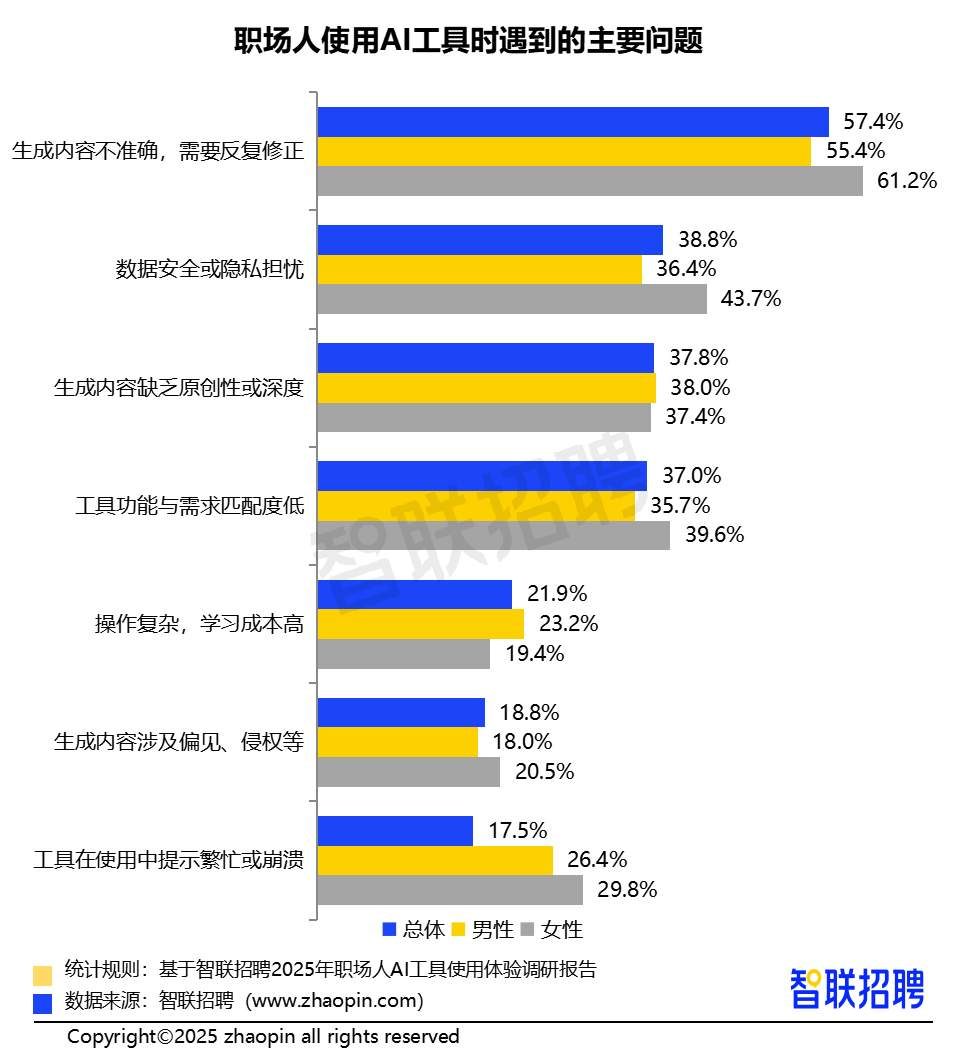
According to a Zhaopin survey, over 30% of office workers believe that AI tools 'require extensive manual modifications to the output,' and over 45% complain that 'instructions need repeated adjustments.' These pain points exactly expose the shortcomings of intense competitive innovation.
Functional bloat further exacerbates the user's burden.
To gain a competitive edge, major players have overloaded their office software with redundant features. AI spreadsheets integrate video generation, image recognition, and numerous field agents, but the actual usage rates of these flashy features are questionable.
In the eyes of some SME leaders, we only need simple data statistics and sharing. However, when we open the software, we have to search for functions among dozens of icons, making it even less efficient than traditional spreadsheets. This logic of adding features for the sake of competition violates the core demand for office tools: 'efficiency and convenience.' It also traps AI office in a vicious cycle where 'the more advanced the technology, the more headache-inducing it becomes for users.'
Fortunately, some players have already begun to awaken. For example, while pursuing a 10 million rows capacity, DingTalk has achieved lightweight operations like 'dialogue-generated spreadsheets' through its 'AI Spreadsheet Assistant,' allowing users to complete data statistics without learning formulas. Its integrated storage and computing architecture, jointly developed with Alibaba Cloud, controls costs while ensuring performance, making it affordable for SMEs.
Therefore, the breakthrough point for intense competition ultimately lies in returning to the user's real needs.
No Matter How Exaggerated the Numbers Are, Simplicity, Efficiency, and Low Cost Are Essential
Office workers, who have an increasing number of AI office products at their disposal, inevitably have concerns while looking forward to technological upgrades. Too many tools and complex functions, along with increasingly detailed sub-option choices, can be mentally taxing.
Just like an Excel sheet, no matter how powerful its functions are, functions like summation, querying, and replacement are the most frequently used. Simple, efficient, and low-cost tools have become the core demand of the market.
Notably, 56.4% of executives list 'lack of professional tools in vertical industries' as their top challenge, 40.5% higher than the overall office worker population. As corporate leaders facing complex and brain-intensive industry challenges, they urgently need a 'tailor-made' AI 'think tank.' A tool that can precisely address professional challenges is the 'office artifact' that executives truly need.
DingTalk's AI Spreadsheet has won the favor of companies like Semir and Intime because it directly addresses the core pain point of e-commerce practitioners: 'real-time Double 11 data monitoring.' It can generate visual reports without complex operations, directly solving the 'problems' of inconsistent SKU fields and data attribution caliber in the retail industry.
For SMEs, the challenges lie in 'not knowing how to use, not being able to afford, and not using it well.'
According to ServiceDirect's '2025 SME AI Report,' 77% of global SMEs regularly use AI tools, but 32% of them need to operate more than seven products simultaneously. The fragmentation among tools and high deployment costs are major obstacles.
Some vendors in the industry are making attempts and efforts in this direction. DingTalk leverages Alibaba's ecological advantages to achieve linked collaboration between Qianniu and DingTalk, allowing e-commerce SMEs to collaboratively manage order and logistics data for cost-effective and efficient operations.
Numerous practices collectively point to a clear industrial trend: AI office is shifting from technology-driven to demand-driven. Future competition will no longer be about 'who has more functions,' but rather 'who provides more precise services.'
Looking back at the outcome of the '10 million rows battle,' it must ultimately return to the essence of office work. On one hand, it showcases the immense potential of AI technology in empowering office scenarios. On the other hand, as the market size races towards the trillion-dollar level and major players continuously break through technological parameters, throwing out various exaggerated numbers, it's even more crucial to review: What is the core value of office tools?
A single spreadsheet merely poses a question. The market and customers are the ones setting it, while the major players embroiled in the AI office sector are the ones solving it.
*All images in this article are sourced from the internet
-
![]()
July Sees Record 65.1% Penetration Rate for New Energy Passenger Vehicles, Fueled by Robust Export Growth
-
![]()
After Three Months of Duan Jianjun Taking Over, Yu Kexin 'Goes Missing' as Top Sales Executive—Is Volvo's Core Management Facing Another Shake-Up?
-
![]()
Lexus Wants to Repeat Tesla's Playbook
-
![]()
Cars Priced at 50,000 Yuan Struggle in Sales, While Those Over 400,000 Yuan See High Demand
-
![]()
Analysis of BBA Reputation Index in July 2026: Service Issues Become a Common Problem
-
![]()
CATL Takes a Step Back, Li Auto Dives Deeper
-
![]()
Tencent's Chess Game in WorkBuddy
-
![]()
R&D Cycle Cut in Half Following Trends: Joint Venture Automakers Now Producing Quick-Turnaround Vehicles