Why There Are No Losers in the 2025 Search Battle
 12/01 2025
 671
671
From Fierce Clashes to Win-Win Scenarios
Written by / Chen Dengxin
Edited by / Li Jinlin
Formatted by / Annalee
Search has long been a fiercely competitive domain.
In the age of AI, renowned global internet firms have embraced this technology, seeking opportunities to shift from traditional to new growth drivers. Consequently, search has emerged as a pivotal battleground.
In 2025, major players have placed an even greater emphasis on search. From the early-year launches of Doubao, Yuanbao, and DeepSeek to the year-end introductions of Qianwen and Lingguang, an AI-driven entry war centered around search has unfolded.
This raises the question: After a year of intense competition, new search entrants continue to make significant strides, while established players like 'Googles' remain robust with their foundations intact. Why has AI disrupted the fundamental logic of search yet failed to overturn the competitive landscape?
AI Deals a Devastating Blow to Traditional Search
Since ChatGPT sparked the AI revolution, the 'Googles' have found themselves at the epicenter of attention.
A widely accepted notion is that traditional search relies on keyword matching to determine the presence of answers, whereas AI-powered search can address full-chain needs, discerning the accuracy of answers.
In simpler terms, traditional search is akin to having cream; users must manually transform raw ingredients into a cream cake. AI, however, bypasses intermediate steps, providing a complete cream cake in one fell swoop.
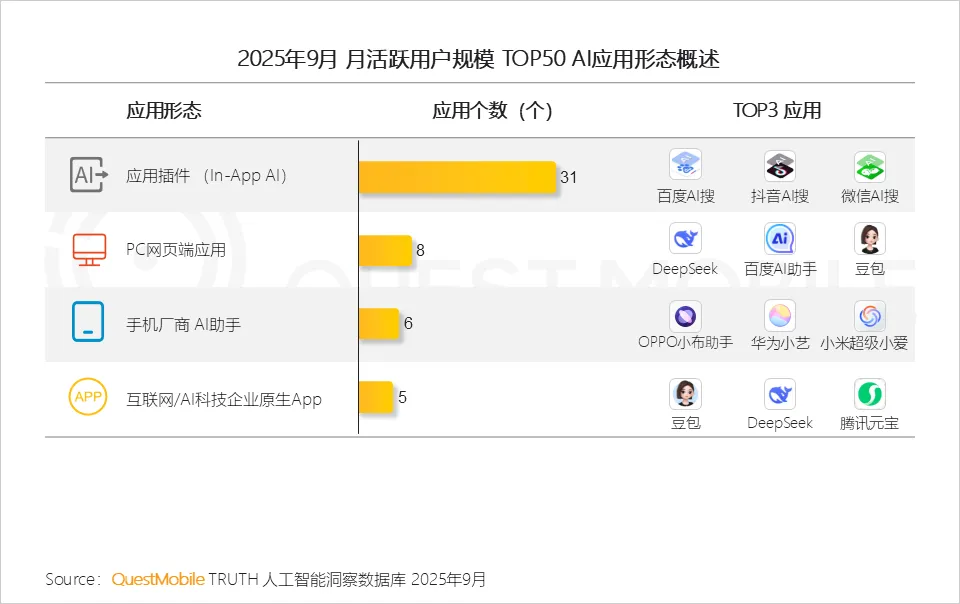
'Xinmou' candidly states: 'In the AI era, personal AI assistants are highly likely to become the next "super entry point"—serving as the primary channel for users to access information, replacing some search functions; acting as the core carrier for intelligent interaction, connecting various hardware devices; and functioning as an aggregated platform for life services, encompassing shopping, travel, healthcare, education, and more.'
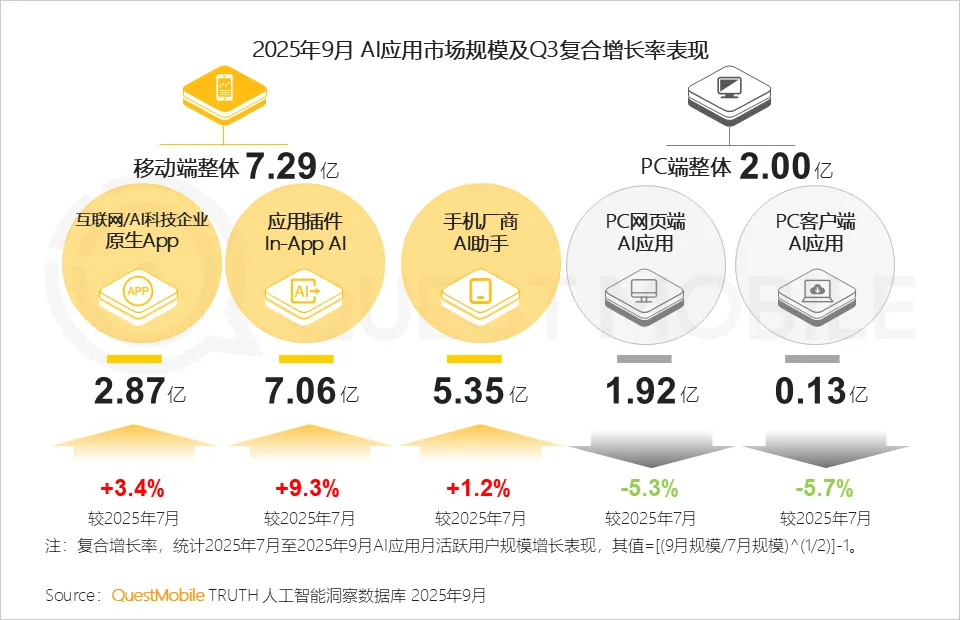
Source: QuestMobile
It is clear that AI has dealt a devastating blow to traditional search.
Consequently, major internet companies have entered the search arena, aiming to redefine the relationship between users and information, unlock growth opportunities for AI implementation, and pursue rapid development.
Abroad, Microsoft has taken the lead by rebranding Bing as Microsoft Bing, viewing it not merely as a search engine but as an AI search service rooted in Microsoft's ecosystem.
Domestically, the competition has been fierce and dynamic.
ByteDance's Doubao has maintained steady growth, reaching 172 million monthly active users in the third quarter of 2025, surpassing DeepSeek's 145 million. Tencent's Yuanbao witnessed a 55.2% year-over-year increase in monthly active users in the first half of 2025, ranking second on the AI native app surge list and emerging as the most notable 'dark horse' among AI native mobile applications. Alibaba's Qianwen and Lingguang both became blockbuster products in November 2025, surpassing ChatGPT, Sora, and DeepSeek to become the fastest-growing million/ten-million-level AI applications in history...
In essence, AI applications centered around 'dialogue + search' are gaining widespread popularity.
Against this backdrop, concerns naturally arose about the 'Googles,' given that search is their core business, often referred to as a 'cash cow,' and 'search + information feed' forms the cornerstone of their ecosystems.
However, reality has proven otherwise.
In the third quarter of 2025, Google's revenue reached $102.346 billion, a 16% year-over-year increase, surpassing the $100 billion mark for the first time in history, with AI-related revenue reaching billions of dollars.
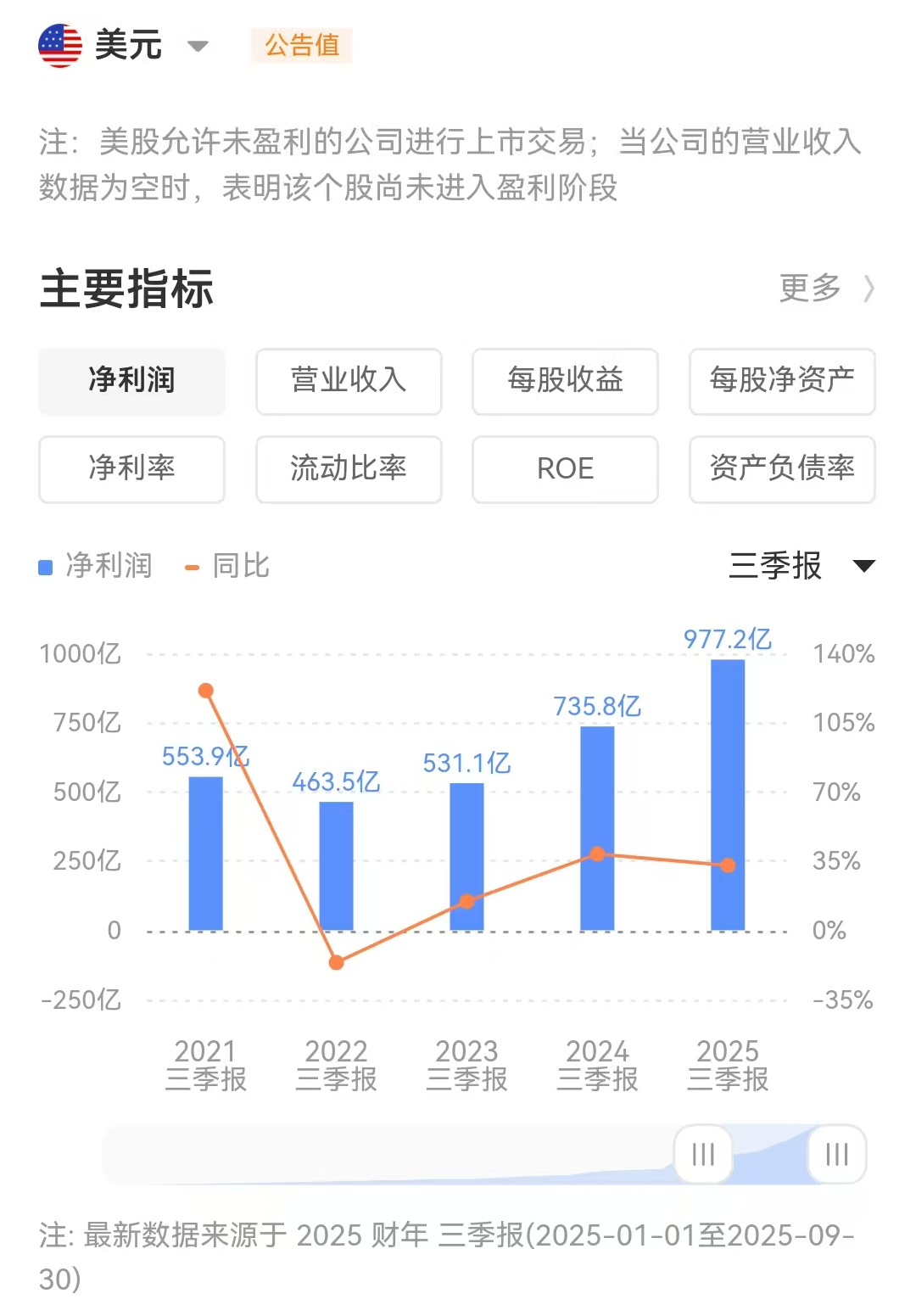
Google's Performance Soars
During the same period, Baidu disclosed its AI business revenue for the first time, approximately 10 billion yuan, a more than 50% year-over-year increase, with AI native marketing service revenue reaching 2.8 billion yuan, a 262% year-over-year increase.
In other words, new search entrants are advancing alongside the 'Googles.'
The Expanding Market Accommodates More Players
Rather than becoming victims of AI, the 'Googles' have actually benefited from the AI boom. There are three reasons for this.
First, the expanding market is more inclusive.
Previously, the internet suffered from information silos: most content platforms tended to prohibit third-party scraping, confining relationships, interactions, and content within their ecosystem's product matrix, with sharing limited to partners.
As a result, traditional search often functioned as ecosystem search.
For example, ByteDance launched Toutiao Search in 2019, primarily serving its matrix products like Douyin and Toutiao. Leveraging its vast content pool, it played a pivotal role within the ecosystem.
Similarly, WeChat and Alipay incorporated search functions, becoming important entry points for their respective ecosystems and markers of ecosystem search.
Today, while information silos persist, AI has gradually blurred boundaries, transforming search from a static market to an expanding one.
As is known, a shrinking market breeds disillusionment, a static market fosters cutthroat competition, and an expanding market thrives with vitality. Thus, it is unsurprising that players advance together in an expanding market.
Second, they did not remain passive.
A review shows that while AI assistant applications have proliferated, their first-month user churn rate exceeds 80%, with only a few truly competitive options.
'Dolphin Research' states: 'Recently, OpenAI's launch of an AI browser indicates that the product's disruptive power is not yet mature. If it merely attempts to mimic existing products by wrapping ChatGPT, the entry value will remain with traditional giants that control the scenes.'
This implies that the expanding market is not yet solidified, and the 'Googles' have opportunities to reshape search and attract user migration.
Taking Baidu as an example, it has reconstructed search, evolving the search box into a 'smart box' that supports over a thousand characters of input and multimodal capabilities like photo, speech, voice, and video.
Li Yanhong stated: 'We use AI to reconstruct the search results page, not simply inserting AI summaries into search results but transforming search from an internet application dominated by text content and links into an AI application dominated by rich media content like images and videos.'
As a result, the 'Googles' possess the capital to fearlessly compete across boundaries.
Public data shows that Google's search business, driven by the AI model, has surpassed 75 million daily active users in the U.S., with query volumes doubling. Currently, 70% of Baidu's search results pages contain AI-generated content, and users exposed to AI search results exhibit higher retention rates, with query volumes increasing by 6% year-over-year.
Advancing Side by Side
Third, the first-mover advantage cannot be overlooked.
The first-mover advantage is a crucial barrier in business competition, providing companies with time to build competitive moats. Once solidified through user habits, cost advantages, and brand appeal, it becomes difficult for latecomers to displace incumbents.
This holds true in the search arena, where the 'Googles' remain the dominant players.
Take Google as an example; it currently holds over 90% of the global search market share, firmly suppressing Microsoft's Microsoft Bing. It is no exaggeration to say that the latter, even with AI enhancements, has not posed a substantial threat to Google.
Moreover, in terms of AI technology, the 'Googles' are not lagging.
As early as 2016, 'AI First' became Google's core strategy, while Baidu proclaimed 'strengthening the mobile ecosystem and winning in the AI era' in the same year. Both companies found themselves in the same boat.
Based on this, the 'Googles' possess full-stack AI capabilities spanning chips, models, frameworks, and applications, giving them a favorable position in search competition.
'Huxiu' states: 'Full-stack capabilities have transitioned from a technological option three years ago to a competitive necessity today. It represents the inevitable stage of AI industry maturation towards commercial viability and foreshadows a future competitive landscape that emphasizes systemicity and sustainability.'
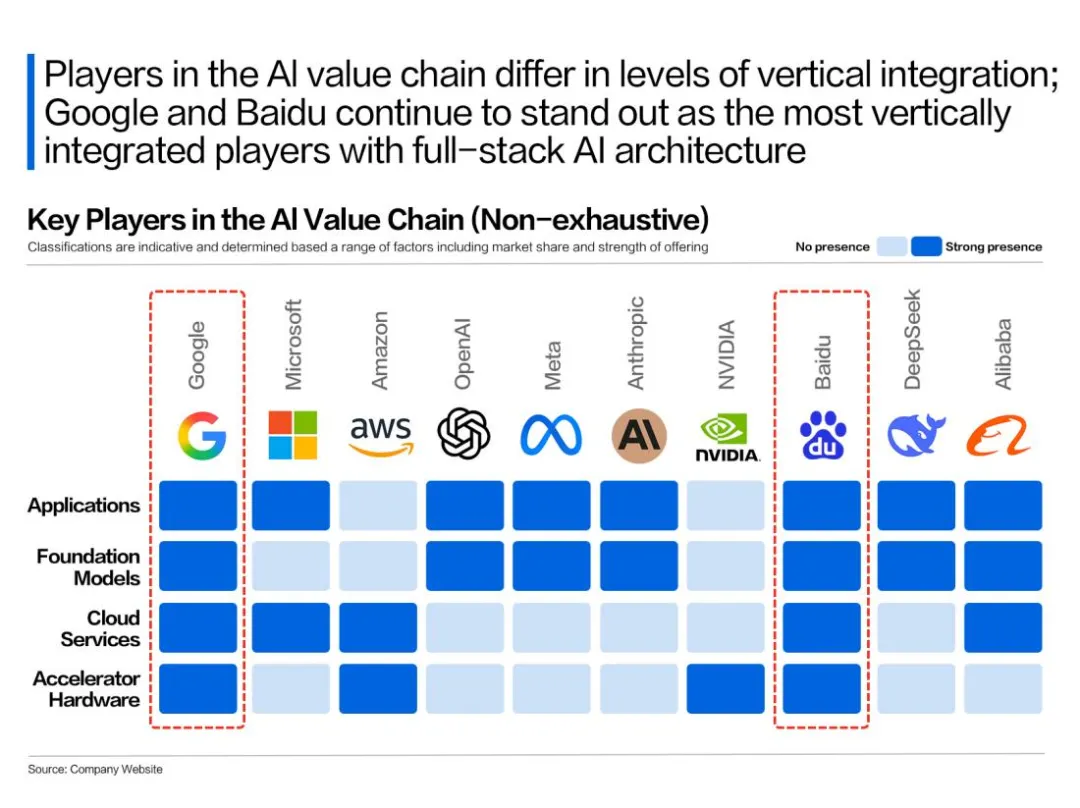
Established Search Players Wield Full-Stack AI Capabilities
From this, it is evident that while the search battle rages on, the entry point has not changed hands.
Consequently, capital markets have reevaluated the 'Googles': Warren Buffett made his first purchase of Google in the third quarter of 2025, with 17.84 million shares propelling it to become his tenth-largest holding. Google is poised to become the third tech company to surpass a $4 trillion market capitalization, while Hillhouse Capital, Citigroup, and others increased their stakes in Baidu in the third quarter of 2025.
In summary, as major internet companies continue to invest heavily, the battle centered around the critical entry point of search intensifies, presenting a flourishing landscape in the short term. The future evolution of the competitive landscape remains to be seen.
The only certainty is that, regardless of the strategies employed, users are the true winners.
-
![]()
July Sees Record 65.1% Penetration Rate for New Energy Passenger Vehicles, Fueled by Robust Export Growth
-
![]()
After Three Months of Duan Jianjun Taking Over, Yu Kexin 'Goes Missing' as Top Sales Executive—Is Volvo's Core Management Facing Another Shake-Up?
-
![]()
Lexus Wants to Repeat Tesla's Playbook
-
![]()
Cars Priced at 50,000 Yuan Struggle in Sales, While Those Over 400,000 Yuan See High Demand
-
![]()
Analysis of BBA Reputation Index in July 2026: Service Issues Become a Common Problem
-
![]()
CATL Takes a Step Back, Li Auto Dives Deeper
-
![]()
Tencent's Chess Game in WorkBuddy
-
![]()
R&D Cycle Cut in Half Following Trends: Joint Venture Automakers Now Producing Quick-Turnaround Vehicles