US Vote to Reshape WiFi IoT Market Landscape
 01/23 2026
 657
657
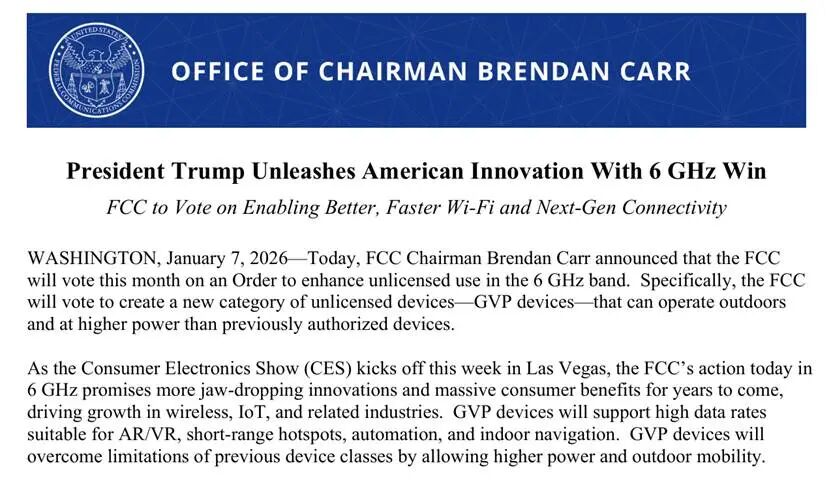
Brendan Carr, Chairman of the US Federal Communications Commission (FCC), recently made an announcement: This month, the FCC will cast a vote on a decision aimed at bolstering unlicensed utilization of the 6 GHz band. Specifically, the FCC will deliberate on establishing a new category of unlicensed access devices—geofenced variable power (GVP) devices. These devices, which boast higher power than previously approved ones, can be deployed outdoors. Brendan Carr characterized this move as an integral part of a broader initiative to 'unleash American innovation and leadership.' This decision is poised to significantly reshape the future market landscape of WiFi-based devices and the unlicensed spectrum IoT.
Unlocking Greater Frequency Resources for High-Power WiFi IoT Development
In its related announcement, the FCC stated that actions concerning the 6 GHz band herald a wave of groundbreaking innovations and substantial consumer benefits in the years ahead, propelling the development of wireless, IoT, and related sectors. GVP devices will support high-data-rate applications, including augmented reality/virtual reality (AR/VR), short-range hotspots, automation, and indoor navigation. By permitting higher power levels and outdoor mobility, GVP devices will surmount the limitations of previous device categories. This places the United States at the forefront of technological leadership, yielding benefits for consumers, the economy, and innovators.
Geofenced variable power (GVP) devices are anticipated to overcome the technical and regulatory constraints faced by other low-power devices, such as low-power indoor (LPI) and very low-power (VLP) devices. GVP devices offer data transmission rates suitable for augmented/virtual reality, short-range hotspots, automation processes, and indoor positioning and navigation, operating at significantly higher power levels than VLP devices. Unlike LPI devices, which are confined to indoor use, GVP devices are not subject to such restrictions. However, GVP devices cannot be used indiscriminately; the FCC will enforce this by prohibiting GVP devices from operating in exclusion zones on specific frequencies to safeguard existing licensed services from significant risks of harmful interference.
Relevant professionals have disclosed that GVP devices will rely on an internal database within the device to ascertain whether it can safely increase power. To prevent interference with nearby existing licensed frequency device links, the database can instruct the device to reduce power or switch to another channel.
Carr remarked in a statement, 'This is fantastic news for consumers, who will enjoy better, faster, and more affordable wireless services.'
In addition to the proposed creation of a new GVP device category, the FCC will also solicit comments on proposals that 'may enhance the practicality of unlicensed devices in the 6 GHz band.' This vote is scheduled for a public committee meeting on January 29.
It is evident that this US spectrum policy primarily paves the way for high-power WiFi devices. As stated in the announcement, current WiFi access devices for AR/VR, short-range hotspots, automation, and indoor navigation necessitate higher power to achieve elevated speeds, low latency, and extended range. Moreover, WiFi 7/8 both require 6 GHz resources to implement their respective functions. If the FCC vote is approved, it will further expand the quantity and influence of WiFi IoT terminals, potentially supplanting other access methods to a certain extent.
The 6 GHz Band Competition Intensifies
Non-licensed spectrum access technologies, exemplified by WiFi, and licensed spectrum technologies, represented by cellular communications, have been engaged in a 'covert struggle' over scarce radio spectrum resources. The 6 GHz band has emerged as a focal point of competition in recent years, as it represents the sole large bandwidth, high-quality resource in the mid-band spectrum, spanning a total of 1200MHz from 5925MHz to 7125MHz. It holds immense potential for wide coverage and large capacity, prompting all parties to vie for access to this resource. The allocation of frequency resources, which access technologies hinge upon, depends on the policy orientations of major economies, with the policy orientations of the United States and China being particularly influential for the global development of mobile communications and WiFi.
At the International Telecommunication Union World Radiocommunication Conference held in December 2023, the two major factions of cellular and WiFi engaged in a fierce competition over the allocation of the 6 GHz spectrum, becoming a focal point of the conference. During the meeting, some Asia-Pacific countries, led by China, proposed allocating the 6425-7025MHz band for 5G/6G; while countries in the Americas, spearheaded by the United States, advocated for utilizing the entire 6GHz spectrum for Wi-Fi.
In fact, as early as April 2020, the United States announced the opening of the 6 GHz spectrum through an unlicensed approach, allocating its entire 1200M bandwidth to wireless local area networks to foster the development of next-generation Wi-Fi technologies; in 2023, the United States further opened the 6 GHz spectrum to extremely low-power devices, including wearable devices.
China took the global lead in July 2023 by designating the upper band of the 6 GHz spectrum (6425-7125MHz) as a dedicated band for 5G/6G systems, providing assurances for the rapid deployment of domestic 5G networks and the research and development of future 6G technologies; no explicit regulations have been established for the lower band (5925-6425MHz). Many overseas countries have explicitly allocated the lower band of the 6 GHz spectrum (5925-6425MHz) for Wi-Fi, while reserving the upper band (6425-7125MHz) for mobile communications.
WiFi shipments also enjoy an advantage in the global market. Taking IoT as an example, according to IoT Analytics statistics, WiFi-connected IoT devices account for 32%, representing the highest proportion among all technology-supported connection scales.
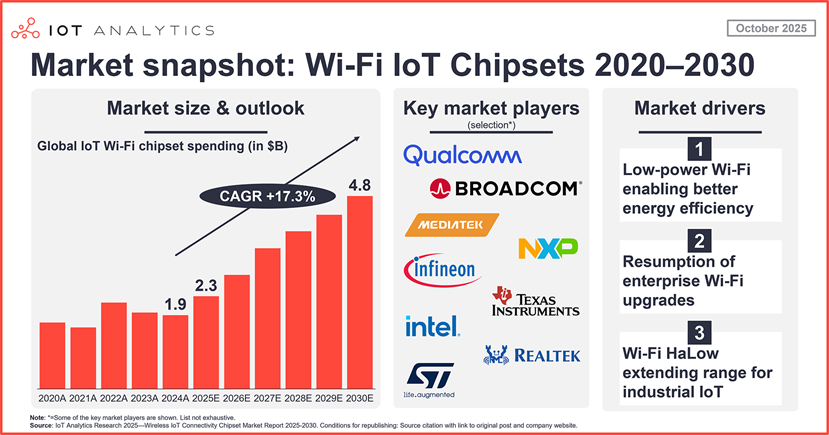
As of April 2025, over 1 billion Wi-Fi devices supporting the 6 GHz band have been shipped globally and have swiftly become standard features in smartphones and tablets. It can be said that clarifying the policy for the 6 GHz spectrum is a fundamental prerequisite for the rapid development of the WiFi ecosystem. It is foreseeable that if the FCC vote is approved, it will also largely usher in a boom in the high-power WiFi market.
Reactions from Various Stakeholders
In response to the FCC's proposed vote on GVP device spectrum, several manufacturers have already expressed clear intentions of support. Notable examples include industry giants such as Apple, Meta, Microsoft, Broadcom, and Qualcomm, who have been advocating for the GVP category, particularly for the support of wearable and connected devices. Additionally, organizations such as the Consumer Technology Association and WiFi Forward have also actively endorsed this vote.
In August 2025, Apple and Meta submitted an application to the FCC, emphasizing their stance on the issue and arguing that 'having sufficient power is a prerequisite for bolstering industry investment in new GVP devices. GVP devices are likely to be primarily wearable technologies, and when used in applications such as augmented reality, these devices will face significant latency and throughput demands.'
However, multiple countries hold differing viewpoints. For instance, the UK regulatory agency Ofcom confirmed that it plans to adopt a new spectrum sharing approach in the high-frequency 6 GHz band, enabling both mobile communications and WiFi providers to utilize these bands simultaneously. Specifically, the 160MHz from 6425MHz to 6585MHz will be prioritized for WiFi, while the 540MHz from 6585MHz to 7125MHz will be prioritized for mobile communications, with clear technical conditions and controls attached, allowing simultaneous use by both mobile communications and WiFi. This is made feasible by the Automatic Frequency Coordination (AFC) database, which prevents interference between different devices. Ofcom also decided to permit outdoor and high-power WiFi devices to operate in the low-frequency 6 GHz band (5925MHz to 6425MHz), as long as they are controlled by an AFC system.
As a scarce resource, radio frequencies largely dictate the direction and competitiveness of the wireless industry's development. Therefore, policies related to frequency allocation have consistently been a focal point of concern for the industry. Currently, some characteristics of WiFi are highly contingent on the 6 GHz frequency resource. Every policy shift regarding the allocation of the 6 GHz frequency may determine the trajectory of the WiFi industry chain.
-
![]()
Xiaomi's MiMo Stages a Two-Year Comeback to Top Global Inference Volume Rankings
-
Tech Titans' Offline Tussle for Desktop Dominance: The Office Agent Showdown
-
![]()
Full-Spec Power and BOSE Subwoofer: The REDMI K100 Pro Max Performance Review
-
![]()
Yuewen’s Unending Innovation: Navigating Content Industry Shifts
-
![]()
Huawei, Li Auto, XPENG, Xiaomi: After Scrutinizing Seven Papers, What Are 'World Models' and 'VLA' Really Competing For?
-
![]()
Proposed to Raise 955 Million Yuan through Private Placement! Huicheng Vacuum Boosts Localization of Ultra-Precision Optical Coating Equipment
-
![]()
Cash Flow Soars 13-Fold! What Major Strategic Move is Wuhan Five Square Optoelectronics Planning?
-
![]()
Leaked Design of vivo X500: Reverts to Circular Camera Module in Top-Left Corner, Pays Homage to Classic X90 Aesthetic