In-Depth: The Two Sessions Set a Trillion-Yuan Target, Beidou is Reshaping New Growth and Underlying Narratives
 03/18 2026
 747
747
Foreword:
At the 2026 National Two Sessions, China's satellite navigation industry established its core coordinates for the 15th Five-Year Plan period: to continue implementing the Beidou scale application project and drive the scale of the Beidou industry beyond 1 trillion yuan within five years.
This figure, set against the backdrop of China's satellite navigation and positioning services industry achieving a total output value of 575.8 billion yuan in 2024 and projected to surpass 620 billion yuan in 2025, implies that the Beidou industry must expand by nearly 400 billion yuan in scale over the next five years.
Author | Fang Wensan
Image Source | Network
From 575.8 billion to 1 trillion, the confidence behind the target stems from industrial foundations
The White Paper on the Development of China's Satellite Navigation and Positioning Services Industry in 2025, released by the China Satellite Navigation and Location Services Association, clearly outlines the solid foundations of the Beidou industry.
In 2024, the total output value of China's satellite navigation and positioning services industry reached 575.8 billion yuan, a year-on-year increase of 7.39%.
Among this, the core output value directly related to satellite navigation technology research and development and applications, including chips, algorithms, and terminal equipment, reached 169.9 billion yuan, while the associated output value driven by derivatives reached 405.9 billion yuan, accounting for 70.49% of the total output value.
Behind the steady growth in industrial scale lies a comprehensive breakthrough in the autonomous control of core technologies.
By the end of 2024, the total number of satellite navigation patent applications in China had exceeded 129,000, maintaining a global lead.
The localization rate of upstream core components has surpassed 95%, with navigation chip processes reaching 14nm and significant breakthroughs achieved in key technologies such as anti-jamming and low power consumption.
The market cost of high-precision positioning terminals has dropped from 5,000 yuan in 2020 to 850 yuan in 2026, clearing a core cost barrier for large-scale applications.
By the end of 2024, over 98% of the nation's registered operational vehicles had been equipped with Beidou terminals, with the railway system achieving full Beidou positioning coverage. Agricultural machinery automated driving had adopted Beidou precision guidance across more than 10 million acres of farmland, and over 400,000 police terminals nationwide had been connected to the Beidou positioning service platform.
In the consumer sector, approximately 288 million smartphones nationwide supported Beidou positioning functions, with high-precision lane-level navigation covering over 99% of urban and township roads across the country. Daily position services exceeded 1 trillion instances, with total daily navigation service mileage surpassing 4 billion kilometers.
Recently, the Office of the China Satellite Navigation System Management officially announced that the Beidou Satellite Navigation System will undergo an in-orbit upgrade project in the near future, comprehensively optimizing and adjusting the operational status of in-orbit satellites.
Upon completion of the upgrade, the positioning accuracy, anti-jamming capabilities, and short message communication capabilities of the Beidou system will all see comprehensive improvements, providing stronger technical support for large-scale applications during the 15th Five-Year Plan period.

Three New Growth Sectors: How Beidou is Rewriting Industrial Growth Logic
If the past three decades of Beidou's growth were primarily driven by breakthroughs in core technologies and infrastructure construction, then the journey towards the trillion-yuan mark over the next five years will see Beidou's new growth emanating from the comprehensive outbreak (explosive growth) of three core sectors.
These sectors not only represent growth spaces for the Beidou industry itself but also serve as important growth poles for China's new quality productive forces in the economy.
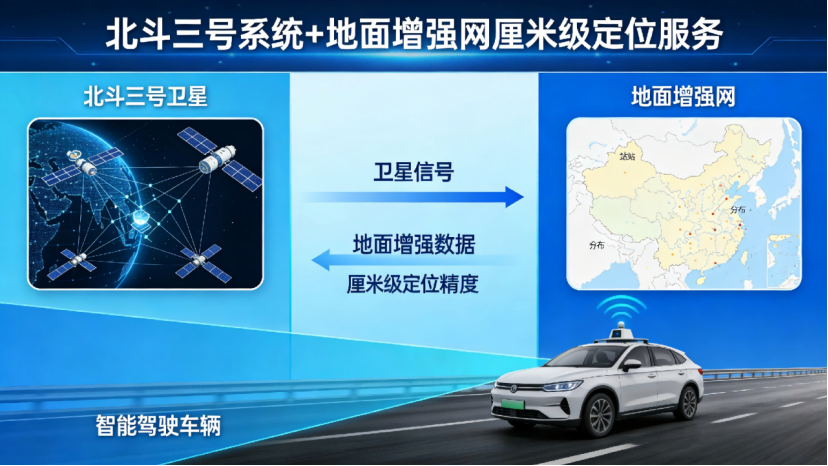
① Intelligent Connected Vehicles and Smart Transportation: For autonomous driving at Level 3 and above, centimeter-level high-precision positioning and highly reliable spatiotemporal synchronization are indispensable core capabilities for autonomous driving systems.
The Beidou-3 system, in conjunction with ground augmentation networks, is already capable of providing stable centimeter-level positioning services nationwide, perfectly matching the technical requirements of intelligent driving.
Relevant institutions estimate that the market size for the niche sector of onboard high-precision positioning terminals alone will surpass 100 billion yuan over the next five years, while the associated markets for derived smart transportation scheduling, vehicle-road coordination services, and travel data operations will reach the trillions.
Beyond autonomous driving, Beidou's applications in the smart transportation sector have already formed a mature commercial closed loop (closed loop).
Over the next five years, with the comprehensive construction of smart transportation infrastructure, Beidou's applications in the transportation sector will shift from "point-based empowerment" to "full-system reconstruction," becoming the core growth support for the trillion-yuan target.
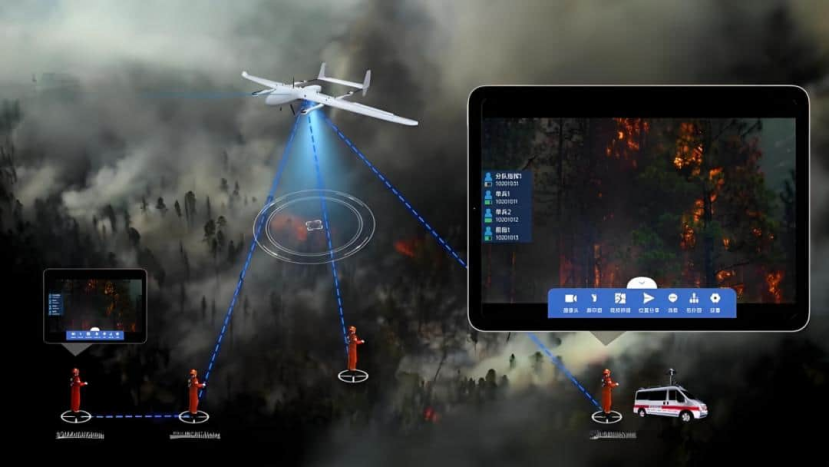
② Low-Altitude Economy: Relevant data shows that China's low-altitude economy has already surpassed 500 billion yuan in scale and is expected to reach 2 trillion yuan by 2030. Beidou is the indispensable "air traffic light" for the development of the low-altitude economy.
The Beidou system can not only provide centimeter-level positioning services for low-altitude aircraft, enabling precise route planning and position control, but also, through its short message communication capabilities, achieve full controllability and emergency communication for aircraft in areas with insufficient ground communication network coverage.
Currently, Beidou has already been implemented in multiple scenarios, including low-altitude logistics, low-altitude cultural tourism, emergency rescue, and urban air mobility.
During the 15th Five-Year Plan period, with the continuous deepening of low-altitude airspace management reforms, the low-altitude economy will witness explosive growth.
As the spatiotemporal benchmark for low-altitude transportation, Beidou will fully participate in the rule-setting and ecosystem construction of the low-altitude economy, sharing in the growth dividends of the trillion-yuan low-altitude economic market.
③ Spatiotemporal Big Data and Ubiquitous Applications: In the era of the digital economy, all dynamic data is inseparable from the two core dimensions of time and space.
Beidou is providing a unified spatiotemporal benchmark for the entire digital economy system, becoming a core infrastructure in the era of the Internet of Everything.
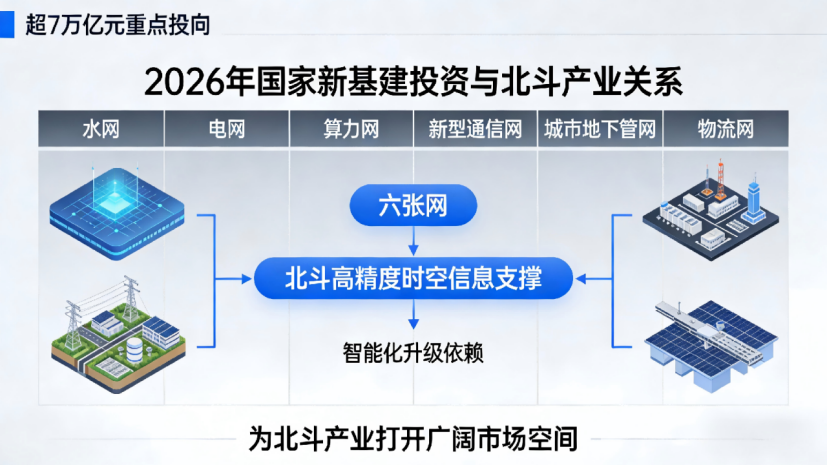
Meanwhile, the more than 7 trillion yuan in new infrastructure investments clearly identified by the state in 2026 will focus on the "six networks": water networks, power grids, computing networks, new communication networks, urban underground pipe networks, and logistics networks.
The intelligent upgrading of each of these networks is inseparable from the high-precision spatiotemporal information support provided by Beidou, opening up vast market spaces for the sustained growth of the Beidou industry.
In the real economy sector, Beidou's empowerment has already covered multiple core industries, including agriculture, industry, marine affairs, and energy.
Furthermore, the integration of Beidou with cutting-edge technologies such as 5G, AI, computing networks, and big data is giving rise to a large number of brand-new application scenarios.
These cross-border integrated scenarios are continuously expanding the application boundaries of Beidou, transforming it from a single navigation system into a "spatiotemporal data operating system" that empowers thousands of industries, providing a continuous stream of growth momentum for the trillion-yuan target.
Three-Tiered Underlying Narrative Reconstruction: Beidou's Value Transcends Navigation Itself
The trillion-yuan target set by the Two Sessions is superficially an expectation for the scale growth of an industry, but at its core, it represents the three-tiered underlying narrative reconstruction that Beidou is undergoing.
This reconstruction elevates Beidou's value beyond that of a mere navigation tool, making it an iconic symbol of China's high-quality development process.
As a core supplier of the four global satellite navigation systems recognized by the United Nations, the Beidou system has been fully integrated into the standard systems of 11 international organizations, including civil aviation, maritime affairs, mobile communications, and search and rescue.
Its related services and products have been exported to over 140 countries and regions worldwide, providing Beidou accelerated positioning and high-precision services to over 1.5 billion users globally.
In the global satellite navigation arena, China's Beidou is transitioning from "accepting rules" to "setting rules" through compatibility and interoperability with Russia's GLONASS and Europe's Galileo systems.
Another narrative reconstruction of Beidou is its value descent from a "distant aerospace project" to a "tangible People's wellbeing (livelihood) infrastructure."
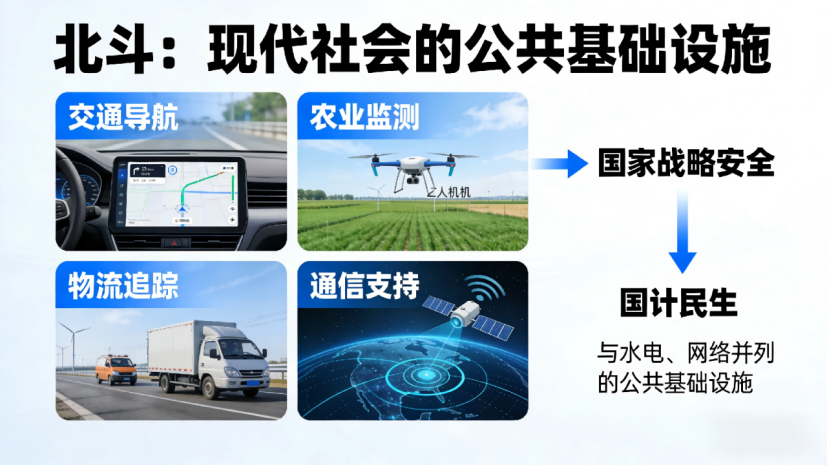
With the system's comprehensive completion and large-scale applications, Beidou's value has extended from the national strategic security level to all aspects of the national economy and people's livelihoods, becoming an indispensable public infrastructure in modern society, much like water, electricity, and the internet.
The daily requests for position services exceeding 1 trillion instances reflect the daily needs of hundreds of millions of users, serving as the best proof of Beidou's transformation from a "national treasure" to a "livelihood infrastructure."
The most core underlying narrative reconstruction of Beidou is its transformation from an isolated satellite navigation industry into a "parent system" that empowers the entire digital economy.
The synergy between satellite internet and the Beidou system constructs an integrated air-space-ground information infrastructure; the fusion of artificial intelligence and Beidou enables the full release of the value of spatiotemporal data.
Computing networks provide support for the processing and application of Beidou's massive spatiotemporal data; while the spatiotemporal data generated by Beidou itself is one of the most core and widely applied basic data elements in the data element system.
Conclusion:
In 1994, the Beidou-1 system project was officially approved, marking China's journey to independently build a satellite navigation system.
In 2020, the Beidou-3 Global Satellite Navigation System was officially commissioned, making China the third country in the world to independently possess a global satellite navigation system.
In 2026, the National Two Sessions set a trillion-yuan target, and Beidou embarked on a new journey from system completion to industrial outbreak (boom), from domestic applications to global services.
Over more than three decades, Beidou has descended from the stars to become an integral part of everyday life.
Partial References: Caijing Wuji: "Beidou Industry to Surpass 1 Trillion Yuan in 5 Years: Where Will It Come From? How Will It Get There?", China Report: "Marching Towards the New: How Will the Beidou Industry Surpass 1 Trillion Yuan Within 5 Years?", Aladdin Omnimedia: "The Two Sessions Set the Tone: A 10 Trillion Yuan AI Industry Blue Ocean Opens! The Collision of Technology and Culture Ignites a New Trend", Shaanxi Beidou Technology Development and Application Co., Ltd.: "7 Trillion Yuan Invested in the 'Six Networks': Beidou Aims for a Trillion-Yuan Level", Zhengjieju: "A Major Signal from the Two Sessions: China's Next Trillion-Yuan Track is in the Sky"
-
![]()
Proposed to Raise 955 Million Yuan through Private Placement! Huicheng Vacuum Boosts Localization of Ultra-Precision Optical Coating Equipment
-
![]()
Cash Flow Soars 13-Fold! What Major Strategic Move is Wuhan Five Square Optoelectronics Planning?
-
![]()
Leaked Design of vivo X500: Reverts to Circular Camera Module in Top-Left Corner, Pays Homage to Classic X90 Aesthetic
-
![]()
DeepSeek Shows Signs of Foraying into Code Agents, Launches WeChat Official Account Focused on Harness
-
![]()
Auto Companies Deny Claims That ‘Cooperation with Huawei Is Non-Essential’, as Huawei Transforms into a ‘Public Platform’
-
![]()
Starship to Independently 'Return to the Launch Tower': SpaceX's Ambitions Extend Beyond Rocket Building to Dominating Space Transportation
-
![]()
Starship Set to Independently 'Return to the Launch Tower': SpaceX is Revolutionizing Space Transportation, Not Just Building Rockets
-
![]()
Anthropic and OpenAI Face Off Against Deepseek