Xiaomi Hires Meizu Executive for PR? But Its Achilles' Heel Has Never Been PR
 03/03 2026
 539
539
Did Xiaomi Hire a PR Executive with a Meizu Background?
On the afternoon of the 2nd, a personnel shift at Xiaomi sparked discussions within industry circles. According to multiple media reports, Zeng Yang, former Vice President of StarV Meizu, has officially joined Xiaomi Group's PR department as Media Head. BlueWhale News also reported that her internal rank is equivalent to that of Wang Hua, the former General Manager of Xiaomi's PR department, and she will oversee Xiaomi's media-related operations.
Public records indicate that Zeng Yang's career has spanned traditional media, internet communities, and leading e-commerce platforms. She previously worked at CCTV Finance Channel as a journalist, editor-in-chief, and producer. Later, she joined Zhihu as Executive Editor-in-Chief and Research Institute Director, then moved to JD.com's PR department before recently overseeing market branding and PR communications at StarV Meizu.
Filling the Void: Xiaomi Bolsters Its PR Team
Many have interpreted Zeng Yang's appointment as "Xiaomi's PR welcoming a new leader." However, based on her role, this move appears more as a business-level reinforcement—addressing a key gap in Xiaomi's media and brand communication. Whether she assumes a new "PR lead" role remains to be confirmed.
In November of the previous year, Wang Hua was transferred to Xiaomi's Wuhan headquarters. As a core figure in Xiaomi's external communications alongside Lei Jun, Wang's departure from Beijing was rumored to be a "scapegoat" for a controversy involving a key opinion leader (KOL). However, he denied this, stating it was a "normal transfer."
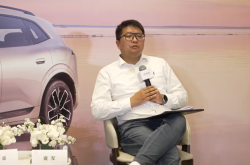
Since then, Xiaomi's PR-related work has been jointly managed by Lei Jun's assistant, Xu Jieyun, who holds the official titles of General Manager of Xiaomi Group's PR Department, Deputy General Manager of Group Strategic Marketing, and Special Assistant to the Group Chairman. 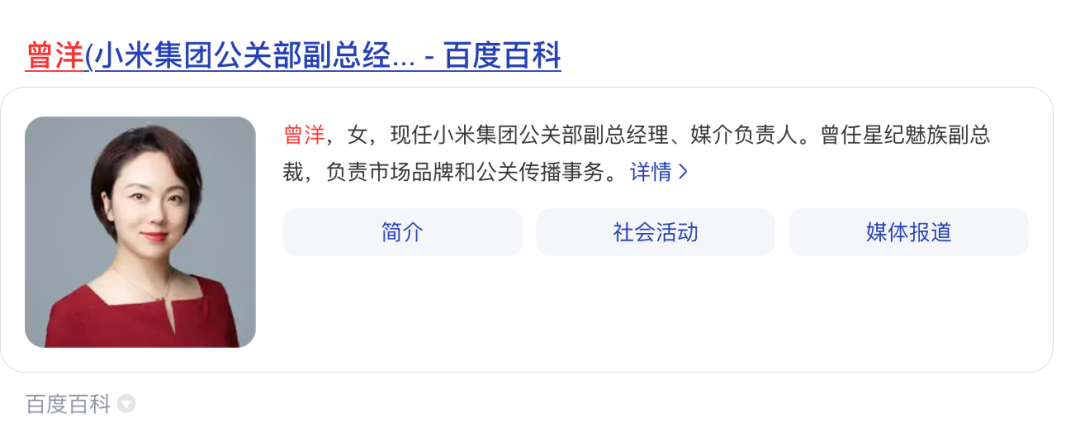 Image: Updated screenshot from Baidu Baike
However, Zeng Yang's Meizu background has sparked some light-hearted jests: "After Meizu 'taught' Lei Jun to make smartphones, will it now guide Xiaomi in PR?"
This sentiment harks back to a chapter in the smartphone industry. Before founding Xiaomi, Lei Jun had close ties with Meizu. After stepping down as CEO of Kingsoft, Lei Jun once sought to invest in Meizu, publicly stating on social media, "Why do I love Meizu? Because it's one of the few companies in China that does things with heart."
Huang Zhang, Meizu's founder, also intended to bring Lei Jun on board to lead Meizu's business. However, they clashed over equity, prompting Lei Jun to start anew—symbolically sipping a bowl of millet porridge to embark on his "final entrepreneurial journey." The two became estranged.
For instance, Huang Zhang once posted on Meizu's official forum about "an angel investor": "I'm not afraid of him, just disgusted. He used his angel investor status and relevant leaders to approach me, extracting Meizu's business secrets. From overall philosophy to smartphone design, development processes to supplier selection, production and sales, company status to core personnel access, and financial reports. Led by his sincerity and the leaders' good intentions, I fell into his trap."
Lei Jun can hardly deny this "episode." Early on, Xiaomi's business model, product philosophy, MIUI system logic, fan engagement, and community-building all faintly mirrored Meizu's approach.
To some extent, referring to Meizu and Xiaomi as mentor and protégé is not an overstatement. This connection has kept the two in a unique relationship of competition and mutual influence over the past decade—from early mutual inspiration to mid-term direct clashes, to now, with Meizu at its fourth crossroads and Xiaomi expanding its "human-vehicle-home" ecosystem to become a symbol of Chinese tech.
Their paths have crossed again. At a critical juncture for Xiaomi's premiumization, Zeng Yang's joining makes this intersection more symbolic, drawing industry attention and interpretation.
Notably, Xiaomi Group has not publicly confirmed Zeng Yang's hiring. Rumors suggest that many seasoned PR and media professionals have been approached for this role.
Xiaomi's Achilles' Heel Has Never Been PR
Shifting focus to the present, Xiaomi's core issue—or Achilles' heel—has never been PR, nor can it be easily resolved by a single personnel change.
Since 2025, Xiaomi Auto has faced multiple safety-related controversies, putting immense pressure on product reliability and user trust. For a giant transitioning from smartphones to automotive, the margin for safety errors is infinitely compressed.
Lei Jun once publicly "showed weakness" in May of the previous year, stating, "The past month has been the toughest since founding Xiaomi. I felt low, canceled some meetings and trips, and paused social media interactions."
He may have realized that compared to before Xiaomi's premiumization strategy, today's communication environment is more fragmented and emotionally charged. A moderate lowering of posture can win sympathy and offset public opinion pressure. Moreover, personal IP and traffic are double-edged swords—they aid communication and business but also trigger greater trust crises.
As Lei Jun emphasized in his May 2025 internal speech, after 15 years, Xiaomi's scale, influence, and social attention have reached new heights, demanding it act as a true industry leader. "Xiaomi no longer enjoys a 'rookie protection period' in any sector and must set higher standards and goals."
This marks a critical transition for Xiaomi and Lei Jun. They must break from past paths and redefine their positioning to achieve premiumization and transform themselves.
Against this backdrop, both inside and outside Xiaomi, hopes are pinned on the PR team to defend, counterattack, and tell Xiaomi's premiumization story. However, they often overlook a fact: PR is merely an amplifier, not a "story creator." What Xiaomi truly needs is an unwavering commitment to product strength and values.
Enterprises that truly transcend cycles all win long-term user trust through superior product experiences and clear value propositions.
PR can strengthen perceptions and mitigate conflicts to a degree, but it cannot invent stories out of thin air, nor hide business, product, or technical flaws. If products, technologies, or brands have objective shortcomings, even the most clever PR tactics will backfire, triggering public backlash. 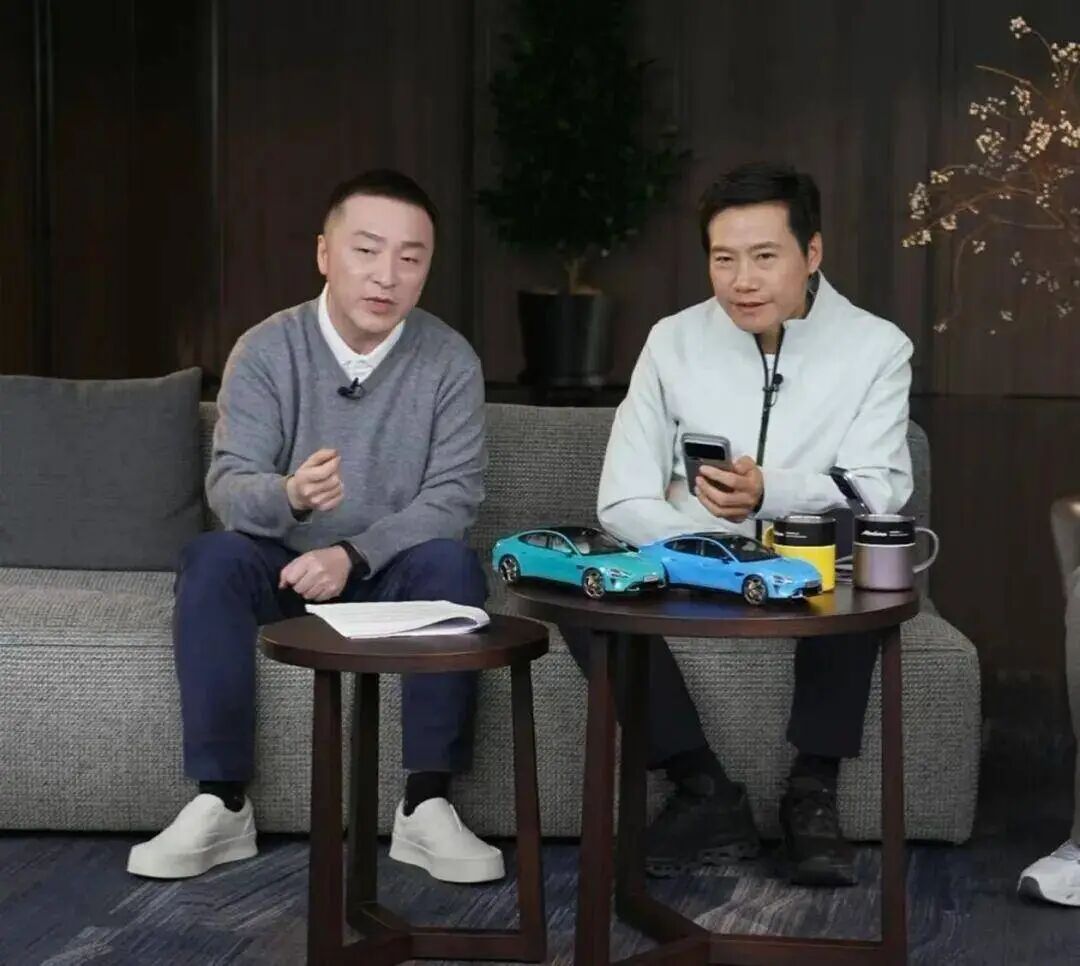 Image: Live stream screenshot of Lei Jun and Xu Jieyun
Currently, Lei Jun is striving to lead the team upward, building a premium brand image. However, Xiaomi's long-standing labels—"For the Feverish," "¥1,999," "high cost-performance"—remain obstacles to brand elevation.
For Xiaomi's market PR team, breaking past stereotypes requires more than cost-performance narratives, spec-based marketing, or traffic-driven tactics. Their challenge is: How to tell a compelling "premiumization story."
"This demands a new narrative logic—one aligned with 'human-vehicle-home' premiumization—to meet user and market expectations for 'safety, quality, and credibility.'"
In my view, this narrative must satisfy several logical foundations:
1. **Grounding in Products and Safety**: Without stable, reliable products and technologies, all communication is castles in the air.
2. **Winning Long-Term User Trust**: Beyond early "feverish" circles, focus on core technologies, innovative products, lifestyle contributions, and social value—e.g., breakthroughs in self-developed chips, imaging systems, smart manufacturing, and automotive safety—to reshape public perception.
3. **Establishing a Crisis Response System Matching Premium Positioning**: When issues arise, opt for transparency, honesty, and verifiable communication over hype. Avoid evasion, delays, or blame-shifting; rebuild reputation through accountability.
Simply put, Xiaomi's best way out of current public opinion dilemmas and user anxiety is to showcase irrefutable product capabilities, core technologies, and user experiences, truly ascend, and solidify its core moat.
An external "monk" like Zeng Yang might also disrupt Xiaomi's internal balance, better leveraging PR functions and easing pressure on Lei Jun. Her media and content background could prove valuable here.
Certainly, we also see subtle shifts in Xiaomi's PR strategy—a focus on professionalization and refined operations. This adjustment is inevitable as Xiaomi transitions from a startup to a mature public company, likely involving growing pains and turbulence.
From this angle, jokes about "Meizu teaching Xiaomi PR" can be dismissed with a smile. Corporate competition is ultimately a marathon. Personnel changes are tactical; strategic success still hinges on products and users.
References: 21st Century Business Herald, "Meizu Smartphones Hit the Brakes: The 'Specialist' Faces Its Fourth Crossroads"
-
![]()
Proposed to Raise 955 Million Yuan through Private Placement! Huicheng Vacuum Boosts Localization of Ultra-Precision Optical Coating Equipment
-
![]()
Cash Flow Soars 13-Fold! What Major Strategic Move is Wuhan Five Square Optoelectronics Planning?
-
![]()
Leaked Design of vivo X500: Reverts to Circular Camera Module in Top-Left Corner, Pays Homage to Classic X90 Aesthetic
-
![]()
DeepSeek Shows Signs of Foraying into Code Agents, Launches WeChat Official Account Focused on Harness
-
![]()
Auto Companies Deny Claims That ‘Cooperation with Huawei Is Non-Essential’, as Huawei Transforms into a ‘Public Platform’
-
![]()
Starship to Independently 'Return to the Launch Tower': SpaceX's Ambitions Extend Beyond Rocket Building to Dominating Space Transportation
-
![]()
Starship Set to Independently 'Return to the Launch Tower': SpaceX is Revolutionizing Space Transportation, Not Just Building Rockets
-
![]()
Anthropic and OpenAI Face Off Against Deepseek