[Industry In-Depth Research] Alibaba Forges Alliances with Fierce Competitors: What’s Behind Jack Ma’s Strategic Vision?
 03/04 2026
 611
611

Author | Wuji Discover more financial insights | BT Financial Data Pass The full text comprises 3,667 characters, with an estimated reading time of 9 minutes. Editor's Note:
In 2026, China’s internet sector undergoes a transformative shift in competitive-cooperative dynamics. Alibaba and Tencent make a rare joint investment in Moonshot AI, while Alibaba and Douyin progressively integrate their ecosystems. This evolution signals not only a strategic realignment among tech giants from rivals to partners but also embodies a vivid manifestation of technological self-reliance and strength in the new consumer landscape. From collaborative positioning in AI infrastructure to seamless fusion of e-commerce traffic, China’s internet industry is dismantling barriers with a "new paradigm of competitive cooperation," fostering an open and symbiotic digital ecosystem.
As the Year of the Horse commences, Alibaba frequently forms strategic alliances with other internet behemoths, heralding a new era of competitive cooperation within the industry.
Recently, Beijing-based Moonshot AI, a two-year-old startup, completed its "Series C+" funding round, raising over $700 million and sending ripples through the AI sector. The funding scale was substantial, and the investor lineup was star-studded. Notably, Alibaba and Tencent—long-time "rivals" with frequent clashes in e-commerce and mobile payments—rarely collaborated to heavily invest in this emerging tech company.
Following this funding round, Moonshot AI's valuation soared to between $10 billion and $12 billion, marking it as the fastest-growing Chinese startup to achieve such market scale domestically.
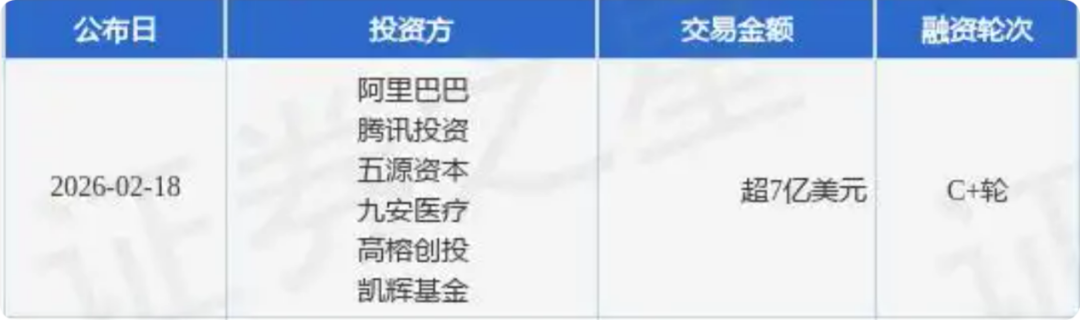
Beijing-based Moonshot AI is an AIGC company primarily focused on AGI. Founded on April 17, 2023, it secured angel round funding led by Sequoia China just two months later, with participation from top-tier VC firms like ZhenFund and Capital Today. On July 11 of the same year, Moonshot AI completed its Series A funding led by Meituan Dragonball Capital, marking astonishingly rapid progress. By December 31, 2025, Yang Zhilin, founder of Moonshot AI and a protégé of Tsinghua Professor Tang Jie and assistant professor at the Institute for Interdisciplinary Information Sciences at Tsinghua University, disclosed in an internal letter that the company had secured another $500 million in funding. Led by IDG Capital with a $150 million investment, existing shareholders including Alibaba, Tencent, Sequoia China, Meituan, Xiaohongshu, Gaorong Capital, and Wang Huiwen (individual) also participated. In just two years, this emerging company has become a hot target pursued by giants like Alibaba, Tencent, and Meituan.
The fact that internet giants Alibaba and Tencent have broken new ground by collaborating on Moonshot AI is not an isolated case. Alibaba is also gradually expanding cooperation with another rival, Douyin, in the e-commerce sector.
1
Why Are the Two Giants Collaborating?
Alibaba and Tencent's ability to collaborate may stem from their shared interest in Moonshot AI's Kimi large model. At its core, Moonshot AI pursues a dual strategy of self-research and investment to hedge technological risks, secure positions in AI infrastructure, and capture incremental opportunities in scenarios and globalization. This collaboration essentially reflects a strategic consensus and a competitive-cooperative choice between the two giants in the AI era.
Despite being relatively new, Kimi has repeatedly topped the iOS Free Apps chart. In March 2024, driven by features like "supporting 2 million-word contexts," Kimi's AI assistant app briefly claimed the top spot on Apple's App Store China Free Apps chart. During its peak, Kimi consistently ranked high in the Productivity and Utilities categories, becoming one of the fastest-growing AI applications at the time. In the Android market, Kimi frequently ranked among the top three in AI/efficiency app download charts across major domestic Android stores like Huawei, Xiaomi, and OPPO.
While no authoritative public data exists on specific market shares, the large model market is dynamically evolving, and vendors typically do not disclose exact figures. In reports by third-party agencies like IDC China, Kimi has not yet been listed alongside leading models like Alibaba's Tongyi Qianwen, Baidu's ERNIE Bot, or iFLYTEK's SparkDesk. However, leveraging its long-context capabilities, Kimi has rapidly accumulated users in niche scenarios such as legal and financial document processing.
Although Alibaba has Tongyi Qianwen and Tencent has Hunyuan (Yuanbao), both giants are supporting Kimi because self-research carries risks, and investment serves as technological insurance. Developing foundational models involves extreme uncertainty, requiring massive investment and long cycles with no short-term returns. Investing in Moonshot AI hedges against technological missteps. Since its inception, Moonshot AI has focused on long-text processing, complex reasoning, and Mixture of Experts (MoE) architectures, complementing Alibaba and Tencent's self-research paths and avoiding directional errors.
By investing, Alibaba and Tencent aim to acquire cutting-edge capabilities at a lower cost, compensate for (make up for) self-research shortcomings in long-context processing, professional reasoning, and efficiency. This not only mitigates risks from delayed self-research progress but also binds them to top-tier AI teams, ensuring they are not excluded from core AI technological trends.
2
What Makes Moonshot AI So Attractive?
Moonshot AI, pursued by so many giants, undoubtedly has unique strengths. Currently, it is one of the few independent large model companies in China with global competitiveness, even needed by giants like Alibaba and Tencent to strengthen their cloud and scenario ecosystems.

Moonshot AI's true "moat" lies in its radical efficiency revolution. Large models are notoriously "compute-hungry," but Moonshot AI has achieved "magical" cost reductions and efficiency gains through proprietary innovations like the Muon second-order optimizer and Kimi Linear architecture. It requires only 50% of the industry-average training data for equivalent performance, boosts inference speed sixfold, and reduces memory usage by 75%, breaking the industry myth that "large models equal high costs."
Alibaba Cloud and Tencent's Hunyuan each have strengths but also shortcomings. Alibaba Cloud enhances its MaaS (Model-as-a-Service) capabilities to provide top-tier models for government and enterprise clients, building a closed loop of "compute-model-application." Tencent is addressing gaps in Hunyuan's general foundational capabilities and complex reasoning to empower scenarios like WeChat, Enterprise WeChat, documents, and gaming. Their common goal in investing in Kimi is to secure core positions in the AI supply chain's model layer, avoiding reliance on external models like OpenAI.
Despite its short history, Moonshot AI has demonstrated commercial and global validation, forming predictable growth—a key metric for giants like Alibaba and Tencent. Its efficiency advantage is most prominent: Kimi achieves low-cost, high-efficiency model iteration, leading globally in usage on platforms like OpenRouter, gradually forming a commercial closed loop (closed loop) with rapidly growing API revenue. Its overseas revenue now surpasses domestic earnings, creating a replicable monetization path. This aligns with Alibaba's cross-border e-commerce and Tencent's gaming overseas expansion, enabling global market synergy.
After decades of competition, Alibaba and Tencent's competitive logic is shifting. AI is the future battleground, and large models are the next-generation digital infrastructure—neither can afford to be absent. The market is vast enough that no single player can dominate, making collaboration more cost-effective than solo efforts. Joint investments reduce individual risks while enabling synergies at the model layer, allowing differentiated competition at the application layer.
The formidable Kimi has united China's two giants in a collective bet, signaling a concentration of primary market investments in top-tier model companies. Alibaba and Tencent's joint investment in Moonshot AI is a strategic choice to hedge self-research risks, secure AI infrastructure positions, and gain the upper hand in global AI competition—provided Moonshot AI maintains the strength worthy of these giants' respect.
3
Alibaba and Douyin Begin to "Break Down Walls"
Not only can Alibaba and Tencent "sit at the same table," but China's internet sector in spring 2026 is also witnessing new competitive-cooperative dynamics. Once seen as "mortal enemies," Alibaba and Douyin are now moving toward unprecedented deep integration. From interoperability at the payment layer to frontend traffic exchange and supply chain collaboration, this shift not only marks the end of the "walled garden" era but also signals that China's internet industry has entered a high-quality development phase centered on "interconnectivity."
In 2025, Alibaba, JD.com, Pinduoduo, and Douyin E-commerce shared a stage for the first time at the "Inaugural Export-to-Domestic Commodity Expo." The four platforms abandoned zero-sum competition, opting instead to share supply chain resources and jointly help foreign trade enterprises tap the domestic market. This "online-offline fusion" model not only stimulated consumption recovery but also sent a clear message: in an era of stock competition (market saturation), cooperation creates more incremental value than confrontation. By 2026, this macro-level strategic tacit understanding had translated into micro-level product implementations.
The most visible change occurred in the linkage between Gaode Maps (Alibaba's navigation app) and Douyin. Now, when users search for specific stores on Gaode, the interface directly displays group-buying coupons or purchase links from Douyin stores, enabling seamless jumps to Douyin for transaction completion. This seemingly simple feature update represents a deep "handshake" between Alibaba and Douyin's ecosystems.
As Alibaba's core entry point for local life services, Gaode possesses precise location data and massive travel traffic, while Douyin commands highly engaging content-driven consumption scenarios. Their integration means Alibaba addresses its content deficit, and Douyin gains richer offline fulfillment scenarios. This closed loop of "map navigation + content seeding + instant transactions" significantly shortens user decision paths and enhances commercial conversion efficiency.
Additionally, as China's antitrust and interconnectivity policies deepen, Douyin E-commerce has begun gradually integrating Alipay as a payment option. This is not merely an addition of payment channels but also an interoperability of trust mechanisms. For merchants, it eliminates the need for multiple payment settlement systems across platforms, drastically reducing operational costs. For consumers, it preserves payment habits and streamlines the shopping experience. Removing payment barriers clears the way for deeper collaboration on traffic and data.
For Alibaba, amid anxiety over stagnating traffic growth, integrating Douyin's massive content flow is key to activating inventory (existing users) and increasing user engagement. For Douyin, having transitioned from rapid growth to refined operations in e-commerce, it urgently needs Alibaba's mature supply chain, logistics infrastructure, and high-net-worth user base to sustain GMV growth. Their complementary strengths form a perfect puzzle of "content + shelf" and "traffic + fulfillment."
This cooperation also reflects the maturity of China's digital economy governance model. Guided by policies, platform economies are shifting from "disorderly expansion" to "standardized, healthy, and sustainable development." Giants now recognize that building open, symbiotic ecosystems holds far greater long-term value than erecting walls to hoard traffic. In the future, we may see more cross-platform membership interoperability, data sharing, and even joint marketing campaigns.
Alibaba's alliances with other internet giants are not an endpoint but the starting point for China's internet to enter the "borderless retail" era. When traffic is no longer a private moat but a shared resource, China's internet and tech industries will undergo a true efficiency revolution. In this transformation, the ultimate beneficiaries will be millions of merchants and billions of consumers, as a more open, efficient, and diverse digital commercial landscape unfolds.
This article is an original work by BT Finance and may not be used, reproduced, disseminated, or adapted without permission. Infringement will be subject to legal liability.
-
![]()
Proposed to Raise 955 Million Yuan through Private Placement! Huicheng Vacuum Boosts Localization of Ultra-Precision Optical Coating Equipment
-
![]()
Cash Flow Soars 13-Fold! What Major Strategic Move is Wuhan Five Square Optoelectronics Planning?
-
![]()
Leaked Design of vivo X500: Reverts to Circular Camera Module in Top-Left Corner, Pays Homage to Classic X90 Aesthetic
-
![]()
DeepSeek Shows Signs of Foraying into Code Agents, Launches WeChat Official Account Focused on Harness
-
![]()
Auto Companies Deny Claims That ‘Cooperation with Huawei Is Non-Essential’, as Huawei Transforms into a ‘Public Platform’
-
![]()
Starship to Independently 'Return to the Launch Tower': SpaceX's Ambitions Extend Beyond Rocket Building to Dominating Space Transportation
-
![]()
Starship Set to Independently 'Return to the Launch Tower': SpaceX is Revolutionizing Space Transportation, Not Just Building Rockets
-
![]()
Anthropic and OpenAI Face Off Against Deepseek