Liang Rubo Guides ByteDance Through Four Years, Steering the Behemoth into the AI Age
 07/06 2026
 374
374
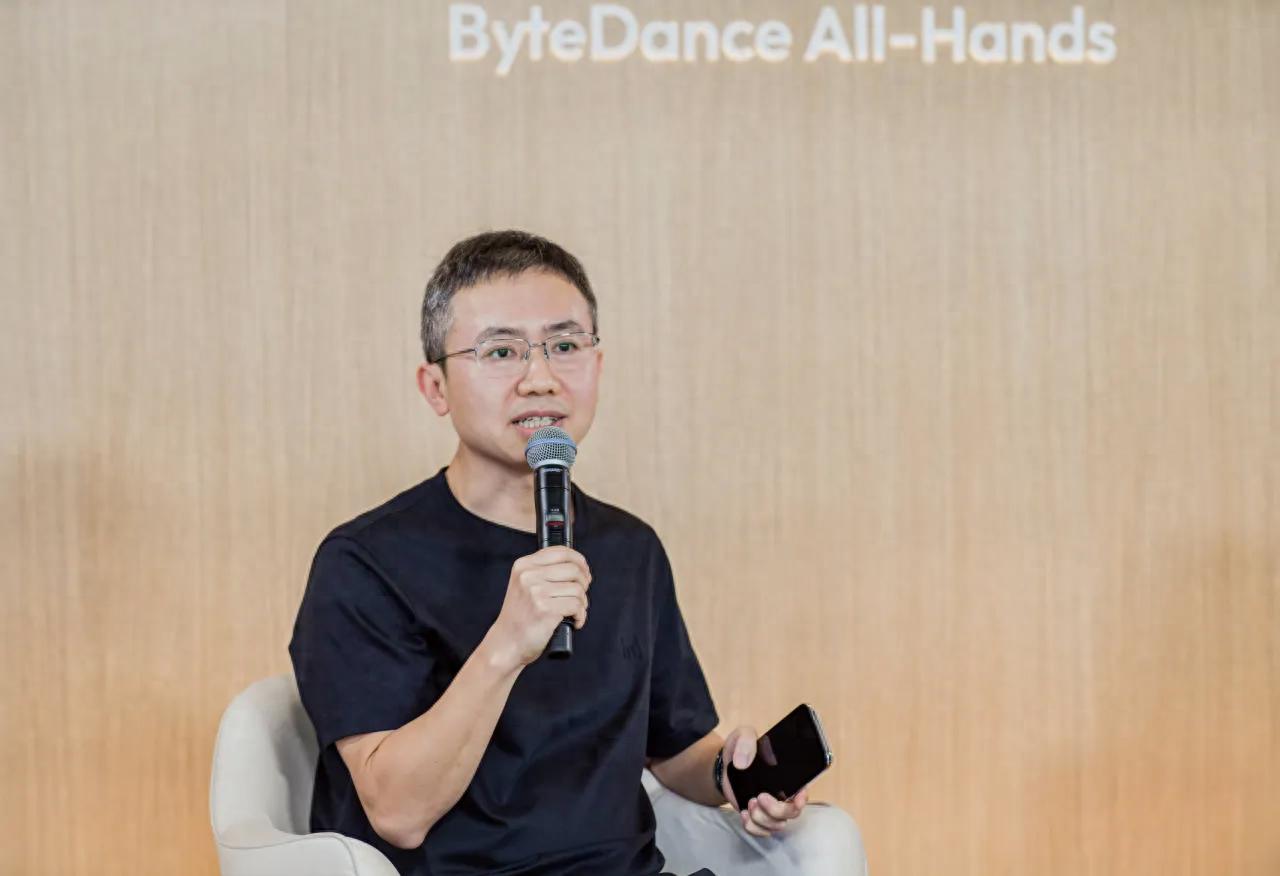
In May 2021, Zhang Yiming announced his resignation as CEO of ByteDance, passing the baton to his college roommate, Liang Rubo.
What challenges did Liang Rubo face at that juncture?
Prior to Zhang Yiming's departure, ByteDance's revenue stood at approximately $34.3 billion in 2020. The pressure was monumental.
Four years on, in 2025, ByteDance's annual revenue soared to approximately $186 billion, marking a year-on-year increase of about 20% and surpassing Tencent and Alibaba to claim the top spot among Chinese internet firms.
Under Liang Rubo's stewardship for four years, ByteDance's revenue has more than quintupled.
A CEO with a technical background has delivered a stunning performance that has left everyone in awe.
01
Let's first delve into Liang Rubo's achievements over these four years.
Upon assuming the CEO role in 2021, he initiated three major transformations: enhancing organizational efficiency, deploying an AI strategy, and pursuing globalization.
In terms of organizational efficiency, ByteDance launched a "streamlining and strengthening" initiative in 2022, slashing management costs by 35% over three years.
In the latter half of 2022, ByteDance's overall workforce and organizational size remained stagnant. In an era when internet giants were generally expanding, Liang Rubo opted to "slim down."
Regarding globalization, TikTok's "Clover Project" established seven regional data centers in Europe. By 2025, ByteDance's overseas revenue surged nearly 50% year-on-year, with its share rising from 25% in 2024 to over 30%, a record high.
The revenue figures speak volumes:
$61.7 billion in 2021, $85 billion in 2022, $120 billion in 2023, $155 billion in 2024 (a 29% year-on-year increase), and approximately $186 billion in 2025.
In four years, revenue skyrocketed from $61.7 billion to $186 billion, a threefold increase.
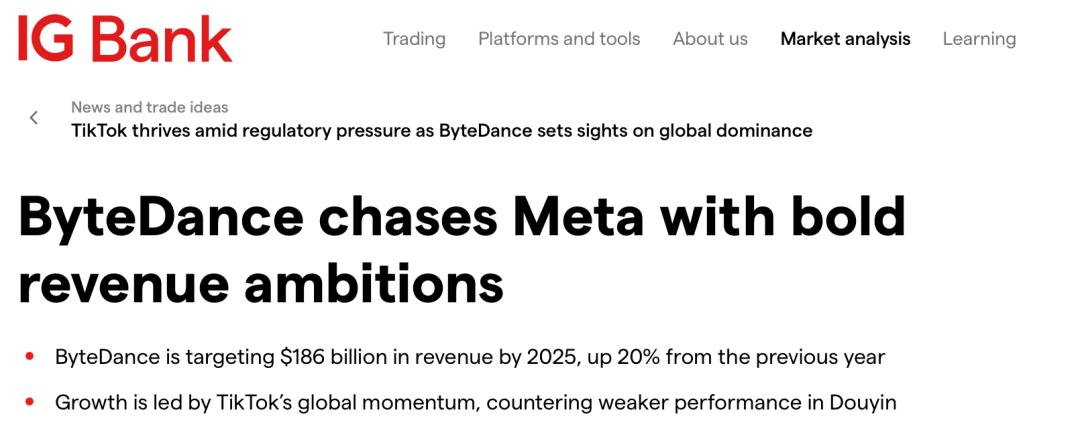
Although the growth rate gradually decelerated from 86% in the early stages to around 20%, the scale is now incomparable.
When Liang Rubo took the helm, ByteDance was a high-growth star company; four years later, it has evolved into China's internet revenue behemoth.
02
However, what impresses the industry most about Liang Rubo is not merely maintaining the status quo but pivoting.
In 2023, ByteDance established AI Lab.
In 2024, it rolled out version 1.6 of the Doubao large model, reducing inference costs to one-third of the industry benchmark.
In 2025, Doubao's monthly active users surged from 99.8 million in the first quarter to 230 million in the fourth quarter, becoming China's first AI-native application with over 100 million daily active users.
In the first quarter of 2026, Doubao's monthly active users reached approximately 345 million, surpassing the combined total of the second and third-ranked apps. The daily average token usage reached 180 trillion, a more than 1,500-fold increase since its launch.
Volcano Engine's MaaS commands a 49.5% market share in China's public cloud.
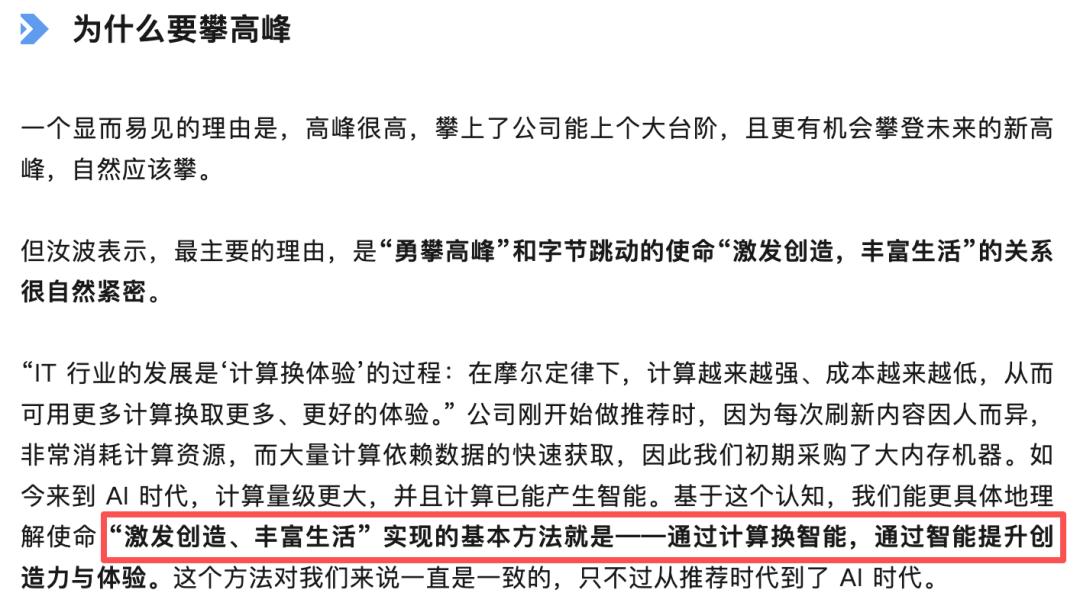
In an internal memo, Liang Rubo stated that from the recommendation era to the AI era, ByteDance's approach to fulfilling its mission remains unchanged: "Transforming computation into intelligence and enhancing creativity and experience through intelligence."
(Image source: ByteDance's official WeChat account)
How significant is ByteDance's investment in AI?
In 2025, the annual capital expenditure reached approximately 160 billion yuan, with about 90 billion yuan earmarked for AI computing chips and server procurement.
The 2026 AI infrastructure budget has been revised upward multiple times, with overall investment further increasing compared to 2025.
Profits were sacrificed in the process.
In 2025, ByteDance's net profit plummeted by more than 70% year-on-year, dropping from approximately $33 billion in 2024 to just over $9 billion.
However, Liang Rubo's choice is unequivocal: trading profits for the future.
03
On June 29, 2026, Liang Rubo issued a company-wide memo, his first in four years.
The significance of this memo rivals that of his assumption of the CEO role in 2021.
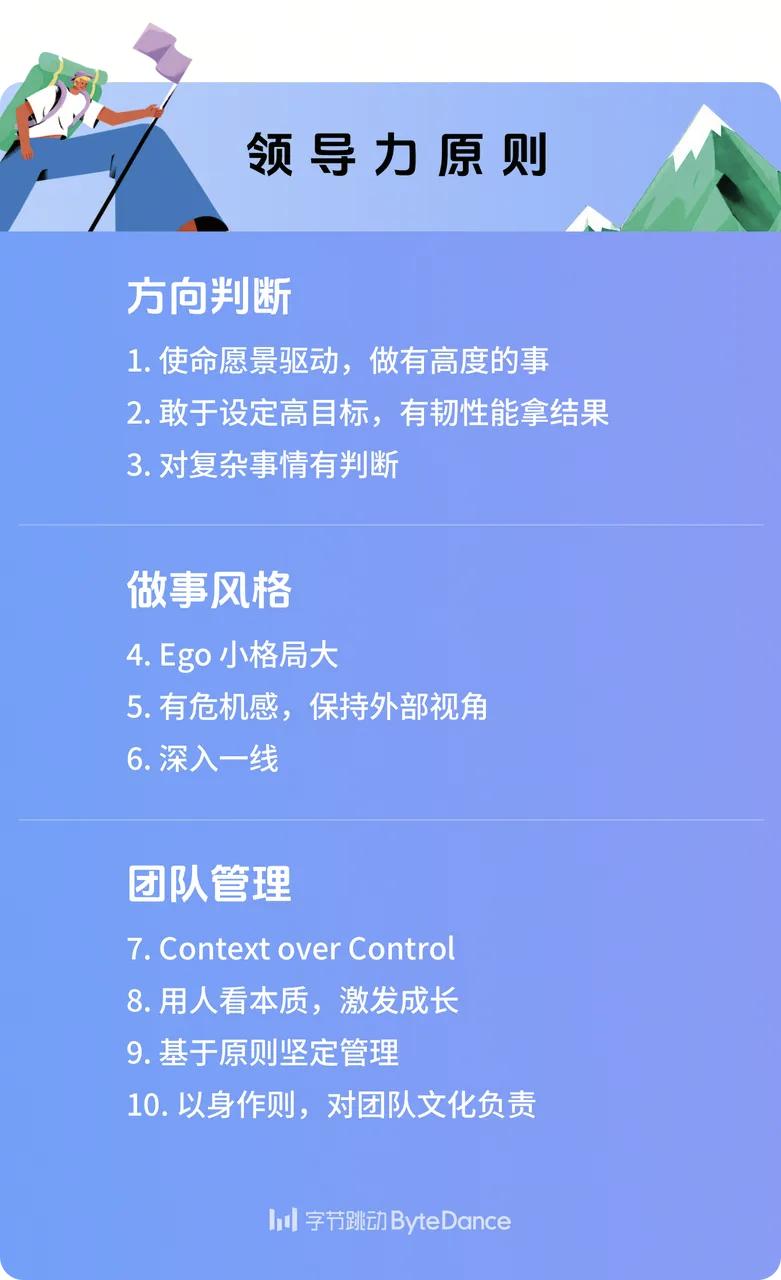
In the memo, Liang Rubo comprehensively updated ByteDance's cultural system and leadership principles, focusing on three directions:
First, pursue ambitious goals. Managers should not solely focus on short-term revenue but dare to set challenging high targets.
Second, stay close to the frontlines. Managers should not remain secluded in offices reviewing reports but must regularly immerse themselves in business, products, and users.
Third, Context over Control. Replace layered control with sufficient information sharing, listing multi-level approvals, redundant meetings, and ineffective reports as negative management examples.
(Image source: ByteDance's official WeChat account)
This memo is regarded by the industry as a foundational organizational restructuring for ByteDance in the AI era.
Liang Rubo wrote in the memo, "Based on the ongoing industry transformations and our organizational development needs, we have recently reviewed and updated our cultural content."
Four years ago, he inherited a position of power; four years later, he is reforming a set of rules.
04
Some may wonder: Why does ByteDance, already the internet revenue leader, need to overhaul its rules?
The answer lies in Liang Rubo's 2024 internal speech.
He stated that ByteDance's keyword for 2024 is "Always Pioneering, Escaping the Gravity of Mediocrity."
He cited an example: A former ByteDance employee joined a startup and accomplished in one month what would have taken six months previously.
"In a mediocre and inefficient organization, people feel more tired because, despite their hard work, the results are unsatisfactory. This is what I find most concerning and crisis-inducing."
When a company grows to a certain size, its greatest enemy is not competitors but internal "gravity."
Liang Rubo is acutely aware of this. In January 2026, he set the annual keyword as "Scaling New Heights," explicitly making the short-term core goal to excel in the Doubao/Dola assistant applications.
At the Volcano Engine FORCE Conference in June, he said, "Over the past few years, we have been narrowing our business scope to focus on AI."
From "doing everything" to "only doing the most important things," Liang Rubo is transforming ByteDance from an expansion machine driven by "sheer force" into a precision organization "focused on tough battles."
Conclusion
When Liang Rubo took over as CEO of ByteDance in May 2021, numerous questions arose:
Could Zhang Yiming's "shadow" stand alone? Could a technically oriented individual manage a company of 100,000 employees?
Four years later, the answers are evident in the numbers:
Revenue surged from $61.7 billion to $186 billion, Douyin's DAU increased from 600 million to 760 million, and Doubao's monthly active users grew from zero to 345 million.
He has not only safeguarded the empire Zhang Yiming built but also led ByteDance into the AI battlefield.
Despite a net profit plunge exceeding 70% in 2025, sparking external debates, the industry believes Liang Rubo is clear-eyed:
The current profits are exchanged for future opportunities. If ByteDance loses the AI battle, its massive revenue will be nothing but a castle in the air.
Six years later, he declares, "Scaling New Heights."

(Image source: ByteDance's official WeChat account)
Liang Rubo has proven himself a competent "defender" over the past four years; now, he aims to prove he can also be a "pioneer."
Liang Rubo has done well these past four years. The next four years will be the true test.
-
![]()
The Surprisingly Significant Impact Difference Between Quiet and Noisy Cars!
-
![]()
Breaking Through Storage Cycle Barriers: How AI Large Models and Coding Technology Synergize to Drive Transformation in the Security Industry
-
Facilitating the Slimming of Camera Modules! O-film Obtains Utility Model Patent for Periscope-Type Reflective Component
-
![]()
Hikvision Raytine’s Millimeter-Wave Body Imaging Security Inspection Device Achieves ECAC SSc Category A Standard Level 2.1 Certification for European Civil Aviation
-
![]()
Global Market Share for Security Windows Hits 26%! This Optical 'Little Giant' Makes Its Debut on NEEQ
-
![]()
The Evolutionary Path of Agent Engineering: From Prompt to Harness by Zhang Yutao, Co-founder of Moonshot AI
-
![]()
Profits and stock prices are both declining, so why are executives from these auto companies increasing their purchases?
-
![]()
Burning Tens of Billions of Dollars, Yet No Unified Definition for World Models