WPS Remains Unchanged; It’s the Users’ Perception of “Free” That Has Shifted
 07/07 2026
 358
358
On July 6, Kingsoft Office released a straightforward and clear statement:
Claims that WPS is “overcharging and betraying users” are baseless.
The statement outlined four core principles: free features remain accessible at no cost, membership benefits are maintained without reduction, high-cost services are billed separately based on demand, and user feedback is taken seriously.
Niudao read the statement three times, grasping each word individually but perceiving a nuanced shift in meaning when viewed as a whole.
WPS hasn’t changed; rather, users’ expectations of what “free” entails have evolved.
01
Let’s first explore WPS’s history of offering free services.
In the late 1980s, Qiu Bojun single-handedly developed WPS 1.0. Before Microsoft Office entered the Chinese market, WPS was the go-to software for computer-based typing. Later, Microsoft Office arrived with aggressive bundling strategies, nearly pushing WPS out of the market.
It wasn’t until 2005, when WPS Personal Edition was made available for free, that it began to recover its user base.
During those years, the relationship between users and WPS was straightforward: if it was free, they used it; if it charged, they looked for alternatives.
But this balance was disrupted in the mobile internet era.
WPS was no longer just a text editor; it transformed into a cloud-based document tool, PDF utility, format converter, template library, and AI assistant.
Its cost structure changed accordingly, yet many users still viewed it as merely “free typing software.”
02
Now, let’s examine the second principle in the statement: “Membership benefits will never be downgraded or reduced.”
Behind this statement lies an uncomfortable truth for WPS:
Users feel they are paying more without receiving additional value.
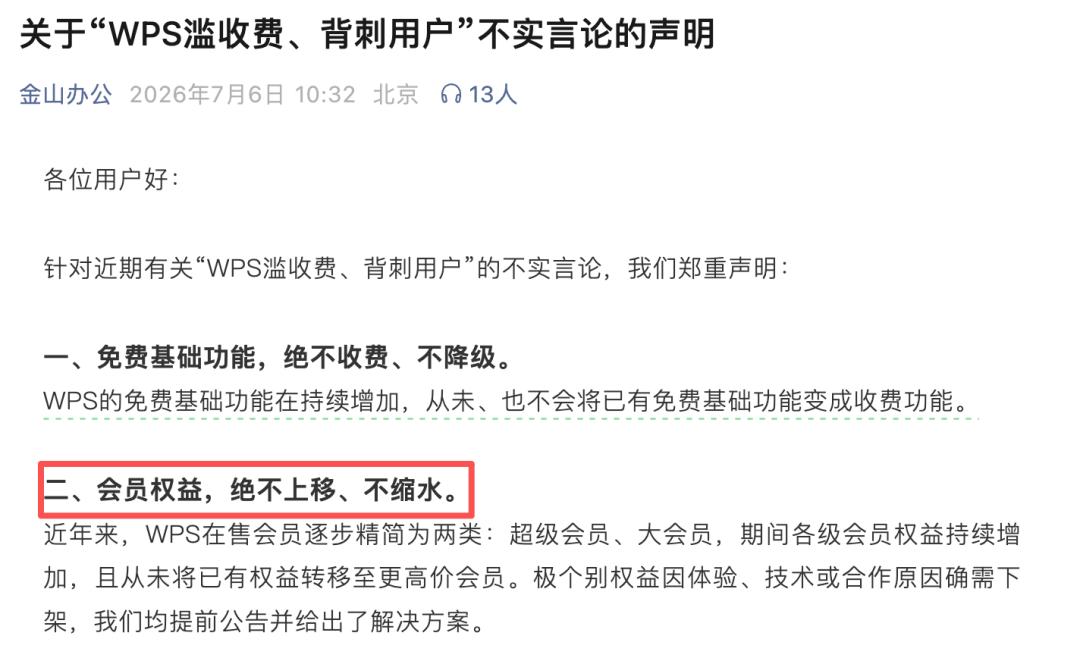
(Source: Kingsoft Office’s official Weibo)
Niudao specifically reviewed the evolution of WPS’s membership system.
A few years ago, WPS offered separate memberships: Daoke Member, WPS Member, and Super Member.
Later, these were consolidated into Super Member and Grand Member. Then, with the introduction of AI features, a separate AI Member tier was created.
WPS claims this is “simplification,” but users perceive it differently: functions that were once accessible with a single membership now require two.
The statement explains: “In rare cases where benefits must be removed due to experience, technical, or partnership reasons, advance notice and solutions are provided.”
The logic is sound.
But users don’t care about the process; they only care about the outcome: am I paying more or less?
03
What confuses users the most is the third principle in the statement: “High-cost services are billed separately and purchased on demand.”
WPS charges separately for AI features, citing “high costs.”

(Source: Kingsoft Office’s official Weibo)
WPS didn’t publicly calculate these costs in the statement, but Niudao can make a rough estimate:
The inference costs of large models are indeed substantial, and the more they are used, the greater the financial losses.
If AI costs were included in membership fees, there would only be two outcomes:
Either membership prices rise, and everyone pays, or AI features are downgraded to basic versions. WPS chose a third option: separate pricing, where only users who need it pay.
This choice is commercially sound, but it steps into a minefield:
Users are far more sensitive to “price hikes” than to “new paid options.”
04
Niudao believes WPS’s real issue may lie in another detail: inconsistent pricing across channels.
WPS membership prices vary significantly across official channels, app stores, third-party platforms, and enterprise purchases.
A user who buys a membership on the official website may discover a colleague purchased the “same” membership on Pinduoduo for less than half the price, creating a sense of “overpaying” that overwhelms rational judgment.
Coupled with frequent adjustments to membership packages, users are confused about which version they bought and what features it includes. When a function is removed from their benefits, the “sense of betrayal” becomes immediate.
When users shift their focus from “value for money” to “feeling cheated,” no amount of explanation can easily win them back.
The fourth point in WPS’s statement says: “We take criticism and suggestions seriously and make timely improvements. For malicious rumors and deliberate defamation, we will defend our rights by law.”
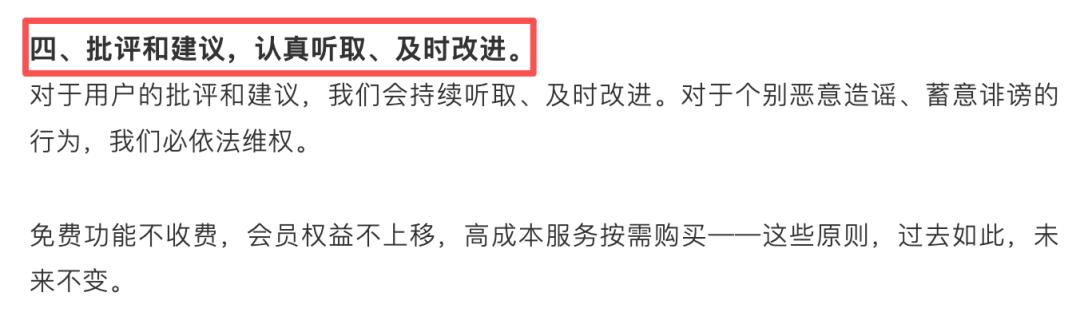
(Source: Kingsoft Office’s official Weibo)
The first half reflects an open attitude; the second half sets a clear boundary.
But Niudao wants to emphasize: what truly hurts users is not “free turning into paid,” but the failure to clearly explain in advance that “pricing standards are changing.”
User trust in WPS is built on an implicit contract:
WPS should understand Chinese users better than Microsoft. But now users are confused because WPS is treating them the way Microsoft does.
Niudao has a soft spot for WPS.
It’s one of the few domestic software products that survived the PC era and continues to thrive.
In an era when Microsoft Office nearly monopolized the market, WPS carved out a path with its free model.
Now it wants to do the same with AI, which is not inherently wrong.
Keeping free features free is the greatest respect for long-time users.
Billing high-cost services separately is the most rational commercial choice.
Both logic points are valid individually, but together they form a chain of reasoning that users find difficult to understand.
WPS’s statement says, “This has been our approach in the past and will remain unchanged in the future.”
But if it could explain the “why” behind the changes more clearly, flatten price disparities across channels, and define membership benefits more precisely, it probably wouldn’t need to issue such a lengthy statement in response.
-
![]()
The Surprisingly Significant Impact Difference Between Quiet and Noisy Cars!
-
![]()
Breaking Through Storage Cycle Barriers: How AI Large Models and Coding Technology Synergize to Drive Transformation in the Security Industry
-
Facilitating the Slimming of Camera Modules! O-film Obtains Utility Model Patent for Periscope-Type Reflective Component
-
![]()
Hikvision Raytine’s Millimeter-Wave Body Imaging Security Inspection Device Achieves ECAC SSc Category A Standard Level 2.1 Certification for European Civil Aviation
-
![]()
Global Market Share for Security Windows Hits 26%! This Optical 'Little Giant' Makes Its Debut on NEEQ
-
![]()
The Evolutionary Path of Agent Engineering: From Prompt to Harness by Zhang Yutao, Co-founder of Moonshot AI
-
![]()
Profits and stock prices are both declining, so why are executives from these auto companies increasing their purchases?
-
![]()
Burning Tens of Billions of Dollars, Yet No Unified Definition for World Models