Tencent’s Strategic Maneuver: Selling Kuaishou, Investing in Kling
 07/07 2026
 508
508
By | Bishan
Source | Bowang Finance
On July 6, Tencent unveiled plans to divest 273 million shares of Kuaishou, priced between HK$43.15 and HK$44.53 each, potentially raising up to US$1.6 billion (HK$12.5 billion). This move involves offloading roughly 40% of Tencent’s 15.7% stake in Kuaishou, leaving it with approximately 9% post-transaction.
Just four days prior, on July 2, Kuaishou’s subsidiary, Kling AI, secured a staggering US$3 billion in funding, valuing the company at US$18 billion post-investment. This marked the largest funding round ever for a global video generative AI firm, with Tencent taking the lead by contributing RMB 1.363 billion.
In a strategic pivot, Tencent is reducing its holdings in Kuaishou while ramping up investment in Kuaishou’s AI assets. This maneuver underscores a few key insights: Tencent sees the value of Kuaishou’s short-video business and content platform as being discounted, while Kling’s AI assets are being priced at a premium. It’s not that Tencent is bearish on Kuaishou; rather, it’s a case of capital revaluing assets—content platforms are seen as legacy assets, while AI represents growth assets.
The deeper rationale stems from Tencent’s own circumstances. Its stock price dipped to around HK$400 in the past month, with valuations nearing levels seen in late 2022. The company has been aggressively repurchasing shares, buying back nearly HK$500 million worth daily, totaling almost HK$10 billion in the past month. Facing pressure on its own stock, Tencent needs to liquidate some external investments. Selling Kuaishou is more advantageous than offloading stakes in Pinduoduo, Xiaomi, or Sea, as Kuaishou houses US$18 billion worth of AI assets that can chart an independent growth trajectory. Tencent’s issue isn’t a lack of vision; it’s a lack of capital.
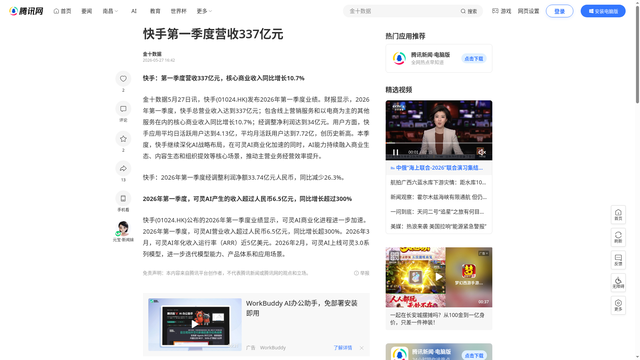
Screenshot Source: Tencent News/Jinshi Data, May 27, 2026 | Kuaishou’s Q1 revenue hit RMB 33.7 billion, with Kling AI contributing over RMB 650 million, up 300% year-over-year.
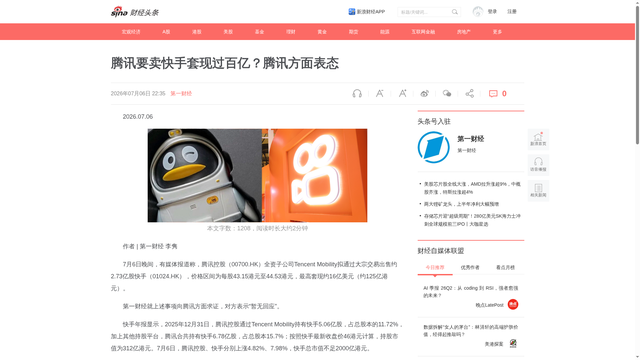
Screenshot Source: Yicai/Sina Finance, July 6, 2026 | Tencent plans to sell 273 million Kuaishou shares, potentially raising HK$12.5 billion.
01
Why Is an AI Company Losing RMB 1.9 Billion Annually Valued So Highly?
When Kling’s financing details were released, many questioned whether the valuation was inflated.
In 2025, Kling generated roughly RMB 1.1 billion in revenue but reported a net loss of RMB 1.9 billion, nearly quadrupling from RMB 500 million in 2024. By the end of 2025, Beijing Kling had total assets of RMB 244 million, total liabilities of RMB 253 million, and negative net assets of RMB 9 million—technically insolvent. How, then, can a company with negative net worth be valued at US$18 billion?
The answer lies in its growth trajectory. In Q1 2026, Kling generated RMB 650 million in revenue, up over 300% year-over-year. Its annualized revenue run rate soared from US$240 million in December 2025 to US$500 million in March 2026, a 108% increase in just six months. With over 100 million global users across 224 countries and regions, and nearly 50,000 enterprise clients, Kling stands out as one of the few players in the global video generative AI sector generating commercial revenue, especially amid Sora’s shutdown and industry consolidation.
More critically, consider the valuation framework. Kling’s US$18 billion valuation, based on a US$500 million annualized revenue run rate, implies a price-to-sales (P/S) ratio of 36x. In contrast, Kuaishou’s parent company, with a market cap of approximately US$23.5 billion (as of July 2 closing) and expected 2026 revenue of RMB 146.8 billion, trades at just 1.15x P/S. As an AI company, Kling’s valuation multiple is 31x higher than Kuaishou’s as a content platform. This stark disparity explains why Kuaishou spun off Kling—while integrated, Kling’s value would be capped by Kuaishou’s 1.15x P/S ratio; independently, the market prices AI assets at 36x.
Kuaishou’s own challenges accelerated the spin-off. In Q1 2026, its revenue grew just 3.4% year-over-year to RMB 33.7 billion, the slowest pace since listing. Adjusted net profit fell 26.3% year-over-year to RMB 3.374 billion. Live-streaming revenue declined 13.5% year-over-year, while advertising revenue grew 9.3%—far below Douyin’s 20%+ growth in the same period. Annual AI capital expenditures are expected to reach RMB 26 billion, up RMB 11 billion year-over-year. While Kling is housed within Kuaishou, it neither benefits from AI valuation premiums nor stops draining the parent company’s profits. Spinning it off for independent financing is a relief for both parties.
However, the US$18 billion valuation comes with conditions. The financing agreement includes a clause: If Kling fails to go public by October 30, 2031, investors have the right to a repurchase at an 8% annual simple interest rate. The five-year IPO deadline and 8% repurchase guarantee mean capital provided US$3 billion but set a countdown timer. From 2026 to 2031, Kling must navigate from commercialization to IPO within five years. Every dollar of the US$3 billion comes with time costs.
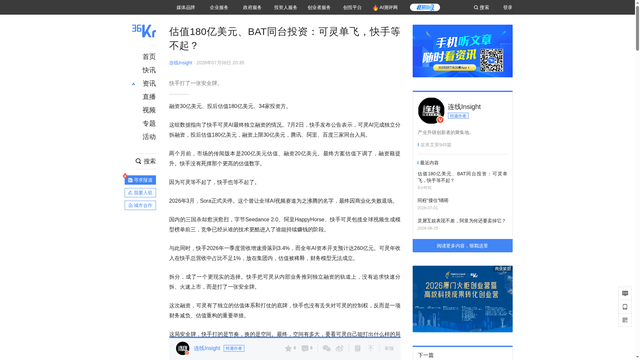
Screenshot Source: 36Kr, July 6, 2026 | Kling AI raises US$3 billion at a post-money valuation of US$18 billion, with BAT investors on board.
Kuaishou’s equity arrangement is also noteworthy. Post-financing, Kuaishou retains a 68.33% stake in Kling, while Cheng Yixiao (Kuaishou’s CEO) receives a 1% stake at zero cost (with a three-year lockup), and Kling CEO Gai Kun receives a 3% stake plus up to 4x voting rights. This arrangement signals two things: First, Kuaishou will not relinquish control, and Kling’s financials will remain consolidated in the parent company’s reports. Second, the core team is deeply incentivized, trading equity for loyalty. This isn’t offloading a burden but “making what should be valuable truly valuable.”
02
Selling Kuaishou to Fund Buybacks, Betting on Kling for the Future
Tencent’s reduction of its Kuaishou stake, while raising HK$12.5 billion on the surface, is essentially an asset revaluation and cash reallocation.
Tencent currently holds 679 million Kuaishou shares (15.7% stake). At Kuaishou’s latest closing price of HK$46, this is worth HK$31.2 billion. Selling 273 million shares to raise HK$12.5 billion reduces its position by 40%. Where will this money go? The most direct use is share buybacks—Tencent has repurchased nearly HK$10 billion worth of shares over the past month, almost HK$500 million daily. HK$12.5 billion could fund another month of buybacks. With its stock at HK$400, even Tencent sees it as undervalued.
Here’s a telling timeline: Tencent’s Kuaishou divestment occurred after Kling’s financing closed. In other words, Tencent first secured its stake in Kling AI (as a lead investor with RMB 1.363 billion) before deciding to reduce its Kuaishou holding. The logic is clear—retain AI assets, liquidate content platform stakes. This isn’t a negative verdict on Kuaishou but a prioritization between “AI assets” and “content platform assets.”
Tencent’s investment strategy shifted fundamentally around 2021. Prior to that, its approach was “connect everything”—using capital and traffic to secure positions in e-commerce, local services, short video, and global markets, with investments like Kuaishou, JD.com, Meituan, and Sea. The turning point came in 2021, with regulatory tightening and antitrust scrutiny prompting Tencent to refocus. In 2022, it distributed Meituan shares to shareholders, reaping over HK$100 billion. In 2021, it sold JD.com stakes for nearly HK$80 billion. By early 2025, it reduced holdings in Weimob and UBTECH.
Today, many external stakes lack meaningful synergy with Tencent’s core business, and returns have plateaued. The fair value of Tencent’s listed investment portfolio fell from RMB 672.7 billion at the end of 2025 to RMB 547.1 billion by March 2026, a quarterly decline of RMB 125.6 billion. In this context, “holding tight” is no longer rational.
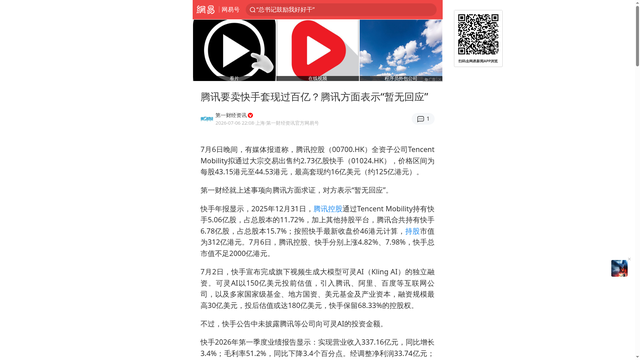
Screenshot Source: Yicai/NetEase, July 6, 2026 | Tencent plans to sell 273 million Kuaishou shares, raising HK$12.5 billion, while Kling AI secures US$3 billion in financing.
A counterexample illustrates the point. When Bill Gates took Microsoft public, he held ~45% of its shares. Later, his family office diversified into “stable” sectors like railways, real estate, and hotels by continuously selling Microsoft stock. Forbes estimates this cost Gates over US$1 trillion in lost gains. The best investment is often the one you understand best. Tencent clearly grasps this—aggressively repurchasing its own stock at HK$400 while liquidating inefficient external investments is rational financial management.
03
Kling’s Breakout Amid a Three-Way Race
Securing US$3 billion in financing doesn’t guarantee Kling’s success. The domestic video generative AI sector now features a three-way rivalry: ByteDance’s Seedance, Alibaba’s HappyHorse, and Kuaishou’s Kling. These three dominate global text-to-video rankings, with competition escalating from “who has cooler tech” to “who can sustain profitability.”
ByteDance’s Seedance 2.0 went viral after its February 2026 launch, with Game Science founder Feng Ji calling it “the strongest video generative model on Earth.” ByteDance leverages its ecosystem traffic—Ji Meng AI taps Douyin and Jianying’s user base to divert C-end creators. Alibaba’s HappyHorse emerged in April 2026, led by Kling’s former technical chief Zhang Di, targeting enterprise advertising and e-commerce merchants to capture B-end market share.
Kling differentiates itself through first-mover advantage and global reach. About 75% of its revenue comes from overseas markets, with its Baseball Live effect trending on overseas social platforms and topping app store charts in 42 countries. This is a barrier ByteDance and Alibaba can’t replicate quickly. However, vulnerabilities persist: Currently, ~70% of revenue comes from C-end subscriptions, with B-end API sales underrepresented. C-end subscriptions are high-risk—if ByteDance’s Ji Meng or Alibaba’s HappyHorse launch cheaper or free tools, Kling’s revenue could dilute. Shifting from “C-end dominant” to “B-end dominant” is a critical hurdle for Kling’s commercialization.
Cost pressures are even harsher. AI video incurs far higher compute and inference costs than text models, with each video request demanding greater inference loads, storage, and bandwidth. Kuaishou’s 2026 AI capital expenditures are expected to reach RMB 26 billion, while Kling has accumulated RMB 2.4 billion in losses over two years. With US$3 billion in fresh funding, burning cash will only accelerate—model iterations, compute expansion, and global team-building all require substantial investment. Sora’s fate already set a survival threshold: Models that can’t control compute costs or secure stable commercial revenue will be eliminated.
From a broader perspective, Kling’s competition isn’t just a three-way fight. The global video content creation market is estimated at US$140 billion, with 10% annual growth expected over three years. North America has long held over 40% of the global AI video market. If Kling can defend its overseas lead while resisting ByteDance and Alibaba domestically, its ceiling is high. But “if” is a word capital markets dislike.
04
Conclusion
Tencent’s sale of Kuaishou and purchase of Kling represent a precise strategic shift in asset revaluation for the AI era.
The valuation logic for content platforms is being rewritten. Kuaishou, as a short-video platform, trades at 1.15x P/S with 3.4% revenue growth and a 26% profit decline—a classic profile of a mature platform hitting bottlenecks. Kling, as an AI video company, trades at 36x P/S with over 300% revenue growth and a doubled annualized revenue run rate in six months—a valuation befitting a high-growth sector leader. The gap isn’t accidental; it reflects capital markets’ divergent pricing of “legacy assets” versus “growth assets.”
Tencent’s choice embodies a broader logic: divest low-efficiency assets, double down on high-efficiency ones, and concentrate resources on AI—the biggest variable. Selling Kuaishou to raise HK$12.5 billion for share buybacks while investing RMB 1.363 billion in Kling—reducing content platform stakes with one hand, increasing AI stakes with the other—signals that in the AI era, content platforms have visible value ceilings, while AI assets’ ceilings remain distant.
For Kuaishou, Kling’s independence isn’t shedding a burden but a valuation reset. Kuaishou still holds 68.33% of Kling, so its valuation gains directly boost Kuaishou’s investment income. But this hinges on Kling meeting its 2031 IPO commitment—otherwise, the 8% repurchase rate will impose heavy financial pressure on Kuaishou. October 30, 2031, is now etched in contracts, unavoidable.
For Kling, the US$3 billion infusion and US$18 billion valuation are just starting points. The real tests lie ahead: Can it defend market share against ByteDance and Alibaba? Can it shift revenue from C-end subscriptions to stable B-end
-
![]()
The Surprisingly Significant Impact Difference Between Quiet and Noisy Cars!
-
![]()
Breaking Through Storage Cycle Barriers: How AI Large Models and Coding Technology Synergize to Drive Transformation in the Security Industry
-
Facilitating the Slimming of Camera Modules! O-film Obtains Utility Model Patent for Periscope-Type Reflective Component
-
![]()
Hikvision Raytine’s Millimeter-Wave Body Imaging Security Inspection Device Achieves ECAC SSc Category A Standard Level 2.1 Certification for European Civil Aviation
-
![]()
Global Market Share for Security Windows Hits 26%! This Optical 'Little Giant' Makes Its Debut on NEEQ
-
![]()
The Evolutionary Path of Agent Engineering: From Prompt to Harness by Zhang Yutao, Co-founder of Moonshot AI
-
![]()
Profits and stock prices are both declining, so why are executives from these auto companies increasing their purchases?
-
![]()
Burning Tens of Billions of Dollars, Yet No Unified Definition for World Models