Tongcheng & Dida: A Mutually Beneficial Acquisition
 07/10 2026
 519
519

Author | Bishan
Source | Bowang Finance
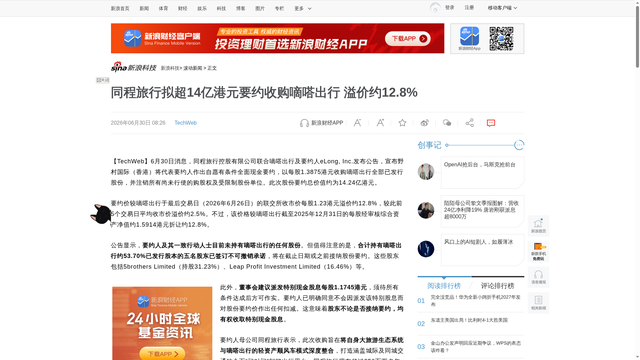
On the evening of June 29, a merger and acquisition (M&A) announcement sent ripples through the travel sector of the Hong Kong stock market. Tongcheng Travel (00780.HK) announced that its wholly-owned subsidiary, eLong, would launch a comprehensive cash offer to acquire Dida Chuxing (02559.HK) at a price of HK$1.3875 per share, with a total consideration of approximately HK$1.424 billion.
Several key figures in this transaction are noteworthy: a 12.8% premium, five core shareholders locking in 53.7% of the equity, and no plans for privatization or delisting. The certainty of the transaction is exceptionally high, as CITIC Bank has provided a dedicated credit line of HK$1.5 billion, fully covering the acquisition amount. The day after the announcement, Dida Chuxing's stock price surged by 88.19%, while Tongcheng Travel's stock price fell by more than 4%.
The capital markets rendered their verdicts in a stark "fire and ice" contrast: for Dida, this marked a dignified exit from its peak to a loss of momentum two years after its listing; for Tongcheng, it represented another strategic move to fill gaps in its travel ecosystem. But what has been acquired for HK$1.4 billion—is it a value trough or a hot potato with limited growth potential?
01
Dida's Decline: From Ride-Sharing Leader to 80% Market Cap Erosion
Many still recall Dida's heyday. In 2019, when Didi's ride-sharing service was temporarily suspended due to safety incidents, Dida seized this once-in-a-lifetime opportunity, with its market share soaring to 66.5% at one point, nearly monopolizing the entire ride-sharing sector. According to Frost & Sullivan data, Dida still held a 43.4% market share by transaction volume in 2020, firmly at the top.
The turning point came in June 2024. Dida listed on the Hong Kong Stock Exchange at an issue price of HK$6 per share, debuting as the "first shared mobility stock." However, on its first trading day, it broke below the issue price, closing at HK$4.65, a 22.5% drop. Subsequently, its stock price continued to decline, and by June 26, 2026, before trading was halted, the closing price was only HK$1.23, with its market cap shrinking by nearly 80% from the issue price.
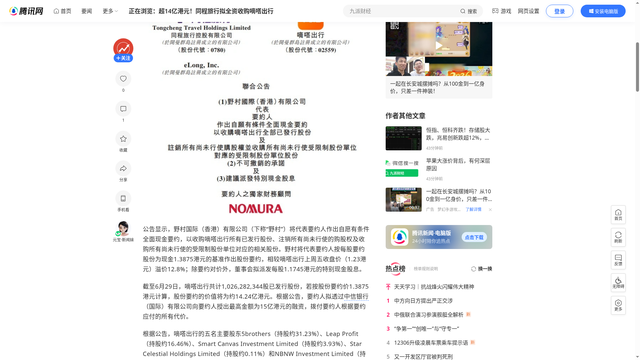
The financial figures were even more striking. Dida's 2025 annual report showed full-year revenue of RMB 502 million, a 36.2% year-on-year decline from RMB 787 million in 2024; adjusted net profit fell from RMB 211 million to RMB 138 million, a roughly 34.7% decrease; gross margin slipped from 72% in 2024 to 66.3%, having once exceeded 80% before the listing.
Screenshot Source: Sina Tech 2026-06-30 | Tongcheng Travel to Acquire Dida Chuxing for Over HK$1.4 Billion with a ~12.8% Premium
The contraction of its core business was fatal. In 2025, Dida's total ride-sharing transaction volume fell to RMB 4.511 billion, a 38.7% year-on-year decline; ride-sharing order volume was 76.5 million, less than 65% of that in 2024. The company clearly stated in its annual report that intensified competition in the mobility services industry led to a reduction in ride-sharing platform services, resulting in a decline in completed orders.
The fundamental reason was the changing competitive landscape. After Didi's ride-sharing service resumed in 2022, it quickly regained momentum with its main platform's traffic; Hello relied on its massive two-wheeler user base and Alipay access, with its ride-sharing business profitable for seven consecutive years, steadily increasing its market share; Gaode, with its map app boasting over 800 million monthly active users, launched ride-sharing nationwide by the end of 2024, leveraging its traffic advantage for a significant market impact. Caught between these three giants, Dida couldn't compete with Didi in terms of capacity or match Gaode and Hello in terms of traffic acquisition costs and channel coverage.
A deeper issue lay in the structural flaws of its business model. The core competitiveness of ride-sharing is its "lightness"—the platform doesn't own vehicles or employ drivers, merely acting as a matchmaker. However, this "lightness" also means the platform inherently lacks strong control over the supply side. Car owners are not platform employees; they accept orders when convenient and decline when troublesome, requiring the platform to continuously invest resources to maintain an inherently loose network. In 2025, Dida made over 1 million AI risk warning outbound calls, incurred insurance costs of RMB 15.476 million, and provided driver and passenger incentives totaling RMB 65.173 million. The annual report bluntly stated: the fixed cost component of operation and maintenance service fees did not significantly decrease with the decline in order volume.
Customer acquisition cost was another weakness. In 2025, Dida's selling and marketing expenses were RMB 122 million, with the selling expense ratio rising from 21.7% to 24.2%. Didi, with its ecosystem traffic entry points, had a selling expense ratio of only 7.4% during the same period, less than a third of Dida's. As an independent platform, Dida lacked low-cost traffic entry points like WeChat, Alipay, or map apps, forcing it to spend heavily on user acquisition.
Screenshot Source: Tencent News/Jiupai Finance 2026-06-30 | Dida Chuxing's 2025 Revenue Falls 36.18% Year-on-Year to RMB 502 Million
02
Tongcheng's Strategy: Completing the Travel Ecosystem, Targeting Lower-Tier Markets
Why did Tongcheng make its move at this time? The answer lies in its own financial reports. In Q1 2026, Tongcheng Travel reported revenue of RMB 5.006 billion, a 14.4% year-on-year increase; net profit attributable to shareholders was RMB 779 million, a 16.5% year-on-year increase. As of March 31, the number of annual paying users reached 254 million over the past 12 months, a record high, with cumulative service volume at 2.047 billion. More than 87% of its registered users came from non-first-tier cities in China.
These figures paint a clear strategic picture: Tongcheng is an OTA giant deeply rooted in lower-tier markets. Backed by Tencent's WeChat ecosystem, Tongcheng is the sole OTA provider within WeChat Wallet, with service entry points deeply integrated into core WeChat Pay scenes like the nine-grid menu, Search, and Channels. This traffic endowment ensures Tongcheng's customer acquisition costs in lower-tier markets are far lower than competitors'.
However, Tongcheng's weaknesses are equally apparent. Its business covers air tickets, train tickets, hotel bookings, and attraction tickets, solving the "how to cross cities" problem but failing to address the "how to get there" issue. After booking high-speed rail tickets and hotels, users' fragmented needs for the "last 100 kilometers"—from home to station, from station to hotel—have historically been ceded to Didi and Gaode.
Liu Jianbin, a travel industry practitioner, bluntly told Caijing Magazine: Tongcheng Travel has solved the low-frequency travel needs (trains and flights) at the back end but hasn't addressed the high-frequency local travel (urban transportation) at the front end. Acquiring Dida Chuxing can close this loop.
That's not all. Tongcheng has been active in acquisitions recently: Dalian Shengya, Wanda Hotel Management, overseas travel group Holidaypirates, payment licenses... Over a year, it has made five acquisitions, spending over RMB 5 billion. The core logic is singular: extend the travel chain and increase user frequency. Dida perfectly fills the most critical gap—ground transportation.
Imagine this scenario: a user books a high-speed rail ticket from Beijing to Hangzhou and a hotel near West Lake on Tongcheng. In the past, the story ended there. In the future, Tongcheng could directly recommend a Dida ride-sharing option on the booking page, allowing one-click orders from doorstep to hotel. From "how to cross cities" to "how to get there," the entire journey can be seamlessly connected within one Tongcheng app.
More importantly, there's synergy in lower-tier markets. Dida's ride-sharing business naturally aligns with the travel needs of low-tier cities—cross-city, low-cost, carpooling—exactly the high-frequency scenes for users in third-, fourth-, and fifth-tier cities. With 87% of Tongcheng's users from non-first-tier cities and Dida serving 366 cities with significant lower-tier market presence, their user profiles highly overlap.
03
The Challenge of This Union: Uncertain Synergies
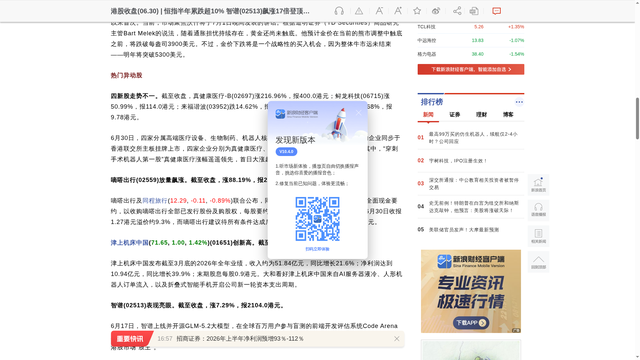
The capital markets' attitudes toward this deal are divided. On June 30, Dida Chuxing's stock price soared by 88.19% in a single day, closing at HK$2.39—its most dramatic surge since listing in June 2024. However, on the same day, Tongcheng Travel's stock price fell by more than 4%. Shareholders on both sides had starkly different evaluations of the deal.
Screenshot Source: Sina Finance 2026-06-30 | Hong Kong Stocks Close: Dida Chuxing Surges 88.19% to HK$2.39
Behind this divergence lies deep-seated doubts about whether the promised synergies will materialize.
First is the design of the transaction structure itself. The announcement clarified that the acquisition is not aimed at privatization, and after closing, Dida will retain its independent listing status on the Hong Kong Stock Exchange, with both brands operating in parallel. The advantage is avoiding the cumbersome approval process of privatization, speeding up transaction execution; however, the drawback is equally clear—Tongcheng cannot thoroughly integrate Dida's organization, and dual-brand operations inherently increase management complexity.
Second is Dida's own transformation dilemma. Realizing the ceiling of its single ride-sharing business, Dida launched a ride-hailing aggregation service and used car transaction lead generation service in 2025. The annual report explicitly stated: 2025 is a critical year for transitioning from a single ride-sharing platform to a comprehensive mobility and vehicle services platform. However, financial data shows that new businesses are far from offsetting the decline in ride-sharing, with overall revenue still declining. This means what Tongcheng has acquired is essentially a single-platform business where ride-sharing still accounts for over 95% of revenue.
A deeper issue is that the ceiling for the ride-sharing business itself may be inherently low. It's not a business where costs can be continuously reduced through economies of scale—ride-hailing platforms have standardized, full-time driver supplies, where larger scale leads to more precise dispatching and declining per-order costs. However, ride-sharing car owners are part-time, with highly random travel times and routes, meaning increased platform scale brings greater management uncertainty. By 2025, Dida's registered users had surpassed 410 million, yet order volume was declining—this contrast between "expanding user base but shrinking business scale" best illustrates the ceiling of the ride-sharing model.
The regulatory environment is also tightening. On June 1, 2026, new ride-sharing regulations took effect, imposing stricter compliance requirements on vehicles, drivers, and platforms. With rising compliance costs, industry supply faces contraction, accelerating the exit of small platforms. Dida's decision to sell at this juncture is both a necessity and a wise move.
Another easily overlooked detail is the funding arrangement for this acquisition. CITIC Bank International has granted the offeror a financing facility of up to HK$1.5 billion, meaning Tongcheng hardly needs to use its own funds. The use of financial leverage indicates, on one hand, that Tongcheng isn't strapped for HK$1.4 billion—its 2025 adjusted net profit was RMB 3.4 billion; on the other hand, it suggests management may not want to bet everything on this deal.
Conclusion
Tongcheng's acquisition of Dida, superficially a resource integration between two Hong Kong-listed companies, actually reflects a deeper trend in China's internet industry: in an era of stagnant traffic growth and intense stock market competition, every vertical platform in niche sectors is facing its moment of integration.
Dida's story is not an isolated case. In recent years, we've witnessed countless vertical platforms rise and fall—they entered the market with innovations in niche sectors, enjoyed brief moments of glory, then either were acquired or slowly faded under the traffic crushing of giants. The ride-sharing sector is particularly typical: highly utilitarian and standardized, users won't install multiple apps—they use whichever platform offers more orders and lower prices. Facing competition from giants, pure vertical platforms have little chance of survival.
For Tongcheng, the HK$1.4 billion buys not just Dida's 410 million registered users and ride-sharing network across 366 cities but also the imagination space of a "door-to-door" travel ecosystem. However, whether this imagination can become reality depends on two key variables: first, whether Tongcheng can effectively convert WeChat ecosystem traffic into Dida's order growth; second, whether Dida's diversification efforts beyond ride-sharing can achieve breakthroughs with Tongcheng's resource support.
Neither variable is easy. Traffic conversion is never a simple "diversion" issue—it involves product experience, user habits, brand recognition, and other factors; diversification is even more fraught with challenges. Dida's previous attempts in ride-hailing aggregation and used car leads have yet to produce convincing results.
HK$1.424 billion bids farewell to an era of ride-sharing. Song Zhongjie and his team spent a decade proving that ride-sharing is a viable business—and also demonstrating that in the face of traffic giants, the independent survival space for pure vertical platforms is rapidly narrowing. For China's internet industry as a whole, Dida's story will repeat itself—those once ambitious entrepreneurs, those shining unicorns, will ultimately either become part of a giant's ecosystem or fade away as ripples in time.
This is not anyone's fault—it's the law of business.
-
![]()
Combined Market Value Plummets by Nearly One Trillion Yuan: What’s Behind the Decline of Two AI Powerhouses?
-
![]()
Detailed Explanation of the Impact of Hikvision Guanlan Coding on Video Quality and Key Frame Quality
-
![]()
The Key Distinctions Between AI-Driven Smart Coding and Traditional Coding
-
![]()
Memory Prices Skyrocket, Becoming ‘Digital Black Gold’ as Shenzhen’s Huaqiangbei Spawns a Wave of Billionaires
-
![]()
Kuaishou Unleashes Its Secret Weapon: Kling
-
Copilot is Over, Industrial AI Enters the Autopilot Era (Part 1)
-
![]()
After the Removal of Purchase Tax and Vehicle and Vessel Tax Incentives, What 'Privileges' Remain for New Energy Vehicles?
-
![]()
The Runaway Cost Crisis is ‘Squeezing’ the Entire Electronics Market