Sales Volume Determines Survival or Death! China's Auto Companies Ranking for 2025 Released, with the 2026 Elimination Round Imminent
 01/04 2026
 635
635
As 2025 concludes, major automakers have successively disclosed their annual sales data, officially finalizing the sales volume pattern in the domestic auto market. This is based on information from the China Passenger Car Association (CPCA), the China Association of Automobile Manufacturers (CAAM), and publicly available data from automakers.
Ranking of Automakers with Disclosed Sales Volume (Excluding those that have not yet announced their sales volume at the time of writing)
The TOP 10 list of China's auto company sales volume in 2025 is clearly presented:
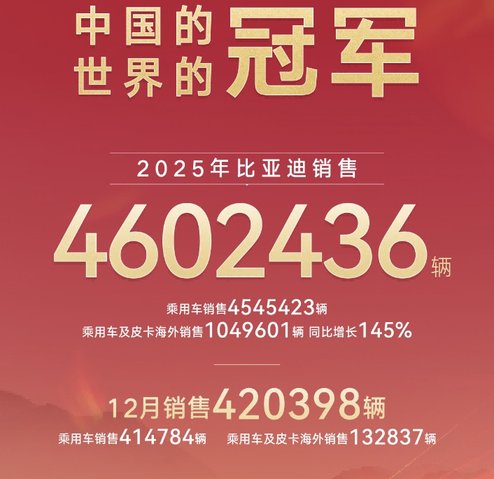
BYD: Annual sales volume reached 4.6024 million units, with a year-on-year increase of approximately 8%. Overseas sales exceeded 1 million units, and pure electric vehicle sales reached 2.2567 million units, topping the global electric vehicle sales chart.
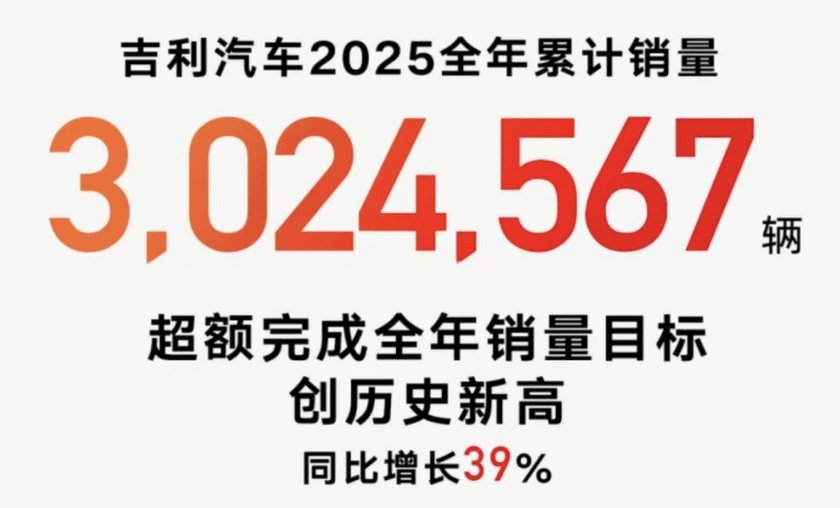
Geely Auto: Annual sales volume reached 3.0246 million units, with a year-on-year increase of 39%. New energy vehicle sales reached 1.6878 million units, with a year-on-year increase of 90%. The Geely Galaxy brand's sales volume reached 1.2358 million units.
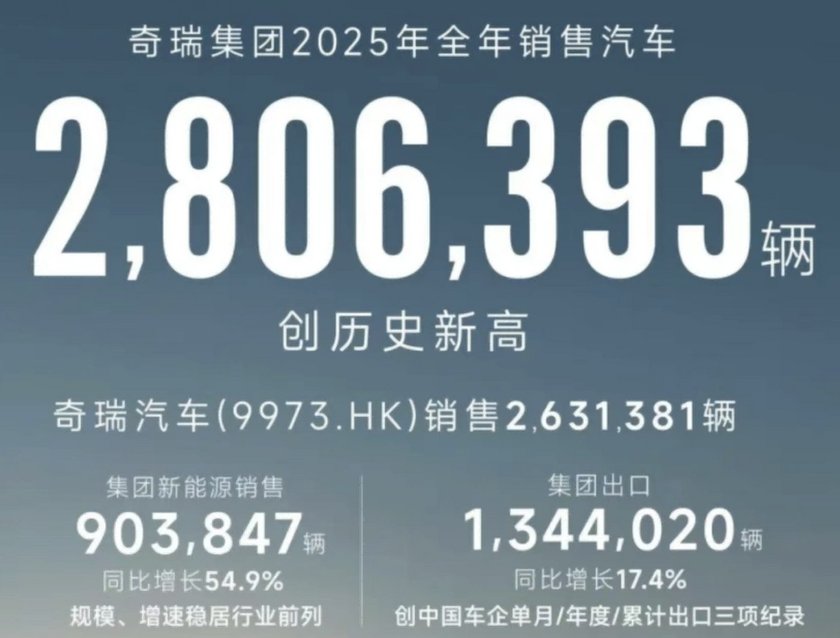
Chery Group: Annual sales volume reached 2.8064 million units, with a year-on-year increase of 7.8%. New energy vehicle sales reached 903,800 units, with a year-on-year increase of 54.9%. Export sales reached 1.344 million units, ranking first in Chinese brand passenger vehicle exports for 23 consecutive years.
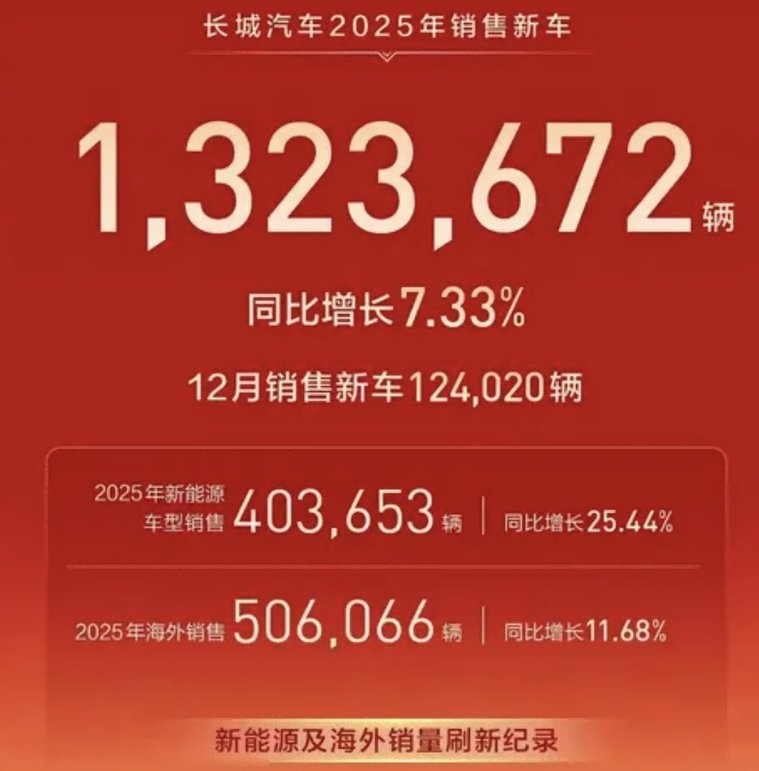
Great Wall Motors: Annual sales volume reached 1.3237 million units, with a year-on-year increase of 7.33%. New energy vehicle sales reached 403,700 units, with a year-on-year increase of 25.44%.
Dongfeng Motor: Annual sales volume exceeded 1.5 million units (with independent passenger vehicles exceeding 1.5 million units and new energy vehicles reaching 1.04 million units), with a 7-percentage-point increase in new energy penetration.
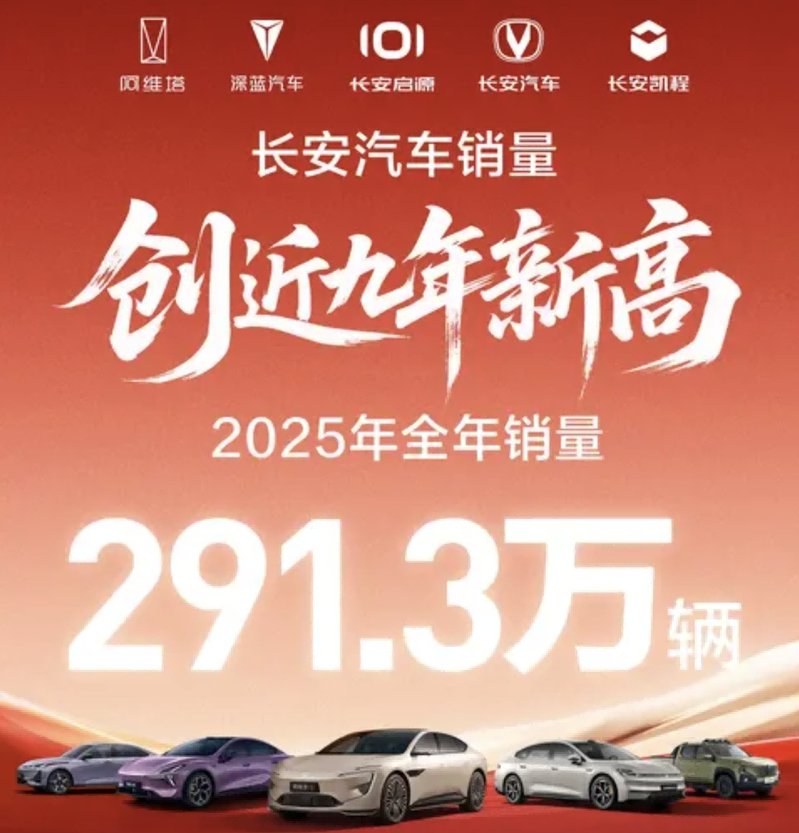
Changan Auto: Annual sales volume reached 2.913 million units, with a year-on-year increase of 8.5%, approaching the target of 3 million units.
FAW Group: Annual sales volume reached 3.302 million units, with a year-on-year increase of 3.2%, achieving 95.7% of the target.
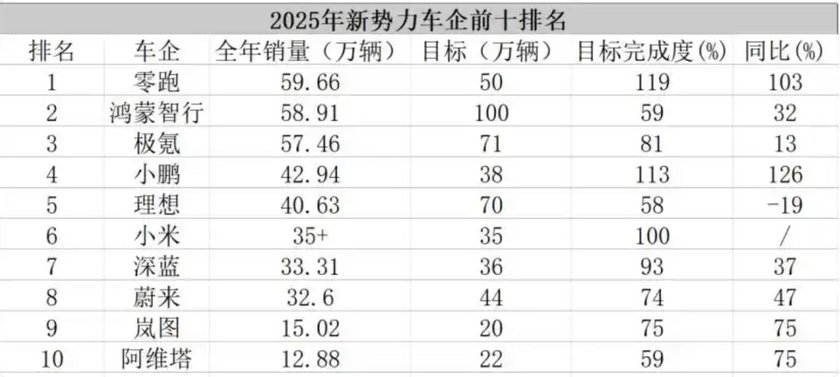
From the characteristics of the ranking, the 2025 auto market presents a distinct trend of 'traditional giants holding firm, transformation pioneers breaking through, and new forces diverging.' Traditional independent brands have performed strongly, with BYD retaining its top sales position with over 4.6 million units sold and overseas sales exceeding 1 million units for the first time, demonstrating global competitiveness. Geely Auto has surged into the top three with a 39% year-on-year increase, and new energy vehicle models accounting for over 55% of its sales, showcasing significant transformation results. The new force camp (new force camp) has seen increased divergence, with Leapmotor achieving doubled sales growth through a high cost-performance strategy, entering the TOP 10 for the first time and becoming the new force sales champion. XIAOMI Auto, as a newcomer to the industry, delivered over 400,000 units in its first year, successfully establishing a foothold. Meanwhile, Li Auto, a former leading new force, experienced an 18.81% year-on-year decline, falling out of the top three among new forces. Joint venture brands are generally under pressure, with most failing to enter the top ten in sales volume. Brands like Dongfeng Peugeot Citroën and Beijing Hyundai have seen their annual sales volumes hover at low levels.
What are the key strengths of the top-selling automakers?
The changes in the sales ranking essentially reflect the inevitable logic of industry development, with the 2025 ranking changes reflecting three core trends. Firstly, the depth of new energy transition determines growth momentum. BYD's continued leadership stems from its full industry chain layout in the new energy sector, with pure electric vehicle sales exceeding 2.25 million units for the year, a 27.86% year-on-year increase. Geely Auto's rapid growth originates from the explosion of its Galaxy brand, which sold 1.236 million units for the year, a 150% year-on-year increase, becoming the fastest new energy brand to reach one million sales. In contrast, enterprises lagging in transition, especially some joint venture brands, still rely on the existing market for fuel vehicles, with their electric vehicle models mostly being 'global vehicle modifications' that struggle to meet Chinese market demands, leading to continuous sales contraction.
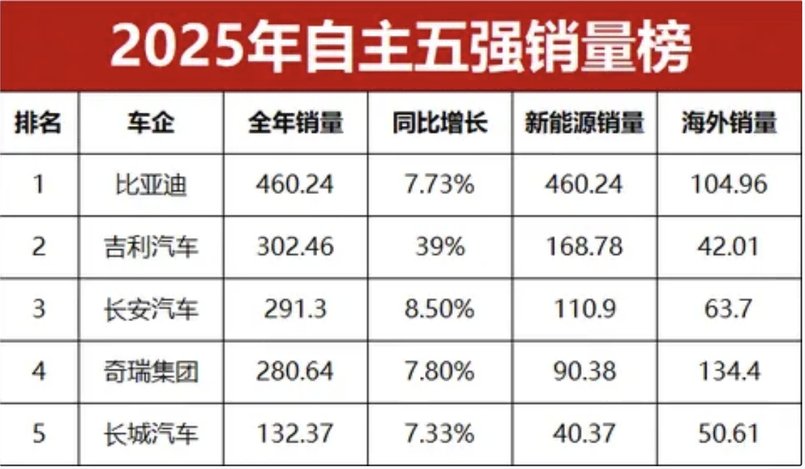
Secondly, global layout has become a new engine for sales growth. Chery Group's export sales exceeded 1.34 million units for the year, maintaining its first place in Chinese brand passenger vehicle exports for 23 consecutive years. BYD's overseas sales reached 1.0496 million units, a 145% year-on-year surge. Great Wall Motors' overseas sales exceeded 500,000 units, a record high. Breakthroughs in overseas markets not only offset competitive pressure in the domestic market but also became a key support for revenue growth, which is an important reason for top automakers to maintain high sales volumes. Meanwhile, small and medium-sized automakers lacking overseas layouts are becoming increasingly passive in the fierce competition of the domestic market.
Thirdly, technological strength and product positioning determine market share. XPENG Motors in the new force camp (new force camp) achieved a 126% year-on-year increase through iterative intelligent driving technology, while Leapmotor quickly seized the mid-to-low-end market with precise cost-performance positioning. HIMONOVA solidified its position in the intelligent vehicle sector by leveraging the intelligent advantages of the HarmonyOS cockpit. Conversely, Li Auto's sales declined due to overly concentrated product positioning, with its 'family vehicle' segment being squeezed by competitors. New forces like LUXEED and Polestar have seen continuously low sales due to their reliance on external suppliers for core technologies, lacking product competitiveness.
Three Types of Enterprises Face Elimination Risk in China's 2026 Auto Market Elimination Round
In 2026, China's auto market will witness an even more brutal elimination round. With the triple pressures of policy phase-out, cost increases, and technological iteration, the industry's consolidation speed will significantly accelerate, with industry predictions suggesting that over 50 automakers face the risk of closure or mergers and acquisitions. Based on enterprise sales performance, operating conditions, and industry trends, the following three types of automakers are most likely to face bankruptcy and elimination.
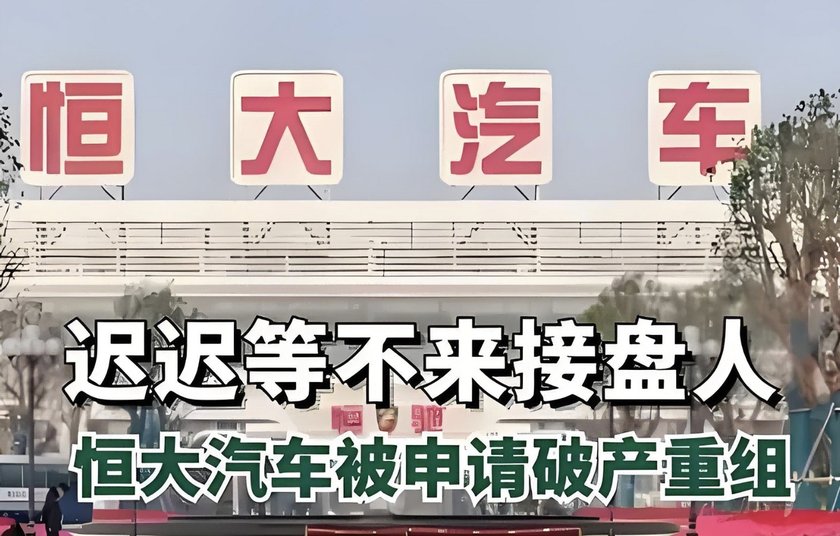
The first type is joint venture brands with annual sales volumes of less than 100,000 units. These enterprises have fallen into a vicious cycle of 'scale collapse—high costs—profit losses.' Dongfeng Peugeot Citroën sold only 46,400 units from January to November 2025, a volume that cannot support the high costs of research and development sharing and channel maintenance under the joint venture model. Brands like Beijing Hyundai and Yueda Kia have annual sales volumes ranging from 100,000 to 300,000 units, but their net profit margins have generally fallen below 1%, struggling to maintain market share through price wars and falling into the dilemma of 'selling more but losing more.' With the phase-out of new energy vehicle purchase tax exemptions and further contraction of the fuel vehicle market, the probability of these joint venture brands lacking core competitiveness exiting the Chinese market exceeds 80%.
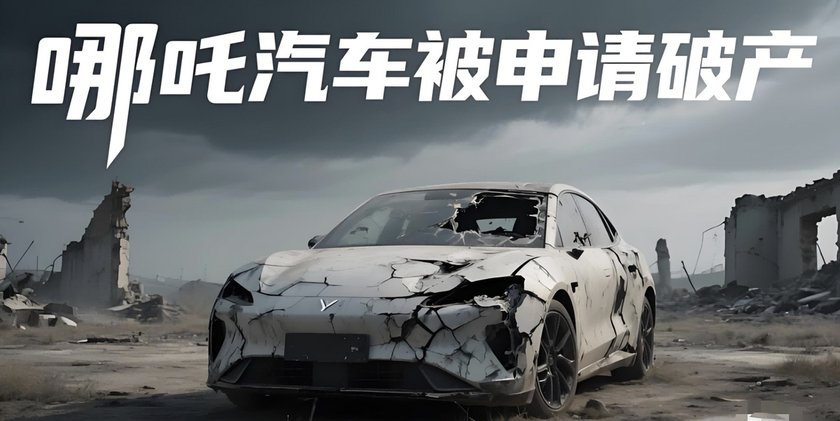
The second type is small and medium-sized new forces that are 'asset-light and technology-free.' These enterprises are essentially 'assembly plants' dependent on the supply chain, with core technologies entirely reliant on external procurement and extremely weak risk resistance. LUXEED sold only 12,000 units in 2025, relying on a single model, and its founder's share reduction and cashing out triggered a trust crisis. Polestar incurs a loss of 270,000 yuan per vehicle sold, with a gross profit margin as low as -49.4%. Even with a 600 million USD loan from Geely to 'stay alive,' its 'blood transfusion survival' without core technologies is unsustainable. In 2026, with the capital tide receding, these enterprises will face bankruptcy and restructuring due to broken capital chains.
The third type is 'second-generation enterprise' new forces incubated by traditional automakers. These enterprises rely on their parent companies' resources but struggle to break free from traditional institutional constraints, with low decision-making efficiency and slow market responses. Despite being established for many years, they continue to incur huge losses. IM Motors has an asset-liability ratio as high as 75.04% and has sustained huge losses for five years. ARCFOX has accumulated losses exceeding 22.4 billion yuan in the past six years, entirely dependent on subsidies from BAIC BluePark. In 2026, with their parent companies' subsidies becoming unsustainable, these 'second-generation enterprise' brands that cannot prove their commercial viability will likely be abandoned by their parent companies, becoming 'sacrifices' of traditional automakers' failed transformations.
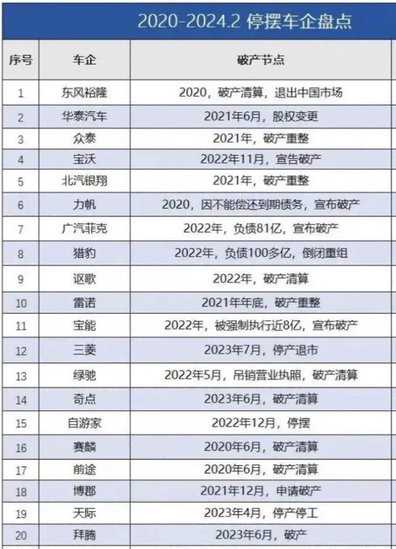
Additionally, some small and medium-sized traditional automakers that are slow in transition also face elimination risks. These enterprises lack core new energy technologies and overseas market layouts, with their market shares continuously shrinking under the pressure of top automakers and increasingly tense capital chains. They may face closure or mergers and acquisitions in 2026.
Epilogue
The 2025 sales ranking is a 'report card' of China's auto industry transformation and serves as an 'admission ticket' to the 2026 elimination round. The dual tests of policy phase-out and market competition will accelerate industry consolidation, ultimately concentrating resources in high-quality enterprises. For automakers, only by accelerating the new energy transition, building strong technological barriers, and expanding global markets can they survive in the fierce competition. China's auto industry will also bid farewell to 'wild growth' in this elimination round and move towards a new stage of high-quality development.
-
![]()
Enflame Tech's IPO Journey: Navigating Over 5.9 Billion Yuan in Losses and Soaring Debt in Q1 This Year
-
![]()
Trillion-Yuan Giant Li Shufu 'Streamlines': Could Levc Be the Casualty?
-
![]()
AI Competes for Electricity and Generates Power in the Gobi Desert
-
![]()
The First Batch of Victims of the AI Bubble: Programmers
-
![]()
ByteDance, DJI, and Xiaohongshu Secure Top Three Positions Among China’s Fastest-Growing Unicorns
-
Tesla's in-car voice system in China is finally learning to 'understand human language'
-
![]()
Foreigners Are Amazed: Chinese Electric Vehicle Drive Systems Unveil Innovative 'Poses'
-
![]()
700,000 Brothers and the Future of Robots: Behind JD.com's 'Nirvana Plan'