New Subsidy Policy Unveiled: Can New Energy Vehicles Be Rescued in 2026?
 01/04 2026
 611
611
On December 30th, the National Development and Reform Commission (NDRC) announced that China will persist with its trade-in incentive policy in 2026. The long-awaited national subsidies for vehicle trade-ins in 2026 have finally been rolled out:
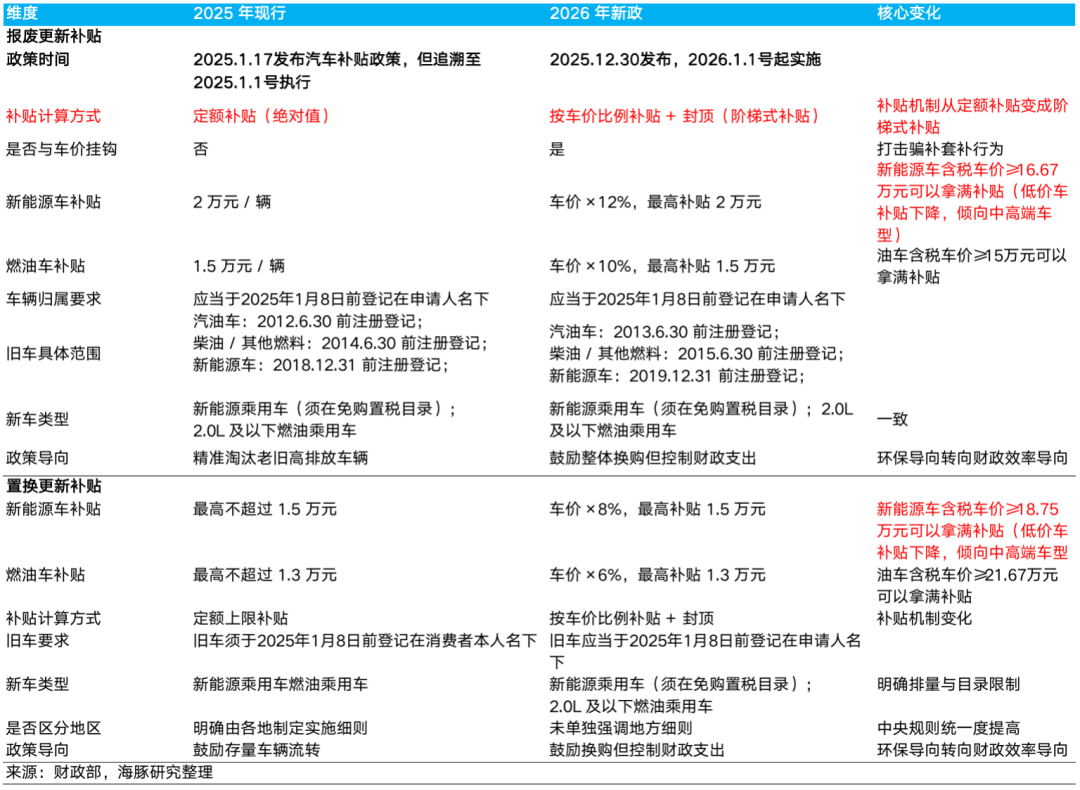
① Scrapping and Replacement Subsidies: After scrapping an old vehicle, a subsidy equivalent to 12% of the new energy passenger vehicle's price (capped at a maximum of 20,000 yuan) will be provided. For purchasing a fuel passenger vehicle with a displacement of 2.0 liters or less, a subsidy of 10% of the vehicle price (up to a maximum of 15,000 yuan) will be granted.
This implies that after scrapping an old vehicle, purchasing a new energy vehicle with a price (inclusive of tax) of 166,700 yuan or more will make one eligible for the full subsidy. Similarly, purchasing a fuel vehicle with a price (inclusive of tax) of 150,000 yuan or more will qualify for the full subsidy.
② Trade-In Replacement Subsidies: Upon transferring an old vehicle, a subsidy of 8% of the new energy passenger vehicle's price (up to a maximum of 15,000 yuan) will be provided. For purchasing a fuel passenger vehicle with a displacement of 2.0 liters or less, a subsidy of 6% of the vehicle price (capped at a maximum of 13,000 yuan) will be available.
Based on this calculation, purchasing a new energy vehicle with a price (inclusive of tax) of 187,500 yuan or more through trade-in will make one eligible for the full subsidy. Purchasing a fuel vehicle with a price of 216,700 yuan or more (inclusive of tax) will also qualify for the full subsidy.
The following are several key questions that Dolphin Research has regarding the trade-in policy:
1. Does the vehicle trade-in policy align with market expectations?
The national and local subsidy policies are largely in line with the draft version that circulated in the market last week. Although the policy remains relatively positive, the stock prices of the entire vehicle sector had already factored in this policy expectation in advance last week. Given that the purchase tax on new energy vehicles will still be halved in 2026, there remains significant uncertainty regarding the demand for the new energy vehicle sector in 2026. Consequently, investors may opt to cash in on this national subsidy policy.
2. How will the total subsidy amount evolve?
In 2025, the total subsidy pool for "trade-in" was 300 billion yuan, distributed in four batches (81 billion yuan for the first two batches and 69 billion yuan for the last two batches before 2025). Among these, the vehicle "trade-in" subsidy accounted for 145 billion yuan, representing 48.4% of the total pool.
In 2026, although the overall total subsidy amount has not been disclosed yet, judging from the first batch of "trade-in" funds released, the initial tranche of funds in 2026 is 62.5 billion yuan (for all industries), marking a 23% decrease compared to the 81 billion yuan in the first quarter of 2025. Therefore, the total subsidy amount in 2026 may only be around 77%-80% of that in 2025, with the corresponding total vehicle subsidy amount potentially ranging between 110 billion yuan and 120 billion yuan (also reflecting a 75%-80% reduction compared to 2025).
The total subsidy amount is pivotal for the vehicle sector. In the fourth quarter of 2025, the automotive market did not exhibit the traditional "year-end rally effect" but instead witnessed a year-on-year decline in sales. Passenger vehicle retail sales in October and November dropped by 0.5% and 8.1% year-on-year, respectively. During the same period, the cumulative number of insured vehicles decreased by 570,000, with vehicles priced below 200,000 yuan contributing to a decline of 545,000 units, becoming the primary factor dragging down the market.
The decline was primarily attributed to the tightening of trade-in subsidy policies in multiple regions since October, with increased access restrictions for scrapping and replacement and the early closure of subsidy application channels in some areas. This was mainly because the national and local "trade-in" subsidy quotas were largely depleted around October, directly suppressing the replacement demand of mainstream consumer groups for vehicles priced below 200,000 yuan.
3. What are the primary changes in the 2026 trade-in subsidy policy compared to 2025?
① Change in Subsidy Calculation Method: The subsidy format has shifted from a fixed-amount, one-size-fits-all subsidy in 2025 to a tiered subsidy based on the proportion of the new vehicle price in 2026. However, the same per-vehicle subsidy caps as in 2025 have been retained (e.g., a maximum of 20,000 yuan for scrapping a new energy vehicle and 15,000 yuan for trade-in).
② Shift in Beneficiary Structure from Low-Priced to Mid-to-High-Priced Vehicles, Favoring Automakers with Mid-to-High-End Models as Sales Mainstays: This shift directly leads to a structural change in the vehicle models benefiting from the subsidies. In 2025, all eligible vehicles, regardless of price, enjoyed the same fixed subsidy amount, which had a particularly pronounced stimulating effect on low-priced models (especially those priced below 100,000 yuan) (the lower the vehicle price, the higher the proportion of the subsidy amount to the vehicle price).
In 2026, only vehicles priced above a certain threshold will qualify for the full subsidy (e.g., approximately 167,000 yuan or more for scrapping a new energy vehicle and approximately 188,000 yuan or more for trade-in). Consequently, mid-to-high-end models (especially those priced between 150,000 yuan and 200,000 yuan or above) will become the core beneficiaries, with their per-vehicle actual subsidy levels remaining largely unchanged from 2025. In contrast, low-priced models priced below 150,000 yuan, especially those below 100,000 yuan, will receive significantly less subsidy than in 2025.
From the automakers' perspective, this policy is also more advantageous for those with mid-to-high-priced models as their sales mainstays (such as Li Auto, NIO, and Huawei's Smart Selection vehicles). Conversely, it is less favorable for automakers like BYD and Geely, whose mainstay models are in the mid-to-low-end segment, as the subsidy levels for their mainstay models will directly diminish.
③ The policy adjustments are primarily aimed at optimizing the efficiency of fiscal fund utilization and guiding consumption upgrading:
This initiative aims to enhance the efficiency of fiscal fund utilization, foster consumption upgrading, and industrial upgrading. By setting price proportion thresholds, excessive subsidies for low-priced models can be curtailed (in 2025, there were instances of "subsidy fraud" for some low-priced vehicles or zero-kilometer used car exports for arbitrage), encouraging automakers and consumers to shift towards higher-value, higher-quality products. This helps alleviate the industry's "cutthroat" price competition, promote an upward shift in the industry's overall price range, and enhance profitability.
Simultaneously, the 2026 new policy significantly tightens the eligibility requirements for old vehicles, and this adjustment applies to both scrapping and replacement scenarios. The new regulations explicitly stipulate that the old vehicles used for scrapping or replacement must be registered and actually held under the applicant's name for at least one year (the transfer registration must be completed before January 8, 2025, to meet the holding period requirement). In contrast, the 2025 policy only mandated the old vehicle to be transferred before January 8, 2025, without imposing any restrictions on the actual holding period.
The core purpose of this adjustment is also to combat "subsidy fraud" behaviors, such as obtaining subsidies by temporarily purchasing and transferring old vehicles, ensuring that subsidy funds are genuinely utilized to stimulate the renewal consumption of existing vehicles, and improving policy precision and fund utilization efficiency.
4. What is the subsidy timeline? What will be the overall impact on the automotive market?
To cater to the peak consumption demands during holidays such as Christmas, New Year's Day, and the Spring Festival, the state has already allocated the first batch of 62.5 billion yuan in ultra-long-term special treasury bonds to local governments in advance to support the trade-in fund plan. According to the notice jointly issued by the NDRC and the Ministry of Finance on December 30, 2025, the 2026 trade-in policy will be officially implemented from January 1, 2026. This means that consumers can apply for and avail of the new national subsidies when purchasing eligible new vehicles from the first day of the new year.
The timely renewal of the policy and the early availability of funds also help alleviate the downward pressure on the automotive market in the first quarter of 2026, which mainly stems from two aspects:
① The purchase tax on new energy vehicles will be reinstated from exemption to a 50% reduction (5%) starting from January 1, 2026, directly increasing the cost of vehicle purchases;
② The scale of the national subsidy for "trade-in" policies in 2025 directly doubled compared to 2024. Coupled with the purchase tax exemption, it stimulated a large number of consumers to purchase vehicles in advance, prematurely exhausting part of the demand in 2026.
The implementation of the new policy, by providing continuous subsidy support, can stabilize market expectations and avert a cliff-like decline in sales due to a "policy vacuum period." Essentially, it aims to smooth out the sales disruptions caused by the imposition of the purchase tax on new energy vehicles after January 2026.
However, due to the change in the subsidy method from "fixed amount" to "based on vehicle price proportion," which raises the subsidy conditions, the support for low-priced models weakens. Additionally, the overall vehicle subsidy amount is expected to decline by 20% compared to 2025. Coupled with the purchase tax adjustment, the overall vehicle sales in 2026 may still face certain challenges year-on-year. Nevertheless, the policy fine-tuning will have a stabilizing effect, narrowing the decline. The market structure will be more skewed towards mid-to-high-priced models.
- END -
// Reprint Authorization
This article is an original piece from Dolphin Research. Authorization is required for reprinting.
// Disclaimer and General Disclosure
This report is intended solely for general comprehensive data purposes, serving users of Dolphin Research and its affiliated institutions for general reading and data reference. It does not take into account the specific investment objectives, investment product preferences, risk tolerance, financial situation, or special needs of any individual receiving this report. Investors must consult with independent professional advisors before making any investment decisions based on this report. Any person making investment decisions using or referring to the content or information mentioned in this report does so at their own risk. Dolphin Research shall not be held responsible for any direct or indirect liabilities or losses that may arise from the use of the data contained in this report. The information and data in this report are based on publicly available sources and are intended for reference purposes only. Dolphin Research strives to ensure but does not guarantee the reliability, accuracy, and completeness of the relevant information and data.
The information or opinions mentioned in this report shall not, under any jurisdiction, be considered or construed as an offer to sell securities or an invitation to buy or sell securities, nor shall they constitute recommendations, inquiries, or endorsements of relevant securities or related financial instruments. The information, tools, and materials contained in this report are not intended for or intended to be distributed to jurisdictions where the distribution, publication, provision, or use of such information, tools, and materials conflicts with applicable laws or regulations, or to citizens or residents of jurisdictions where Dolphin Research and/or its affiliates or associated companies are required to comply with any registration or licensing requirements.
This report merely reflects the personal views, opinions, and analytical methods of the relevant creators and does not represent the stance of Dolphin Research and/or its affiliated institutions.
This report is produced by Dolphin Research, and the copyright is solely owned by Dolphin Research. Without the prior written consent of Dolphin Research, no institution or individual shall (i) make, copy, reproduce, duplicate, forward, or distribute in any form copies or replicas of this report in any way, and/or (ii) directly or indirectly redistribute or transfer it to other non-authorized persons. Dolphin Research reserves all relevant rights.
-
![]()
Enflame Tech's IPO Journey: Navigating Over 5.9 Billion Yuan in Losses and Soaring Debt in Q1 This Year
-
![]()
Trillion-Yuan Giant Li Shufu 'Streamlines': Could Levc Be the Casualty?
-
![]()
AI Competes for Electricity and Generates Power in the Gobi Desert
-
![]()
The First Batch of Victims of the AI Bubble: Programmers
-
![]()
ByteDance, DJI, and Xiaohongshu Secure Top Three Positions Among China’s Fastest-Growing Unicorns
-
Tesla's in-car voice system in China is finally learning to 'understand human language'
-
![]()
Foreigners Are Amazed: Chinese Electric Vehicle Drive Systems Unveil Innovative 'Poses'
-
![]()
700,000 Brothers and the Future of Robots: Behind JD.com's 'Nirvana Plan'