What Groundbreaking Innovations Will This Year's CES Usher into the Automotive Industry?
 01/12 2026
 592
592
Introduction
The CES Exhibition isn't about making precise forecasts; rather, it's about embracing the spirit of a 'new beginning' with open arms.
'I predict that by 2026, Google's flagship product will shift from search to artificial intelligence.' This was the bold prediction made by 'tech visionary' Kevin Kelly in the 2016 inaugural edition of 'The Inevitable,' as he peered into the technological landscape a decade ahead.
As the concluding chapter in a trilogy exploring technological trends, the future scenario Kelly painted with twelve key concepts such as 'cognifying,' 'interacting,' 'screening,' and 'sharing' has, for the most part, materialized. The prophecy that AI would emerge as the ultimate product form has not only been validated by tech behemoths but has also firmly taken root among numerous automotive companies, becoming a pivotal force propelling industry evolution.
On January 9th, the 2026 CES, often dubbed the 'Super Bowl of Tech,' officially drew to a close. Over recent years, the ascendancy of new energy vehicles has gradually shifted the exhibition's focus towards electric cars. As AI technology transitions from algorithmic realms to tangible entities, the narrative focus of this year's CES has subtly shifted. Electric vehicles are no longer the sole protagonists; instead, they have become key platforms for showcasing AI capabilities.
01 Intelligent Assistant: The Next Evolutionary Leap?
'Think of Tesla cars as essentially robots on four wheels.'
'Automobiles are set to evolve from mere transportation vehicles of the industrial age to spatial robots in the AI era.'
Both Elon Musk and Li Xiang have articulated similar visions. If the first half of the new energy vehicle era was characterized by electrification, then the second half is undoubtedly centered around intelligence. The pinnacle of this intelligence is pointing towards 'intelligent assistants.' At the 2026 CES, this trend appears to be expanding beyond Tesla and Li Auto's visions, becoming a collective endeavor across the industry.
Driving, the core function of automobiles as transportation vehicles, naturally places intelligent driving at the forefront of intelligence advancement. At the CES Exhibition, NVIDIA unveiled the Alpamayo autonomous driving platform, showcasing its core AI reasoning capabilities. Elon Musk responded to this with targeted insights, detailed in 'Elon Musk Disses NVIDIA's Autonomous Driving: Wait Another Five to Six Years,' which we won't delve into here.
Beyond the driving function itself, as Li Xiang remarked, 'Automobiles represent the largest application of artificial intelligence in the physical world.' In extended scenarios like interactive experiences and private schedule management, the intelligent value of automobiles is being further unlocked, echoing the developmental trajectory of AI technology. OpenAI defines five stages of artificial intelligence:
L1: Chatbots. AI possesses basic dialogue and interaction capabilities, enabling seamless conversations with users.
L2: Reasoners. AI will be capable of solving complex problems at a level akin to that of a human doctor, demonstrating robust reasoning and problem-solving abilities.
L3: Agents. AI can take independent actions, not only thinking but also executing tasks without continuous human supervision.
L4: Innovators. AI can assist in invention and creation, driving technological progress with creativity and innovation.
L5: Organizations. AI will be capable of performing the work of an entire human organization, demonstrating a high degree of autonomy and strategic thinking.
Currently, automotive assisted driving has largely covered L1 and L2 levels. From the exhibits at the 2026 CES Auto Show, advancing towards L3-level agents has become a common pursuit among many automakers.
Mercedes-Benz showcased the all-new electric GLC, featuring the fourth-generation MBUX system based on the new MB.OS architecture. This system integrates dual AI engines from Microsoft and Google, providing a more open and intelligent interactive experience.
BMW highlighted the all-new iX3, equipped with an AI intelligent personal assistant based on Alexa+ technology. This assistant enables natural conversations akin to those with real humans and expands the in-car application ecosystem to scenarios like video conferencing and cloud gaming.
Great Wall Motors, showcasing multiple models, not only presented its multi-energy layout but also focused on its displayed VLA full-scenario large model and the vision for the next-generation ASL agent. The aim is to achieve deep intelligence in automobiles that can 'understand, see, and think,' with plans to initiate overseas adaptation of related technologies to promote Chinese intelligent solutions globally.
Geely has also taken similar strides, with its global AI technology system successfully evolving into the 2.0 era. This achievement enables cross-domain integration of AI technology across various vehicle domains, granting automotive intelligence a continuously evolving 'worldview' and 'judgment' for the first time. The fruits of this technology system will also be applied and equipped in the latest electric vehicles from Geely, Lynk & Co, and Zeekr.
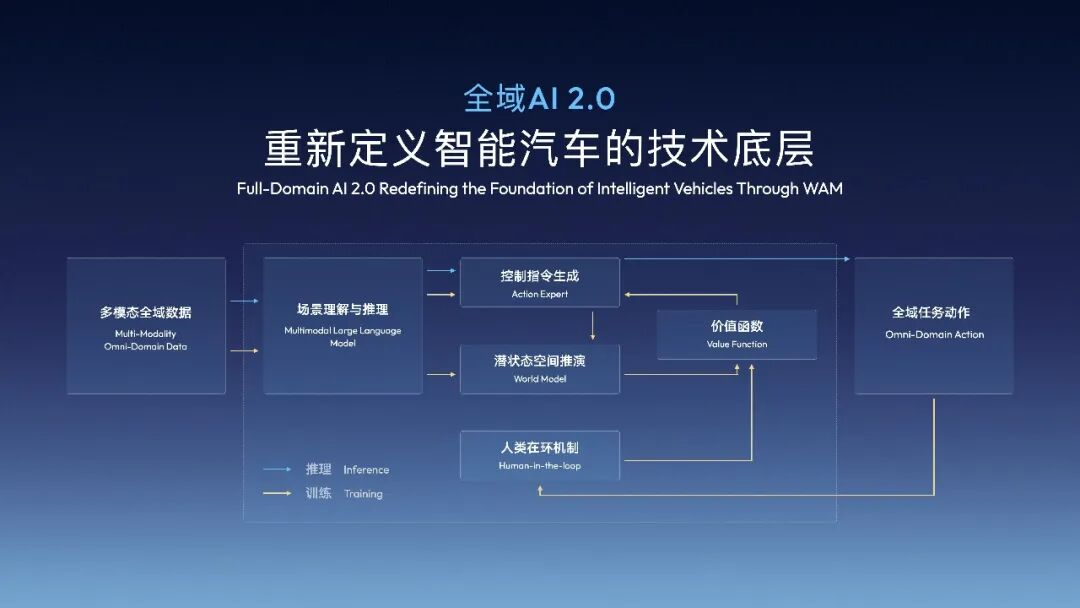
Despite varying entry points, the strategic cores of several automakers are remarkably consistent: driving automobiles from a mere aggregation of functional modules towards intelligent qualitative changes at the vehicle level, ultimately transforming them into intelligent assistants capable of collaboration, understanding the environment, and making autonomous decisions. This viewpoint aligns with the long-term layouts of Tesla and Li Auto.
For Li Auto, the future VLA (Vehicle Intelligent Assistant) will be a 'driver model that operates like a human driver.' Li Xiang divides VLA into three stages, with the third stage marking the initiation of the 'human intelligence' phase. Meanwhile, VLA will possess a complete brain system with language and CoT (Chain of Thought) reasoning capabilities, enabling it to see, understand, and truly execute actions in line with human operation.
Tesla accelerates this process through technological implementation. The chatbot Grok on Elon Musk's social platform X has already been integrated into vehicles. After the driver issues a command, Grok intelligently adds multiple destination options on the central control screen, allowing drivers to plan their trips more efficiently. Tesla introduces that this upgrade aims to transform Grok into a thoughtful assistant for every driver, guiding them forward like a 'private guide.'
However, this intelligent evolution centered around automobiles is merely the prelude to the AI revolution in the physical world. Greater transformations lie in cross-scenario, all-dimensional intelligent linkages.
02 The 'ChatGPT Moment' of Physical AI Looms: What Does It Mean for Automobiles?
The evolutionary trajectory of automotive intelligent assistants is clear, but to achieve a deeper intelligent revolution, it's necessary to break through the confines of a single product and expand the vision to intelligent linkages across the entire physical world.
Kevin Kelly once remarked that in the future, everyone would possess an AI assistant akin to a personal secretary, with a popularity level comparable to today's navigation software. Previously, this prophecy was challenging to realize due to issues like immature technology and insufficient data accumulation. However, with the continuous maturation of automobiles as the largest application scenario for AI in the physical world, a breakthrough opportunity is emerging.
Yet, the explosion of physical AI is by no means confined to the automotive realm. As Huang Renxun stated in his speech at this year's CES, 'The ChatGPT moment for physical AI is approaching.'
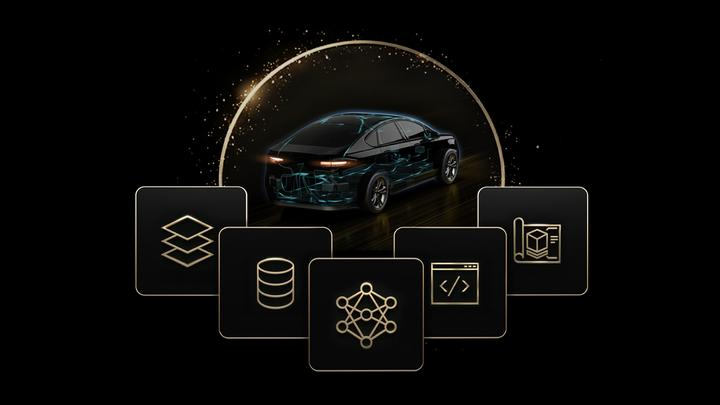
Besides automobiles representing 'transportation,' this year's CES showcased innovative applications of physical AI in multiple fields such as 'clothing, food, and shelter': Plaud's NotePin S flash capsule can record and organize every sentence heard by the user around the clock, marking key points at any time; the Mui Board Gen 2 bedside intelligent detector can accurately judge the user's sleep status without any sensors; the Wind Chef cooking agent can automatically generate cooking plans based on the ingredients' quantity, thickness, and initial temperature and execute operations...
The electricity generated by the Second Industrial Revolution wove an invisible network, subtly driving world transformation. AI technology is replicating this path, constructing an intelligent network connecting everything. As the largest mobile carrier of AI, automobiles will inevitably be deeply integrated into this network. At that juncture, when automobiles, as ports, possess sufficient intelligence levels, linkages with other intelligent agents will give rise to more innovative possibilities.
The simplest form of linkage has already occurred. Boston Dynamics' Atlas robot, equipped with 56 degrees of freedom in fully rotating joints, has now been stationed at Hyundai's Georgia factory to undertake manufacturing tasks. It's no longer a machine confined to executing fixed code but a general labor force capable of continuous learning through AI and adapting to new positions, achieving intelligent collaboration between industrial scenarios and the automotive industry.
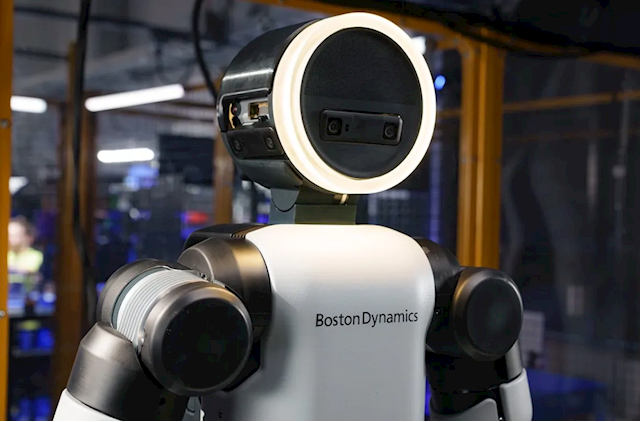
Meanwhile, automakers and automotive suppliers are actively exporting their technological capabilities and expanding the boundaries of intelligent applications. XPENG and Tesla are venturing into the robotics field, while Li Auto has introduced intelligent glasses. Additionally, Aptiv has extended its intelligent edge computing and sensor fusion technologies, verified in millions of vehicles, to emerging fields such as autonomous mobile robots. Valeo has expanded its in-cabin sensing system from driver monitoring to new scenarios like two-wheeler helmet detection. This fully demonstrates that technologies accumulated in the automotive field are also empowering new sectors such as robotics and the low-altitude economy.
In this global wave of intelligence, Chinese power is on the rise. In the introduction to the latest book '2049: The Next 10,000 Days,' co-authored with Chinese finance writer Wu Chen, Kevin Kelly wrote at the outset, 'I believe China will be one of the most powerful forces in the future world.' Chinese companies are not only actively laying the groundwork in vehicle intelligence but also demonstrating global influence in AI ecosystems, supply chain innovation, and other aspects, which was fully confirmed in the automotive and intelligent fields at this year's CES.
How to embrace the future? Kevin Kelly provided the answer a decade ago. The last keyword in 'The Inevitable' isn't a prophecy but a 'beginning': We are at the stage of a new beginning, and technology will continue to drive society forward.
Prophecies aren't necessarily accurate, as he wrote in his new book: 'In my 50 years of dealing with futurology, I've realized that almost all predictions—including my own—are wrong. I wrote this book not to reveal the future but to shape it. I hope to instill in readers a belief: We can build a better world than today by actively imagining and taking action.'
The CES Exhibition isn't about making precise forecasts; rather, it's about embracing the spirit of a 'new beginning' with open arms. From automotive intelligent assistants to all-domain physical AI linkages, from technological breakthroughs to industrial collaboration, a more intelligent future driven by AI is being gradually constructed. The deep participation of Chinese companies will undoubtedly inject stronger impetus into this revolution and provide more possibilities for shaping a better intelligent world.
Editor-in-Chief: Yang Jing Editor: Wang Yue
THE END
-
![]()
Enflame Tech's IPO Journey: Navigating Over 5.9 Billion Yuan in Losses and Soaring Debt in Q1 This Year
-
![]()
Trillion-Yuan Giant Li Shufu 'Streamlines': Could Levc Be the Casualty?
-
![]()
AI Competes for Electricity and Generates Power in the Gobi Desert
-
![]()
The First Batch of Victims of the AI Bubble: Programmers
-
![]()
ByteDance, DJI, and Xiaohongshu Secure Top Three Positions Among China’s Fastest-Growing Unicorns
-
Tesla's in-car voice system in China is finally learning to 'understand human language'
-
![]()
Foreigners Are Amazed: Chinese Electric Vehicle Drive Systems Unveil Innovative 'Poses'
-
![]()
700,000 Brothers and the Future of Robots: Behind JD.com's 'Nirvana Plan'