Joint Ventures Kick Off the Year with Major Price Cuts: Is a Challenging Year Ahead for All?
 02/25 2026
 671
671
Lead-in
Introduction
2026 is poised to be another fiercely competitive year in China's automotive market. The early bird catches the worm, and in this context, the sooner a company acts, the greater its chances of outshining its competitors.
On the eve of the Spring Festival, the China Association of Automobile Manufacturers (CAAM) released production and sales data for January. This data underscored the impact of the approaching holiday and changing subsidy policies, which dampened consumer enthusiasm. The market's start in 2026 was far from encouraging.
Given the likelihood of this trend continuing, companies' uncertain market expectations kept everyone on edge during what should have been a festive period. Reports indicate that many auto industry employees remained busy during the Spring Festival, suggesting that the annual industry competition had quietly commenced.
As the holiday concluded, some rushed back to prepare for the year's challenges, unveiling a series of promotional strategies. Indeed, the auto market in 2026 appears to have adopted a new mantra: "intense competition" barely scratches the surface; only by fighting tooth and nail will success be achieved.
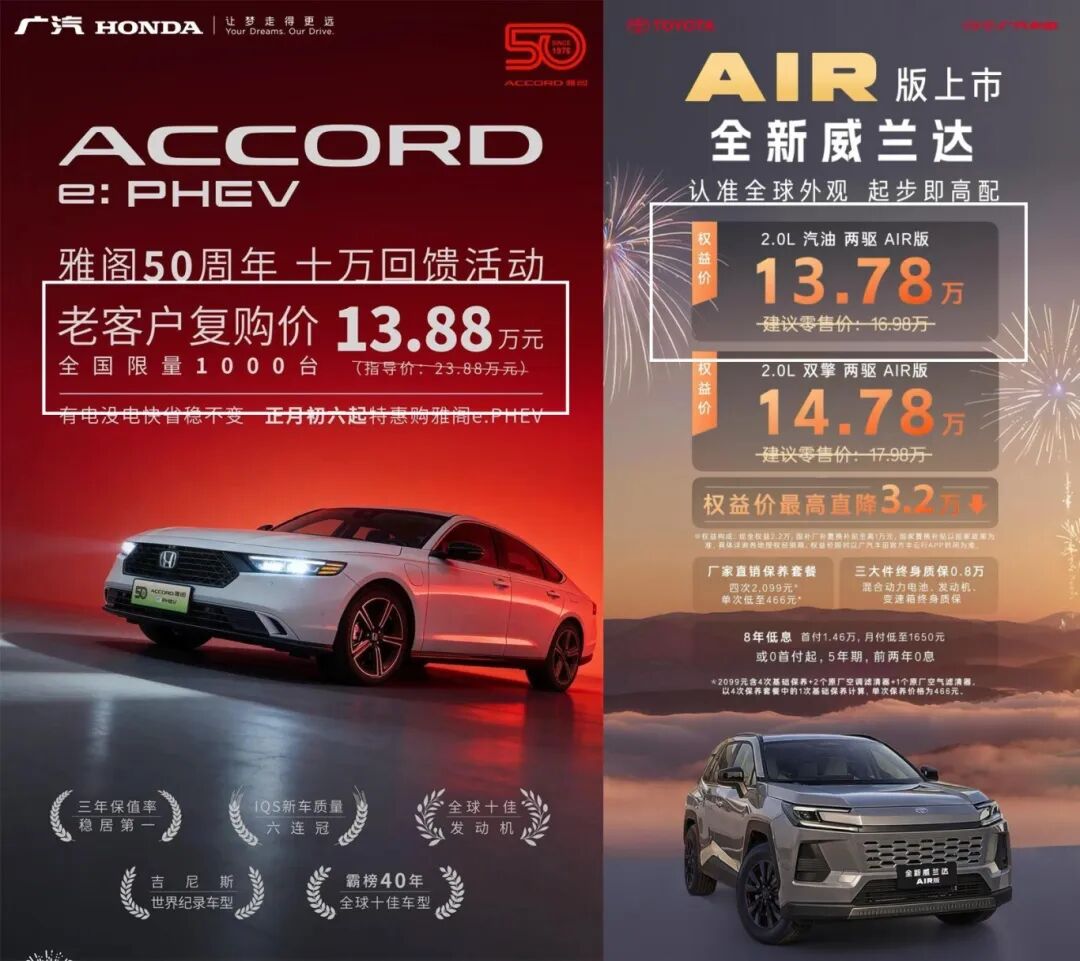
Believe it or not, the once-benchmark B-class sedan, the Accord, now offers its e:PHEV model at a repurchase price of RMB 138,800 for loyal customers. On the eighth day of the Lunar New Year, GAC Toyota followed suit, offering a promotional price of RMB 137,800 for its Weylandda AIR variant, along with an 8-year, low-interest financing policy.
In recent years, joint venture brands have faced criticism, with many believing their heyday has passed and they should cede market share in China. The closure, consolidation, or transformation of second-tier joint venture automakers reflects this sentiment.
However, with Toyota, Volkswagen, and Nissan fully committing to "China-focused" new energy vehicles in 2025 and aggressively countering negative sentiment—even initiating price wars—the outcome of this battle remains uncertain.
Undoubtedly, Honda and Toyota's recent moves are just the prelude to this year's market upheaval. The price war will not cease, nor can it afford to. Especially with a lackluster start to the year, competition will be as fierce, if not fiercer, than last year. Whether joint ventures or domestic brands, "clashing" will be commonplace, and "self-sacrificing" pricing will become the norm.
01 "Official Price Cuts" Are Just the Beginning
Earlier in the year, on February 11, CAAM reported that passenger vehicles (including sedans, SUVs, MPVs, and crossovers), a core component of China's auto consumption, saw production and sales of 2.062 million and 1.988 million units, respectively, down 4.1% and 6.8% year-on-year.
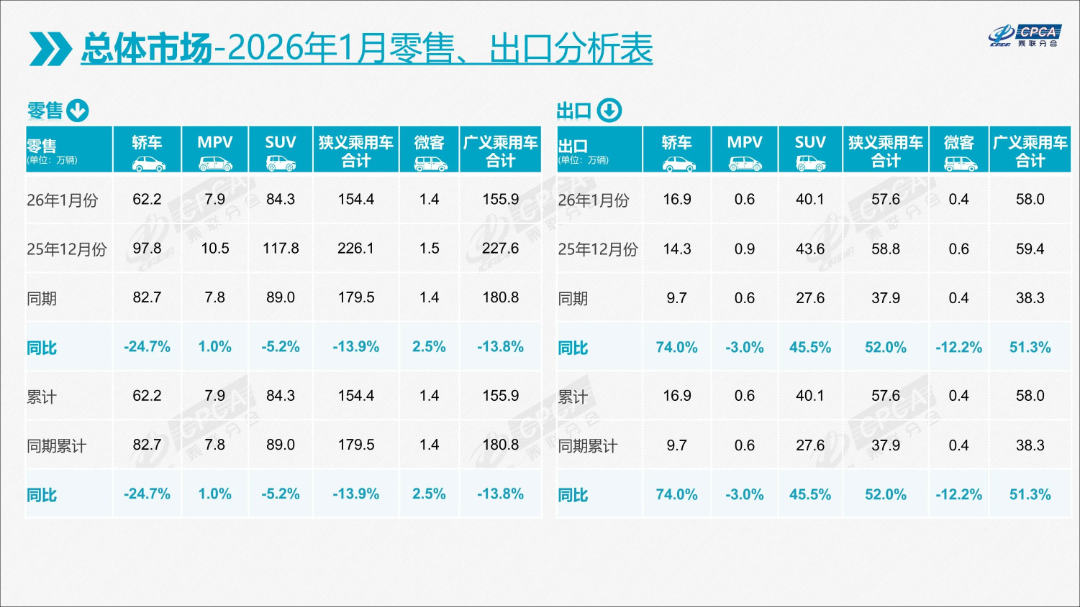
The following day, data from the China Passenger Car Association (CPCA) indicated that 1.544 million domestically produced narrow passenger vehicles were sold in January, continuing a 13.9% year-on-year decline.
Faced with this, some might wonder how China's vast auto market could remain sluggish despite government incentives to boost consumption. However, those within the industry know these figures barely scratch the surface of the market's severity. In other words, the gloomy start is merely a harbinger of what's to come.
The competitive landscape in 2026 will far exceed expectations.
For joint ventures, this is only their second full year of employing extraordinary measures to defend their position in China. With past achievements at stake, there's no time for complacency.
Looking back at the past year, sales declines for GAC Honda/Dongfeng Honda, Dongfeng Nissan, and FAW-Volkswagen/SAIC-Volkswagen were evident. Even Toyota, through significant price adjustments and localized new energy strategies, managed only single-digit growth for its two joint ventures.
With models like Toyota's bZ3X and Nissan's N7/N6 making an immediate impact, it would be premature to dismiss joint ventures as "out of touch." However, the reality is that, aside from a few enduring models, the declining freshness of new offerings poses a new challenge for all joint ventures.
Price wars and a flood of new models are now essential for survival.
To the average observer, Honda's decision to put the Accord on sale might seem desperate and surprising, given its limited product lineup and setbacks in new energy strategies. However, given years of declining sales, this move seems almost inevitable.
Yet, when GAC Toyota eagerly wielded the price-cutting blade against the Weylandda, launched less than six months prior, outsiders detected a new tone. Faced with market shifts, joint ventures may be slow to react and accustomed to arrogance, but the looming threats of 2026 are undeniable.
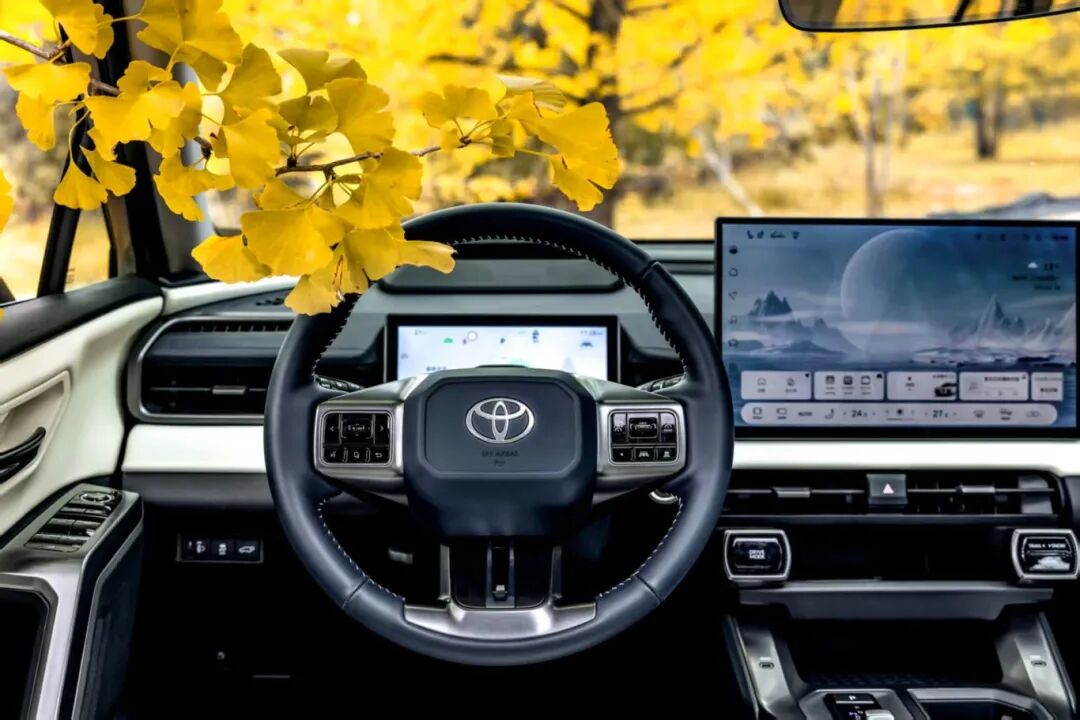
As a leading joint venture automaker, did GAC Toyota feel the previous Weylandda price was too high? Perhaps. More importantly, this appears to be a proactive response to future market trends.
"Can you believe you can now buy a new-generation joint venture product for roughly half the price?" This is not the message joint ventures aim to convey to consumers at this stage.
Their underlying message is clear: from now on, "joint venture" will no longer be synonymous with premium pricing. Even the most influential brands will humble themselves and compete on value. The Weylandda is merely the "vanguard" in a vast array of vehicles.
In March, GAC Toyota's bZ7 will officially launch, followed by models like Nissan's NX8, Audi's E7X, and Volkswagen's ID.ERA 9X/With the crowd 08, which have appeared on the Ministry of Industry and Information Technology's approval list.
A new war is quietly brewing. As deep participants in China's auto market, any joint venture wishing to stay must go all-in. "Official price cuts" are hardly the sole solution to survival crises. At this critical juncture, being the first to act is crucial. Regardless of perceptions of losing face, survival remains the top priority.
02 The Market Defense War Is No Empty Threat
Recently, stories involving joint venture brands have been sparse.

Amid claims of "joint venture decline," the fact that Honda's new Fit, limited to 3,000 units, sold out immediately is quite surreal. Yet, such minor fluctuations aptly summarize China's auto market landscape. With annual sales of 30 million units, no struggling automaker will be denied a chance to succeed.
We understand how difficult it is for joint ventures, dancing in chains, as China's auto industry rapidly transitions from internal combustion to EVs and from manufacturing vehicles to delivering emotional value.
Of course, facing this irreversible trend, we never believed the departures of Suzuki, Renault, DS, Jeep, or Mitsubishi were losses for Chinese consumers. High-handedness comes with consequences. In China, joint ventures must align with trends; any pretense is meaningless.
Looking ahead to 2026, will China's auto market rise or fall? Many ask this question. Interestingly, for individual participants, competition will not ease regardless of overall market conditions.
The era of easy gains is long gone. Surviving joint ventures must rely on China and adopt strategies that resonate with Chinese consumers to avoid repeating past mistakes.
We've long discussed which brand might be the next to exit China after second-tier joint ventures, with candidates including Mazda, Peugeot/Citroën, Hyundai/Kia, and even General Motors or Honda.
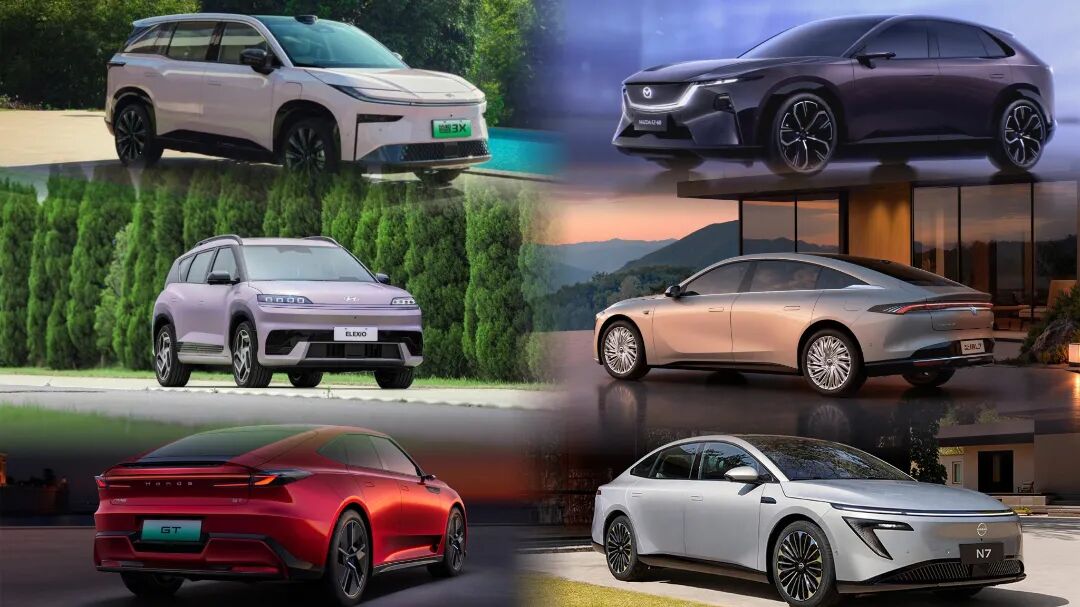
In 2025, models like Mazda's EZ-60, Buick's Ultimate L7, and Hyundai's EO represented these brands' final attempts at self-redemption. For Chinese automakers, these products may lack the power to revive the companies, but they demonstrate a newfound determination among joint ventures.
"This year, no one will have it easy!"
This is not just the inner monologue of joint ventures determined to survive after finding their direction. After years of turbulent development, joint ventures in 2026 seem ready to face challenges head-on.
Everyone knows how challenging it is for joint ventures to rise and defend their market position after years of effortless success. However, given Honda and Toyota's early-year determination to fight, might the predetermined script ease slightly?
Most likely, after these price cuts, many joint venture fuel (internal combustion) models will follow suit, upgrading while cutting prices. Meanwhile, new energy products like the bZ7 will leverage Chinese technology and manufacturing quality, shedding brand baggage and competing on equal footing to carve out a niche.
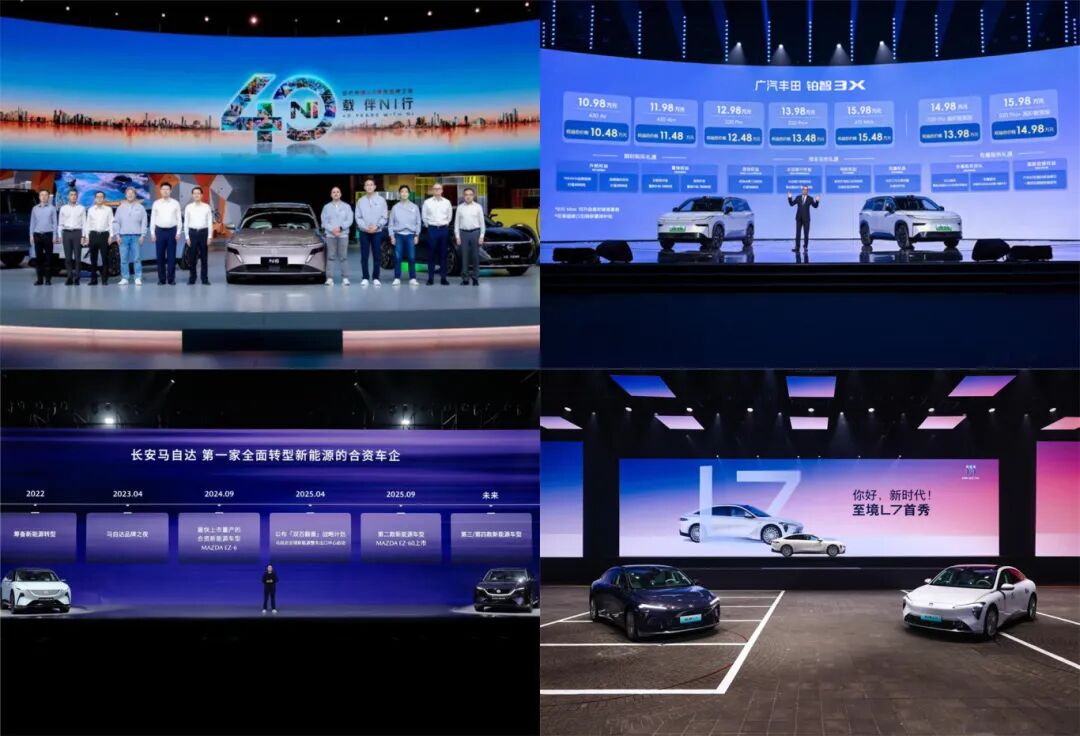
In China, one must act like a Chinese enterprise. Standing at the 2026 milestone, regardless of whether this year follows the economic narrative of "the best year in the next decade," joint ventures' counteroffensive momentum will not wane. Moreover, with the pace of EV transformation slowing and competition shifting to brand and corporate system levels, the prospect of fierce joint venture battles seems plausible.
In this new round of competition, anti-inner-roll initiatives serve as self-soothing or opponent-paralyzing placeboes. Joint ventures and domestic brands, traditional automakers and new forces, were never allies and are even less likely to collaborate now. Recognizing this, the brutal reality of China's 2026 auto market will be a "white-knuckle, red-blade" struggle.
Editor-in-Charge: Shi Jie Editor: He Zengrong
THE END
-
![]()
Depreciation Rate on Par with Mobile Phones: Just 40% Value Retention After Three Years—Why Do Battery Electric Vehicles Lose Their Worth?
-
![]()
Clearing Bugatti Stock Worth 7 Billion: Why is Porsche 'Cutting Ties'?
-
![]()
Don’t Dismiss Huawei’s Potential in Sedans Just Because the Shangjie Hasn’t Hit It Big Yet
-
![]()
Unsold Cars in China Find Success Overseas
-
![]()
Ghosn: Only I Can Save Nissan, Shareholders Beg Me to Return
-
![]()
Expanding Automobile Consumption: It's Time to Address the High Cost of Electric Vehicle Repairs
-
![]()
Luna Ultra Entangled in 'National Subsidy Fraud' Controversy, Insta360 Pushed to the Brink by DJI
-
![]()
People have long suffered from splash ads. Will the 'temporarily disappeared' traffic behemoth make a comeback?