2026 CEVS Forum: Volkswagen’s Real Transformation in China Goes Beyond Electric Vehicle Manufacturing
 04/13 2026
 557
557
If you still believe Volkswagen is merely “jumping on the electric vehicle (EV) bandwagon” in China, this article will prompt you to rethink your perception of the company.
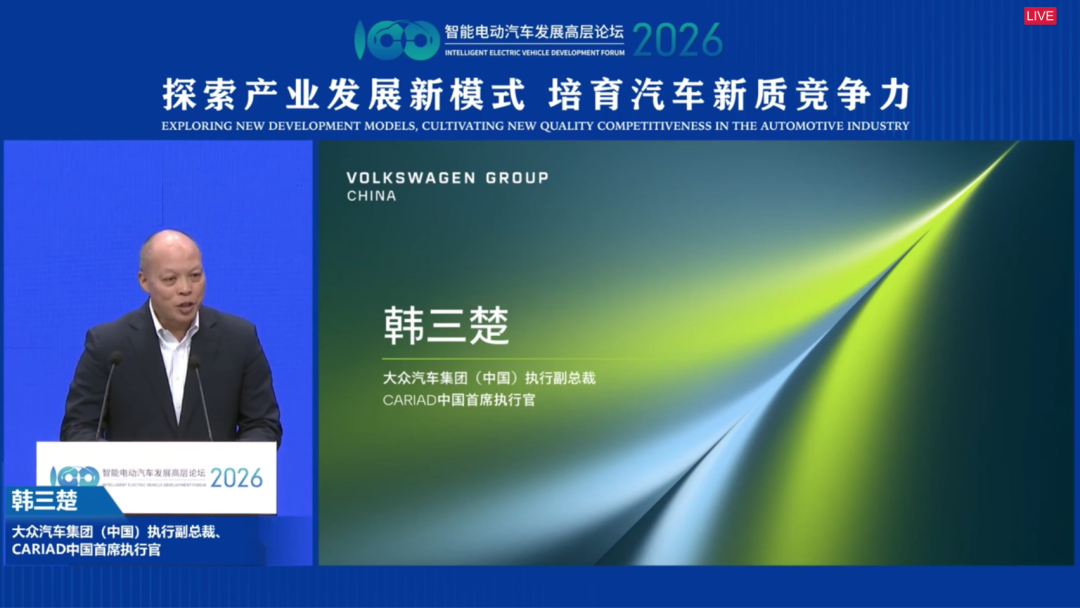
On April 11, Han Sanchu, Executive Vice President of Volkswagen Group China and CEO of CARIAD China, delivered a nearly 10,000-word keynote address at the 2026 China Electric Vehicle 100 Forum (EV100) Intelligent Electric Vehicle Development Forum. His speech was grounded in specific timelines, technical approaches, and mass-production data, avoiding emotional appeals or anecdotal narratives.
After reading, one key insight emerges: Volkswagen’s strategic focus in China is shifting from “localized production” to “localized innovation”—a transformation far more profound than most observers realize.
China’s Market Speed: Redefining Global Industry Standards
Han Sanchu opened with a set of statistics that every automotive industry analyst should note.
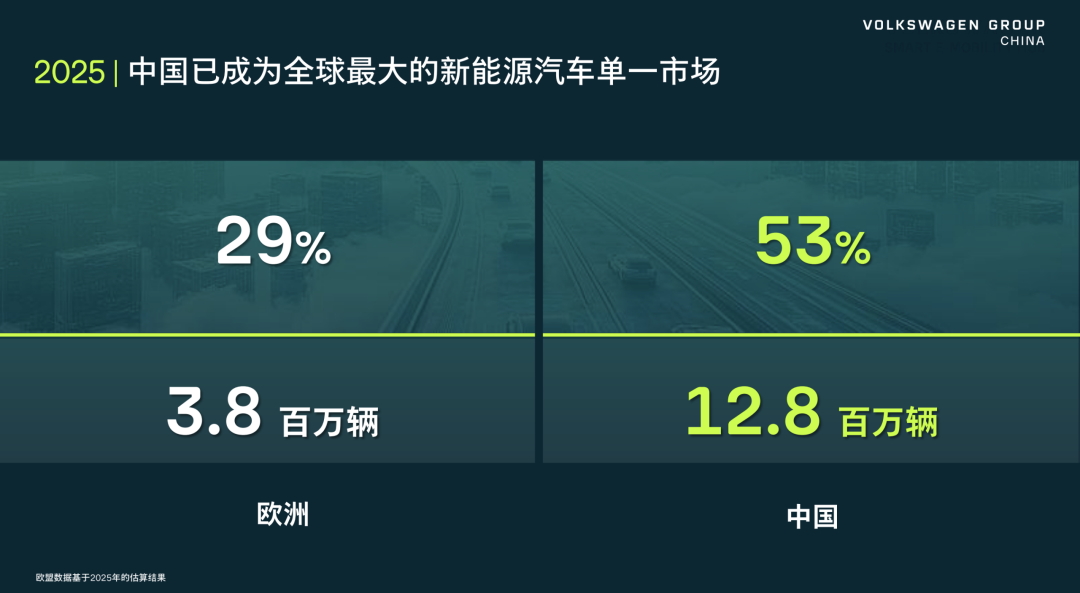
By 2025, Europe’s new energy vehicle (NEV) penetration rate is projected to reach approximately 30%, with annual sales nearing 4 million units. In stark contrast, China’s NEV penetration rate has already surpassed 50%, with annual sales approaching 13 million units.
This gap extends beyond sheer scale. China’s market hosts over 100 NEV brands competing on a level playing field, with blurred distinctions between “mainstream” and “luxury” segments. Intelligent driving features and digital cockpits have evolved from “value-added extras” to “industry standards.”
According to Han Sanchu’s assessment: China is now shaping the global competitive landscape for new energy vehicles.
For a global automaker like Volkswagen, this means: Establishing genuine local R&D capabilities in China is no longer optional—it is essential for maintaining global competitiveness in the NEV era.
Three Phases, One Fundamental Transformation
Volkswagen has operated in China for over four decades. Han Sanchu categorizes this journey into three distinct phases.
The first phase involved assembling imported components domestically, exemplified by models like the Santana and Jetta.
The second phase emphasized deep localization, raising the local component sourcing rate to over 90% and building a resilient supply chain.
The third phase, initiated in 2024, is defined by “building end-to-end capabilities, from product definition to technology development.” Rather than importing mature solutions from Germany, Volkswagen now completes the entire R&D cycle within China.
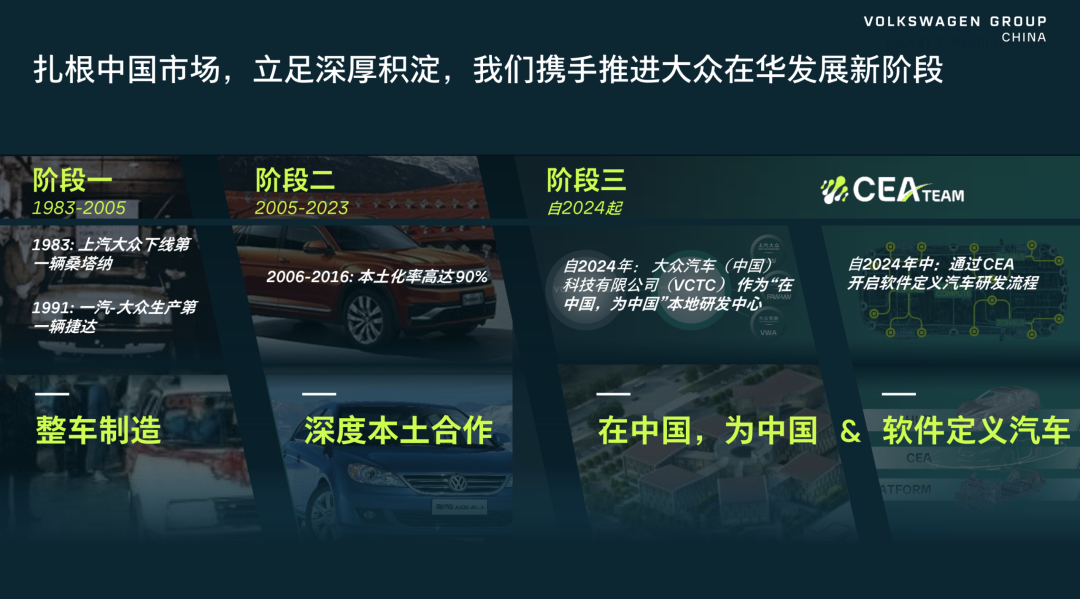
This phase is marked by two pivotal developments: the establishment of Volkswagen China Technology Company (VCTC)—Volkswagen’s first R&D center outside Germany with full vehicle development capabilities—and the launch of the group’s first locally developed regional control electronic and electrical architecture, CEA.
CEA: Volkswagen’s Strategic Pivot in China
If one concept encapsulates Han Sanchu’s speech, it is CEA—the Regional Control Electronic and Electrical Architecture.
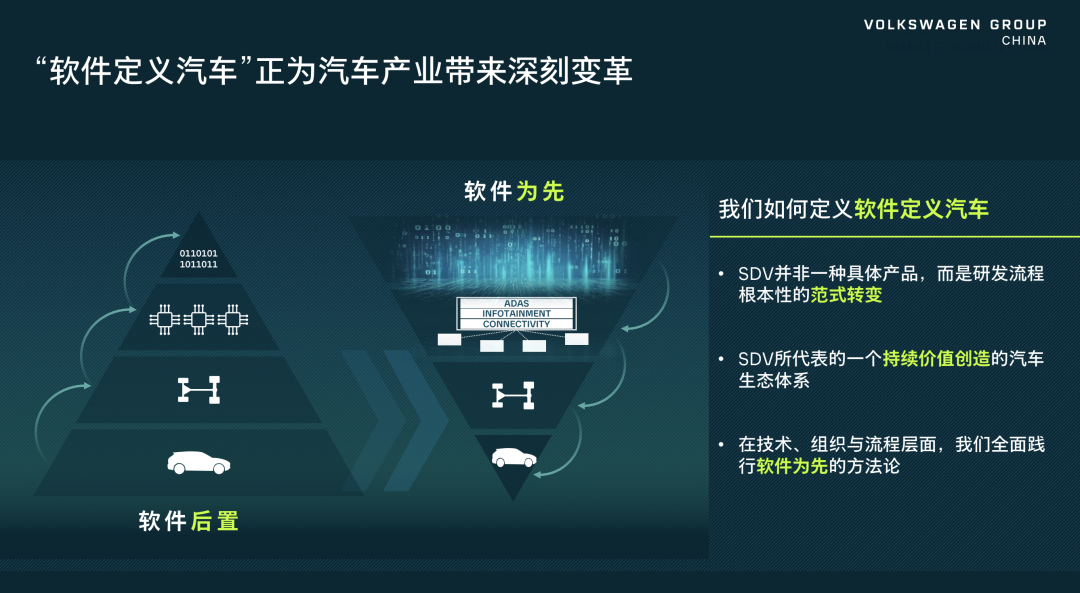
Its significance is straightforward. Traditional automotive development resembles constructing a house: the platform serves as the foundation, the body as the exterior walls, and functional modules as the rooms. This system functioned efficiently during the internal combustion engine era. However, as vehicles transition to being “software-defined,” a mere foundation and walls are insufficient. What is needed is an intelligent building management system capable of uniformly handling utilities, security, and communications while enabling continuous upgrades.
CEA fulfills this role. It facilitates deep hardware-software integration, supports ongoing OTA updates across the entire vehicle, and allows functions to evolve throughout the vehicle’s lifecycle—rather than being fixed at the factory.
This represents not just a product but a paradigm shift in R&D.
18 Months: From Concept to Reality
What truly stands out is the speed of CEA’s implementation.
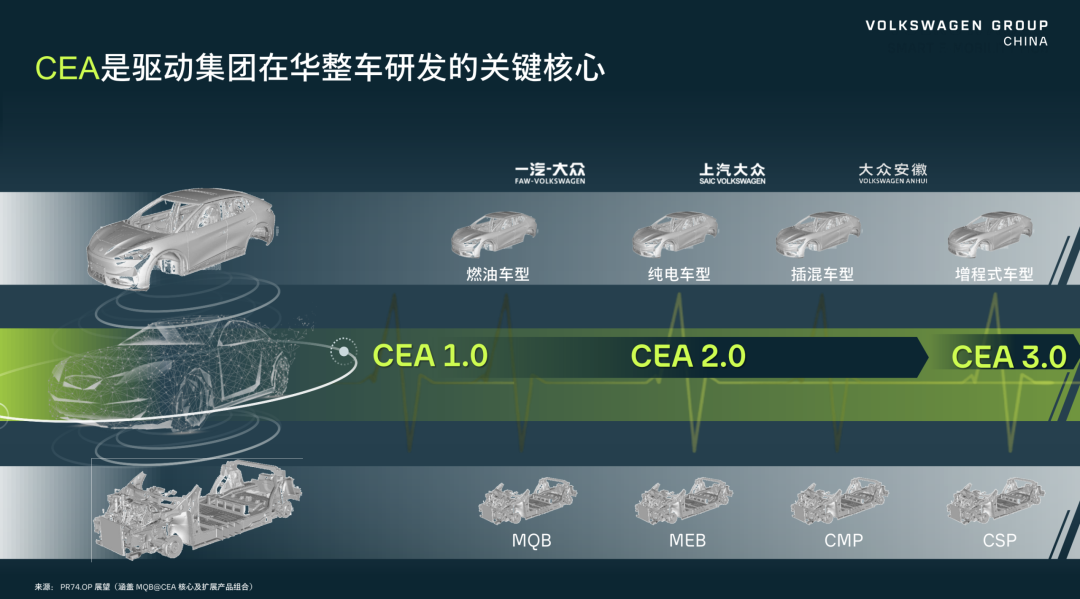
In July 2024, Volkswagen formed a strategic partnership with XPENG to jointly advance CEA 1.0 development. The objective was clear: complete the architecture’s initial development and functional verification within 18 months.
The outcome: CEA 1.0 entered mass production as scheduled by the end of 2025.
Han Sanchu highlighted the significance of this milestone in three ways:
① Volkswagen acquired independent software development capabilities for the first time.
② It successfully built its first locally developed software stack.
③ It gained sustainable, locally rooted technological competitiveness.
Meanwhile, CARIAD China has assembled a local software engineering team of over 1,000 members, established R&D networks in Beijing, Shanghai, and Hefei, and constructed the C-Group technology ecosystem: a joint venture with Horizon Robotics for intelligent driving (CARIZON), a joint venture with Thundersoft for intelligent cockpits (CARThunder), and the acquisition of design firm ARK to create CARIATIVE, focusing on digital UX/UI.
Clear Roadmap: Three Phases to Industry Leadership
Han Sanchu outlined a highly detailed technology roadmap in his speech:
Phase 1 · Present: Initial Acceleration
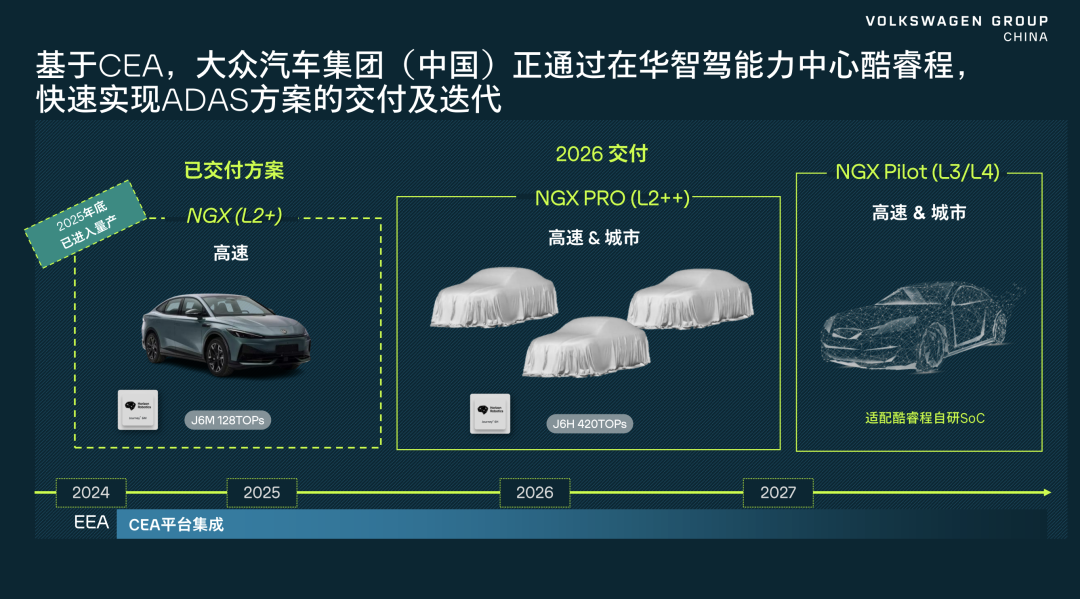
CEA 1.0 and CARIZON’s L2+ intelligent driving solution have entered mass production on new MEB platform models, with continuous iterative optimization.
Phase 2 · 2026-2027: Accelerated Local Autonomous Development
The CMP platform will adopt CEA and introduce L2++ solutions covering highway and urban navigation-assisted driving. CEA 2.0 is planned for mass production in 2027, laying the groundwork for L3 capabilities.
Phase 3 · 2029: Moving Toward Industry Leadership
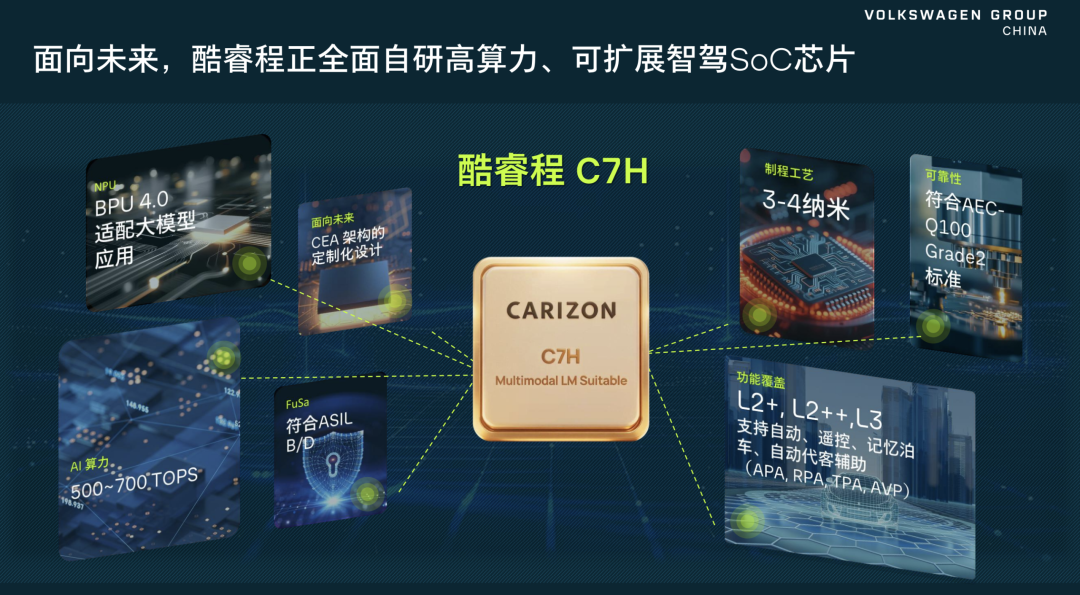
CEA will enter a highly intelligent phase. The in-house ADAS chip project will be implemented, establishing a complete link from vehicles, architectures, ECUs to chips. Vehicles will evolve into “AI cars” empowered by multiple intelligent agents.
Notably, in November of the previous year, Volkswagen Group officially announced that CARIZON would initiate self-development of an intelligent driving system-on-chip (SoC). A traditional automaker is now venturing into chip-level development—a clear indication that Volkswagen does not intend to rely permanently on external suppliers but to seize control over its computational foundation.
Product Level: 2026 Marks the “Volkswagen Moment”
Technological advancements must ultimately manifest in market offerings. Han Sanchu announced:
In 2026, multiple brands under Volkswagen Group will launch over 20 new energy vehicle models in the Chinese market. Specific models, as detailed in our previous article “2026 Beijing Auto Show: Key Product Technologies from Volkswagen,” will be showcased during this Beijing Auto Show. By 2027, approximately 30 models; by 2030, around 50 models.
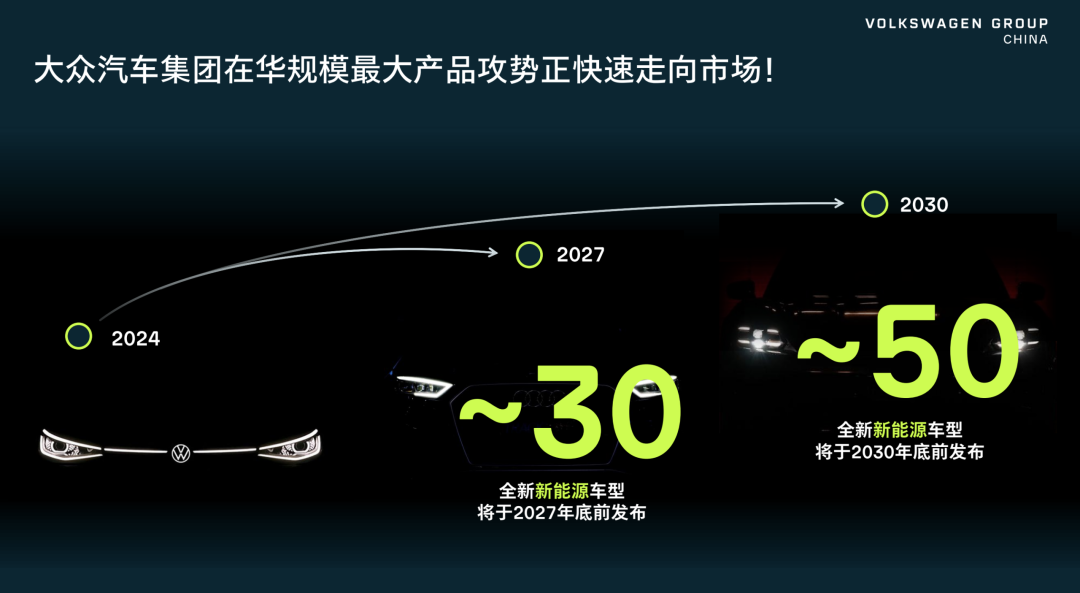
Meanwhile, leveraging the “software-defined vehicle” development process, Volkswagen has accelerated its development cycles by 30% and optimized costs by up to 50%. This enables faster and more competitive market launches for its products.
References and Images
Speech transcript and PPT from Han Sanchu’s presentation at the China Electric Vehicle 100 Forum, Volkswagen Group China.
*Unauthorized reproduction or excerpting is strictly prohibited.
-
![]()
AI Stranded at the Dock of the Era
-
![]()
New Progress! OFILM's Acquisition of Minority Stake in OFILM Microelectronics Approved
-
![]()
From Setbacks to a Potential 1.6 Billion Yuan Deal: What Has Seer Technology Achieved?
-
![]()
Why Has a Former Bottom-of-the-Barrel Destination Become a New Hotspot for Chinese Brands Going Global? | Xiaguang FM
-
![]()
The Hidden Battle of 618 Efficiency: Kunshan Asia No.1, AI, and JD.com's Logistics Performance This Year
-
New Energy Vehicle Safety Baseline Further Strengthened: MIIT Initiates 2026 Safety Hazard Inspections
-
![]()
China Office Intelligent Agent Platform Market Research Report 2026
-
![]()
Analysys: China's GEO Service Provider Market to Reach Approximately 1.6 Billion Yuan in Q1 2026, with Top 10 Industry Concentration Below 10%