2026 China EV100 Forum: Academician Ouyang Minggao Unveils Automotive Tech’s Future in the '15th Five-Year Plan' with a 10,000-Character Essay
 04/13 2026
 544
544
At the recently concluded China EV100 Forum, Academician Ouyang Minggao from the Chinese Academy of Sciences delivered a keynote address titled 'Retrospect and Prospect of China's Automotive Pure Electric Drive Technology Transformation Strategy.' This address not only provided a systematic review of China's new energy vehicle (NEV) industry's 'overtaking on a new path' over the past decade but also offered a rigorous analysis of technological trends and the industry's future during the upcoming '15th Five-Year Plan' period.
For automotive industry professionals, tech enthusiasts, policymakers, investors, and especially those keenly following automotive technology and industry development trends, this address was a treasure trove of information, signaling a clear shift: the 'follow-the-leader' model is obsolete, and the final battle has commenced, transitioning from 'single-technology breakthroughs' to 'comprehensive technology system competition.'
Today, Vehicle has distilled the key insights from this in-depth address, aiming to provide you with high-level perspectives for product definition, technology planning, and business investment strategies.
1. Track Switching: From 'Price Competition' to the Coupling of Three Major Values
As the penetration rate of new energy vehicles exceeds 50%, the industry has reached an inflection point, shifting from high-speed growth to high-quality development. Academician Ouyang clearly stated that during the '15th Five-Year Plan' period, the industry must transition from 'price competition' to 'value competition.'
In addition to the functional value (hardware configuration, mechanical quality) and emotional value (brand identity, intelligent experience) commonly discussed in current product definitions, he emphasized asset value for the first time.
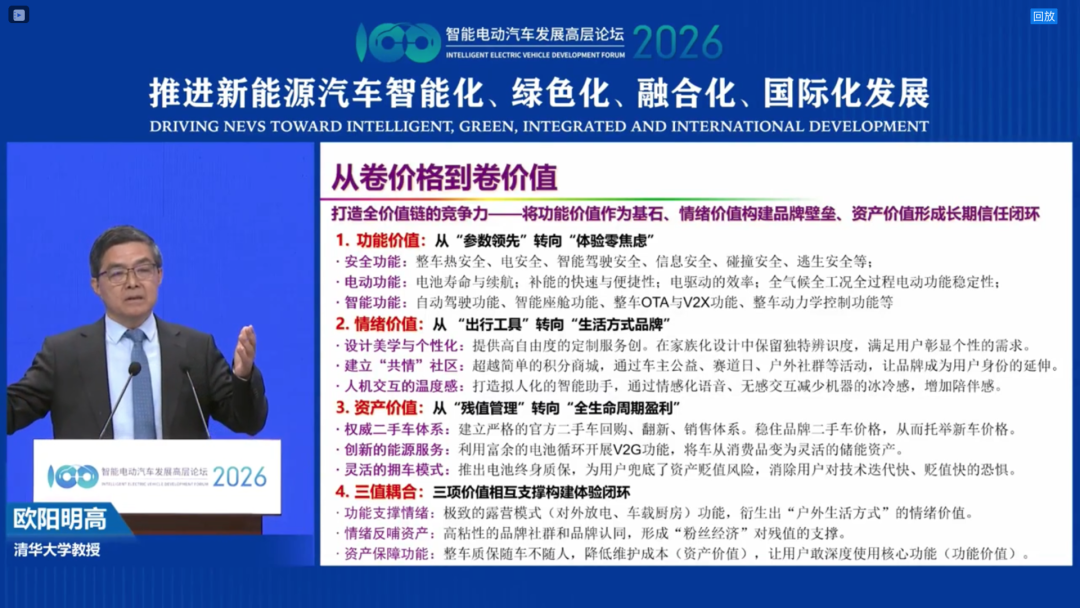
Future intelligent electric vehicles, particularly those equipped with long-life lithium iron phosphate batteries (often boasting cycle lives of two to three thousand times), can fully 'earn money' through Vehicle-to-Grid (V2G) interactions post-power market reforms. As vehicles evolve from pure consumer goods to appreciable mobile energy storage assets, new business models must be introduced for full lifecycle value management (such as warranty strategies and battery redundancy design).
2. Core Barriers: Reshaping Moats with the 'Seven Comprehensives' Technology System
In the past, innovations in single technologies (such as a high-energy-density battery cell or a first-to-market radar) could alone create a competitive edge. However, without strategic positioning and integration across the entire technology chain, such advantages can quickly be neutralized. Academician Ouyang proposed a 'seven comprehensives' technology system competition framework, which is the crux of his address:
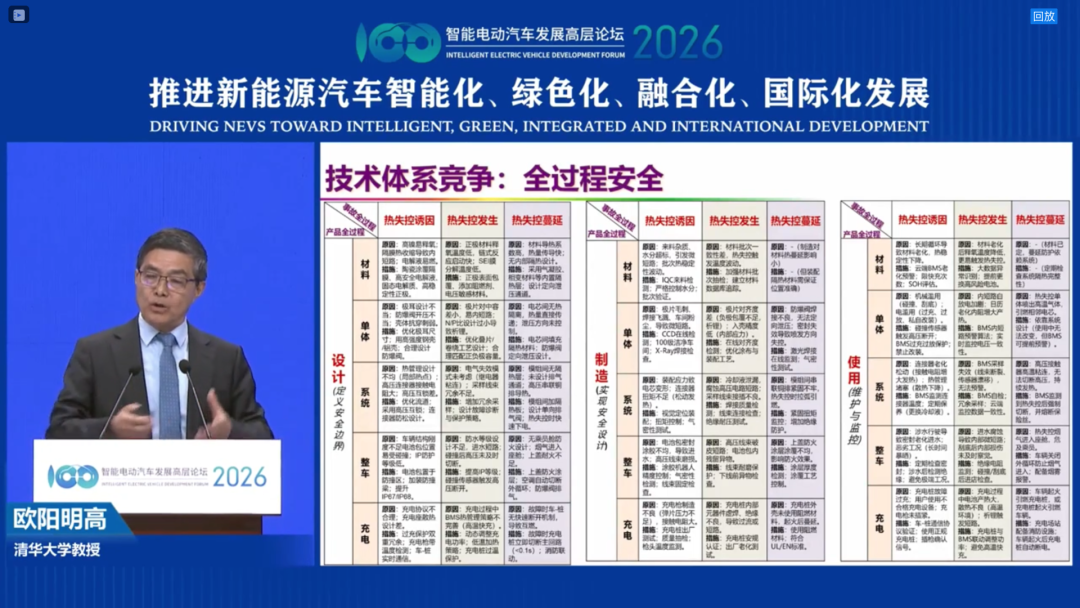
Comprehensive Safety: Safety cannot rely solely on individual battery cells; it must be designed across the entire chain, from materials, cells, systems, and vehicles to charging networks. Especially today, as ultra-fast/flash charging operates on the boundary between safety and lifespan, hotspot separation design and real-time safety boundary calibration are paramount.
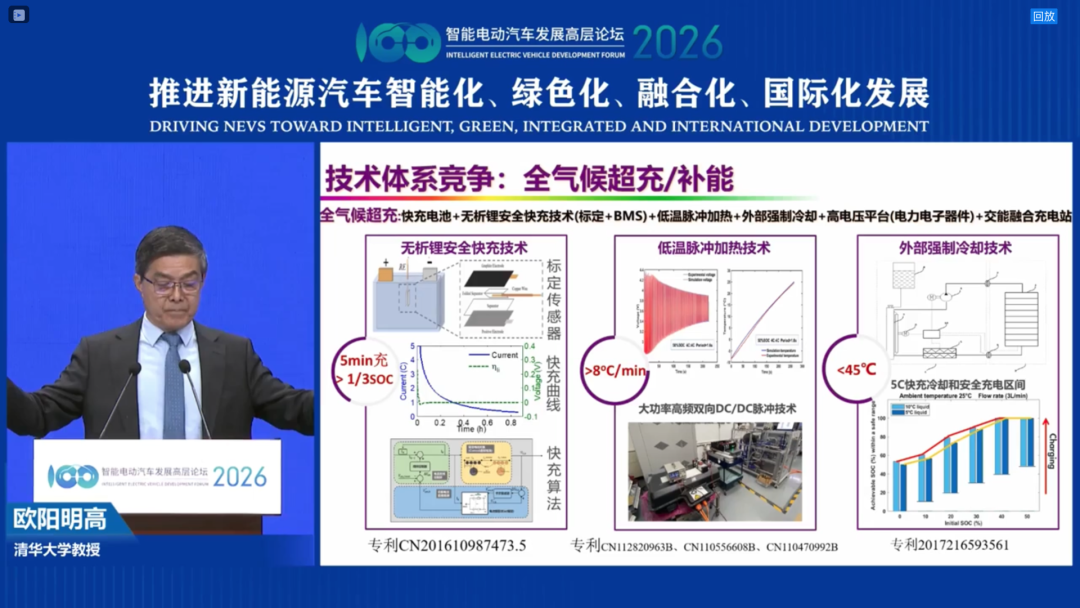
All-Weather Ultra-Fast Charging: This is not a single technology but a complex systems engineering project, including lithium-plating-free safe fast charging, low-temperature pulse heating, external forced cooling, and the construction of 'photovoltaic-storage-charging-swapping integrated' charging station systems. Megawatt-level ultra-fast charging cannot directly connect to the power grid and must rely on energy storage systems for buffering.
Fully Autonomous Driving: This will determine the outcome of the second half of the race. Academician Ouyang tends to favor a leapfrog approach beyond the traditional L2 to L3 progression, possibly jumping directly from L2 to L4. With the rapid development of artificial intelligence and end-to-end large models, whether pursuing Tesla-style vertical deep integration or NVIDIA-style horizontal ecosystem empowerment, high-level intelligent driving supported by powerful computing power and massive data loops is the true core.
Fully Wire-Controlled Chassis: Encompassing distributed drive and in-wheel motors, this is the physical foundation for achieving extreme responsiveness in high-level intelligent driving execution.
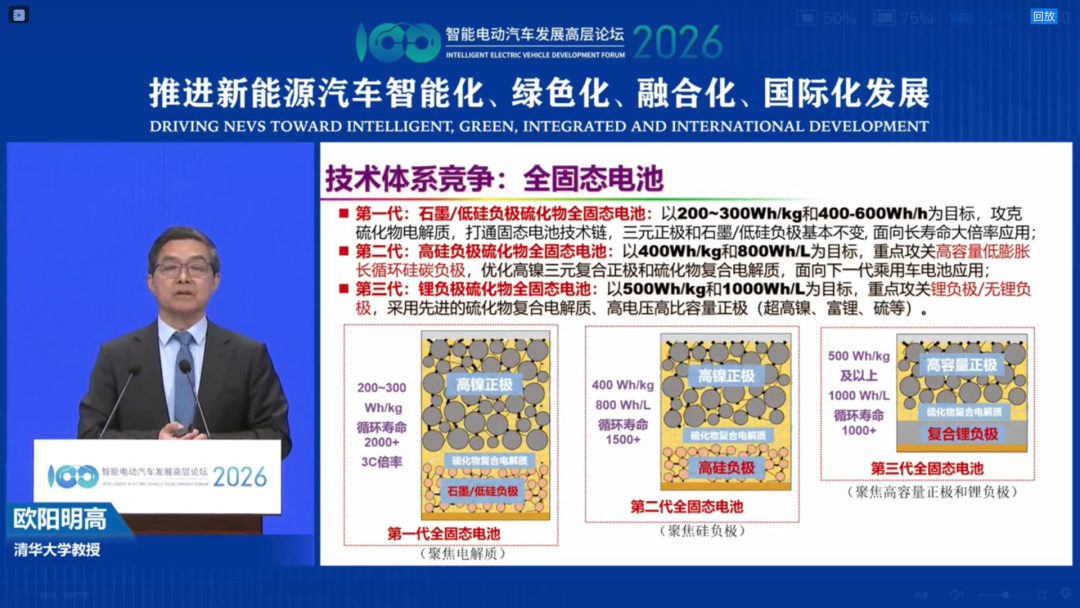
All-Solid-State Batteries: As the 'holy grail' of next-generation power batteries, Academician Ouyang offered a rational expectation—current interfacial side reactions (chemical, mechanical, thermal stability) remain scientific challenges. Mass-market availability of 300Wh/kg all-solid-state batteries will likely not occur until the end of the '15th Five-Year Plan' period, requiring gradual evolution from solid-state electrolyte breakthroughs to silicon-carbon anodes and lithium-rich manganese-based cathodes. Automakers must remain cautious in their product timelines.
All-Condition High Efficiency: To create pure electric vehicles with a real-world range of 1000 kilometers, energy consumption pain points during high-speed cruising and low-temperature environments must be addressed. At high speeds, air resistance accounts for a significant portion, and the motor's field-weakening region increases copper and iron losses, reducing efficiency. Meanwhile, small-capacity batteries perform poorly in high-speed conditions, leading to sharp increases in fuel/electricity consumption for plug-in hybrids.
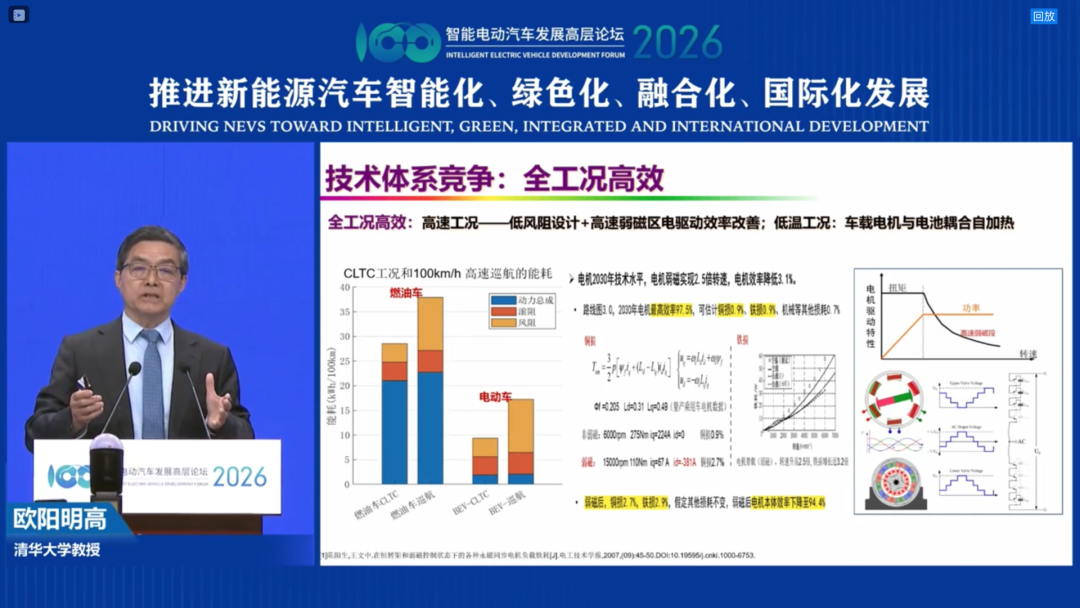
Fully Functional Electric Vehicles: Electric vehicles are not just transportation tools but also mobile carriers for power generation, energy storage, and intelligent computing.
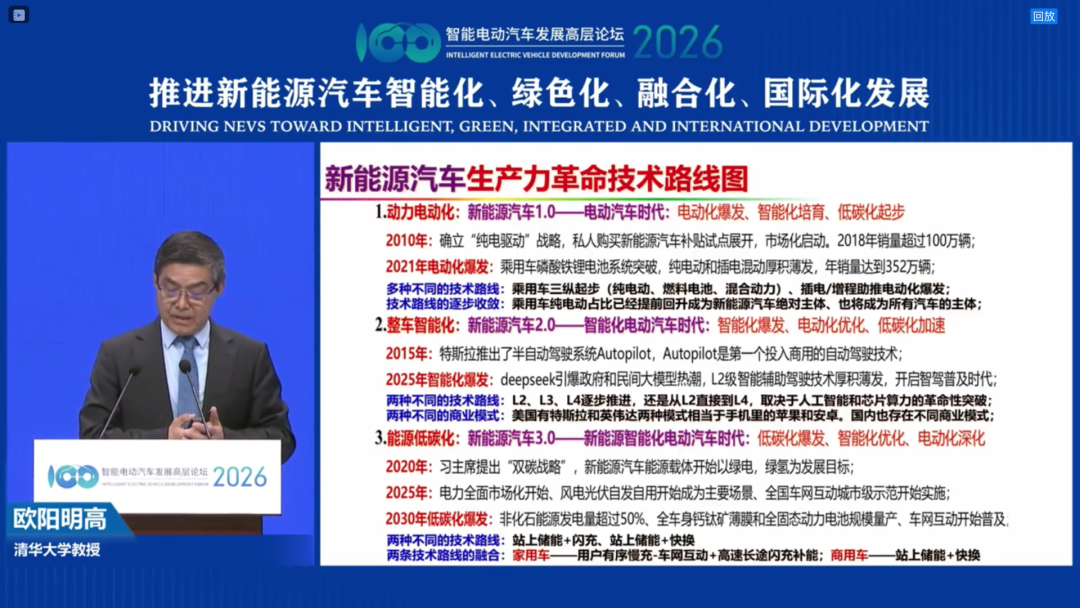
3. Final Evolution: Restructuring and Reshuffling of Five Major Industry Models
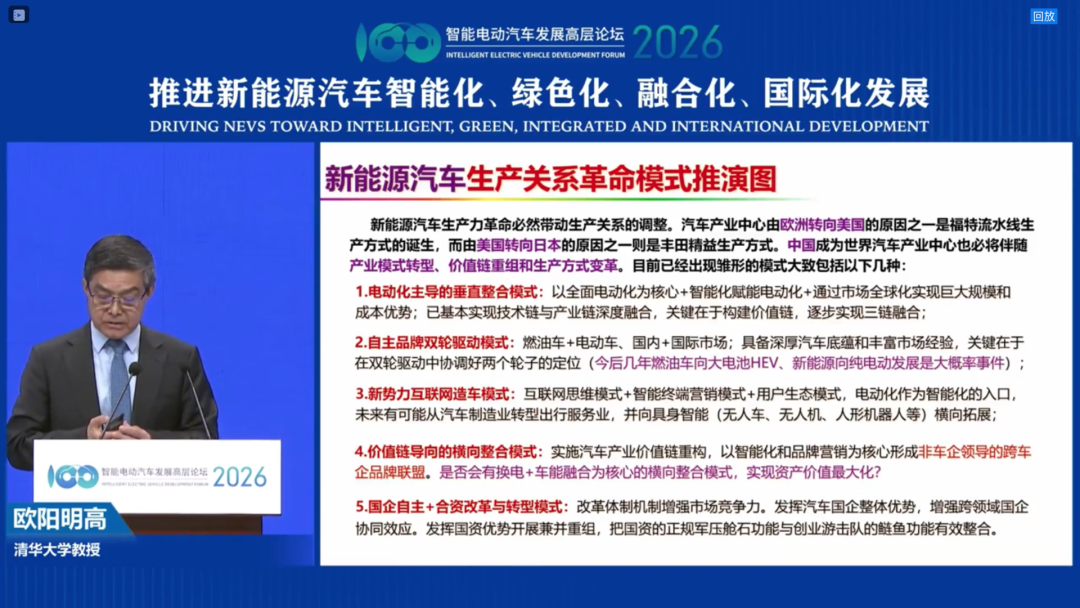
Revolutions in productive forces inevitably lead to the restructuring of production relations. From Ford's assembly line to Toyota's lean production, and now with China becoming the world's automotive center, value chains are rapidly reorganizing. Academician Ouyang summarized five emerging survival models:
Vertical Integration Model Led by Electrification: Based on large-scale electrification and empowered by intelligence, this model achieves a high degree of coupling and cost optimization across the technology, supply, and value chains. This primarily refers to the BYD model.
Dual-Energy Drive Strategy for Domestic Brands: Established automakers compete on both fuel/hybrid and pure electric fronts, with large-battery hybrids and pure electric vehicles coexisting as the new norm.
New Force Internet-Based Automaking Model: Using electrification as an entry point for intelligent terminals, the core lies in user ecosystems and marketing, with significant potential for horizontal expansion into mobility services and even embodied intelligence (such as humanoid robots).
Horizontal Integration Model Guided by Value Chains: Cross-automaker brand alliances led by non-automakers (such as Huawei's Smart Selection Vehicle Ecosystem) or asset operators centered around 'battery swapping + vehicle-energy integration.'
State-Owned Enterprise 'Independent + Joint Venture' Transformation Model: Leveraging financial and scale advantages, these enterprises play a 'stabilizing' role, combining market-oriented mechanisms for mergers, acquisitions, and cross-sector collaboration.
Vehicle Conclusion
Returning to the essence of electric vehicles, as Academician Ouyang Minggao emphasized in his closing remarks: Electric vehicles are the most efficient vehicles for utilizing green electricity, the lowest-cost vehicles, and the fastest-responding, most suitable vehicles for achieving autonomous driving.
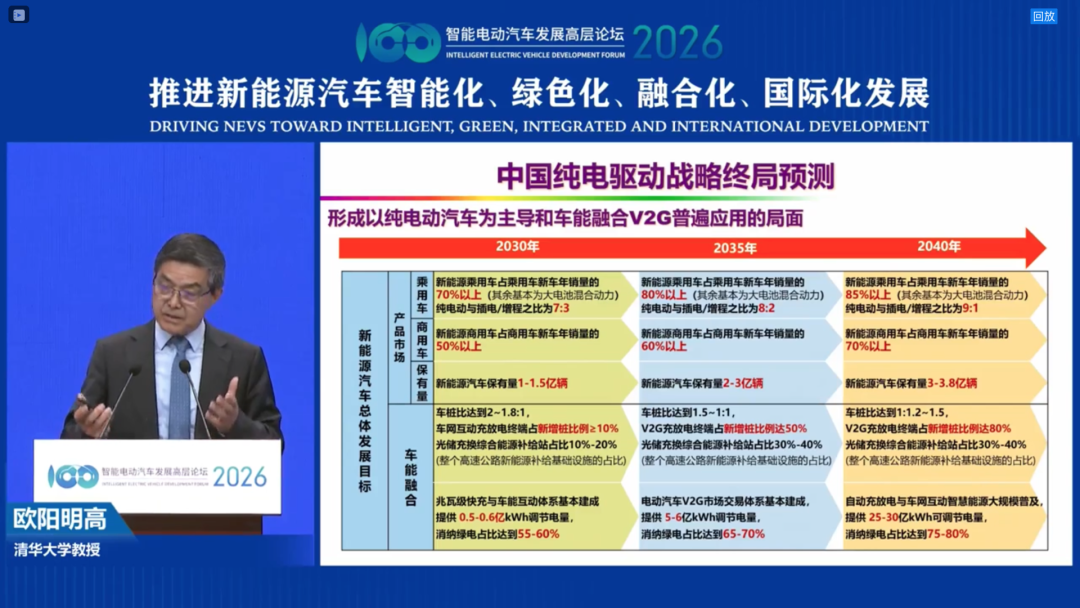
Whether you are a practitioner in the automotive manufacturing industry, a tech enthusiast, policymaker, or investor, we are all participating in a grand convergence of technological routes—electrification, intelligence, and low-carbonization. There are no shortcuts in this revolution. Only by abandoning short-sighted, single-point competition and solidly building your own comprehensive technology moat can you secure a ticket to the final showdown in the ruthless competition of inventory management.
References and Images
Retrospect and Prospect of China's Automotive Pure Electric Drive Technology Transformation Strategy - Delivered by Academician Ouyang Minggao from the Chinese Academy of Sciences at the China EV100 Forum
*Unauthorized reproduction or excerpting is strictly prohibited.
-
![]()
AI Stranded at the Dock of the Era
-
![]()
New Progress! OFILM's Acquisition of Minority Stake in OFILM Microelectronics Approved
-
![]()
From Setbacks to a Potential 1.6 Billion Yuan Deal: What Has Seer Technology Achieved?
-
![]()
Why Has a Former Bottom-of-the-Barrel Destination Become a New Hotspot for Chinese Brands Going Global? | Xiaguang FM
-
![]()
The Hidden Battle of 618 Efficiency: Kunshan Asia No.1, AI, and JD.com's Logistics Performance This Year
-
New Energy Vehicle Safety Baseline Further Strengthened: MIIT Initiates 2026 Safety Hazard Inspections
-
![]()
China Office Intelligent Agent Platform Market Research Report 2026
-
![]()
Analysys: China's GEO Service Provider Market to Reach Approximately 1.6 Billion Yuan in Q1 2026, with Top 10 Industry Concentration Below 10%