Japanese Giant to Contract Manufacture for Chinese Brand
 06/18 2026
 371
371
Global Automotive Industry Sees Shift in Offensive and Defensive Strategies
In Europe, a Japanese automotive giant is making room for a Chinese brand on its core production lines.
Recently, Nissan Motor announced the formal signing of a non-binding memorandum of understanding on cooperation with Chery International UK, confirming that from April 2027, it will open Production Line 1 at its Sunderland plant in the UK to contract manufacture complete vehicles for Chery. This marks the first time a mainstream Japanese automaker has contract manufactured vehicles for a Chinese independent brand in Europe's core market.
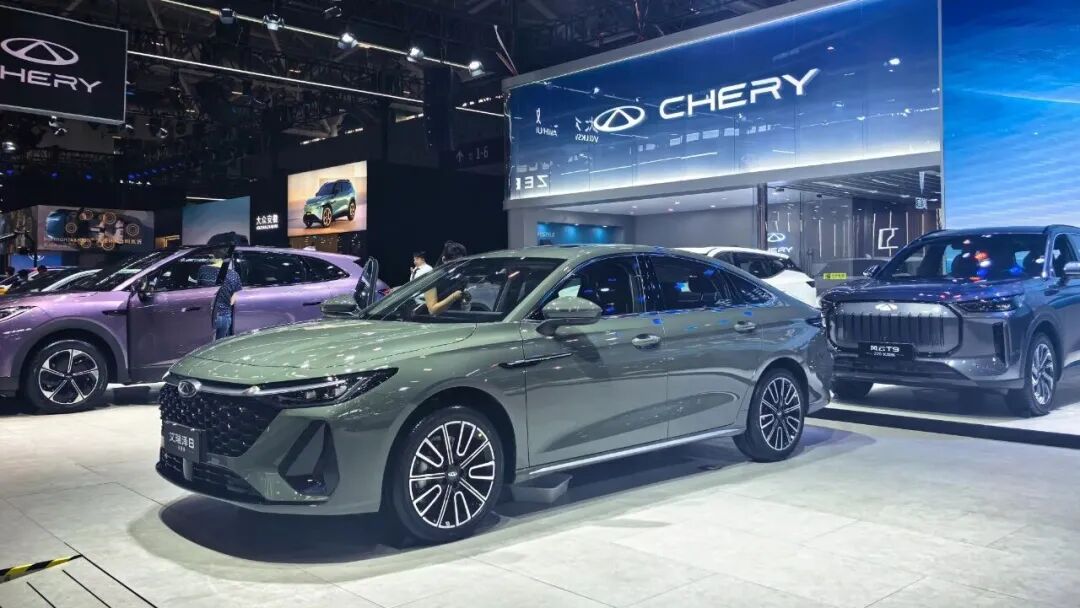
Chery Automobile's booth at the 2026 Guangdong-Hong Kong-Macao Greater Bay Area Auto Show (Photography/Liu Shanshan)
Behind this cross-border contract manufacturing collaboration lies the current predicament of idle production capacity faced by traditional foreign automakers, alongside the strong rise of Chinese automakers going global. According to export data released by the China Association of Automobile Manufacturers (CAAM) on June 10, China exported 930,000 vehicles in May this year, a year-on-year increase of 68.7%, marking the second consecutive month of monthly exports exceeding 900,000 units. From January to May, domestic auto exports reached a cumulative 4.059 million units, a significant year-on-year increase of 63%. Among them, new energy vehicle exports totaled 1.833 million units, accounting for over 45% of total exports, becoming the core growth pillar for Chinese automakers going global.
Thus far, the traditional global automotive industry landscape of 'Western technology, Eastern markets,' which has persisted for years, is showing signs of loosening. A new cooperation model of 'Eastern technology, Western production capacity' is emerging as a new trend in the global automotive industry's evolution.
Idle Production Capacity at Overseas Established Automakers
Located in northeastern England, the Sunderland plant was once Nissan Europe's 'crown jewel' and one of the largest vehicle manufacturing bases in the UK. Equipped with two complete vehicle production lines, the plant had an annual production capacity of up to 600,000 units at its peak, producing Nissan Europe's mainstay models such as the Qashqai, Juke, and Leaf, and employing approximately 6,000 people, making it one of the UK's largest automotive employers. At that time, the efficient operation of the Sunderland plant was a crucial support for Nissan's influence in the European market.
However, with the accelerated electrification transformation of the global automotive industry and persistently weak demand in the European domestic auto market, this once-stellar plant has fallen into the predicament of idle production capacity. According to MarkLines statistics, the actual operating rate of the Sunderland plant in 2025 was only 45.5%, down 8.7 percentage points from 2023, with annual vehicle production reaching approximately 273,000 units, less than half of its designed capacity.
For asset-heavy automotive factories, idle production lines mean persistently high fixed costs. Continuous expenditures on plant maintenance, equipment depreciation, and personnel salaries erode corporate profits, making the Sunderland plant a burden on Nissan's European operations.
Behind the predicament of a single factory lies Nissan's overall decline in global operations. According to Nissan's financial report, its global sales fell to 3.15 million units in the 2025 fiscal year, with consolidated revenue at JPY 12.0 trillion, a year-on-year decrease of 4.9%. Operating profit declined by 16.9% to JPY 58 billion, with an operating profit margin of only 0.5%, barely maintaining a positive bottom line. Net losses reached a staggering JPY 533.1 billion, adding to the JPY 670.9 billion net loss in the 2024 fiscal year, resulting in cumulative net losses exceeding JPY 1.2 trillion over the two fiscal years.
In Europe, the Sunderland plant's predicament is not an isolated case. Data released by AlixPartners previously showed that the average capacity utilization rate of European automotive factories is only 55%, significantly lower than the industry's healthy range of 70%-90%, with most factories operating at less than three-quarters capacity. Currently, giants such as Volkswagen, Stellantis, and Ford generally face insufficient operating rates at their European plants, with overall idle production capacity in the European market even exceeding 2 million units.
Chinese Auto Exports Soar
In stark contrast to the sluggish sales and idle production capacity faced by traditional overseas automakers, the scale of Chinese auto exports continues to surge.
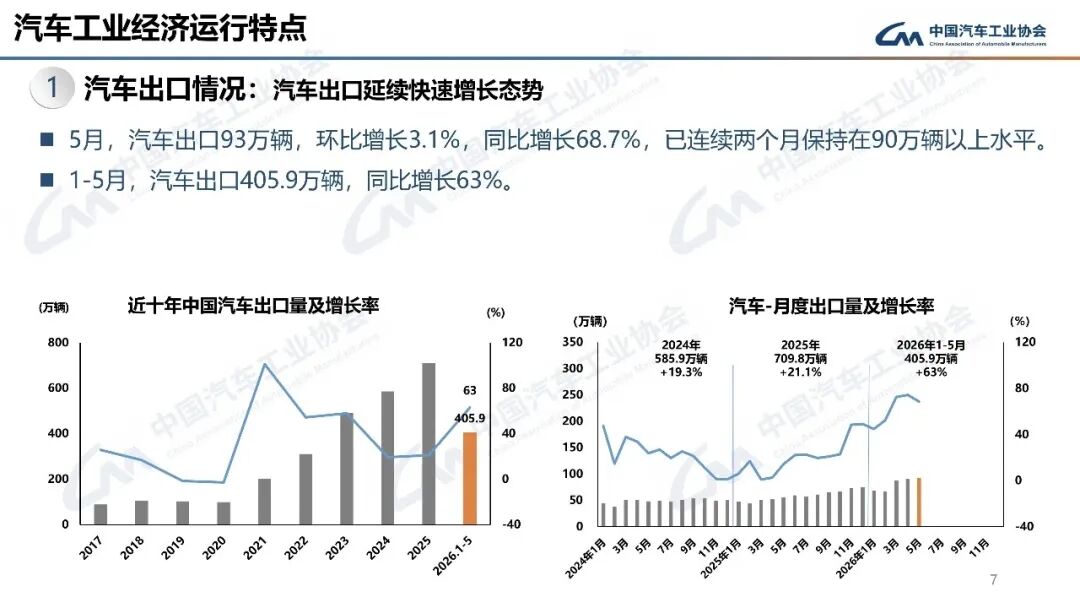
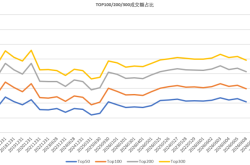
Chart Source: China Association of Automobile Manufacturers
According to data from the China Association of Automobile Manufacturers, from January to May this year, China's cumulative auto exports reached 4.059 million units, a year-on-year increase of 63%. Chen Shihua, Deputy Secretary-General of the CAAM, stated that China's new energy vehicles' in-vehicle systems, intelligent driving, and cabin interaction capabilities meet the needs of overseas users, with rapid iteration of localized intelligent functions, forming a core competitive advantage over the intelligence shortcomings of traditional overseas automakers.
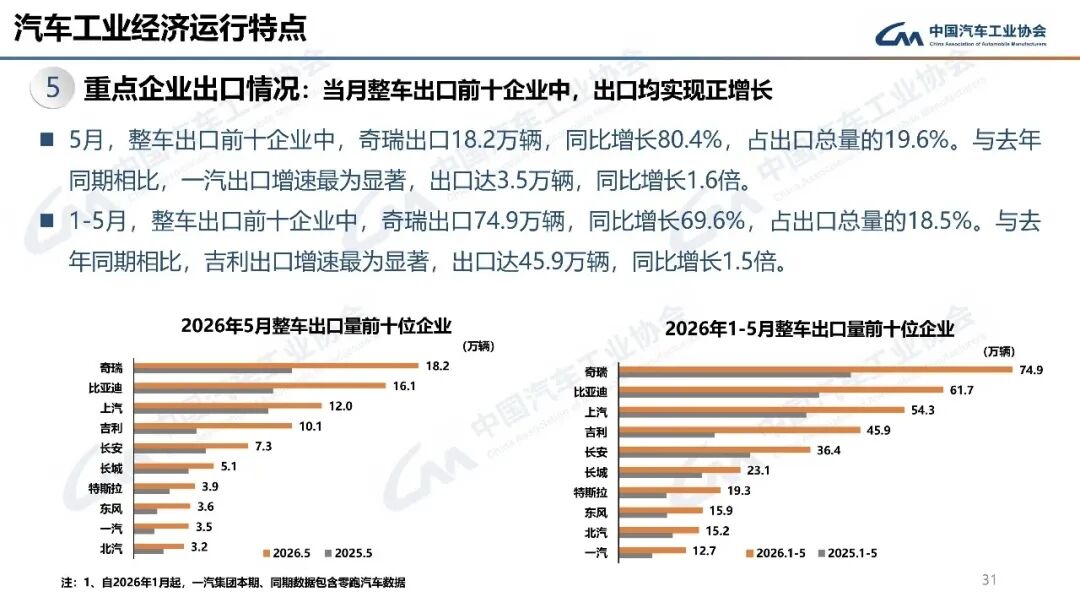
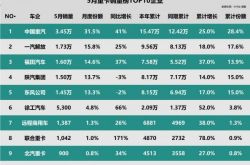
Chart Source: China Association of Automobile Manufacturers
Among domestic automakers going global, Chery Automobile holds a leading position. According to CAAM data, Chery's overseas sales reached 182,000 units in May, retaining the monthly export sales crown. From January to May, Chery Group's cumulative vehicle exports reached 749,000 units, showing strong momentum in overseas market expansion.
The European market has become Chery's core growth market. According to 2025 financial report data, Chery's annual sales in the European market increased by over 200% year-on-year. In the first quarter of 2026, Chery's European sales reached 90,579 units, a year-on-year surge of 170%, with March sales alone reaching 38,670 units, a year-on-year increase of 369%, and market share rising to 2.45%, making it the fastest-growing mainstream traditional Chinese automaker in the European market. Chery's three brands—Chery, Jetour, and Omoda—perform strongly in the UK market, with combined sales reaching 10,052 units in April this year, second only to Volkswagen (12,884 units) and far exceeding Nissan's 4,079 units during the same period, providing a market foundation for the collaboration between the two sides.
Currently, China's complete vehicle exports primarily rely on ocean freight. This model has inherent drawbacks: prolonged shipping cycles extend inventory turnover, and the EU's high import tariffs continuously compress product profits. Coupled with Step by step escalation (escalating) non-tariff barriers such as carbon tariffs and import access regulations, the cost-effectiveness advantage of pure complete vehicle exports is weakened.
In October 2024, the EU imposed additional anti-subsidy tariffs of up to 35.3% on Chinese electric vehicles, on top of the existing 10% basic tariff, bringing the comprehensive tariff rate for Chinese auto brands like SAIC MG to 45.3% at one point. Even though China and the EU reached a consensus on a 'price commitment' framework in January 2026, pricing space is still constrained by minimum import prices.
Cui Dongshu, Secretary-General of the China Passenger Car Association, stated that it is an excellent development strategy for Chinese automakers to leverage existing European production capacity for localized development. Currently, the overall operational efficiency of the European automotive industry is low, with cumbersome processes and complex barriers in market access and qualification approvals. By relying on existing European factories for contract manufacturing and localized production, Chinese automakers can significantly enhance operational efficiency upon landing, effectively reducing various market frictions and compliance resistance in cross-border development. Simultaneously, this model can revitalize idle European production capacity, stabilize local factory operations, safeguard employment for domestic industrial workers, and benefit the European economy and automotive industry development. Moreover, the entry of Chinese automakers can create a beneficial 'catfish effect,' activating Europe's stagnant industrial ecosystem, compelling local automakers to accelerate transformation and quality upgrades, and driving overall progress in the European automotive industry, achieving mutually beneficial development.
Global Automotive Industry Landscape May Be Reshaped
For a long time, the Chinese automotive industry has followed a path of 'exchanging market access for technology,' introducing foreign capital through joint ventures. However, the script is now being rewritten. Factories and production lines of traditional overseas automakers are beginning to experience idleness, while Chinese automakers are accelerating overseas expansion and urgently need localized production capacity to circumvent trade barriers and stay close to end markets. The complementarity of supply and demand has given rise to a new model of industrial cooperation.
In recent years, several Chinese automakers have already revitalized overseas idle production capacity and established global production systems through acquisitions, contract manufacturing, strategic collaborations, and other means. In 2020, Great Wall Motor invested JPY 4.72 billion to acquire General Motors' Rayong plant in Thailand, later mass-producing mainstay models such as the Ora and Haval. In 2023, BYD acquired Ford's production base in Brazil and invested BRL 5.5 billion to build a large-scale vehicle production complex. In 2024, Chery acquired Nissan's idle plant in Barcelona, Spain, achieving localized production through the 'Chinese technology + local brand' model. In May 2025, XPENG Motors acquired a 90.1% stake in an Indonesian electric vehicle manufacturing entity, officially establishing its first overseas production base.
More Sino-foreign collaborations in the automotive industry are underway. On May 13, Li Ke, Executive Vice President of BYD, confirmed that the company is in talks with European automakers such as Stellantis Group, planning to take over idle or underutilized factories in Europe. On May 20, Stellantis Group officially announced cooperation negotiations with Dongfeng Group, planning to achieve localized production of Dongfeng's new energy vehicle models relying on Renault's factory in Rennes, France.
According to an April report by AlixPartners, Chinese automakers plan to produce in at least 16 other countries, expanding overseas production from 1.2 million units in 2025 to 3.4 million units in 2030. This strategy of deep integration into the global automotive industry chain makes the global expansion of Chinese electric vehicles not merely a trade act but a global layout of industrial capabilities.
In the future, as the comprehensive strength of Chinese auto brands continues to rise and traditional automakers accelerate strategic adjustments, the competitive landscape of the global automotive industry will undergo deeper-level reshaping. A new era of the automotive industry, driven by electrification as the core force, with deep participation and leadership from Chinese power and a globally coordinated layout, is accelerating its arrival.
-
![]()
Chinese New Energy Vehicle Design: Stepping Out of the Shadows
-
![]()
Li Auto Awards Executives 35 Million Shares Based on Performance Metrics
-
![]()
Rushing Towards AI 2.0: How Confident is Unisound?
-
经过今年上半年各路AI豪强对市场的反复教育,有一个判断,可能决定未来一两年的走向:
-
![]()
Global Tech Sector Sees Collective Panic: Is the AI Hype Finally Deflating?
-
![]()
Three Consecutive Rises in Heavy Truck Sales: Both New and Old Players are Betting on the Same Thing!
-
![]()
Why Can’t Vivo Bridge the High-End Perception Gap Despite Support from Authoritative Media?
-
![]()
Regulatory Measures and Industry Norms: The Transformation of GEO's Trajectory in the Second Half