GAC Toyota’s Sales Boom: Forging Vehicles with Enduring Value for the Long Haul
 06/23 2026
 378
378
In-Depth, Objective, Insightful
Sustained Growth, Fortuitous Discoveries!
Success Hinges on Execution
Editor: Li Li
Style: Voyager
Source: Shoucai - Shoutiao Finance Research Institute
Amidst a period of market consolidation, GAC Toyota has bucked the trend, charting its own course of performance.
On June 11, the latest figures from the China Association of Automobile Manufacturers (CAAM) revealed that in May, nationwide automobile sales reached 2.629 million units, a 2.1% decrease year-on-year. Domestic terminal sales stood at 1.7 million units, marking a 20.4% decline compared to the previous year. From January to May, cumulative sales reached 12.207 million units, down 4.2% year-on-year.
Against this challenging backdrop, GAC Toyota has demonstrated an upward trajectory. The company reported terminal deliveries of 66,127 units in March, 54,117 in April, and 55,048 in May, securing its position as the leader among joint-venture brands for the first time in a quarter. The new energy segment has been particularly noteworthy. In May, sales of the BZ family surpassed 10,000 units, with the BZ 3X maintaining its top spot among joint-venture pure electric models for nine consecutive months.
This success is no mere coincidence. Wen Dali, Executive Deputy General Manager of GAC Toyota, credits the company’s operational philosophy: “Toyota does not gamble.” In his view, a pragmatic and steady approach equips the company with resilience in the face of external challenges. The fiercer the storm, the steadier the foundation, enabling consistent progress.
While many brands are embroiled in a “price war” cycle, artificially shortening product lifecycles, GAC Toyota has taken a different approach. New models are introduced with a stable pricing strategy, sending a clear market signal: product value will not be significantly diminished by short-term promotions. This strategic resolve and adherence may well be the key to weathering cyclical fluctuations and achieving steady advancement.
1. Avoiding Trends, Emphasizing Meticulous Execution: Forging Vehicles with Enduring Value
Implementing seemingly straightforward business principles is often easier said than done.
Looking ahead to 2026, the Chinese auto market is undergoing significant restructuring. CAAM data for the first five months of 2026 shows ongoing adjustments in market shares among joint-venture passenger vehicle brands: German brands have contracted to 10.4%, Japanese to 8.7%, American to 7%, Korean to just 1.6%, and other brands combined at no more than 1.4%.
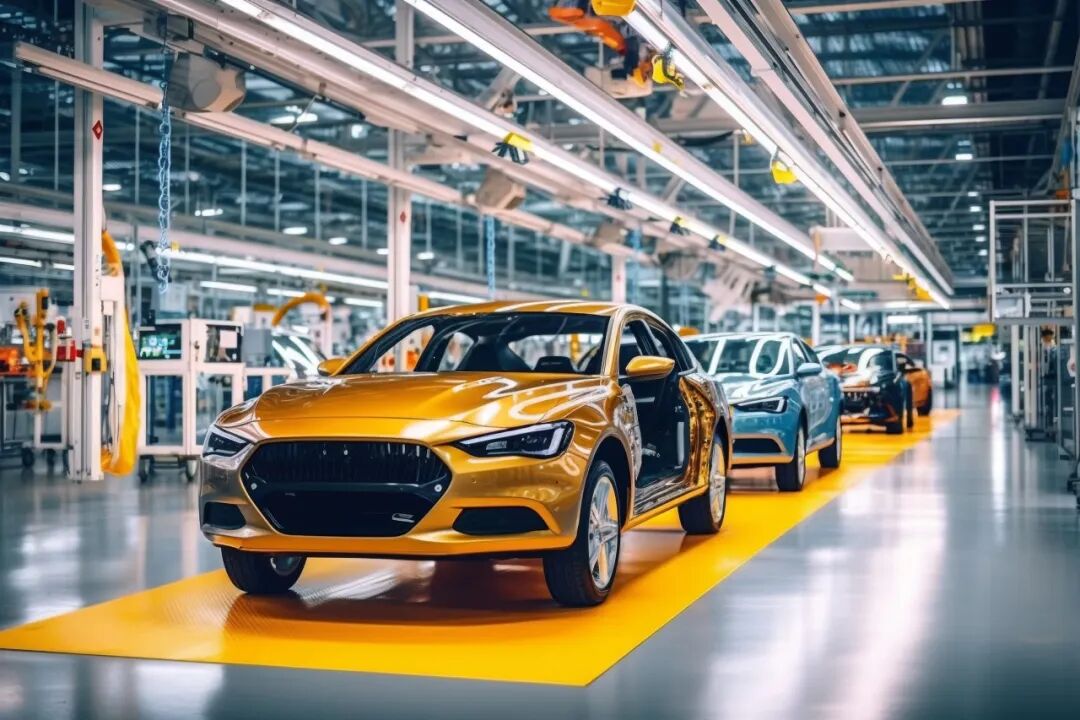
These figures clearly indicate that joint-venture brands have moved beyond the era of uniform growth or decline, with accelerated internal differentiation. What specific strategies has GAC Toyota employed to exhibit such unexpected resilience?
Analyzing the performance, the underlying logic becomes apparent. Taking the latest May data as an example, the combined sales of the three flagship models—Sienna, Camry, and Highlander—accounted for 47% of the total. In the first five months, sales of intelligent electric hybrid models rose to 54%, replacing traditional fuel vehicles as the primary force. This shift has quietly completed a balanced iterative upgrade of the product mix.
However, a closer look at segment markets reveals that traditional mainstays remain competitive: Sienna has held the top spot in the MPV segment for five consecutive months, while Camry has led the joint-venture mid-to-high-end sedan sector for three months. Combined with the synergistic efforts of hybrid and pure electric products, a multi-product, multi-powertrain network has been established. These lines neither rely on nor compete with each other but instead provide mutual support, thereby diversifying market risks.
Industry analyst Li Xiaojing believes this balanced structure did not form by chance but is the result of proactive strategic choices. The company does not rely on a single blockbuster model to drive sales. Instead, across different market segments, it has built not isolated islands but a risk-diversified, mutually reinforcing operational matrix. Consequently, the more uncertain the external environment, the more pronounced the resilience advantages of this system become, with operational resilience propelling GAC Toyota to the top among joint ventures.
If this balanced structure represents a “static advantage,” then the external shocks of 2026 served as a litmus test for the system’s “dynamic resilience.”
In March 2026, affected by international geopolitical conflicts, global oil prices surged. International crude oil futures on the New York exchange briefly exceeded $100 per barrel, causing a sharp downturn in the pure fuel vehicle market. CPCA data shows that in May, retail sales of conventional fuel passenger vehicles plummeted by 39% year-on-year, while new energy vehicle penetration reached 63%, with no fuel vehicles among the top ten sellers.
Amid high oil prices and shrinking fuel vehicle markets, GAC Toyota maintained stability through the low fuel consumption advantages of its hybrid products. HEV models did not decline with the market trend but instead acted as stabilizers. Coupled with efforts in both intelligent electric hybrids and new energy sectors, this balance of stability and advancement was key to its independent market performance.
Delving deeper, GAC Toyota’s approach reflects a unique understanding of intelligent electric transformation among traditional fuel vehicle brands: consistently aligning with diverse user travel needs, avoiding short-term trends and explosive growth, but instead meticulously cultivating each market segment, fully addressing diverse user demands, and achieving steady growth.
While the entire industry is trapped in a vicious cycle of “price cuts—hesitation—further price cuts—premature product lifecycle termination,” GAC Toyota adheres to “full-line upgrades without price hikes.” Deputy General Manager Peng Baolin succinctly states: “We don’t build short-term ‘disposable cars’ but long-term ‘vehicles with enduring value’.” This conveys that product value will not be easily compromised by short-term promotions, reflecting strategic confidence.
2. From “Listening” to “Defining”: Continuously Building Better Electric Vehicles
Beyond the stabilizing effect of balanced operations, the strong rise of the BZ brand is seen as a spearhead for electrification.
On March 6, 2025, the BZ 3X was officially launched with seven trim levels priced between RMB 109,800 and RMB 159,800. Notably, the high-end intelligent driving version, priced at RMB 149,800, became the first in the industry to offer LiDAR-based advanced intelligent driving in the RMB 140,000 price range, securing over 10,000 orders within an hour of launch.
However, sustaining success post-launch is the more critical challenge. Facing initial monthly sales fluctuations, GAC Toyota engaged deeply with users, initiating a “deep user cultivation” approach. Over the past year, the BZ 3X has held over ten face-to-face user communication sessions, gathering thousands of authentic owner suggestions.
This workflow, internally termed “data forging,” is the soul of GAC Toyota’s market methodology. Each week, the team sifts through social media platforms, owner groups, and dealership feedback like panning for gold, analyzing each comment and even directly calling owners for clarification. Through this nearly tenacious persistence, they accurately identified deep-seated anxieties among EV users: battery safety and intelligent parking safety.
In response, GAC Toyota introduced an industry-first “Manufacturer’s Triple Responsibility” policy: first, the manufacturer directly compensates with a new vehicle in case of spontaneous combustion. Second, if battery capacity decay exceeds standards within specified years and mileage, the manufacturer replaces it with a brand-new original battery free of charge. Third, the manufacturer covers all repair costs and third-party damages resulting from intelligent parking accidents.
In the view of industry analyst Wang Tingyan, including these core commitments directly in purchase contracts represents legally enforceable promises. This shifts risks entirely from users to the manufacturer, restoring electric vehicles as trustworthy durable assets for families. From “upgrades without price hikes” in pricing to “risk-free” guarantees, GAC Toyota consistently signals that long-term product value will not be easily compromised by technological advancements, ultimately converting these promises into purchasing power.

Of course, assuming responsibility is just risk mitigation; quality evolution is the cornerstone of sales. Just three months after the BZ 3X’s launch in June 2026, GAC Toyota rolled out its first OTA update, optimizing 26 functions at once. Within a year, three major OTA updates followed. Especially with the 2026 new model launch, the product featured upgrades without price hikes. Responding to owner demands, standard features now include original factory dashcams, sentry mode, and fully equipped front seats with ventilation, heating, and memory functions.
By balancing iteration capabilities and user sincerity, GAC Toyota signals to the market that joint ventures can not only build good electric vehicles but also sustainably improve them with resilience. Official data shows that within just 14 months of launch, cumulative BZ 3X sales exceeded 100,000 units, ranking among the top in joint-venture new energy sales and compact pure electric SUV segments for seven consecutive months.
If the BZ 3X is the vanguard, the debut of the BZ 7 propels this offensive to new heights. In March 2026, as GAC Toyota’s first luxury large pure electric sedan equipped with Huawei’s HarmonyOS cockpit, it not only comes standard with Huawei’s highly efficient 97.5% motor but also positions itself within the RMB 200,000 price threshold for pure electric sedans through a limited-time privileged price of RMB 147,800 to RMB 199,800, demonstrating full sincerity.
Thus, GAC Toyota’s electrification strategy path becomes clear. From the BZ 3X’s user-centric approach to the BZ 7’s embrace of cutting-edge technology, the company is transitioning from “building electric vehicles” to “defining electric vehicles.” The journey of deep user engagement reveals a simple truth: true competitive moats lie not in stacking flashy hardware but in transforming user anxieties into corporate responsibilities, self-evolution, and market expansion drivers.
3. Cultivating Slow Skills: Mastering Quality and Trust Accounts
Beneath GAC Toyota’s turnaround lies product breakthroughs on the surface and systemic restructuring at its core.
In today’s context of rapid intelligent supply chain iterations and ever-changing local user demands, traditional automaking’s lengthy decision-making chains and detached product definitions are being amplified as shortcomings. GAC Toyota’s solution is to empower those closest to the market—shifting them from executors to decision-makers.
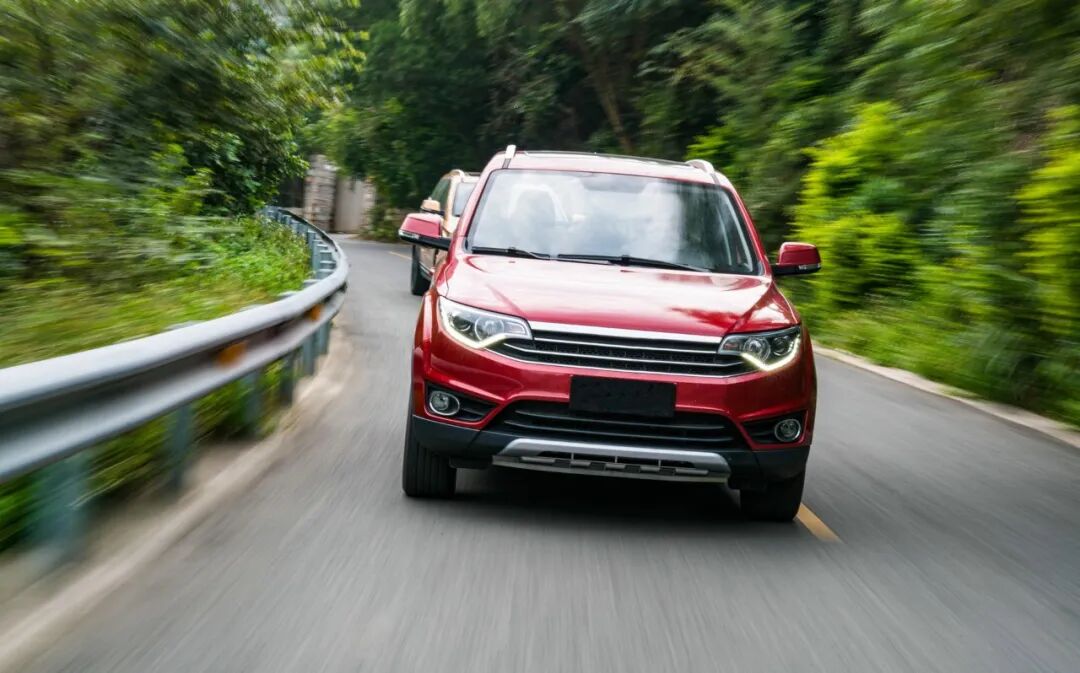
Specifically, building on Toyota’s global chief engineer system, GAC Toyota evolved the RCE mechanism: a Chinese local team fully leads the entire process from market assessment and product planning to technology development, real-world validation, and post-launch market performance. This grants those who best understand the Chinese market complete product definition rights and accountability, fundamentally altering the logic of joint-venture new energy vehicle manufacturing.
Meanwhile, GAC Toyota did not discard Toyota’s systems but integrated Toyota’s TBP problem-solving methodology with Huawei’s IPD (Integrated Product Development) approach. Under the premise of thorough safety validation and uncompromised quality standards, development cycles and market response speeds were significantly shortened.
Focusing on the BZ 7, its choice of Huawei’s electric drive and HarmonyOS cockpit, along with Momenta’s intelligent driving solution, exemplifies a “global foundational strength plus China’s top tech empowerment” collaborative model. This enabled it to deliver 4,637 units in its first month, ranking among the top three in joint-venture pure electric mid-to-large sedan sales.
The vitality of institutional innovation also stems from Toyota’s operational philosophy of “Genchi Genbutsu” (go and see for yourself) and quality prioritization, which, after two decades of collaboration within GAC Toyota’s core team, has internalized into organizational assets and a shared working language. This cultural foundation is particularly evident in supply chain strategies.
Facing industry-wide cost pressures, GAC Toyota adheres to “nurturing procurement.” It neither chases the lowest bids nor arbitrarily shifts costs by changing suppliers. Instead, it dispatches technical teams to help long-term partners improve lean operations, sharing technology-driven cost savings. This long-term focus, rather than short-term gains, ultimately earned the brand credibility in quality and trust.
According to LatePost, during BZ 7 development, Toyota insisted on using higher-cost, more rigorously validated passive safety solutions, arguing that active safety had not yet undergone sufficient safety demonstrations. Ultimately, the GAC team prioritized safety. This decision-making logic and long-termism permeate every critical product development choice.
These seemingly “insufficiently agile,” even “stubborn” and “clumsy” slow skills have forged GAC Toyota’s most difficult-to-replicate value foundation. Amidst this industry’s profound transformations, the company has not only held its ground but taken a solid step forward.
4. Scaling Heights: Continuing to Build Strongholds with Precision and Adaptability
However, this does not mean complacency is warranted. As the saying goes, “the better the situation, the more vital vigilance becomes.” Behind the sales surge lie hidden concerns warranting corporate reflection.
First and foremost, it is crucial to conduct timely reviews of user complaints and inquiries. As of June 16, 2026, Black Cat Complaints has logged a total of 963 complaints concerning GAC Toyota, out of which 62 have been marked as replied and 60 as resolved.
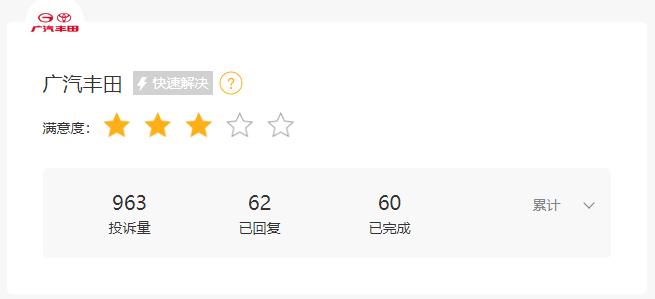
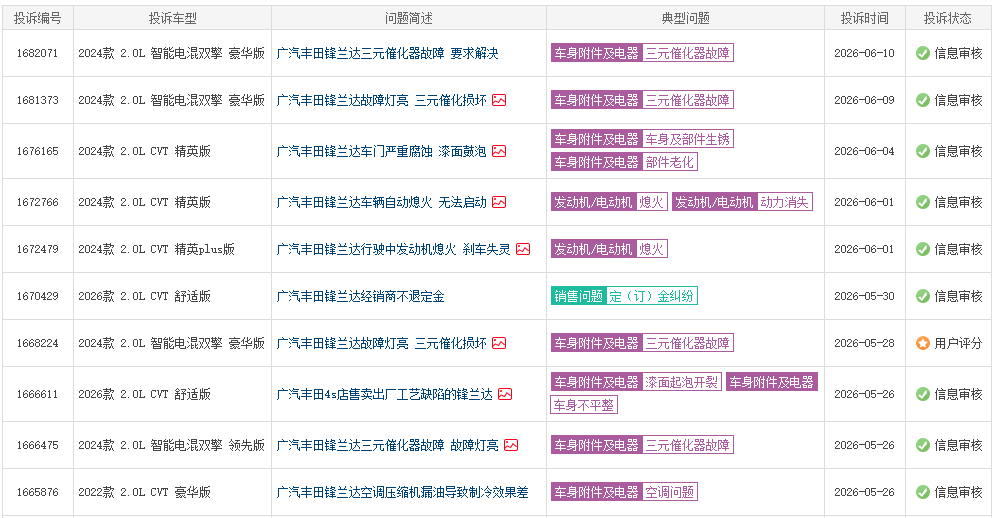
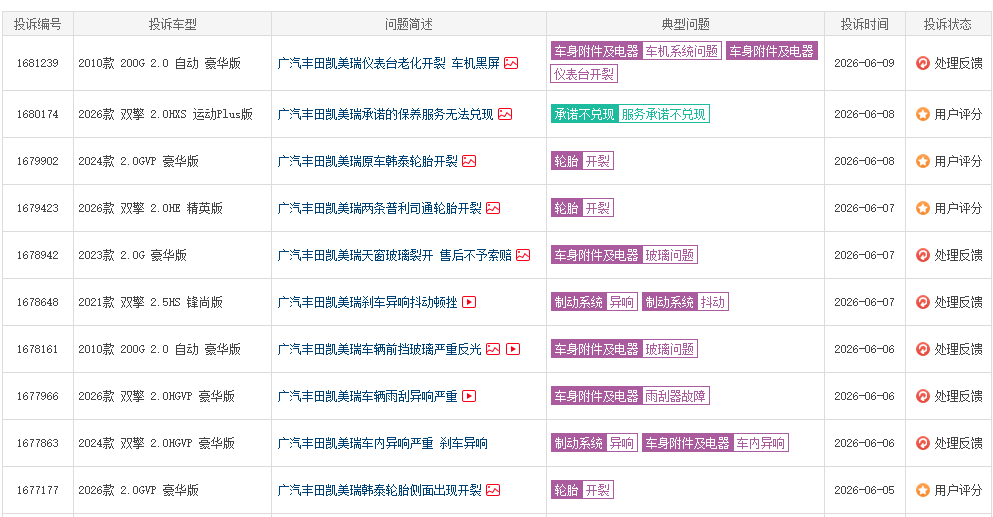
The low response rate and the significant number of unresolved feedbacks cast doubt on whether the brand has established a comprehensive communication channel with its users. Similar problems are evident on CheZhi.com, where numerous GAC Toyota models, including the Frontlander and Camry, have faced quality-related complaints.
Secondly, the frequent recalls involving key models are a cause for concern. On March 27, 2026, according to the State Administration for Market Regulation, GAC Toyota initiated a recall for model S2026M0036V. Starting April 1, certain Highlander vehicles produced between August 7, 2021, and September 22, 2025 (totaling 317,990 units) were recalled due to an inadequate locking mechanism in the second-row seatback adjusters, which could compromise occupant restraint during collisions.
According to Toyota China's website, in August 2025, four models, including the ninth-generation Camry and Levin, were recalled (exceeding 130,000 units) due to potential blackouts during initial startup caused by issues with the combination meter control programs. Additionally, another batch of Camrys required front suspension spring replacements due to insufficient heat treatment.
In December 2025, the State Administration for Market Regulation announced that GAC Toyota recalled certain domestically produced Frontlander vehicles manufactured between March 30, 2023, and August 29, 2025 (1,363 units).
Objectively speaking, it is impractical to expect every user with diverse preferences to be completely satisfied. The aforementioned complaints may be biased, and the recalls might have been delayed, not fully representing the current situation. Nevertheless, they also reflect a sense of responsibility. However, as the adage goes, product experience is the bedrock of development. Identifying and addressing gaps and attentively listening to users are always the right approaches.
Once upon a time, the reputation of "unbreakable Toyotas" spread among consumers through word-of-mouth. The aforementioned complaints and recalls naturally erode this trust. While the "balanced philosophy" stabilizes the market and the "BZ speed" captures the electric transformation niche, companies must continually assess whether the foundation of quality and user trust can remain stable in tandem.
Moreover, challenges in technological quality control persist during the exploration of electrification. According to GAC Toyota's official website, in 2025, GAC Toyota, FAW Toyota, and Toyota China jointly initiated a recall involving over 37,000 vehicles, primarily including domestically produced bZ4X, BZ4X, and imported Lexus RZ models.
Among these, 7,211 domestically produced BZ4X vehicles were recalled. The issues included software defects in the air conditioning control unit, which could reduce defogging and defrosting performance under specific fault codes. Additionally, the electric heating water heater components lacked durability.
A review of the situation reveals that achievements and challenges are intertwined, indicating that the company is still in a critical phase of upward progress and must continue to strive without letup. Leading the market for three consecutive months has boosted morale, but it is only the beginning. One cannot overlook the aggressive rise of domestic new energy vehicles and the collective decline of joint-venture brands. To sustain achievements and even revitalize the entire joint-venture sector, GAC Toyota must continue to strengthen its internal capabilities, address shortcomings, build on strengths, lay solid foundations, and pursue precise and adaptive changes.
The fiercer the storm, the steadier the foundation must be for a more solid run. Substantial sales are never built on mere declarations but are accumulated through the attitude displayed after every fault, the fulfillment of every maintenance coupon, the experience of every drive, and the reputation of every iteration.
No matter how times change, prioritizing users, practical vehicle manufacturing, and solidifying quality foundations are ironclad rules for winning the market. These are also the secrets behind GAC Toyota's counter-trend leadership and the direction for future breakthroughs and new beginnings!
This article is an original work by Shoucai.
Please leave a message if you wish to reprint.
-
![]()
【OFweek Weike Cup】Fair Optics Officially Nominated for 2026 Outstanding Contribution Award in Optical Industry Application Solutions
-
![]()
The Competitive Landscape of Financial AI Agents in the 'Long Tail' Market: FinTech Subsidiaries, Financial Leasing, Consumer Finance, AMCs, and Other Players Making Quiet Strides
-
![]()
【OFweek Weike Cup】Fair Optical Officially Enters for the 2026 Optical Industry Annual Innovation Product Award
-
![]()
【OFweek Weike Cup】Wuhan Changjin Photonics Nominated for 2026 Optics Industry Outstanding Component Supplier
-
![]()
【OFweek Weike Cup】Xinyuan Optics Officially Enters for the 2026 Outstanding Contribution Award for Advanced Manufacturing Process Solutions in the Optical Industry
-
![]()
Who Dominates the World Cup: Lenovo, Hisense, or Mengniu?
-
![]()
【OFweek Weike Cup】Shijia Photonics Participates in the 2026 Excellent Optical Component Supplier Award
-
![]()
【OFweek Weike Cup】Dingxinsheng Optics Officially Enters for the 2026 Optical Industry Annual Innovation Product Award