The Competitive Landscape of Financial AI Agents in the 'Long Tail' Market: FinTech Subsidiaries, Financial Leasing, Consumer Finance, AMCs, and Other Players Making Quiet Strides
 06/23 2026
 550
550

The bidding and procurement activities for financial AI agents are currently in full swing.
01Capital has meticulously combed through public bidding data for financial AI agents from January 1 to June 15, 2026. This data encompasses various types of announcements, including tender notices, procurement intentions, solicitations for comments, and exchange announcements. After eliminating duplicates, we recorded 97 valid samples. In terms of bidding volume, banks, securities firms, and insurance companies accounted for over three-quarters of the total.
However, the remaining 97 samples are equally noteworthy. Over 10 types of licensed institutions, including FinTech subsidiaries, leasing companies, consumer finance companies, wealth management subsidiaries, and asset management companies (AMCs), are quietly making their mark in the market.
Although the number of bids from individual institutions is limited, the diverse needs represented by these 'long-tail' institutions serve as a litmus test for whether AI agents can truly penetrate the grassroots levels of the real economy.
01 FinTech Subsidiaries: Playing Dual Roles as Sellers and Buyers
FinTech subsidiaries are unique participants in the financial AI agent ecosystem, acting as both 'sellers' (serving their parent banks or groups) and 'buyers' of AI agents.
Their rationale for external procurement lies in two key aspects: First, they value the supplier's advantages in professional capabilities, which help supplement their expertise; second, outsourcing certain tasks can address flexible staffing and labor cost issues.
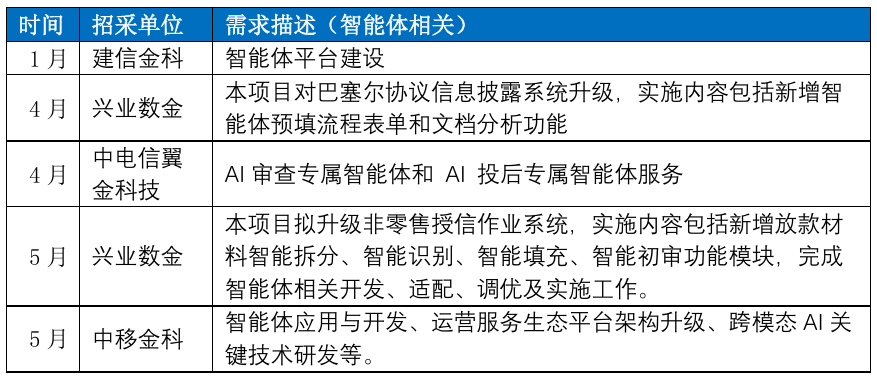
In the bidding data from the first half of the year, two types of FinTech subsidiaries can be identified: First, bank-affiliated subsidiaries, such as Industrial Bank Digital Finance and CCB FinTech, primarily serve their parent banks. Second, operator-affiliated subsidiaries, including China Telecom Wing Finance Technology and China Mobile FinTech, are more inclined to export technical capabilities to financial institutions.
CCB FinTech conducted a bid for 'AI Framework Development Services,' covering areas such as intelligent R&D direction and AI agent platform construction. The project attracted 12 suppliers, with Alibaba Cloud and iFLYTEK ultimately winning the bid.
Industrial Bank Digital Finance focused on 'Intelligent Document Processing for the Entire Credit Approval Workflow,' aiming to upgrade its non-retail credit approval system with new functional modules for intelligent loan material splitting, recognition, filling, and preliminary review, as well as AI agent-related development, adaptation, optimization, and implementation. Additionally, Industrial Bank Digital Finance is advancing corporate governance projects with new AI agent-based pre-filling process forms and document analysis capabilities.
These procurements all target core banking areas of credit and governance, using AI agents to address pain points in the parent bank's operations.
The unique advantage of operator-affiliated FinTech subsidiaries lies in their telecommunications infrastructure and massive data, possessing natural network bandwidth, IDC resources, and de-identified user data.
China Telecom Wing Finance Technology released a 'Partnership Sourcing Announcement for an AI+Digital Empowerment Exclusive AI Agent Service Project (Second Round) for a State-Owned Operator Company,' procuring services for AI review-exclusive AI agents and AI post-investment-exclusive AI agents. China Mobile FinTech issued a request for quotations for the 'Research and Development Project of a Cross-Model AI Automation Execution and Unified Ecosystem Capability Collaboration System,' involving AI agent applications and development, operational service ecosystem platform architecture upgrades, and cross-modal AI key technology R&D.
Operator-affiliated FinTech subsidiaries aim to secure a foothold in the financial AI services market.
Table 1: 2026 Bidding Demand for AI Agents by FinTech Subsidiaries
Data Source: Enterprise Early Warning, Collated by 01Capital
02 Financial Leasing Companies: Multiple Entrants with Diverse Demands
The business foundation of financial leasing lies in equipment ownership, with risk control logic centered around the value management of equipment throughout its lifecycle, demanding high professionalization in due diligence assessment, post-lease supervision, and residual value prediction.
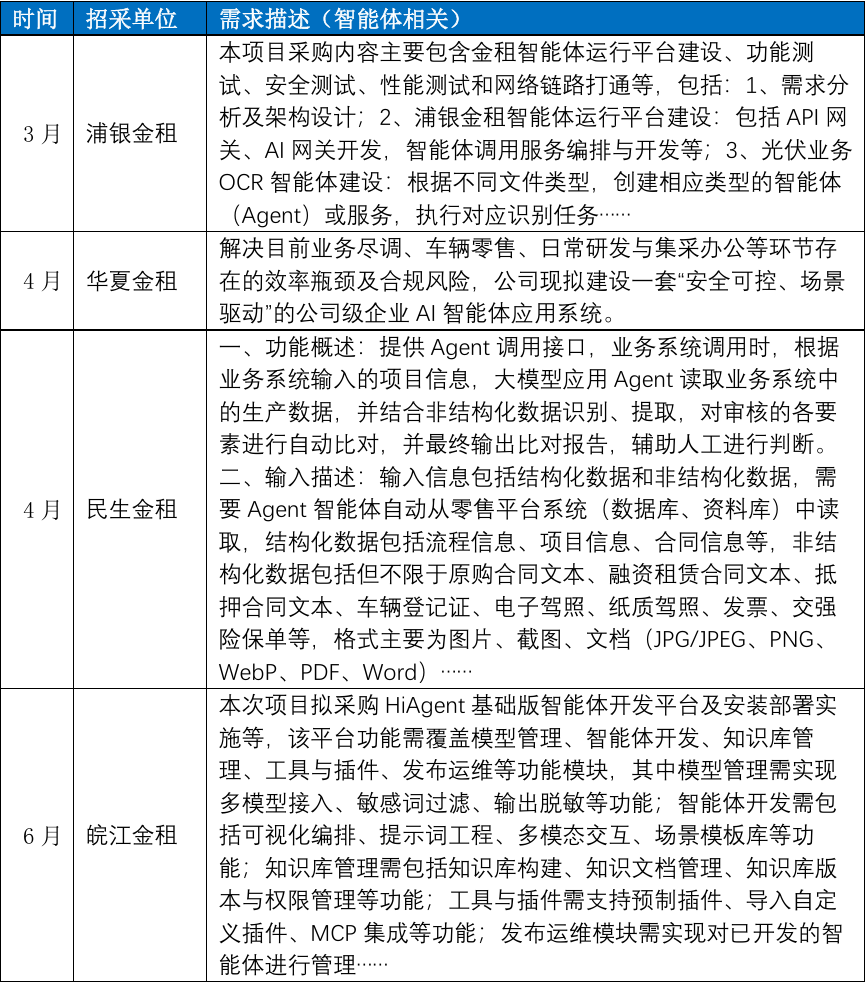
In the first half of 2026, four financial leasing institutions initiated AI agent-related procurement: Huaxia Financial Leasing and Wanjiang Financial Leasing focused on AI agent application systems or development platforms; Minsheng Financial Leasing targeted the single scenario of 'document review assistance'; and Pudong Development Bank Financial Leasing required the simultaneous construction of an AI agent operation platform and an 'OCR AI agent for photovoltaic business.' In 2025, Beijing Bank Financial Leasing and Yongying Financial Leasing also released AI agent bidding demands.
Huaxia Financial Leasing explicitly stated in its tender announcement the need to 'address efficiency bottlenecks and compliance risks in current business due diligence, vehicle retail, daily R&D, and centralized procurement operations.' Wanjiang Financial Leasing procured services for the HiAgent basic AI agent development platform and installation deployment—HiAgent is an enterprise-level AI agent workstation launched by Volcano Engine.
Minsheng Financial Leasing's requirements were highly specific: providing an Agent invocation interface to enable large model application Agents to read production data from business systems based on project information input by the business system, combined with unstructured data recognition and extraction, automatically compare various audit elements, and ultimately output a comparison report.
This means the AI agent needs to simultaneously handle OCR recognition, multimodal parsing, and complex rule comparisons—precisely the type of problem suited for a large model + AI agent architecture.
Pudong Development Bank Financial Leasing's case reveals another trend: collaboration of technical capabilities within the group. The project chose single-source procurement from Pudong Development Bank FinTech, reasoning that the project required the creation and orchestration of AI agents based on the parent bank's AI agent creation platform, with core access limited to internal group employees.
The parent bank builds the platform, and subsidiaries use it—this internal group technology output model is becoming a standardized path for financial holding groups to deploy AI.
Table 2: 2026 Bidding Demand for AI Agents by Financial Leasing Companies
Data Source: Enterprise Early Warning, Collated by 01Capital
03 Consumer Finance Companies: Limited Demand, High Expectations
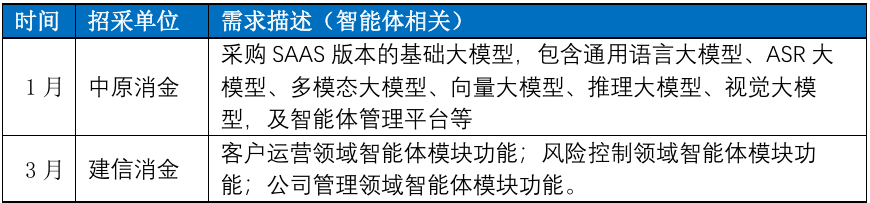
Consumer finance companies directly serve C-end customers and generally do not pursue comprehensive infrastructure construction but have the most direct demand for cost-reducing and efficiency-enhancing marketing tools. In the first half of 2026, Zhongyuan Consumer Finance and CCB Consumer Finance initiated AI agent-related procurement.
Zhongyuan Consumer Finance procured a SAAS version of a foundational large model, covering general language large models, ASR large models, multimodal large models, vector large models, reasoning large models, visual large models, and an AI agent management platform. This was a 'full-suite' procurement, including everything from the underlying model to the management platform.
CCB Consumer Finance procured 'AI Application Innovation (AI Capability Base and AI Agents),' covering three types of AI agents for customer operations, risk control, and corporate management.
In August of the previous year, Industrial Bank Consumer Finance also released a tender for the procurement of AI agent software product solutions required for the construction of an intelligent customer service system.
Consumer finance companies have high expectations for suppliers, demanding successful cooperation cases with systemically important banks, licensed consumer finance companies, or financial peers. The winning bidders, Baidu and JD Technology, also reflect this point.
Table 3: 2026 Bidding Demand for AI Agents by Consumer Finance Companies
Data Source: Enterprise Early Warning, Collated by 01Capital
04 Wealth Management Subsidiaries
Wealth management subsidiaries are the most diversified among 'long-tail' institutions. They need to serve both C-end clients through parent bank channels and support investment managers' research and decision-making (B-end)—offering broad application spaces for AI agents in wealth product recommendations, customer profiling, and market analysis.
Everbright Wealth Management and CITIC Wealth Management, two wealth management subsidiaries, initiated AI agent-related procurement, with the former focusing on risk management and the latter on customer service—one managing 'investment' risks and the other managing 'customer experience.'
Table 4: 2026 Bidding Demand for AI Agents by Wealth Management Subsidiaries

Data Source: Enterprise Early Warning, Collated by 01Capital
05 Asset Management Companies
The core business of asset management companies (AMCs) is the acquisition and disposal of special assets, an area characterized by severe information asymmetry, complex valuation, and long disposal cycles—ideal soil for AI agents to demonstrate value.
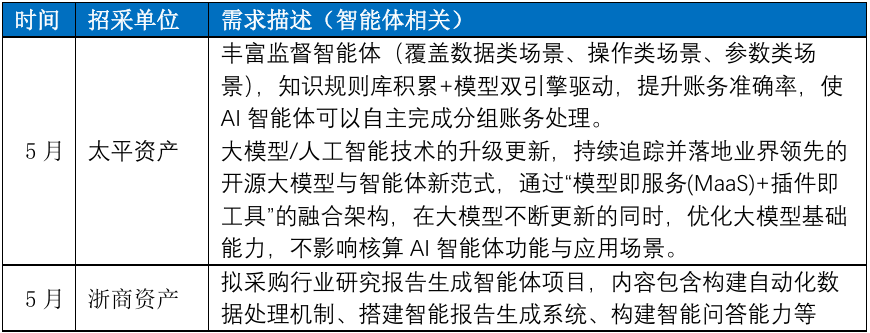
In May 2026, Zheshang Asset released a tender announcement for an 'Industry Research Report Generation AI Agent Project,' aiming to enhance industry research efficiency and intelligence by constructing an automated data processing mechanism, building an intelligent report generation system, and strengthening intelligent Q&A capabilities.
Taiping Asset Management Co., Ltd. took a deeper technical approach, releasing a single-source procurement demand for 'Grouping Valuation for Performance Attribution.' The project background reveals a core pain point in the asset management industry: Grouping valuation, as the underlying data support for attribution analysis, must cover nearly thousands of portfolios, involving different account levels, asset classes, and strategy types, with enormous workloads for data aggregation, accounting, and reconciliation.
Taiping Asset hopes to enrich supervisory AI agents for data, operation, and parameter scenarios, driving improvements in accounting accuracy through knowledge rule base accumulation + dual-engine (model) driving, enabling AI agents to autonomously complete grouped accounting processes.
Table 5: 2026 Bidding Demand for AI Agents by Asset Management Companies
Data Source: Enterprise Early Warning, Collated by 01Capital
06 Other 'Long-Tail' Institutions
Beyond the five types of institutions, payment institutions, trusts, funds, finance companies, futures firms, and consumer protection centers each contributed one bidding record. These 'scattered points' are also noteworthy:
Tianyi Payment's 'Penetrating Regulatory Platform (Phase II) Upgrade R&D Project' incorporates AI intelligent assistants—intelligent Q&A, intelligent analysis, and AI agents—as core components of regulatory technology. This is the payment institution's technical response to compliance pressures: As regulatory requirements in the payment industry become increasingly refined, AI agents can provide '7×24-hour' automation capabilities in anti-money laundering, anti-fraud, and compliance reporting.
Huaxin International Trust plans to optimize embedded process AI agents into AI agent workflows through a comprehensive management system upgrade, primarily involving risk control, compliance, and operations.
Shanxi Cultural Tourism Group Equity Investment Fund Management Co., Ltd. procured a 'Scalable AI Agent Generation Platform.' Previously, two companies procured AI agent-related services in 2025: SDIC Chuangyi Industrial Fund Management Co., Ltd. procured a 'Semantic Data Analysis Wizard' AI agent, and China Asset Management procured AI agent security evaluation services.
China Huadian Group Finance Co., Ltd.'s 'Intelligent Audit Supervision Platform Project (Phase I)' included seven rule-driven AI agent units. Last year, the company also released procurement demands around its treasury system, including AI agent data supply and analysis modules, four AI agents for corporate operating reports, treasury reports, regulatory searches, and treasury customer service, as well as AI agent application supporting management functions.
Tianjin Zhonghe Financial Consumer Rights Protection Center hopes to use AI agents for dispute mediation, releasing a tender announcement for an 'AI Intelligent Mediation Platform Project.' The system adopts an architecture of 'front-end multi-entry points + middle-tier intelligent analysis + back-end standard database,' with the middle tier including AI agents, knowledge bases, mediation models, and rule engine foundations.
The special significance of this case lies in the fact that AI agent applications are evolving from 'efficiency enhancement' to 'consumer protection,' extending from commercial value to social value.
Zhongtai Futures procured AI agent platform services, with similar demands from Huishang Futures, Huatai Futures, and Shenyin Wanguo Futures last year.
Table 6: 2026 Bidding Demand for Financial AI Agents by Other Institutions
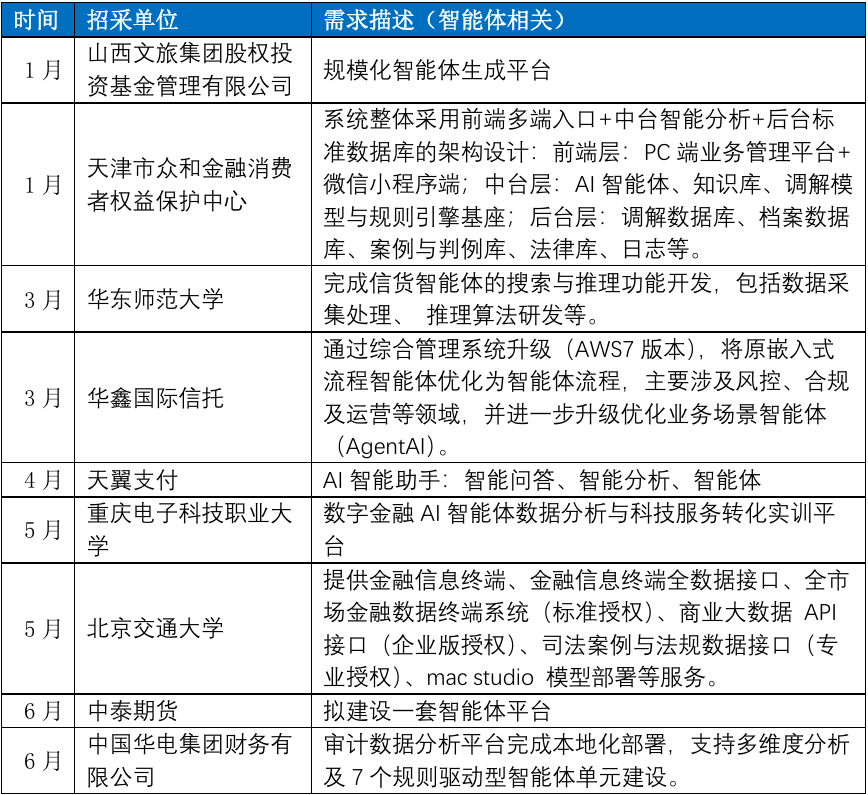
Data Source: Enterprise Early Warning, Collated by 01Capital
-End-
-
![]()
Industry Insights | Electronic Fabric Prices Double, Fueled by AI Demand as a ‘Critical Resource’
-
![]()
Surging by 2000%, Market Value Breaks Through Trillion Yuan! Behind the Glory of AI 'Leader'
-
![]()
Tianfu Communication Shortlisted for 2026 Optics Industry Outstanding Component Supplier Award
-
![]()
【OFweek Weike Cup】Fair Optics Submits Application for 2026 Optical Industry High-Growth Enterprise Award
-
![]()
【OFweek Weike Cup】Fair Optics Officially Nominated for 2026 Outstanding Contribution Award in Optical Industry Application Solutions
-
![]()
The Competitive Landscape of Financial AI Agents in the 'Long Tail' Market: FinTech Subsidiaries, Financial Leasing, Consumer Finance, AMCs, and Other Players Making Quiet Strides
-
![]()
【OFweek Weike Cup】Fair Optical Officially Enters for the 2026 Optical Industry Annual Innovation Product Award
-
![]()
【OFweek Weike Cup】Wuhan Changjin Photonics Nominated for 2026 Optics Industry Outstanding Component Supplier