The Toughest Battery Safety Rules Ever Are Here: Production Halted Over Fire and Explosion Risks
 07/03 2026
 357
357

Lead
Introduction
The "tough enforcer" for low-quality production in the new energy vehicle sector has arrived. Who's most on edge?
After years of growth in the new energy vehicle market, safety remains a top priority for both the industry and consumers. For many, battery safety is the first hurdle when considering an electric vehicle purchase. While few outright reject new energy vehicles, concerns linger over sudden spontaneous combustion, fires after collisions, and potential risks during everyday use.
These fears are not unfounded. As the market penetration of new energy vehicles has surged and production capacity expanded rapidly, safety regulations have struggled to keep pace with industry advancements.
Previous safety standards focused heavily on post-accident warnings, leaving significant room for error. To cut costs and speed up production, some manufacturers compromised on battery protection, thermal management, and chassis safety. This led to the proliferation of models with inadequate safety margins.
Consequently, new energy vehicles have long been stereotyped as "unsafe." Even with improvements in battery technology and manufacturing processes, rebuilding consumer trust has been a slow process. The industry has long lacked comprehensive safety guidelines to address battery-related vulnerabilities.
Now, that's about to change.
On July 1, 2026, two national mandatory standards—the Safety Requirements for Power Batteries for Electric Vehicles and the Safety Requirements for Electric Vehicles—will take effect simultaneously. This marks China's first coordinated effort to enforce core safety standards for both batteries and vehicles.
Dubbed the toughest regulations ever by industry insiders, the new rules provide holistic protection, from addressing fundamental battery risks to ensuring high-voltage safety across the entire vehicle. They aim to gradually ease consumer safety concerns, eliminate industry chaos, and redefine safety benchmarks for the new energy vehicle sector.
01 Comprehensive Battery Regulation Overhaul to Mitigate Risks
The most significant shift in the new national battery standards, compared to the old ones, is the move from "post-incident warnings" to "pre-incident prevention." All technical requirements are now based on real-world accident scenarios encountered by users, targeting high-frequency safety hazards.
The most critical change involves managing thermal runaway in power batteries. Previous national standards were relatively lenient, requiring only a five-minute warning and evacuation time for occupants after a battery cell thermal runaway to meet compliance.
The new standards, however, take a firm stance: after a battery cell thermal runaway, the entire battery system must not catch fire or explode, and it must ensure that fumes do not harm occupants. In essence, the old approach was to "warn you to flee when trouble strikes," whereas the new goal is to "prevent accidents from happening in the first place."
Additionally, to address risks during daily driving, the new regulations introduce two mandatory unified tests, filling gaps in previous standards regarding driving conditions.
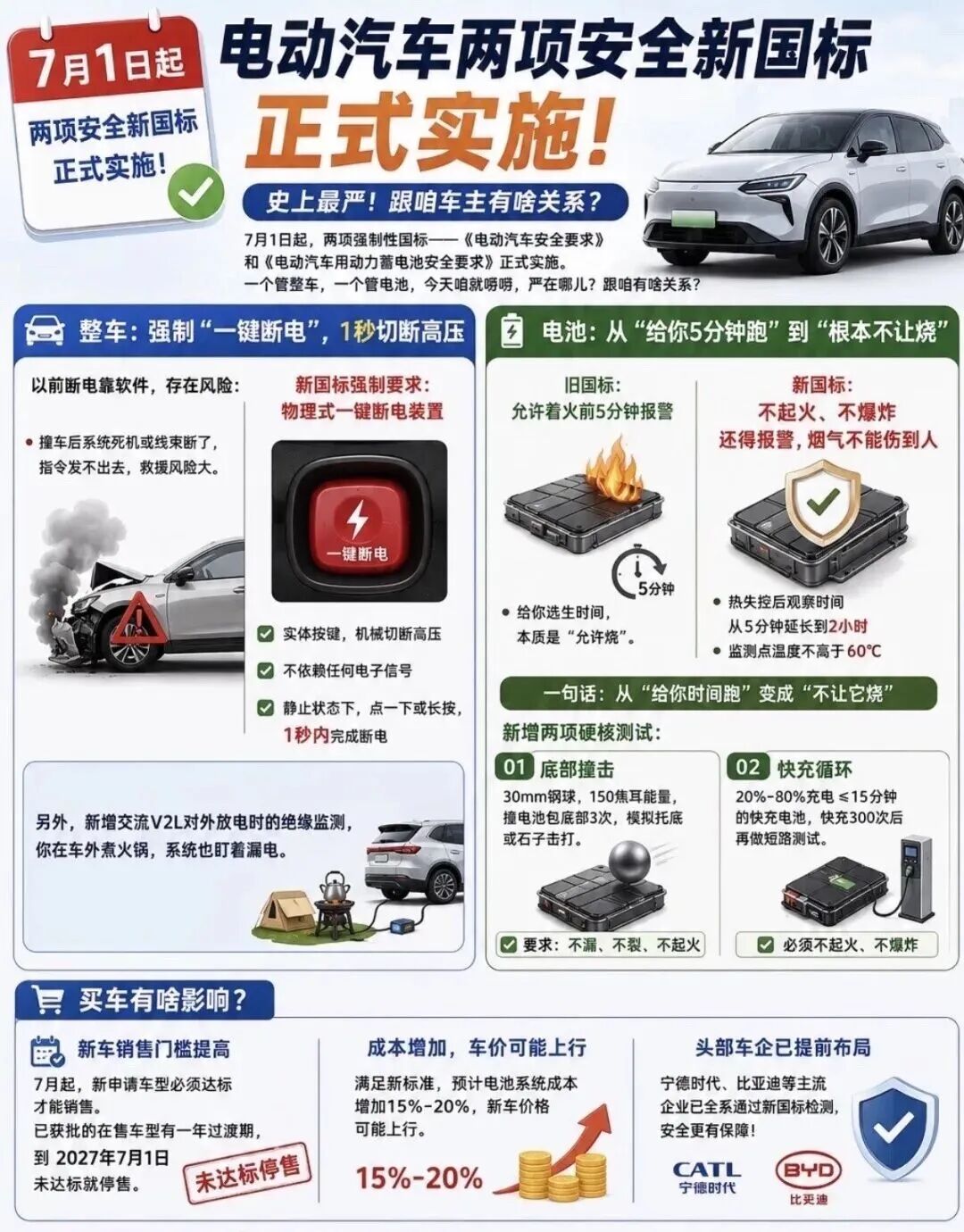
The first is the bottom impact test, specifically designed to tackle chassis scraping and battery damage caused by road debris, speed bumps, and potholes. This eliminates the risk of hidden battery damage and thermal runaway during everyday driving. The second is the fast-charging cycle safety test, aligning with current mainstream fast-charging habits. After 300 high-intensity fast-charging cycles, the battery must still pass an extreme short-circuit test without catching fire or exploding, addressing industry concerns about "long-term fast charging damaging batteries and posing hidden dangers."
Furthermore, the new regulations refine details such as battery insulation protection, crush testing, and operating condition assessments, covering areas like AC circuit insulation and extreme crush protection. They establish unified and stringent quantitative standards for battery safety evaluations, eliminating safety loopholes in ambiguous areas.
Regarding the transition period, which many vehicle owners are concerned about, the new regulations offer phased solutions.
For existing vehicle owners, vehicles registered before July 1, 2026, are exempt from the new national standards. For models currently on sale, there is a one-year grace period. By July 1, 2027, automakers must ensure compliance rectifications for models on sale, with non-compliant models facing mandatory production shutdowns. For new electric vehicle models submitted for approval after July 1, 2026, they must pass the new regulations' tests with a 100% pass rate, with non-compliant models prohibited from mass production and market launch.
While the implementation of the new regulations may seem to have a significant impact on power battery players, this is not entirely the case. Leading battery companies, such as CATL, EVE Energy, and Yutong, have already made early strategic deployments and have been mass-producing compliant technical solutions for years, facing minimal pressure from compliance costs. In other words, for forward-thinking players, the new regulations also serve as a tool to screen out non-compliant competitors and promote their own brands.
However, some small and medium-sized battery manufacturers are facing challenges. The new regulations bring a 15%-20% increase in battery system costs, coupled with substantial investments in production line upgrades, technological research and development, and certification testing, putting cash flow pressure on most technologically weak and low-price-competitive SMEs.
At the same time, the battery traceability system implemented in April this year, combined with the historical accountability logic of the new regulations, further compresses the survival space for small and medium-sized manufacturers. Low-end and inefficient production capacity in the industry will be accelerated for elimination, and market concentration will continue to rise.
02 Synchronized Vehicle Regulation Upgrade to Bolster Safety Defenses
The new regulations are not limited to battery standards; national vehicle safety standards have also been upgraded simultaneously.
If the new battery regulations represent the safety baseline for core vehicle components, then the new vehicle regulations fill in safety loopholes across all scenarios, making the new energy vehicle safety system more comprehensive and reliable.
Among them, the most significant upgrade in the new vehicle regulations is the mandatory introduction of a physical one-touch power-off device.
Previously, high-voltage power cutoff in new energy vehicles relied on the vehicle's software system for control. Once a severe collision occurred, causing the vehicle's computer to crash, circuit damage, or signal interruption, the power cutoff function would fail directly, leaving high-voltage electricity and increasing the risk of rescue electrocution and secondary fires.
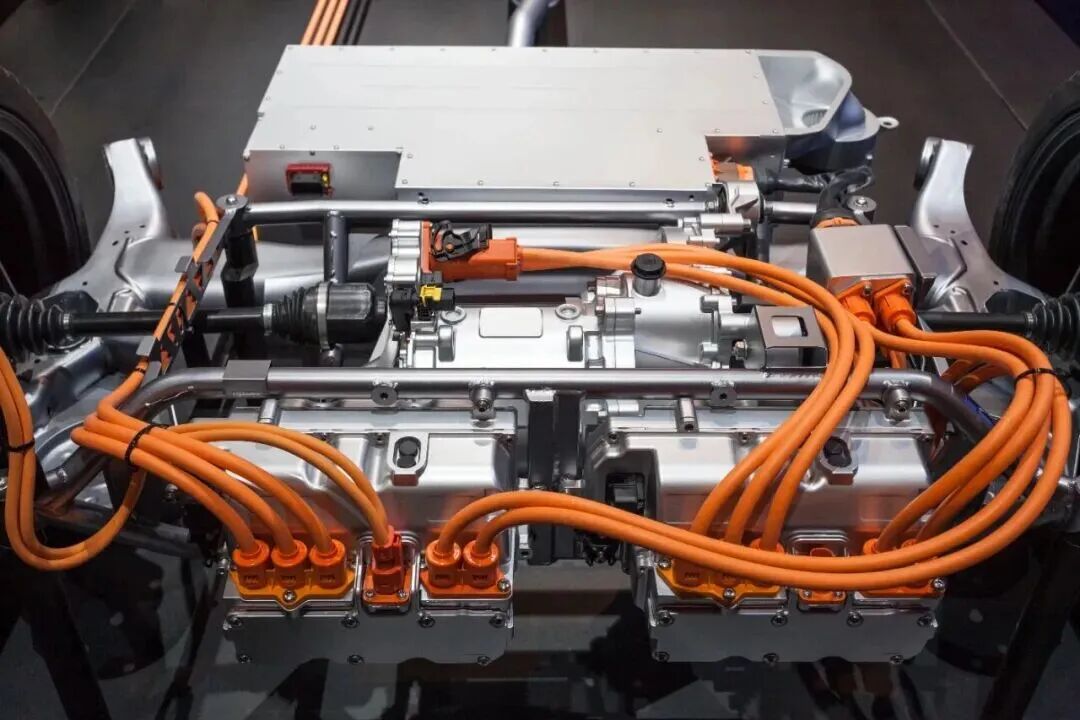
The new regulations completely phase out this software-based power cutoff solution and replace it with a mandatory independent physical one-touch power-off hardware that operates independently of the vehicle's software. Drivers can cut off the entire vehicle's high-voltage circuit within one second by simply touching or holding down the button. Even if the entire vehicle system is completely paralyzed, the power cutoff function remains operational, significantly enhancing the safety of accident rescue and self-rescue.
Regarding vehicle maintenance scenarios, the new regulations have also added a crucial step.
The new national standards clarify the standards for high- and low-voltage maintenance disconnection devices, requiring clear identification of maintenance interfaces and rapid voltage reduction to a safe level after power cutoff. In simple terms, while there were previously hidden dangers of residual high voltage during electric vehicle maintenance, there is now a standardized safety process for vehicle repairs, effectively avoiding the risk of electrocution for maintenance personnel and making after-sales maintenance safer and more standardized.
At the same time, significant upgrades have also been made to chassis safety during daily driving.
The new regulations introduce a whole-vehicle bottom scraping impact test, simulating a vehicle colliding with a hemispherical obstacle with a diameter of 15 cm at a speed of 35 km/h, strictly assessing the chassis and battery protection capabilities. The test requirements are stringent: after the collision, the battery must not leak, the casing must not crack, and fires or explosions are strictly prohibited, directly eliminating the common problem of battery failures caused by minor chassis scraping.
It is worth mentioning that the new regulations also expand the scope of vehicle insulation safety to cover the popular V2L (Vehicle-to-Load) external power discharge camping scenarios.
Previously, there were shortcomings in the AC circuit insulation protection during vehicle external power discharge, posing a risk of electrocution. The new regulations improve relevant insulation standards, making outdoor camping and onboard electricity use safer and meeting the diverse needs of current users.
From an industry perspective, the implementation of the new vehicle regulations is expected to end the development model of some automakers that previously prioritized range over safety.
In the past, some automakers compressed costs and competed on low prices by simplifying chassis protection and weakening high-voltage safety designs. Now, with multiple stringent standards in place, automakers must place greater emphasis on vehicle safety, comprehensively upgrading in multiple dimensions such as battery pack thermal insulation and temperature relief, whole-vehicle high-voltage protection, mechanical structure design, and thermal management algorithms, and completing multiple safety assessments before entering the market.
In the short term, while compliance costs in the industry may rise, in the long term, the new regulations will drive new energy vehicles to continuously evolve towards higher safety standards, accelerate the elimination of low-quality production capacity, and force technological upgrades in the industry, which is highly beneficial for the Chinese automotive industry.

Editor-in-Chief: Yang Jing Editor: He Zhengrong

THE END
-
![]()
Hardware is the skeleton, AI is the soul, and data integrates the two
-
![]()
China’s AI Industry: A Unified Pivot Towards Monetization?
-
![]()
New Progress! Infineon Completes Acquisition of ams OSRAM's Non-Optical Sensor Business
-
![]()
35 Million Bet on an Optical Future! Tengjing Technology Makes a Move in AR
-
![]()
Why World Models Get Stuck on Construction Roads in Autonomous Driving Applications
-
Alibaba Initiates Cultural Transformation: Is Jack Ma Making a Strategic Comeback?
-
Tianfeng Heads to Hong Kong for IPO with RMB 3.8 Billion in Funds: Xingyu's Cross-Border Foray into Embodied AI Faces Uncertain Future
-
![]()
Mengshi Auto’s High-End Aspirations Dashed: Huawei Partnership Fails to Revive Sales, New Model’s Entry Price Dips Below 300,000 Yuan