New Energy Vehicle Startups' 'Mid-Term Exam': Leapmotor Leads, NIO Makes a Comeback, Li Auto Faces Challenges
 07/06 2026
 441
441
At the start of each month, the automotive industry buzzes with anticipation.
When it comes to revealing sales figures, some companies are transparent and forthright, while others are coy and hesitant. Yet, when it comes to speed, the new energy vehicle startups undoubtedly take the lead.
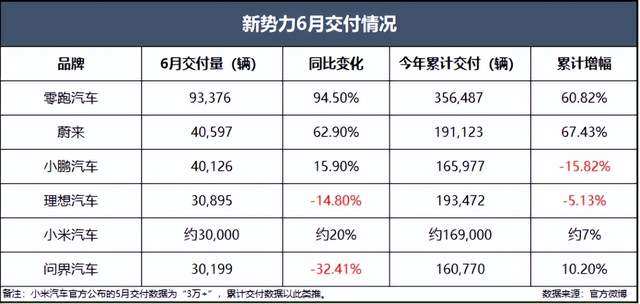
This June, Leapmotor surged ahead, pushing the monthly sales ceiling for new forces to the 90,000-unit mark. NIO and XPeng both crossed the 40,000-unit threshold, solidifying their market positions. Meanwhile, Li Auto, Aito, and Xiaomi found themselves entangled in the 30,000-unit range.
In this round of market reshuffling, the most intriguing aspect is not merely who rose or fell, but the underlying logic behind each company's current standing.
Leapmotor: Cost-Effectiveness as a Competitive Edge, Both Domestically and Internationally
Leapmotor, currently leading the pack among new forces, is undoubtedly a dark horse.
A few years ago, Leapmotor had only one popular model, the T03, with monthly brand sales just surpassing 10,000 units. Now, it can go toe-to-toe with established automakers, a remarkable achievement.
Leapmotor's resilience stems from its commitment to 'full-domain self-research,' akin to BYD's strategy, achieving stringent cost control through self-developed and self-produced core components. Consequently, in the highly competitive price range of RMB 100,000 to RMB 200,000, models like the C10 and C11 under Leapmotor's banner boast impressive configurations.
Leapmotor's proactive 'going global' strategy is another ace up its sleeve. Its deep collaboration with Stellantis Group resulted in 40,900 overseas deliveries in the first quarter of this year, contributing 37% to its global sales share and witnessing a more than fourfold year-on-year growth, effectively alleviating domestic competitive pressures.
However, excessive focus on product cost-effectiveness is not without drawbacks. Operationally, 'high cost-effectiveness' often translates to profit pressures. The first-quarter financial report this year revealed a net loss attributable to the parent company of RMB 390 million, compared to a loss of RMB 130 million in the same period last year, indicating mounting operational challenges.
Simultaneously, Leapmotor faces hurdles in brand upward mobility due to its 'high cost-effectiveness' image. Whether it can break through into the high-end market above RMB 300,000 remains uncertain.

NIO: Established Brand Matrix, Battery Swapping Shows Promise
NIO, a 'veteran' among the new forces, has 'recovery' as its keyword for the first half of the year.
NIO relies on its 'three-brand matrix' to drive growth. The NIO brand maintains a luxury positioning, focusing on technological and service benchmarks. The Onvo brand targets the mainstream market to cater to family users' renewal needs, while the Firefly brand ventures into the premium compact car market to attract young user groups.
The battery swapping business is gradually maturing and could become a cornerstone of long-term profitability. The first-quarter financial report for 2026 showed that NIO's gross profit margin for 'other sales businesses' reached 20.6%, a four-year high, with the battery swapping business, a significant contributor, also generating revenue.
Financially, sustaining profitability remains one of NIO's long-term challenges. Although the company has achieved profitability for two consecutive quarters since the fourth quarter of last year, it must attain annual profitability to dispel doubts.
Currently, besides the planned new models, the operation of NIO's 3,200 battery swapping stations could serve as a breakthrough point.
XPeng: Product Accumulation Pays Dividends, Technological Monetization Accelerates
With consistent technological accumulation, XPeng has experienced a sales rebound, with deliveries returning to the 40,000-unit level in June.
XPeng's first extended-range model and its first full-size SUV, the XPeng GX, have garnered significant consumer attention. Centralized deliveries of this new model commenced in June this year, becoming the primary growth driver for XPeng in June.
Betting on the AI technology route is XPeng's core competitive advantage. Intelligent driving has always been XPeng's corporate hallmark. XPeng is also among the earliest automakers in China to achieve large-scale implementation of urban NGP. In cutting-edge AI fields like humanoid robots and flying cars, XPeng also holds development potential.
In the first quarter of 2026, as the fruits of years of technological accumulation fed into the financial results, XPeng successfully achieved single-quarter profitability, ending its prolonged loss-making streak. Next, it must strive for full-year profitability.
XPeng's shortcomings are also apparent, such as its supply chain management capabilities. Although the company brought in the experienced Wang Fengying in previous years, improving this area requires sustained effort.
On the other hand, XPeng's overseas market expansion has been relatively sluggish. XPeng's truly large-scale overseas expansion only began in 2024, starting indeed late. However, XPeng is accelerating its pursuit, setting a goal to double its overseas sales this year.
Li Auto: Extended-Range Dividends Wane, Active Shift to Pure Electric
As the former leader among new forces, Li Auto now feels a sense of loss. It's not that Li Auto isn't making efforts, but at this juncture, the dividends in the extended-range track are gradually diminishing.
The overall market contraction for extended-range products is the most direct signal. The China Passenger Car Association reported that in May this year, among the wholesale sales of the passenger car market, the proportion of extended-range products slipped to 7.0%, down 3.3 percentage points year-on-year. During the same period, wholesale sales of extended-range passenger vehicles fell 24.9% year-on-year, marking the largest single-month decline in nearly five years.
Not only has the market pie shrunk, but competition has also intensified. Aito, Voyah, Avatr, and other peers have also set their sights on the high-end extended-range SUV segment, and Li Auto no longer holds a dominant position.
Facing growth pressures, Li Auto is actively transitioning to the pure electric market. The Li Auto i6 is a successful case. With the i6, Li Auto abandoned its obsession with being a 'luxury car' and offered a surprisingly competitive price. After all, in the pure electric market, Li Auto is a latecomer, and its previous premium pricing strategy is no longer viable.
Simultaneously, to build long-term competitiveness, Li Auto is shifting from being 'product definition-driven' to 'technology-driven.' It is investing heavily in the self-development of AI and chips, attempting to create a moat in embodied intelligence. However, technology investment is a long-term endeavor and may impose sustained financial burdens. Li Auto must navigate this challenging period.
Xiaomi: Marginal Benefits of Blockbuster Products Wane
Xiaomi's deliveries in June were 'over 30,000 units,' performing on par with last month.
Xiaomi's core competitive barrier lies in its closed-loop product ecosystem of 'people, vehicles, and homes' and the top-tier traffic attention generated by 'Lei Jun's IP.' The emergence of die-hard Xiaomi fans has given the brand user stickiness that other automakers find hard to match, allowing Xiaomi to achieve relatively high gross profit margins per vehicle.
However, to be frank, without substantial price cuts or the introduction of heavyweight new models, it will be difficult for Xiaomi to achieve significant delivery growth, as the marginal benefits of its current 'blockbuster products' are gradually diminishing.
Currently, Xiaomi relies on only two models, the SU7 and YU7, to support its sales, resulting in a relatively thin product lineup. Facing more intense competition in 2026, it will be challenging to maintain the 'blockbuster' status for long. For instance, since October last year, Xiaomi's YU7 has only sustained monthly sales of '30,000+' for four months before gradually retreating to a normal level of around 10,000 units.
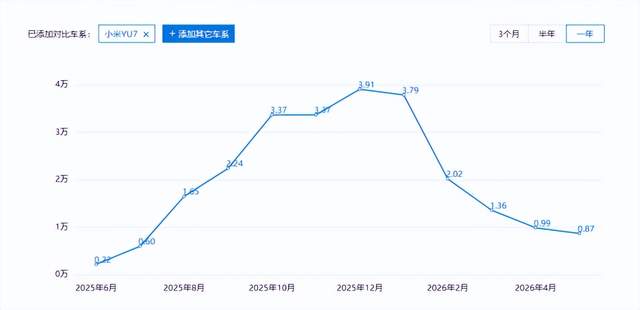
Xiaomi YU7 sales trend, data source: PCauto
In terms of competitive intensity, the Chinese new energy vehicle market is unparalleled. The deciding factor for Xiaomi's success or failure will be the upcoming 'Xiaomi Xuntian.'
Although the market for extended-range products is shrinking, it also means that the market supply chain is sufficiently mature. If 'Xiaomi-style pricing' reappears, coupled with Lei Jun's personal marketing prowess, there is a high probability of creating a 'blockbuster' with the 'Xiaomi Xuntian' product line.
Aito: Huawei Ecosystem Empowers, High-End Matrix Makes Breakthroughs
Aito, under the Harmony Intelligent Mobility Alliance, is the most impactful player in the high-end market.
Relying on Huawei's supply chain and channel empowerment, the Aito M9 and M8 have broken BBA's dominance in the high-end SUV market. The Aito M6, launched in April this year, has formed incremental sales in the more mainstream price range above RMB 200,000. Currently, the Aito brand has also formed a three-dimensional offensive with 'high-end flagships plus volume-driving blockbusters.'
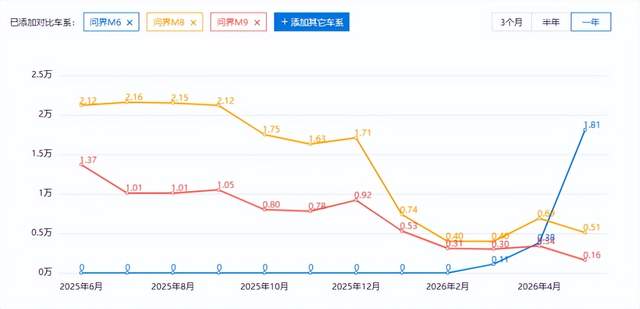
Aito M6/M8/M9 sales trend, data source: PCauto
Due to Huawei's top decision of 'not building cars itself,' its cooperation model is uncertain, leaving Aito facing challenges from its siblings.
On the afternoon of March 4th this year, the 2026 Aito M9 was launched. The biggest selling point of this RMB 500,000-level product is the first-time adoption of a new-generation 896-line LiDAR. However, within a few hours, the GAC Aion A800 was launched, and this RMB 200,000-level product's top-spec version also featured the same LiDAR.
The conflict behind this is Huawei's current four cooperation models. Although the 'Huawei content' varies, only Aito-led Harmony Intelligent Mobility is the favored partner that can enter Huawei's digital stores.
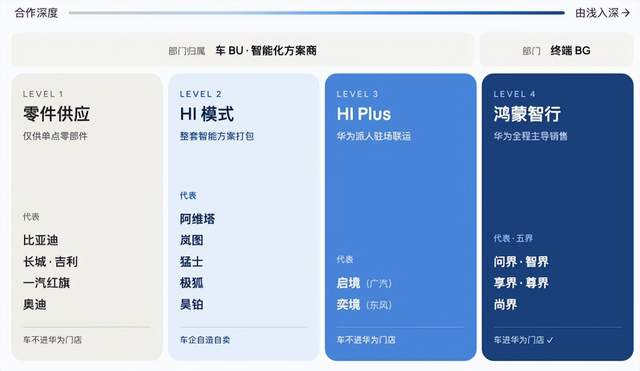
Video screenshot source: Bilibili uploader 'I am HYK'
Traditional OEM brands like GAC Aion, to avoid wasting Huawei's brand label, can only use Huawei-series special configurations as a marketing breakthrough, creating a curious situation of internal competition.
For Aito to take the next step successfully, ensuring its uniqueness is key. This cannot be achieved without Huawei's behind-the-scenes coordination, allowing its various cooperation channels to leverage each other.
Entering the Second Half, 'Systematization' Will Determine Success
When the six companies are considered together, the three development directions for new forces in the second half of the year become clear.
First, the Matthew effect will intensify. Leading new forces, due to scale effects flattening cost curves and accumulating price and technological advantages, will see their market shares tilt even more in their favor. Meanwhile, tail-end new forces with monthly sales in the thousands will either be acquired or exit the market gracefully.
Second, the competitive dimensions will continue to expand. Simply 'selling cars' cannot support market valuations. AI large models, robots, and overseas exports will become the next narrative topics for new forces.
Finally, profitability will determine survival. Under the dual pressures of rising memory prices and sustained price wars, new forces will undoubtedly face a challenging second half. Whether they can stabilize profitability and possess self-sufficiency capabilities will be key to their survival.
So, who will be the leader among new forces in July? We'll wait and see.
-
![]()
The Surprisingly Significant Impact Difference Between Quiet and Noisy Cars!
-
![]()
Breaking Through Storage Cycle Barriers: How AI Large Models and Coding Technology Synergize to Drive Transformation in the Security Industry
-
Facilitating the Slimming of Camera Modules! O-film Obtains Utility Model Patent for Periscope-Type Reflective Component
-
![]()
Hikvision Raytine’s Millimeter-Wave Body Imaging Security Inspection Device Achieves ECAC SSc Category A Standard Level 2.1 Certification for European Civil Aviation
-
![]()
Global Market Share for Security Windows Hits 26%! This Optical 'Little Giant' Makes Its Debut on NEEQ
-
![]()
The Evolutionary Path of Agent Engineering: From Prompt to Harness by Zhang Yutao, Co-founder of Moonshot AI
-
![]()
Profits and stock prices are both declining, so why are executives from these auto companies increasing their purchases?
-
![]()
Burning Tens of Billions of Dollars, Yet No Unified Definition for World Models