Only in the Auto Industry Do Companies Strive Wholeheartedly for Their Own
 07/06 2026
 567
567
I'd rather endure hardships myself than see my family suffer.
Author: He Jian
Editor: Wang Bin
Cover Design: Playtime
No industry complains as fervently as the automotive sector. Leaders of new energy vehicle companies tirelessly recount their 'narrow escapes from death,' akin to Xiang Lin's wife's lamentations, and frequently liken industry competition to a 'battle royale.'
Even persuading someone to venture into car manufacturing seems like an act of malice. He Xiaopeng remarked last year, 'If you wish to harm a friend, persuade him to make cars.' Yet, he seems to have forgotten his own enthusiastic encouragement for Lei Jun to enter the automotive fray.
Industry insiders firmly believe that only four or five car companies will survive in the long run, and each is convinced they will be among the victors. The bugle call for elimination has sounded repeatedly. It seems every year marks the 'second half' of the competition, yet the number of players at the table continues to grow. If the term 'industry' seems insufficient, 'realm' is added, but only foreigners exit with a sense of melancholy (a phrase retained for its contextual flavor, meaning 'leave in gloom').
The attacks seem endless because one company's decline spells another's ascent. Being 'together' likely only exists as a fleeting trend on Weibo.
Each year, the media proclaims it to be the inaugural year of new energy vehicle bankruptcies, but none have been as dramatic as this year. The China Passenger Car Association (CPCA) reported today that in the first half of the year, domestic passenger vehicle retail sales reached 8.75 million units, a 20% year-on-year decrease; new energy vehicle retail sales totaled 4.734 million units, down 13% year-on-year.
In June, nationwide passenger vehicle retail sales stood at 1.651 million units, a 21% year-on-year decrease; new energy vehicle retail sales were 1.037 million units, a 7% year-on-year decrease.
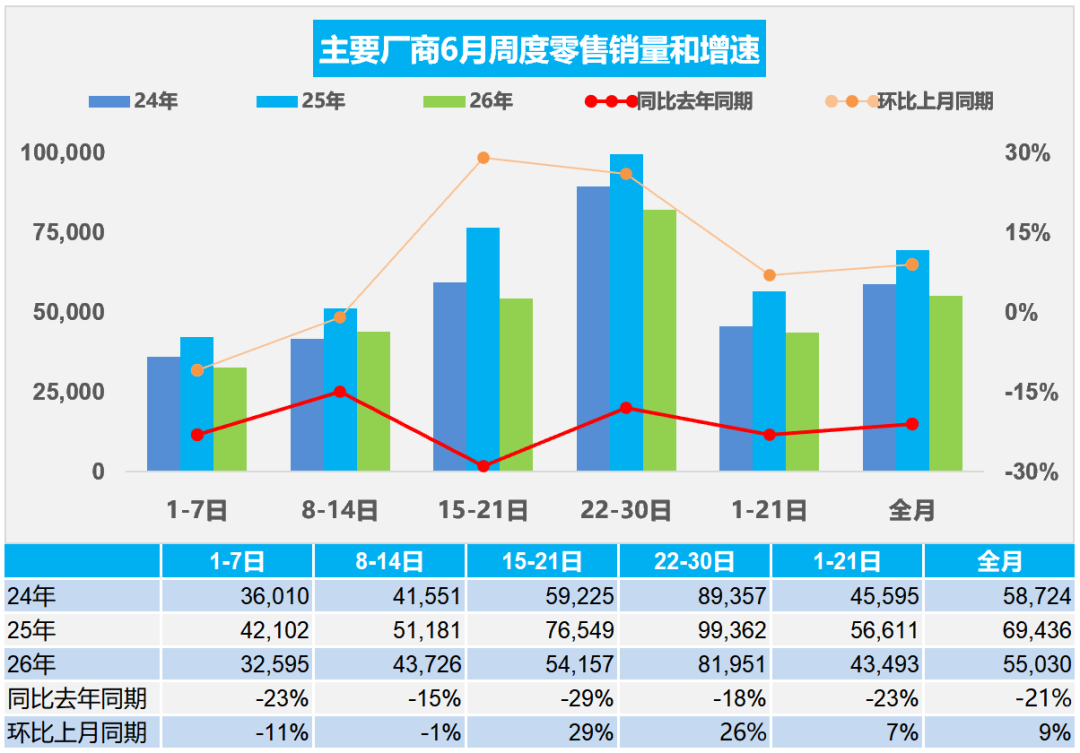
Source: China Passenger Car Association
Most Chinese car companies announced their sales results for the previous month at the beginning of each month. Some companies, like Leapmotor, showcased impressive growth, delivering over 90,000 vehicles that month, nearly doubling year-on-year, yet only completing less than 40% of their annual target.
NIO, making a comeback with the ES8, sold over 40,000 vehicles per month, a 63% year-on-year increase. Li Bin, elated, returned to his alma mater, Peking University, to reminisce about the hard times. XPENG also sold over 40,000 vehicles per month and unveiled the first SUV under the MONA brand yesterday, continuing its focus on cost-effectiveness.
The 30,000-unit threshold is the most crowded, with Li Auto, Xiaomi, AITO, Zeekr, Seres, and ARCFOX all gathered here. Li Auto and AITO's large SUV routes face increasing challenges, while Xiaomi struggles to cope with public criticism.
With the addition of Shangjie, a collaboration with Huawei, SAIC's flagship brand IM Motors appears even more lackluster, with monthly sales of just over 6,000 units, ranking last among new car-making forces, not even matching the sales of Shangjie's Z7 model. Perhaps due to the dismal monthly sales, IM Motors only announced its cumulative sales for the first half of the year, which were just 40,000 units.
Achieving single-digit growth is no easy feat for several independent car brands. In terms of cumulative sales for the first half of the year, BYD saw a significant 15.72% year-on-year decrease but, thanks to its large base, still ranked second among independent brands. SAIC Group topped the list with 2.045 million units. Most independent car companies rely heavily on exports for sales. BYD's exports in the first half of the year accounted for 43.6% of its total sales, while Chery's exports accounted for nearly 70%.
Most joint ventures and foreign brands are declining and accelerating their loss of market share. SAIC Volkswagen's sales in June decreased by 35% year-on-year, GAC Honda's sales decreased by 53% year-on-year, and GAC Toyota's sales decreased by 9.39% year-on-year. Porsche announced the closure of multiple stores in Jining, Shandong; Huai'an, Jiangsu; Nanning, Guangxi; and Wuhu, Anhui.
The sales recovery of some car companies in June underscores that new energy vehicles have become the market's absolute mainstay, while fuel vehicles are becoming obsolete amid soaring oil prices. Even so, new energy vehicles temporarily cannot resolve the overall operational challenges of the automotive market.
Earlier data released by the CPCA showed that the automotive industry's profit in the first five months of this year was 144 billion yuan, a significant 20% year-on-year decrease, with an industry profit margin of only 3.4%. In comparison, the average level of downstream industries is 6.1%. In other words, selling cars is less profitable than selling parts.
From this perspective, the car companies' complaints are somewhat justified. Over the past three years, the profit margin of the Chinese automotive industry has been declining, with 4.3% in 2024, 4.1% in 2025, and even falling to 3.2% in the first quarter of this year.
The low-profit margin in the automotive industry is not solely due to price wars. CPCA data shows that in the first five months of this year, the overall revenue per vehicle in the automotive industry supply chain was 343,000 yuan, but the cost per vehicle reached 305,000 yuan, a 6.7% year-on-year increase. The gross profit per vehicle in the supply chain was 12,000 yuan, a significant 16.2% year-on-year decrease. The cumulative profits of the automotive manufacturing and electrical machinery industries in the first five months of 2026 decreased by 19% and 15% year-on-year, respectively.
A few days ago, Apple significantly raised its prices due to a sharp increase in storage memory chip prices. The automotive industry is also under pressure, compounded by the soaring price of lithium carbonate. Media reports indicate that in the past three months, the overall price of automotive-grade storage chips has increased by about 180%, with high-end models surging by over 300%. The price of lithium carbonate exceeded 200,000 yuan per ton in May, a year-on-year increase of over 160%.
Zhu Jiangming noted that costs are rising across the board. He Xiaopeng lamented that making cars is truly painful, and price increases anywhere will affect them. Li Bin stated that chips and batteries together account for more than half of the car's cost and are already out of control.
Even AITO is struggling a bit. Zhang Xinghai of Seres complained that the cost per AITO vehicle has increased by 15,000 to 20,000 yuan, exerting significant pressure. However, with material costs rising, the prices of new cars are decreasing, posing a huge challenge to vehicle companies, 'an extremely challenging situation.'
Mobile phone and computer manufacturers have passed on the pressure to consumers by raising prices across the board, but most car manufacturers have absorbed the cost increases internally. Even when adjusting prices for facelifted models, they offer a bunch of benefits to appease consumers. From this perspective, car companies are wholeheartedly seeking benefits for their own, 'would rather suffer themselves' (a phrase retained for its contextual flavor), and never let their stakeholders be wronged.
Car companies have not abandoned the idea of raising prices, but in the overall sluggish car market, their price increases are often minimal, and some car companies' price adjustment space is limited to intelligent driving functions or high-end optional configurations. For example, BYD raised the optional price of the 'Divine Eye B Laser' version by 2,100 yuan, and Chang'an Qiyuan Q07's 'Tianshu Intelligent Laser' version by 3,000 yuan.
High-priced models have more room for price adjustments but must proceed with caution. Li Auto canceled the entry-level version of its L series models this year, leaving only the Ultra and Livis versions, achieving a hidden price increase through product structure adjustments. Compared to the previous Ultra version, the Li Auto L9 Ultra increased by 20,000 yuan, and the new Livis version exceeded 500,000 yuan. However, with a 20,000 yuan initial sales benefit, the price of the L9 Ultra remained the same as the previous generation.
More car companies' price increases seem to be just verbal threats, like trying to coax a child. Li Bin advised everyone to buy cars early, citing significant pressure from rising memory prices. Zhu Jiangming said that while costs are rising, they are not raising prices for now but may adjust prices in the future. Lu Fang of VOYAH said that car price increases are likely but also told the media that price increases depend on whether the value provided to users is truly formed.
It's strange. In an era of significant price increases, even egg prices are rising against the trend, but the two most expensive consumer expenditures in a person's life, houses and cars, are both offering discounts.
It's just tough for the shareholders of car companies who invest for value. Over the past year, the market capitalization of global car companies has generally declined, with almost no exceptions. Media reports on the Hong Kong stock automotive sector in the first half of 2026 show that the stock prices of 13 mainstream car companies have all turned green, with BAIC, Seres, VOYAH, Brilliance China, and GAC Group seeing their stock prices halved. Even BYD has fallen by 24%.
The once-favored 'NIO, XPENG, and Li Auto' have all seen their market capitalizations fall below 100 billion Hong Kong dollars, and the three brothers have finally returned to the same starting line. Li Auto has accumulated a 54% decrease over the past year, and XPENG has fallen by 30%. Fortunately, NIO started from a low point and has finally caught up with the other two after a 41% increase over the past year.
In mid-June, the Shenwan Automotive Index fell nearly 19.6% in less than a month, with the total market capitalization of the corresponding sector evaporating by 570 billion yuan. Since the second half of 2025, the sector has been declining for three consecutive quarters.
Even someone as strong as Wang Chuanfu has to face shareholders' questions about the unsatisfactory stock price. At BYD's shareholder meeting, a shareholder choked up and asked, 'If I had bought CATL shares, they would have increased by 76% now, but I only bet on BYD, and now I'm stuck with a 26% loss. I'm very sad.'
Wang Chuanfu said that the current stock price does not reflect the company's potential and asked everyone to be patient, promising better returns for shareholders.
Selling batteries is indeed more profitable than selling cars. In the first quarter of this year, CATL's revenue was 129.131 billion yuan, a 52.45% year-on-year increase, with a net profit of 20.738 billion yuan, a 48.52% year-on-year increase. Media reports indicate that CATL's profit exceeds the combined profit of seven leading car companies.
Only in the auto industry do companies strive wholeheartedly for their own.

© All rights reserved by Shanshang. Unauthorized reproduction is prohibited.
-
![]()
The Surprisingly Significant Impact Difference Between Quiet and Noisy Cars!
-
![]()
Breaking Through Storage Cycle Barriers: How AI Large Models and Coding Technology Synergize to Drive Transformation in the Security Industry
-
Facilitating the Slimming of Camera Modules! O-film Obtains Utility Model Patent for Periscope-Type Reflective Component
-
![]()
Hikvision Raytine’s Millimeter-Wave Body Imaging Security Inspection Device Achieves ECAC SSc Category A Standard Level 2.1 Certification for European Civil Aviation
-
![]()
Global Market Share for Security Windows Hits 26%! This Optical 'Little Giant' Makes Its Debut on NEEQ
-
![]()
The Evolutionary Path of Agent Engineering: From Prompt to Harness by Zhang Yutao, Co-founder of Moonshot AI
-
![]()
Profits and stock prices are both declining, so why are executives from these auto companies increasing their purchases?
-
![]()
Burning Tens of Billions of Dollars, Yet No Unified Definition for World Models