GAC Group Faces Challenges in Second Half After Achieving Just 40% of 2 Million-Unit Sales Target
 07/10 2026
 504
504
Reported by Qi Xin in Beijing for Sing Tao
On July 2, GAC Group (02238.HK/601238.SH) released its production and sales bulletin for June.
The bulletin revealed that the group sold 144,900 vehicles in June, a 3.47% decrease year-on-year, and produced 145,400 vehicles, a 5.13% decline year-on-year, indicating a downturn in both production and sales.
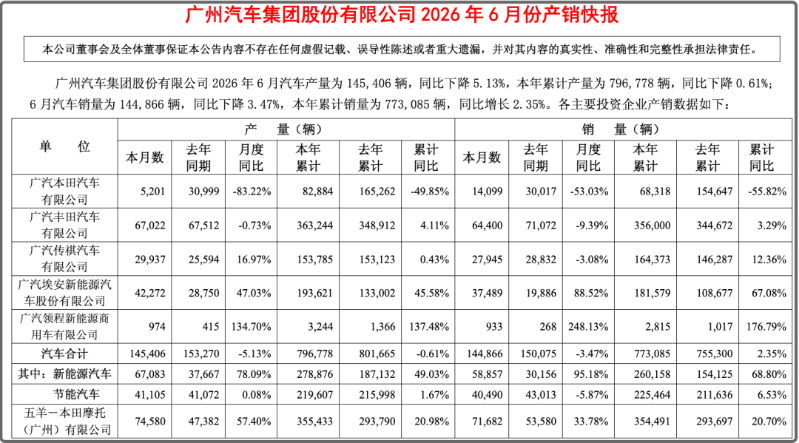
▲ Screenshot of GAC Group's Production and Sales Bulletin
Additionally, the group's cumulative automotive sales for the first half of the year reached 773,100 units, marking a 2.35% increase year-on-year, with energy-saving and new energy vehicles contributing 62.82% of total sales. However, compared to GAC Group's annual sales target of 2 million units set at the beginning of the year, the first-half completion rate stood at only 38.65%. This means that nearly 1.23 million units, averaging over 200,000 units per month, need to be sold in the second half. Given the ongoing challenges in the joint venture sector and fierce competition in the new energy sector, GAC Group faces a significant hurdle.
It's worth noting that the figures in the production and sales bulletin reflect a clear and intense divergence across different sectors, with GAC Group making a precarious transition from 'reliance on joint ventures' to 'self-reliance for survival.'
Decline in the Joint Venture Sector
Data from the China Passenger Car Association shows that retail sales of passenger cars in the national market reached 1.651 million units in June, a 21% decrease year-on-year. Cumulative retail sales for the year so far stood at 8.75 million units, down 20% year-on-year, indicating that the automotive market has entered a phase of stock competition.
Against this backdrop, GAC Group's cumulative sales of 773,100 units in the first half of the year, up 2.35% year-on-year, might seem respectable. However, a closer examination of its various sectors reveals significant issues.
Specifically, GAC Toyota, a joint venture brand, experienced a 9.39% year-on-year decline in sales in June, with cumulative sales of 356,000 units in the first half, up a modest 3.29% year-on-year. GAC Toyota also topped the sales charts among joint venture automakers for three consecutive months in March, April, and May.
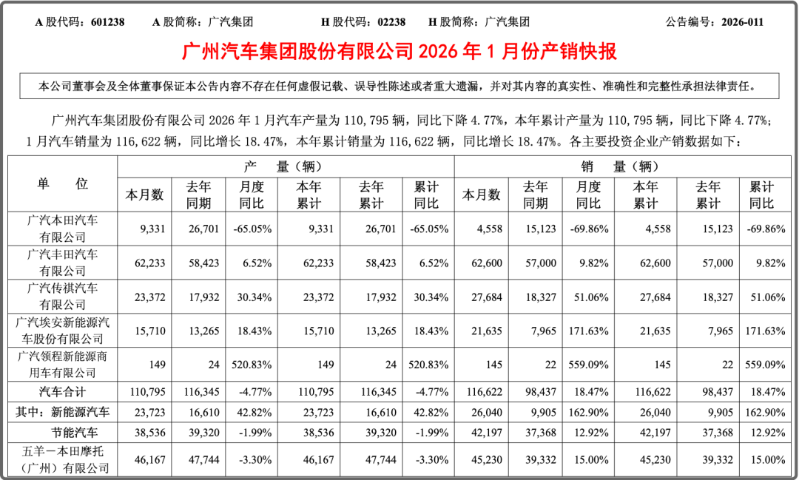
▲ Screenshot of GAC Group's Production and Sales Bulletin
In contrast, GAC Honda's performance was less favorable. In June, GAC Honda sold only 14,099 units, a staggering 53.03% year-on-year decline. Looking back at previous data, GAC Honda's decline is even more alarming. In April, it sold only 5,100 units, a 72.42% year-on-year plunge; in January, it sold only 4,558 units, a 69.86% year-on-year drop.
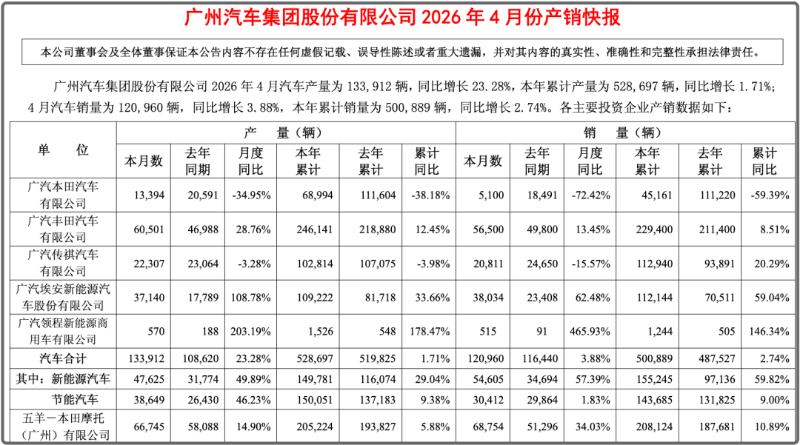
▲ Screenshot of GAC Group's Production and Sales Bulletin
From a corporate perspective, Zhang Xiang, Secretary-General of the International Intelligent Transportation Technology Association, told Sing Tao that the two brands have different technological approaches, with Toyota leading in technology, offering more models, and having broader marketing, giving it stronger overall strength.
Yuan Shuai, co-founder of the New Intelligence New Quality Productivity Salon, told Sing Tao that GAC Honda's sales plunge was not due to short-term fluctuations. The core reason lies in the lag in product iteration. With the continued rise of new energy vehicle penetration in China, GAC Honda's electric vehicle model layout has been significantly slower than the market average. The design and configuration of its existing fuel vehicle product line have long failed to keep pace with changes in domestic consumer demand.
"The era when relying solely on brand premium could drive sales is over. When self-owned brand models at the same price point offer overwhelming advantages in smart cockpits and power performance, GAC Honda's product competitiveness is naturally quickly diluted. Coupled with shaken confidence in the dealer network, a vicious cycle of reduced terminal discounts and high inventory further suppresses consumer purchasing intention. Declining reputation also forms a negative cycle, ultimately leading to a cliff-like drop in sales," Yuan said.
In Yuan's view, GAC Honda is already at a critical juncture. If the issues of an aging product line and declining brand strength are not quickly resolved, it may gradually fade out of the mainstream market. Although GAC Toyota has temporarily stabilized its position, it is only temporarily ahead in the intense competition within the joint venture sector and still lacks sufficient resilience against the impact of new energy brands. "The path of joint venture brands making easy money in the past is no longer viable. How to balance the foreign party's technological routes with the actual needs of the domestic market has become a core issue that GAC's joint venture sector must address."
Zhang Xiang, Secretary-General of the International Intelligent Transportation Technology Association, also told Sing Tao that from a corporate perspective, compared to GAC Honda, GAC Toyota leads in technology, offers more models, and has broader marketing, giving it stronger overall strength.
GAC Chooses to Pivot
Faced with the fading of joint venture dividends and changes in market conditions, GAC Group launched the 'Panyu Initiative' in 2024, relocating its headquarters from Guangzhou's CBD to Panyu—the birthplace of its self-owned brands and home to 30,000 employees related to self-owned brands.
"Decisions must be made where the action is, allowing those who can hear the guns to call for artillery support in time," said Feng Xingya, General Manager of GAC Group, when announcing the launch of the three-year 'Panyu Initiative.' He stated that reform, adjustment, and transformation are the only paths forward for GAC.
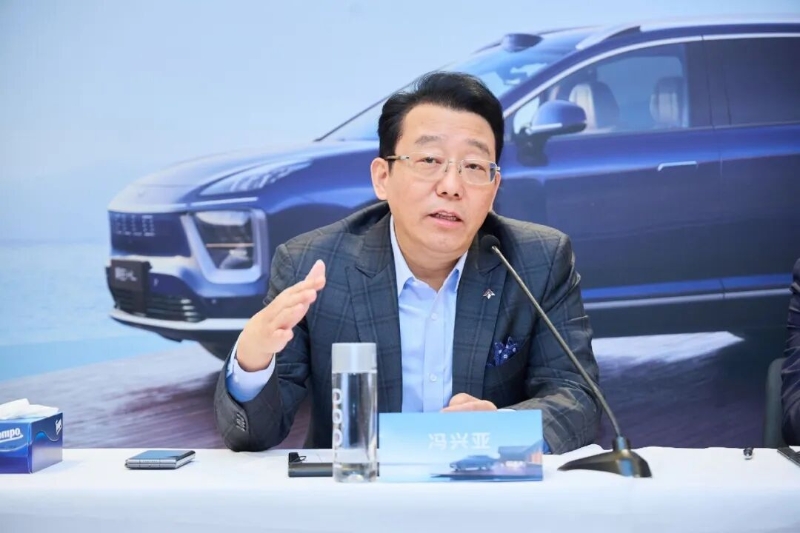
The core of the 'Panyu Initiative' is organizational restructuring. GAC Group established three new departments: the Product Headquarters, Finance Headquarters, and Procurement Headquarters. Among them, the Product Headquarters is the focus of this reform, responsible for defining products based on 'consumer demand.'
"Previously, market and technology were like two wheels spinning out of sync. Now, with 'product definition,' performance indicators are determined by the Product Headquarters," Feng said in a media interview.
In December 2025, GAC Group launched a pilot program for self-owned brand BU (Business Unit). By March this year, three major BUs—Aion Hyper, Trumpchi, and Powertrain—had all been established, each achieving integrated operation and control over research, production, supply, and sales.
Yuan Shuai pointed out that with new energy vehicle companies continuously squeezing market share and industry competition reaching a fever pitch, GAC's past model of relying on joint venture brands to drive sales and traditional hierarchical management to respond to market changes has hit a growth ceiling. This is also the most direct reason for its push for the 'Panyu Initiative' and the implementation of BU system reforms for self-owned brands.
"For GAC, the biggest challenge of this reform has never been about how to split the structure or divide responsibilities on paper. Instead, it is about breaking the management inertia of traditional automakers that has been in place for decades and truly implementing the 'autonomy' of BUs," Yuan believes. Delegating integrated authority over R&D, manufacturing, and sales to the three major BUs essentially represents a restructuring of the group's original power allocation system.
Can Aion 'Turn the Tables'?
The effectiveness of GAC Group's 'Panyu Initiative' can be seen through a series of figures.
According to data released by GAC Group, since the reform was launched, the group's product planning efficiency has increased by 30%, product project approval efficiency by 67%, demand decision-making efficiency by 85%, and the new vehicle development cycle has been shortened to 18-21 months.
The reform's results are also directly reflected at the product level. In the first half of this year, GAC Group's self-owned brands sold a cumulative 346,000 units, up 35.69% year-on-year.
Among the three major BUs, the Aion Hyper BU was the first to be established. Aion Hyper is positioned as 'Smart Enjoyment Life,' focusing on three core values: 'taste, technology, and self-fulfillment,' targeting the middle class of the era. Aion, with 'Smart Pleasure Life' as its core proposition, is positioned as a 'national good car.'
In late January this year, Aion Hyper completed the first phase of channel integration, with 254 stores in 147 cities nationwide achieving dual-brand integration and upgrades. At the product level, the first extended-range model, Aion i60, became the core for driving sales volume. The Aion N60 became the fastest-selling lidar-equipped intelligent driving model to exceed 10,000 units, and the Aion Hyper S600 was officially launched in June, filling the gap in the 200,000-yuan premium sports SUV segment. The launch of the Aion i60 was interpreted by the outside world as an effort to shed the label of 'king of ride-hailing vehicles.' Data shows that Aion Hyper's C-end user share reached 81% in the first half of the year.
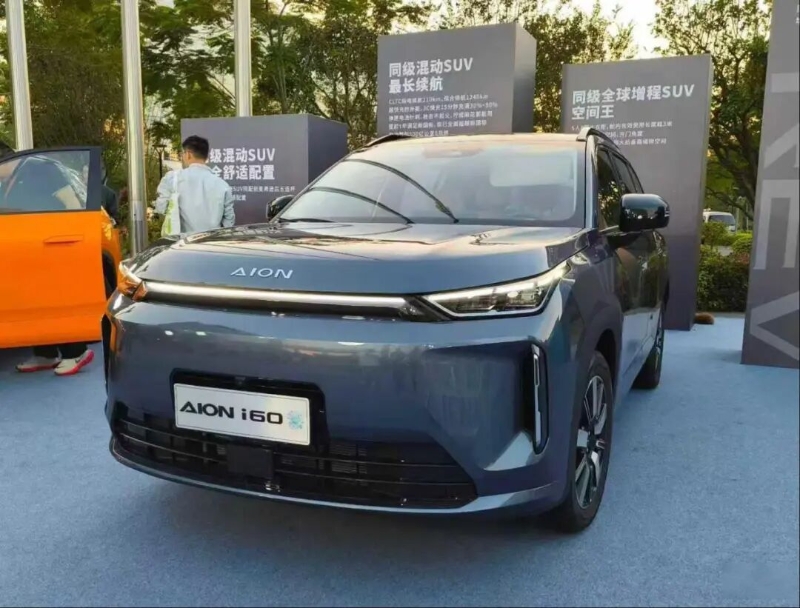
"From the current direction of reform, the implementation of the BU system does address GAC's past core pain points. The independent operation of the three major BUs, similar to internal entrepreneurship, allows each brand's decision-makers to be directly responsible for business results and respond much faster to market changes," Yuan said.
He further analyzed for Sing Tao: The Aion Hyper BU can quickly adjust product configurations and marketing plans in response to the personalized needs of young users. The Trumpchi BU can more flexibly adjust production capacity based on market sales in the layout of fuel and hybrid vehicles. The Powertrain BU can simultaneously open up technology output to both internal brands and external clients, activating the commercial value of its technological reserves.
However, the effectiveness of the reform still requires time to be tested. At the operational level, in 2025, GAC Group's revenue was 95.662 billion yuan, down 10.43% year-on-year; net profit attributable to the parent company was a loss of 8.784 billion yuan, down 1166.51% year-on-year; net cash flow from operating activities turned negative to -15.026 billion yuan. In the first quarter of this year, the group's revenue was 20.039 billion yuan, up a slight 1.98% year-on-year; net profit attributable to the parent company was a loss of 656 million yuan, narrowing by 10.29% year-on-year; net cash flow from operating activities was -3.246 billion yuan, improving by 71.04% year-on-year.
Yuan believes that from the launch of the reform in 2024 to the completion of the establishment of the three major BUs in 2026, GAC Group took more than a year just to implement the structure. Next, it will go through 1-2 years of operational integration and product iteration. It will take at least until 2027-2028 to see whether the actual results of the reform are sufficient to support the enterprise's return to a stable growth trajectory. "Although the pace may seem slow, it is inevitable for traditional automakers to transform."
"The current production and sales pressure is actually a catalyst for reform. When the entire group realizes that there is no way forward without change, it can actually reduce resistance to the reform. As long as the advantages of the BU system can be truly leveraged, allowing each business unit to remain as sensitive to the market as startups, GAC has every possibility of holding its market position in this round of industry reshuffling," Yuan said.
-
![]()
Combined Market Value Plummets by Nearly One Trillion Yuan: What’s Behind the Decline of Two AI Powerhouses?
-
![]()
Detailed Explanation of the Impact of Hikvision Guanlan Coding on Video Quality and Key Frame Quality
-
![]()
The Key Distinctions Between AI-Driven Smart Coding and Traditional Coding
-
![]()
Memory Prices Skyrocket, Becoming ‘Digital Black Gold’ as Shenzhen’s Huaqiangbei Spawns a Wave of Billionaires
-
![]()
Kuaishou Unleashes Its Secret Weapon: Kling
-
Copilot is Over, Industrial AI Enters the Autopilot Era (Part 1)
-
![]()
After the Removal of Purchase Tax and Vehicle and Vessel Tax Incentives, What 'Privileges' Remain for New Energy Vehicles?
-
![]()
The Runaway Cost Crisis is ‘Squeezing’ the Entire Electronics Market