Eight Launch Events in a Single Day! The Automotive World Embraces a 'Wild Thursday,' Yet Rapid Iterations Leave No One Victorious
 07/20 2026
 505
505
Speed is not the sole determinant of success; quality reigns supreme.
Last Thursday was nothing short of a 'Wild Thursday' in the automotive realm.
In just one day, the automotive industry witnessed eight launch events, unveiling seven new models, with activities spanning from the afternoon into the night. A quick glance at the almanac revealed the significance:
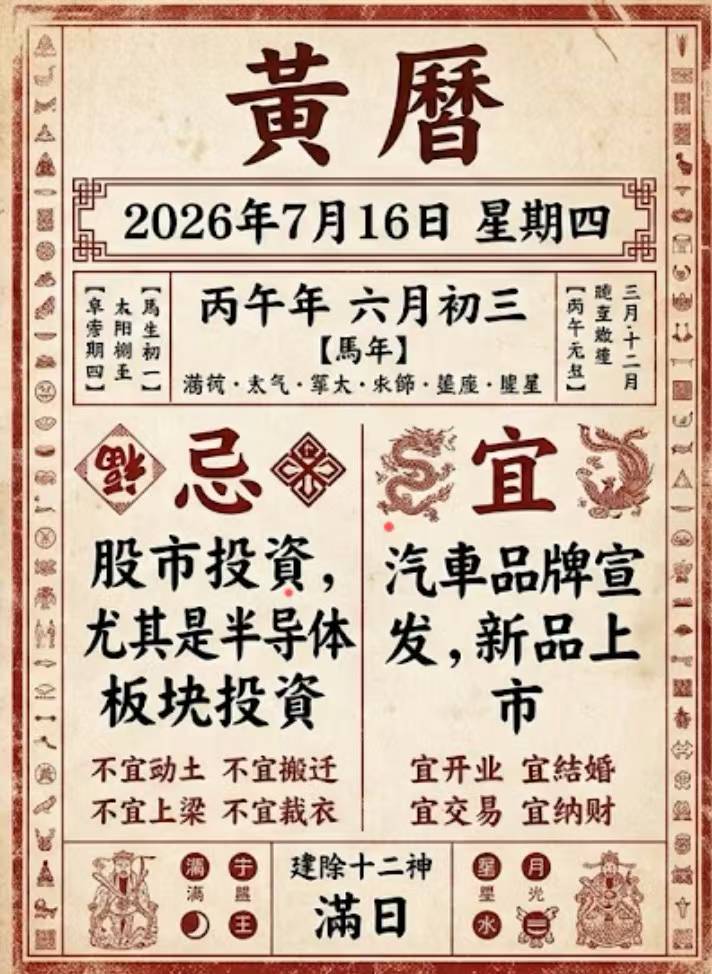
Image Source: Crafted by Dianchetong
The intense schedule of launch events underscores automakers' concerns over market traction and sales figures.
So, what's the root of this anxiety, and how will it impact the entire industry? Today, Dianchetong (ID: dianchetong233) delves into this topic with you.
On this particular Thursday, automotive brands hosted a total of eight launch events:
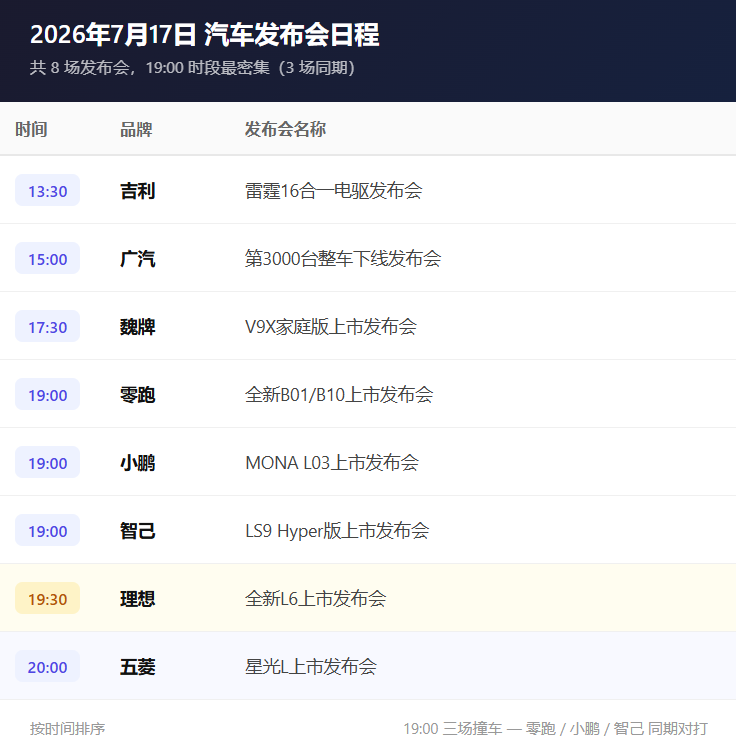
Image Source: Created by Dianchetong
Additionally, Dongfeng Nissan unveiled the 2026 Pathfinder on Thursday but opted not to hold a formal launch event.
Among the models introduced that day, several were pivotal or major updates for their respective brands.
For instance, the Xpeng MONA L03 marks the first SUV under the Xpeng MONA brand and is a crucial model for Xpeng to boost sales in the 120,000-160,000 RMB price range.
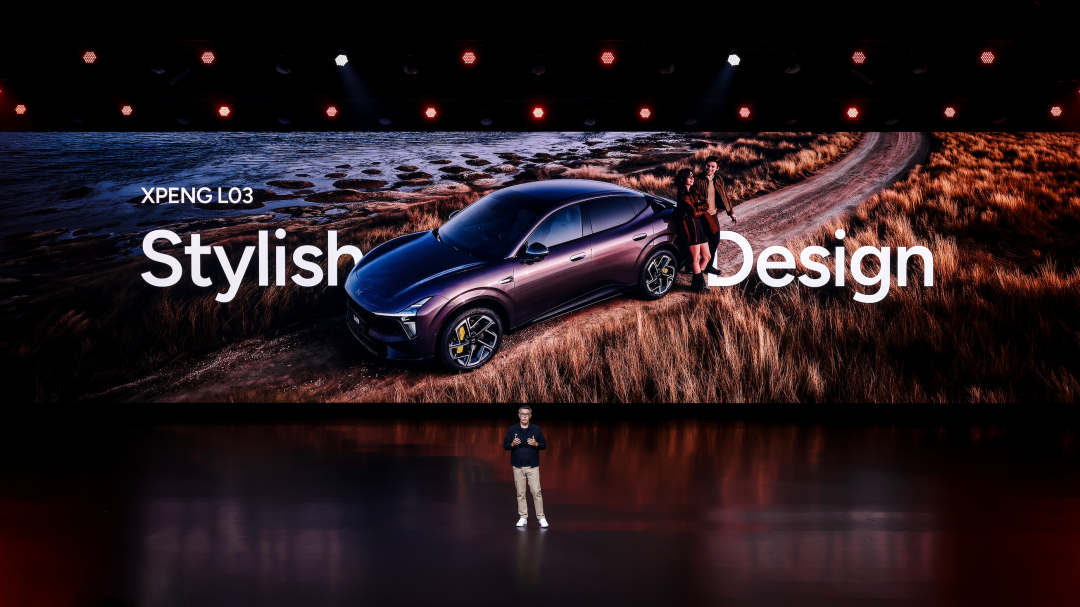
(Image Source: Xpeng Motors)
Another standout is the all-new Li Auto L6, which boasts significant enhancements in range and handling, playing a vital role in driving sales for the Li Auto L series and influencing whether Li Auto's sales will rebound.
The remaining five models also hold significant importance within their brands.
With multiple key models launching on the same day, which coincidentally was a Thursday, some netizens have dubbed it a 'Wild Thursday' for the automotive world.
Why are so many brands opting to launch new models on the same day? Dianchetong (ID: dianchetong233) believes this trend stems from the current dynamics in the automotive industry.
Nowadays, the cycle from research and development to market launch and facelifts has been significantly shortened, with many brands in a rush to outpace their competitors.
This scenario has transformed the entire automotive industry into a large-scale, real-time competitive arena. Automakers, as 'players' in this intense competition, strive to make their moves before rivals, or even make multiple moves, to better 'outmaneuver' them and secure modest profits.
Thus, when automakers collectively rush to meet deadlines and choose to race against time, it's unsurprising that multiple models end up launching on the same day.
But the question persists: Is this pace truly sustainable?
In fact, the recent surge in new car releases in the automotive industry has already caught the attention of industry insiders.
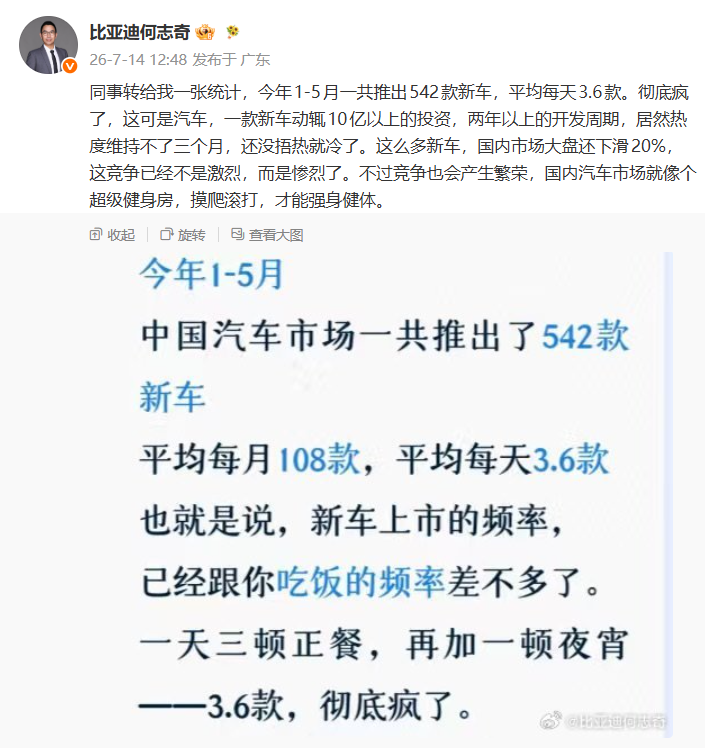
On July 14, BYD Executive Vice President He Zhiqi posted on Weibo about the frequent new car releases in the industry, stating, '542 new models launched from January to May this year, averaging 3.6 per day. Absolutely疯狂 (wild).' 'A new model requires an investment of over 1 billion RMB and a development cycle of over two years, yet it can't maintain its popularity for even three months before fading away.'
(Image Source: Weibo)
Launching 542 new models in five months, averaging 3.6 per day—what does that signify? It's equivalent to new cars being released in China more frequently than most people eat meals!
The question arises: Has such frequent new car releases driven sales growth?
According to data from the China Passenger Car Association, passenger car sales in June were 1.618 million units, down 23.4% year-on-year. From January to June, passenger car sales were 8.701 million units, down 20.2% year-on-year.
In other words, in the first half of this year, more than one-fifth fewer cars were sold compared to the same period last year!
The industry is becoming increasingly competitive, with more frequent launch events, yet fewer cars being sold.
According to sales data disclosed in June, only 41 models sold over 10,000 units per month, while a staggering 334 models sold fewer than 1,000 units per month!
Even after excluding some ultra-luxury or custom models, these figures are still quite alarming.
Automakers are hosting frequent launch events, yet few models are truly selling well. No wonder BYD's He Zhiqi said, 'This competition isn't just intense; it's ruthless.'
However, for automakers, not holding frequent launch events means their product communication efficiency will lag behind competitors, and they may even miss out on the initial buzz after launch. Thus, automakers have no choice but to keep 'competing' along with the industry trend.
Of course, there are brands that are relatively less caught up in this frenzy.
For example, Zeekr, which was criticized in previous years for 'launching three models in a year,' now announces facelift plans well in advance for annual updates, giving consumers time to adjust.
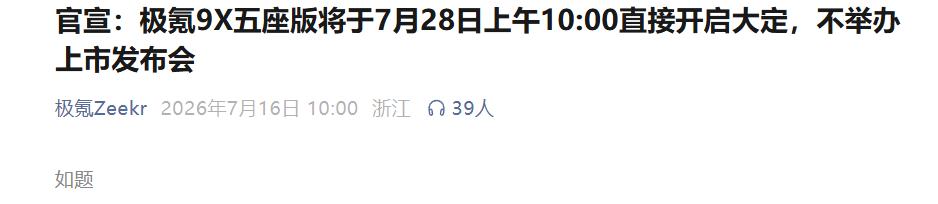
Even for the upcoming Zeekr 9X five-seater version, Zeekr officially announced there would be no launch event, and orders would open directly.
(Image Source: Zeekr)
Another example is Xiaomi, which, despite having no shortage of traffic, announced the launch schedule for its new SU7 well in advance and discontinued the previous model before the new one's release.
With declining sales in the domestic market and such intense competition, many automakers' solution is to accelerate their global expansion.
The fastest-moving independent brands in global expansion, such as BYD, Geely, Chery, and Great Wall, have all seen overall sales growth in June, with exports being a significant driver.
For example, BYD exported 174,897 units in June, accounting for 43% of its total monthly sales. Last year, exports accounted for only 23%, meaning this figure has increased by 20 percentage points in nearly a year.
Even more extreme is Chery, with exports accounting for 76.9% in June, meaning that for every four cars Chery sells, fewer than one is sold in the Chinese mainland market.
Since the domestic market is so fiercely competitive, going abroad to earn higher profits from foreign consumers isn't a bad idea.
Whether it's the concentrated cluster of launch events or the endless stream of facelifts and new models, it all conveys one message: China's automotive industry is truly 'competing' fiercely!
So, does China's automotive industry really need to compete so intensely?
In Dianchetong's (ID: dianchetong233) view, the accelerating pace of facelifts and new model releases is essentially an industry-wide waste of resources.
For automakers, continuing to 'compete' in this way means consuming vast amounts of R&D and marketing resources on high-frequency facelifts and short-term hype marketing.
To meet launch deadlines, automakers have less time for long-term technological accumulation and reliability verification, diluting the effectiveness of R&D investments per model, ultimately leading to hard work with little reward and even harming long-term development.
For consumers, this high-frequency iteration is also unfavorable.
Consumers may have just brought a new car home, only to see a facelifted model with a lower price and more advanced features launch within six months, affecting the vehicle's residual value and creating a sense of 'betrayal' that may influence future car-buying intentions.
Thus, in this environment, while there may seem to be many vehicle choices at attractive prices, many consumers are adopting a 'wait-and-see' attitude, thinking 'the next one will be better' or 'why buy now?' This is clearly not a positive phenomenon for the automotive consumer market.
Dianchetong (ID: dianchetong233) believes that the automotive industry's core competitiveness has never been about how quickly new models are launched but about whether products are truly well-crafted.
For the automotive industry, instead of exhausting itself in rapid-fire iterations, it should try to slow down and shift resources from short-term traffic competition to long-term quality refinement and technological advancements.
After all, what will sustain China's automotive industry in the long run is not rapid-fire iterations but genuinely well-made products.
We hope the industry will see less hype over traffic and more focus on long-termism, breaking free from the cycle of ineffective internal competition and moving toward healthier long-term development.
WAIC 2026, themed 'Intelligent Partners · Co-creating the Future,' opens today with great fanfare!
The AI narrative has shifted from model parameter stacking to Agent productivity implementation; heterogeneous collaboration and photonic computing continue to push computational limits; embodied AI accelerates applications, with robots entering homes and factories, making physical AI a reality.
The Leikeji WAIC exploration team has arrived in Shanghai to witness the annual peak moment of AI industrialization. Stay tuned!
New Energy Vehicle Launch Events
Source: Leikeji
Images in this article are from the 123RF royalty-free image library. Source: Leikeji
-
DRAM, A Disruptive Technological Breakthrough!
-
Robot Army Mobilizes for Action
-
![]()
Electric Vehicle Penetration Soars Past 60%, Yet Seven of Top Ten Brands Hail from Traditional Fuel Vehicle Sector, Casting Doubt on Their Longevity
-
![]()
Conant Optics Clinches R&D and Procurement Framework Deals with Top Tech Firms!
-
![]()
Over 87% Surge in Net Profit for H1 Anticipated! Dongtian Micro Leads in AI Optical Communication
-
![]()
Tech Titans Offload AI Ventures, Tencent Shifts Stakes to Capitalize on Artificial Intelligence Surge
-
![]()
WAIC 2026 Observations: Mapless, Brain-Powered, and Task-Ready—Is Physical AI Taking Off?
-
![]()
Self-driving Technology Hits the Road: NVIDIA's Structural Adjustment, the Emergence of a First Mover... The Second Half of the Autonomous Driving Race Begins