Great Wall Motors Sees 60% Plunge in First-Half Profit, Haval Brand Monthly Sales on the Decline
 07/20 2026
 361
361
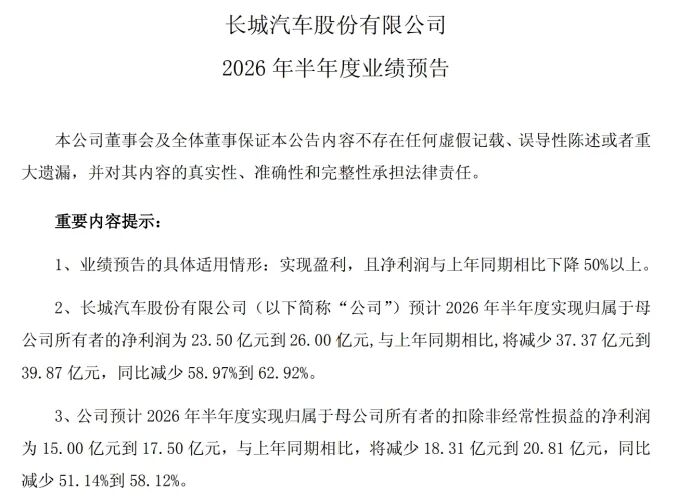
On July 14, Great Wall Motors (02333.HK) unveiled its performance forecast for the first half of 2026.
The company's profit for the first half of the year plummeted by approximately 60% year-on-year. Great Wall Motors attributed this downturn to delayed receipt of overseas tax subsidies and exchange losses, rather than a deterioration in operations. Notably, the company achieved only 32% of its annual sales target in the first half, necessitating a doubling of sales growth in the second half to meet the goal.
Industry competition has intensified, with the Tank brand, once a mainstay, now significantly outperformed by competitors, and sales of the Haval brand experiencing a decline. Nearly half of the company's overseas revenue further amplifies the risks associated with policy and exchange rate fluctuations.
Meanwhile, the company's cash flow continues to surge even as profits decline, a trend rooted in the depreciation and amortization that accompany rapid expansion of fixed assets.
01 Intensifying Industry Competition
Great Wall Motors anticipates its net profit attributable to shareholders for the first half of the year to range between RMB 2.35 billion and RMB 2.60 billion, representing a year-on-year decrease of RMB 3.737 billion to RMB 3.987 billion, or a decline of 58.97% to 62.92%. Net profit after deducting non-recurring items is projected to be between RMB 1.50 billion and RMB 1.75 billion, down by RMB 1.831 billion to RMB 2.081 billion year-on-year, or a decrease of 51.14% to 58.12%.
Regarding the decline in net profit, Great Wall Motors stated in its report that the year-on-year decrease was primarily due to delayed receipt of overseas tax policy subsidy benefits—RMB 2.274 billion received in the same period last year—and the impact of exchange rate fluctuations. After hedging exchange gains and losses and locking in exchange rate preserve value products, the comprehensive exchange loss for the current period was approximately RMB 266 million (unaudited), representing a year-on-year decrease in exchange gains of approximately RMB 1.759 billion, compared to a gain of RMB 1.493 billion in the same period last year.
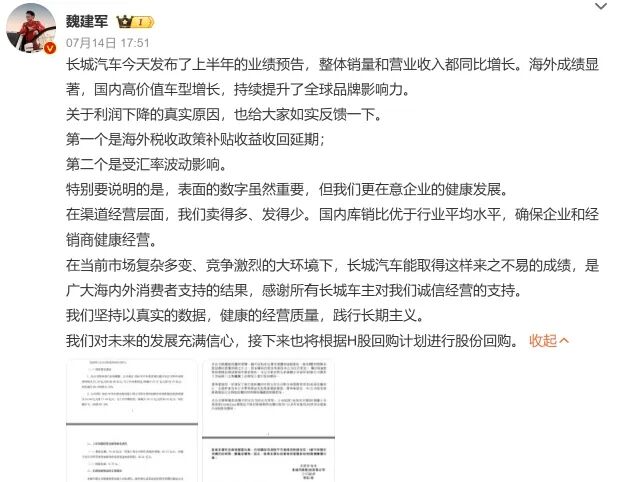
On the same day, Wei Jianjun, Chairman of Great Wall Motors, responded in a post, stating, "Great Wall Motors released its performance forecast for the first half of the year today, showing year-on-year growth in overall sales and revenue. Regarding the true reasons for the profit decline, I will provide honest feedback. First, the delayed receipt of overseas tax policy subsidy benefits; second, the impact of exchange rate fluctuations. It is important to note that while surface figures are significant, we prioritize the healthy development of the enterprise. At the channel operation level, we sell more and distribute less. Our domestic inventory-to-sales ratio is superior to the industry average, ensuring healthy operations for both the enterprise and dealers."
Among its peers, Seres Group (09927.HK) released a performance pre-loss announcement for the first half of 2026 on July 13, projecting a net profit attributable to shareholders loss of RMB 1.5 billion to RMB 1.8 billion for the first half, turning from profit to loss, a decrease of RMB 4-5 billion compared to the previous period.
Additionally, other automakers projecting losses for the first half of this year include GAC Group (02238.HK), BAIC BluePark (600733.HS), and JAC Motors (600418.HS).
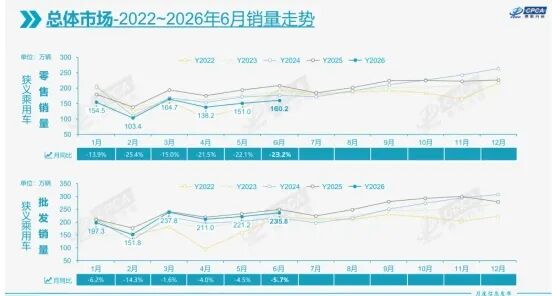
Image Source: China Automobile Dealers Association
On July 14, He Zhiqi, Executive Vice President of BYD Co., Ltd. (01211.HK), sent a message that shocked the entire automotive industry, stating that 542 new models were launched from January to May this year, averaging 3.6 models per day. He remarked, "It's completely insane; this competition is not just fierce but brutal."
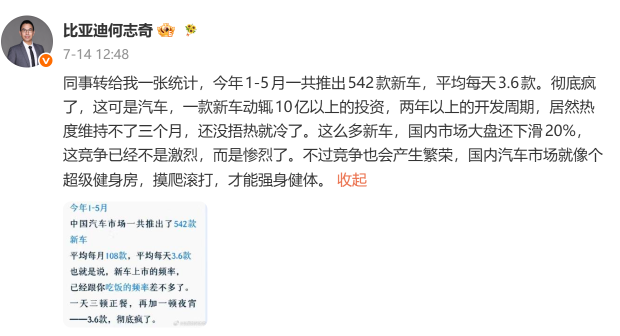
Image Source: Weibo of He Zhiqi from BYD
02 Overseas Markets Cannot Fill the Void Left by Declining Mainstay Brands
Great Wall Motors also faces sales pressure. In the first half of this year, Great Wall Motors' cumulative sales reached 583,895 vehicles, a year-on-year increase of 2.48%. However, new energy vehicle sales in the first half were 144,634 vehicles, a year-on-year decline of 9.8%, accounting for 29.4% of total sales.
Although overall sales increased slightly in the first half of this year, according to the official plan, the annual sales target is no less than 1.8 million vehicles, including 1.2 million domestically and 600,000 overseas. The sales completion rate in the first half was only 32.4%. To meet the target, monthly sales must average 203,000 units in the second half, double the 108,000 units sold in June, imposing immense pressure for the second half.
In terms of products, Great Wall Motors has deployed five brands: Haval, WEY, Tank, Ora, and Great Wall Pickup. Among them, Haval brand sales account for over half of Great Wall Motors' total sales, with a 56% share in the first half.
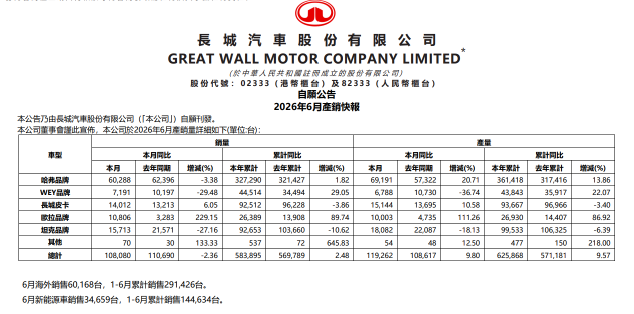
According to the June production and sales report, the Haval brand sold a cumulative 327,000 units from January to June, a year-on-year increase of 1.82%. However, June sales were 60,000 units, a year-on-year decrease of 3.38%, indicating a decline. Meanwhile, the Tank brand sold 16,000 units in June, a year-on-year decrease of 27.16%, and a cumulative 93,000 units from January to June, a year-on-year decrease of 10.62%.
The Haval brand includes models such as Haval H6, Haval Big Dog, Haval Menglong, Haval H9, Haval H5, Haval M6, Haval Xiaolong MAX, and Haval H6L, primarily covering the compact SUV market, with Haval H6 being the main sales driver.
According to regional revenue data, from 2023 to 2025, Great Wall Motors' transaction revenue from China increased from RMB 119.601 billion to RMB 130.429 billion, with the proportion decreasing from 69.05% to 58.53%.
This is primarily due to the increasing proportion of overseas revenue for Great Wall Motors. From 2023 to 2025, the company's overseas revenue proportion jumped from 30.95% to 41.47%. In June 2026, overseas sales reached 60,000 units, with a cumulative 291,000 units sold overseas from January to June, accounting for 49.8% of total sales.
Shi Qingke, President of Great Wall Motors International, stated in a media interview that at least 10 new models will be launched in Europe over the next two years, with plans to build a factory in Europe with an annual production capacity of 300,000 units by 2029.
By brand, the Ora brand performed outstandingly, selling 11,000 units in June, a year-on-year surge of 229.15%, and a cumulative 26,000 units from January to June, a year-on-year increase of 89.74%. Its growth rate leads among the five brands, indicating that Great Wall Motors' strategic layout in the feminine and personalized new energy sector is paying off.
The WEY brand sold 7,191 units in June, a year-on-year decrease of 29.48%, but a cumulative 45,000 units from January to June, a year-on-year increase of 29.05%. However, in the May production and sales report, the WEY brand's monthly sales increased by 31.78% year-on-year, changing from approximately 30% growth to about 30% decline in just one month.
This sharp fluctuation suggests that the WEY brand's market performance may be significantly influenced by short-term factors such as new product launches and promotional policies, and the stability of its brand upward trajectory needs strengthening.
Great Wall Pickup sold 14,000 units in June, a year-on-year increase of 6.05%, and a cumulative 93,000 units from January to June, a year-on-year decrease of 3.86%.
The Tank brand sold 16,000 units in June, a year-on-year decrease of 27.16%, and a cumulative 93,000 units from January to June, a year-on-year decrease of 10.62%.
This performance stands out starkly in the Tank's development history. From 2021 to 2024, Tank sales achieved four consecutive years of growth, reaching 232,200 units in 2024, a year-on-year increase of 42%.
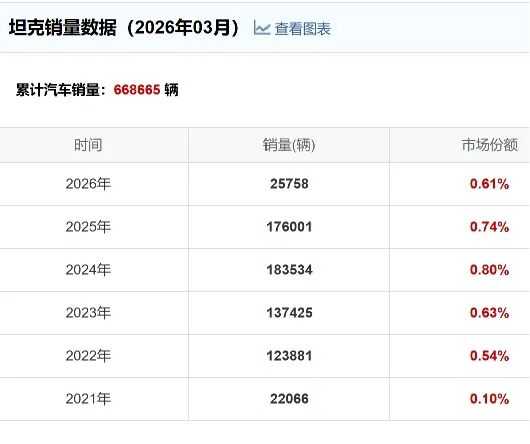
Image Source: Automobile Network
At its peak, the Tank 300 was in short supply even with a RMB 50,000 premium. However, entering 2025, the Tank's annual growth rate plummeted to 0.7%, and in the same year, BYD's Fangchengbao outsold the Tank for the first time.
Entering 2026, the Tank's decline further widened, with its direct competitor, Fangchengbao, selling 35,607 units of a single brand in June, 2.27 times that of the Tank. Just the Fangchengbao Titan 7 model alone sold 23,710 units in a month, surpassing the combined sales of all Tank models. The Tank 300, which once commanded a RMB 50,000 premium, now commonly offers discounts of RMB 10,000 to RMB 30,000.
According to Great Wall Motors' annual reports, from 2023 to 2025, the average selling price per vehicle for Great Wall Motors was RMB 141,400, RMB 163,800, and RMB 168,000, respectively, increasing by approximately RMB 26,600 over three years.
2024 saw the fastest increase in average selling price, with a year-on-year increase of RMB 22,400 to RMB 163,800, and net profit per vehicle reaching a high of RMB 10,300.
However, in 2025, the average selling price per vehicle increased by only RMB 4,200 to RMB 168,000, with the growth rate plummeting from 15.8% to 2.6%, and net profit per vehicle declining to approximately RMB 7,500.
The average selling price per vehicle continues to rise, but the increase has significantly slowed, and profit per vehicle is declining. The gross profit margin trend aligns perfectly with profit per vehicle, standing at 18.72%, 19.51%, and 18.04% from 2023 to 2025, respectively, initially rising and then falling, returning in 2025 to slightly below the 2023 level.
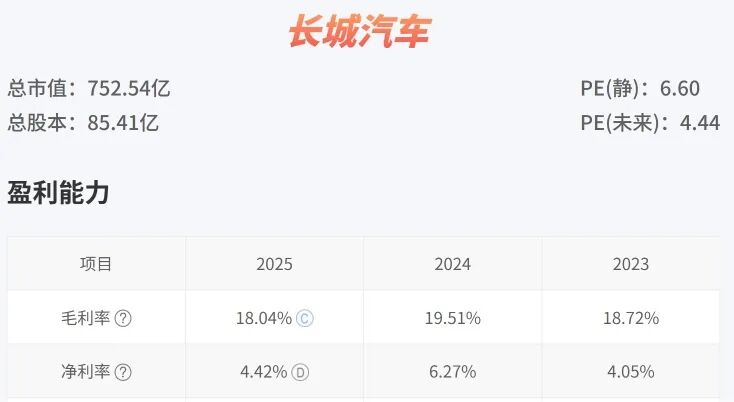
Image Source: Securities Star
Great Wall Motors exhibits a significant divergence between cash flow and profit. From 2023 to 2025, the net cash flow from operating activities was RMB 17.754 billion, RMB 27.783 billion, and RMB 40.355 billion, respectively, growing from RMB 17.754 billion to RMB 40.355 billion, a cumulative increase of approximately 127% over three years.
Meanwhile, net profit attributable to shareholders was RMB 7.022 billion, RMB 12.660 billion, and RMB 9.865 billion, respectively, with a year-on-year decrease of 22.07% in 2025.
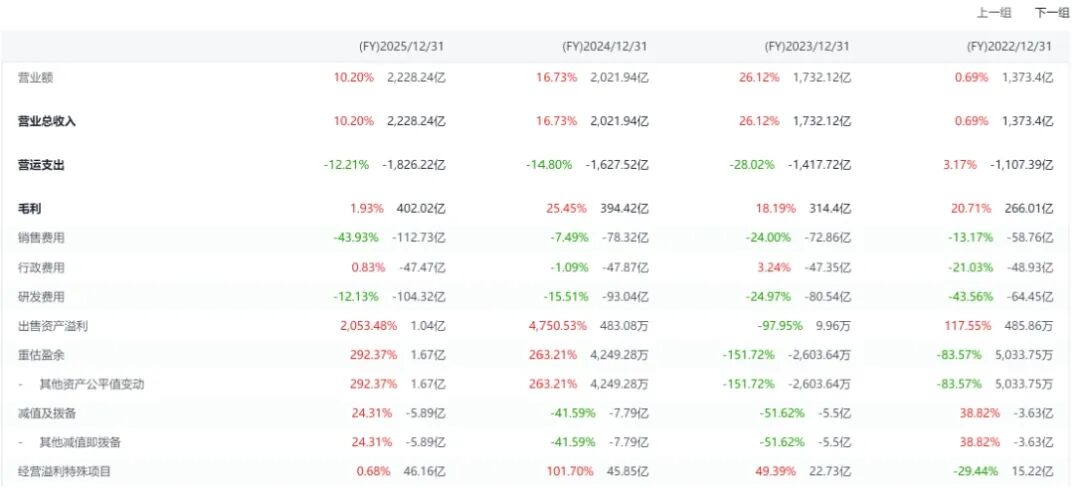
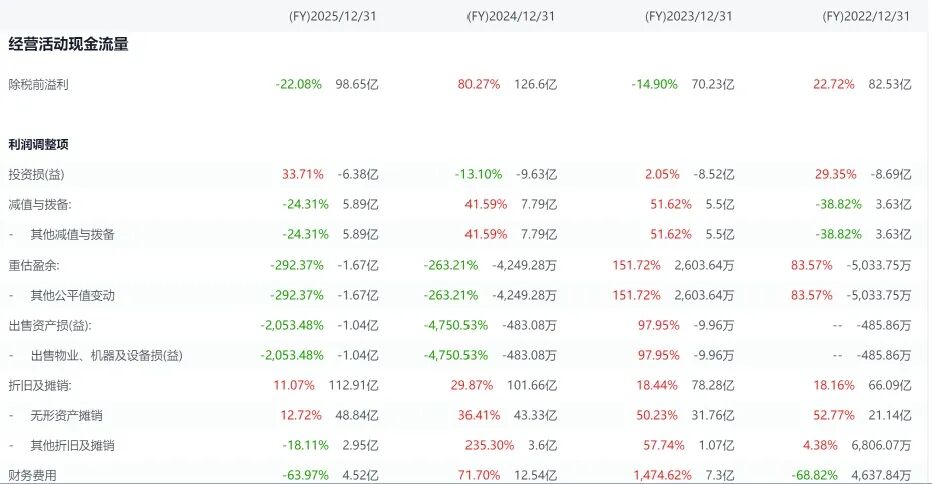
The significant divergence between operating cash flow and profit primarily stems from depreciation and amortization.
From 2023 to 2025, the company's depreciation and amortization were RMB 7.828 billion, RMB 10.166 billion, and RMB 11.291 billion, respectively, with a cumulative increase of approximately 44.2% over three years.
The growth in depreciation and amortization is related to the company's continuously expanding fixed asset scale.
From 2023 to 2025, the company's fixed assets were RMB 26.949 billion, RMB 30.2 billion, and RMB 29.282 billion, respectively.
Source/Hong Kong Stocks Value Line
-END -
-
![]()
AI Memory Race Unveils a Stunning Dark Horse: RedBear AI Raises 6 Rounds of Funding in 15 Months, Valuation Soars Close to RMB 3 Billion
-
![]()
WAIC Concludes: The Three-Year Competition for Large Model Parameters Ends, AI Fully Enters the Industrialization and Implementation Phase for Intelligent Agents
-
DRAM, A Disruptive Technological Breakthrough!
-
Robot Army Mobilizes for Action
-
![]()
Electric Vehicle Penetration Soars Past 60%, Yet Seven of Top Ten Brands Hail from Traditional Fuel Vehicle Sector, Casting Doubt on Their Longevity
-
![]()
Conant Optics Clinches R&D and Procurement Framework Deals with Top Tech Firms!
-
![]()
Over 87% Surge in Net Profit for H1 Anticipated! Dongtian Micro Leads in AI Optical Communication
-
![]()
Tech Titans Offload AI Ventures, Tencent Shifts Stakes to Capitalize on Artificial Intelligence Surge