As Vehicle Manufacturing Costs Become Transparent, How Close Are Consumers to Achieving 'Informed Car Purchasing'?
 07/20 2026
 483
483

Lead
Introduction
Fighting price wars with transparent costs.
As the summer heat intensifies in July, so does the competition in the automotive market.
On the 16th, seven new car models made their debut in a single day. Earlier, semi-annual reports from automakers revealed that even leading companies are feeling the squeeze: Seres and GAC Group have shifted from profit to loss, while Great Wall Motors and Changan Automobile have witnessed significant declines in profits, with their profitability narrowing.
Whether examining specific events, focusing on corporate conditions, or assessing overall market performance, it's clear that pressure is pervasive throughout the industry. Data from the China Passenger Car Association indicates that in the first five months of 2026, domestic retail sales of narrow passenger vehicles reached 7.09 million units, marking a nearly 20% year-on-year decline. The industry's total profit stood at 144 billion yuan, with a profit margin of just 3.4%, significantly lower than the average of 6.1% for downstream industries.
Amidst the exhaustion, struggle, and sense of powerlessness brought on by low prices, pessimism is gradually spreading throughout the industry. In recent years, the call to "curb excessive competition and price wars" has become the strongest within the sector. Under multi-faceted policy guidance, price wars have been somewhat contained, and the recently implemented "China Automotive Industry Vehicle Cost Calculation Rules" (hereinafter referred to as the "Cost Calculation Rules") have provided a powerful remedy to curb disorderly low-price competition.
01 Implementation of the 'Cost Calculation Rules': A Potent Remedy for Chronic Industry Issues
What does a 3.4% profit margin signify? In more tangible terms, for a car priced at 100,000 yuan, the net profit per unit is only about 3,400 yuan; to achieve a 10,000-yuan profit per unit, the selling price would need to approach 300,000 yuan. The thin profit margins in the automotive industry are starkly evident.
The repercussions of low profits are felt across the entire industrial chain.
For automakers, extreme price wars compress profit margins, leading to frequent layoffs, production cuts, factory closures, and asset sales, thereby weakening the industry's resilience. In the distribution channel, dealers operate on slim margins and high volumes, with declining revenues from after-sales services and maintenance, worsening the channel ecosystem. Among consumers, persistent price reductions foster a 'wait-and-see' mentality, making car purchase decisions increasingly cautious.
More alarmingly, some automakers, to offset losses from low prices, are compelled to cut supply chain costs, reduce vehicle testing investments, and simplify warranty services, leading to a proliferation of hidden risks.
As disorderly competition drags the industry into a quagmire, breaking free has become a consensus. On July 15, the "Cost Calculation Rules," jointly developed by the China Association of Automobile Manufacturers and 18 leading domestic automakers, were officially released.
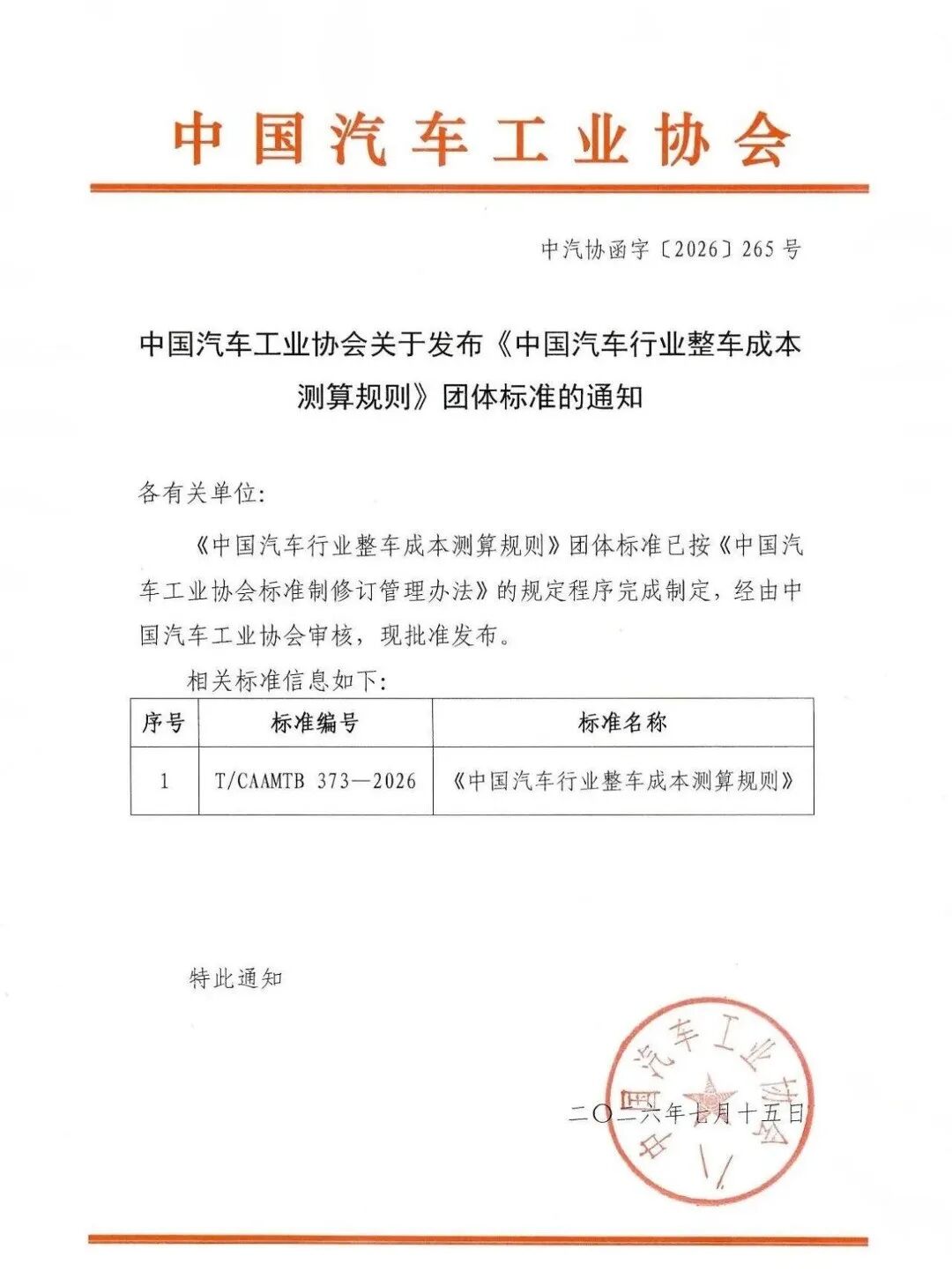
As the first unified cost calculation standard for the entire vehicle industry in China, these rules aim to end the long-standing confusion caused by inconsistent cost accounting methods and lack of benchmarking by aligning with multiple laws, regulations, and industry documents.
Previously, due to varying rules among companies in account classification and expense allocation, cost data for models of the same class lacked horizontal comparability, leaving ample room for gray operations in irrational price wars.
For instance, under the old system, companies could manipulate public opinion through inflated costs or malicious low pricing. On one hand, they could include as many expenses as possible in the per-unit cost, artificially raising the pricing benchmark, then reduce revenues in accounting to create the illusion of selling at a loss, thereby gaining consumer trust. On the other hand, some companies used related-party transactions or accounting estimate adjustments to deliberately lower book costs, portraying themselves as offering 'exceptional value for money' while accusing competitors of 'overpricing,' thus disrupting the market and seizing market share.
The "Cost Calculation Rules" systematically address these regulatory gaps through multiple measures.
Firstly, they establish a unified calculation model to clarify long-standing disputes. The rules provide a framework for calculating product and expense costs for entire vehicles, uniformly defining items that previously had divergent interpretations. They specify that net revenue must be calculated after deducting promotions, rebates, and value-added tax, incorporating all price adjustment tools such as financial subsidies and trade-in allowances into a unified deduction scope. Simultaneously, they clarify the composition of vehicle production costs, including transportation and warranty expenses in cost accounting and providing detailed explanations.
Secondly, they set regulatory red lines to ensure cost authenticity. Companies are prohibited from maliciously reducing costs through related-party transactions or accounting estimate adjustments. The pricing of internally procured components must not be lower than their material costs. The entire calculation process must retain original records such as vouchers to ensure cost data is verifiable and traceable.
Thirdly, they accommodate industry diversity while maintaining appropriate flexibility. The rules allow companies to choose, based on their accounting habits, whether to include transportation and warranty expenses in costs or deduct them from revenue. They also specify that during special periods such as seasonal production fluctuations or new product ramp-up, abnormal costs can be reasonably adjusted.
These three measures not only provide a unified benchmark for the industry, enabling horizontal comparability of models at the same level for the first time but also lay the foundation for establishing a more comprehensive industry credit system.
02 Transparent Costs Act as a Revealing Mirror
For automakers, these rules serve as a 'revealing mirror': those cutting corners are exposed, while diligent manufacturers gain authoritative endorsement.
Commonly seen low-priced cars on the market fall into two essential categories with fundamental differences. One category involves reasonable price reductions achieved through economies of scale or technological advancements that enhance efficiency and reduce costs. These price cuts are sustainable, with vehicle quality improving, benefiting both companies and consumers. The other category involves malicious dumping aimed at short-term market seizure, achieving low prices by cutting supply chain costs, reducing component standards, and slashing testing investments, ultimately harming consumer interests and the industry ecosystem.
The implementation of the new regulations clarifies the fundamental differences between these two types of price reductions. Automakers can no longer maintain low prices through accounting fraud or cost-cutting measures that compromise quality. Instead, they must rely on genuine technological, production, and management capabilities to achieve cost reductions and efficiency gains. This shift enables consumers to clearly distinguish between 'genuine value for money' and 'fake low-price gimmicks,' accurately identifying high-quality models that offer technological benefits.
Simultaneously, the phenomenon of new cars experiencing significant price drops shortly after launch is expected to be curbed. In the short term, under the new regulations, extreme price plunges and irrational large-scale discounts will gradually fade. Prices for some entry-level models may stabilize slightly, and the final purchase prices for consumers might even rise marginally. However, in return, vehicle material quality, safety standards, reliability, and subsequent maintenance and warranty services will receive substantive guarantees.
The bubble of false discounts will be further burst. For example, amid the wave of fuel car price reductions, claims like 'buy an Accord for 110,000 yuan,' 'buy a Camry for 120,000 yuan,' and 'buy a Land Rover for 170,000 yuan' continuously stimulate and mislead consumers. However, upon visiting dealerships, consumers often find that these prices apply to stripped-down older models, with the actual transaction prices of new cars differing significantly from the advertisements.
The "Cost Calculation Rules" specify the scope of vehicle revenue recognition, with net revenue = price − promotions − rebates − value-added tax. Indirect price reduction methods such as trade-in subsidies, zero-interest loans, free maintenance, and upgraded packages are all included in a unified deduction scope, making it easier for regulatory authorities to verify false discounts and significantly reducing the operational space for dealers attempting to exploit loopholes through wordplay. The final purchase prices for consumers will become more transparent.

Furthermore, if automakers claim to be selling at a loss while significantly cutting corners and shortening warranties, regulatory authorities can use the unified cost rules to determine whether this constitutes malicious low-price competition. When consumers encounter false discounts, misleading advertising, or shoddy workmanship, they now have standardized cost data as evidence for complaints.
It is important to emphasize that the rules' flexibility does not restrict normal price reduction behaviors. Clearing old inventory, generational upgrades, and temporary promotions during production ramp-up are not interfered with. Models that achieve genuine cost reductions through self-developed technological breakthroughs or large-scale production still have room for sustained price reductions.
Moreover, when new car prices rise, consumers can also obtain more comprehensive information to better distinguish whether the increase is due to rising raw material costs or other factors.
From a long-term industrial development perspective, the value of the new regulations is even more profound.
On one hand, a healthy competitive environment frees automakers from ineffective price war internal competition, allowing them to allocate more funds, manpower, and technological resources to core areas such as battery research and development, autonomous driving iteration, and chassis technology upgrades. This drives technological advancements in the automotive industry, enabling consumers to continuously enjoy higher-configuration, higher-quality, and more intelligent vehicle models.
On the other hand, a stable pricing system effectively curbs extreme price fluctuations in the automotive market, reducing the impact of disorderly price reductions on the residual value of used cars and stabilizing vehicle depreciation rates. Especially in the new energy sector, with the full inclusion of battery, battery swap, and warranty service costs in the calculations, the influx of low-priced, low-quality battery models into the market can be prevented, significantly reducing consumers' later maintenance and battery swap costs.
In essence, the "Cost Calculation Rules" serve as a potent remedy to address chronic issues hindering industrial development, establishing clearer and more traceable boundaries for price competition. However, fundamentally transforming the industry ecosystem requires more than just a set of rules. The ultimate reshaping of market order still depends on sustained regulatory efforts, rational guidance from the capital market, and prudent choices and active supervision from the consumer side.
For the vast number of consumers, the new regulations will not lower car prices and might even lead to a slight increase. However, they are promoting the gradual formation of a more transparent, healthier, and sustainable automotive market. This is precisely the change the industry has been eagerly anticipating.
Editor-in-Chief: Cao Jiadong Editor: He Zengrong

THE END
-
Observation of AI Business Models: From Token-Based Payment to Outcome-Based Payment
-
Observations on AI Business Models: From Token-Based Payment to Outcome-Based Payment
-
SpaceX Market Insight: The $1 Trillion 'Fireworks' Fizzle Out, Marking the Start of the Super IPO Gamble
-
![]()
Car Prices on the Rise: Is It Wise to Postpone Your Purchase?
-
![]()
Foxconn's Electric Vehicle Venture Hits a Snag
-
![]()
How Did They Open the Door to Europe by Attacking the Century-Old Stronghold of the Automotive Industry?
-
![]()
Qwen Still Shows Hesitation
-
![]()
Qwen: Still a Bit Short on Confidence