Leapmotor Exceeds 100,000 Units, Li Auto Faces Three Straight Months of Decline: China’s Auto Market Competition Intensifies in the Second Half
 08/05 2026
 557
557
In May of last year, the automotive industry launched a high-profile initiative against cutthroat competition. However, over a year later, while major players like BYD have seemingly reduced the frequency of large-scale price cuts on the surface, the underlying intensity of competition has not truly abated.
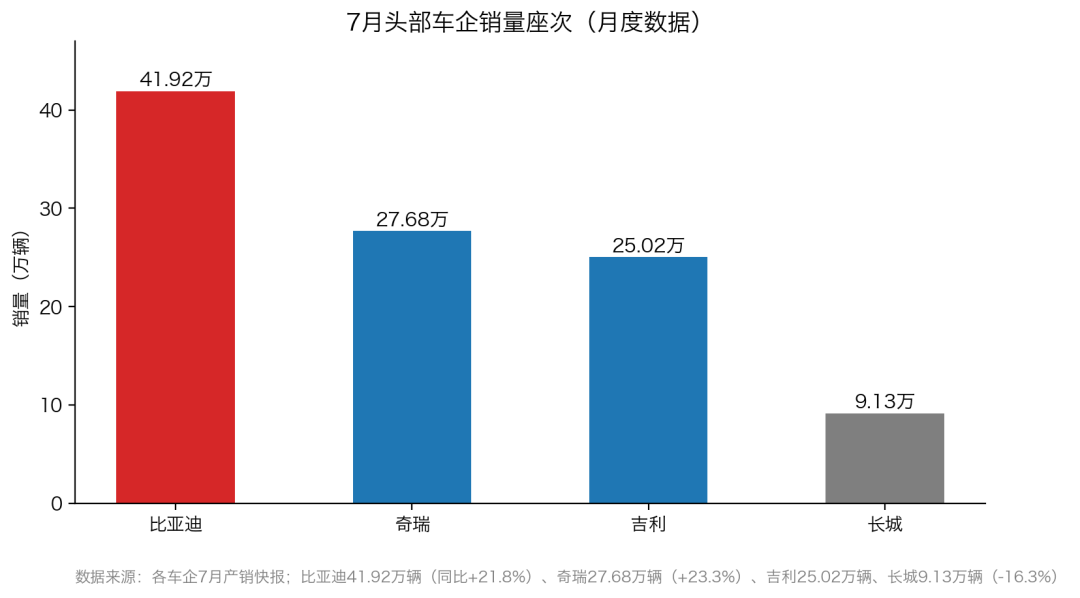
BYD sold 419,200 vehicles in July, maintaining a substantial lead in the market.
Chery Group delivered 276,800 units in July, including 202,500 exports, marking the first time a Chinese automaker has exceeded 200,000 exports in a single month.
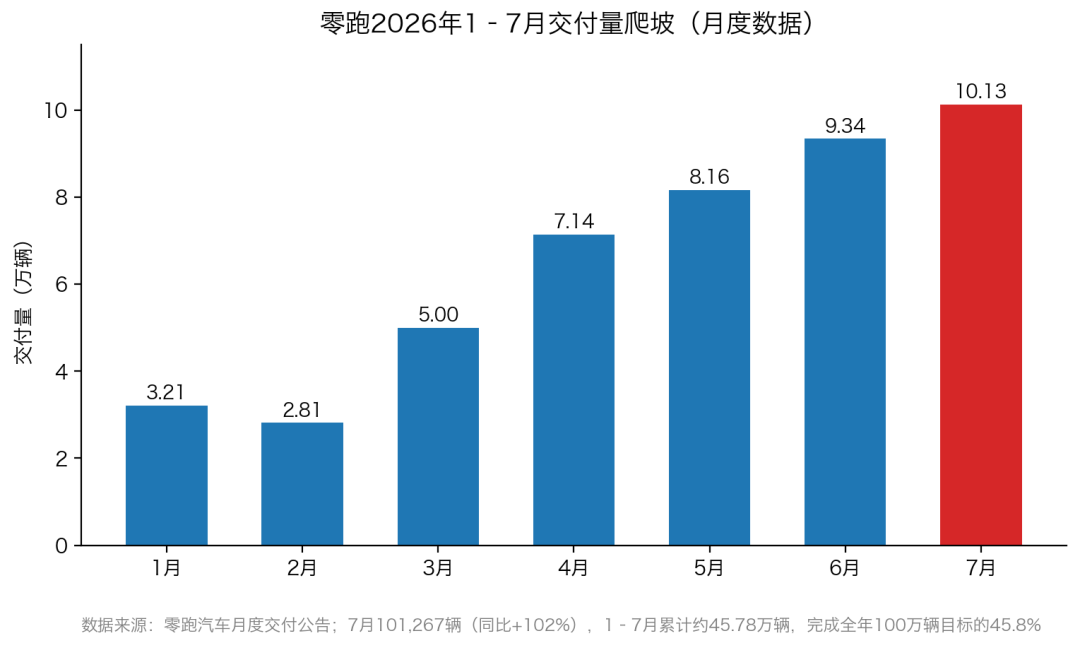
Leapmotor delivered 101,267 units in July, becoming the first emerging domestic automaker to surpass 100,000 deliveries in a single month.
NIO delivered 35,934 units, while XPeng delivered 38,027 units, both maintaining stability within the 30,000-40,000 unit range.
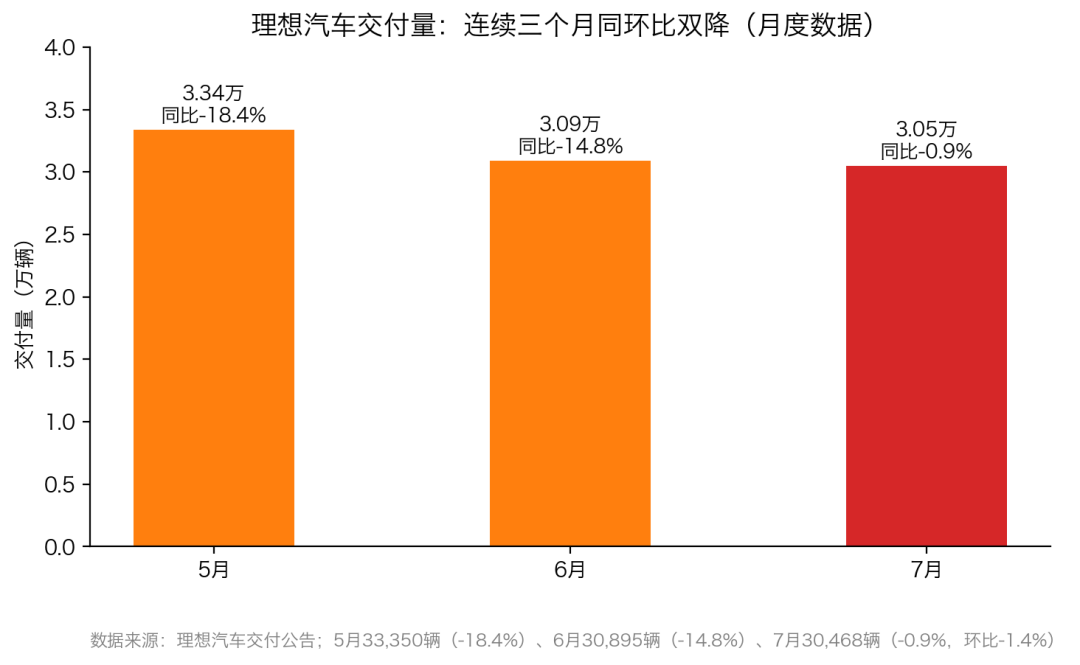
Li Auto delivered 30,468 units, marking a 0.86% year-on-year decrease and a 1.38% month-on-month decline, signaling three consecutive months of both year-on-year and month-on-month decreases.
After reviewing these figures, the most striking impression for Xingkong Jun is that competition in China’s auto market has transitioned from a ‘Spring and Autumn and Warring States’ phase to an ‘elimination race.’
The strong are getting stronger, the weak are being eliminated, and those in the middle are facing mounting pressure.
In this race for survival, two new strategies for success are emerging: achieving ultimate cost-effectiveness (pushing cost-efficiency to the limit) and ensuring early and comprehensive overseas expansion.
Data Source: ifind
First, let’s examine BYD, the market leader.
BYD sold 419,200 units in July, a 21.76% increase year-on-year, with overseas sales reaching 179,800 units, up 124.3% year-on-year.
Fangchengbao sold 41,213 units, a 190.6% increase year-on-year, and Denza sold 19,196 units. From January to July, BYD sold a cumulative total of 2.2277 million units, with overseas sales reaching 969,200 units.
Against the backdrop of an overall shrinking Chinese auto market, BYD has strengthened its lead with a combination of a strong domestic base, high overseas growth, and increased sales of high-end models.
Next, let’s look at the transformation of traditional industry giants.
Geely Holding sold a total of 1.9348 million units in the first half of the year, with a new energy vehicle penetration rate of 56.9% and overseas exports reaching 474,200 units, a 158% increase year-on-year.
Chery Group sold 276,800 units in July, a 23.3% increase year-on-year, with new energy vehicle sales reaching 129,100 units, up 97.5% year-on-year.
The global distribution channels accumulated during the era of fuel-powered vehicles are proving to be crucial assets for these traditional giants in their transition to new energy vehicles.
1. Leapmotor: From 879 Monthly Sales to 100,000 Units
Leapmotor delivered 101,267 units in July, a 102.01% increase year-on-year, becoming the first emerging domestic automaker to exceed 100,000 deliveries in a single month.
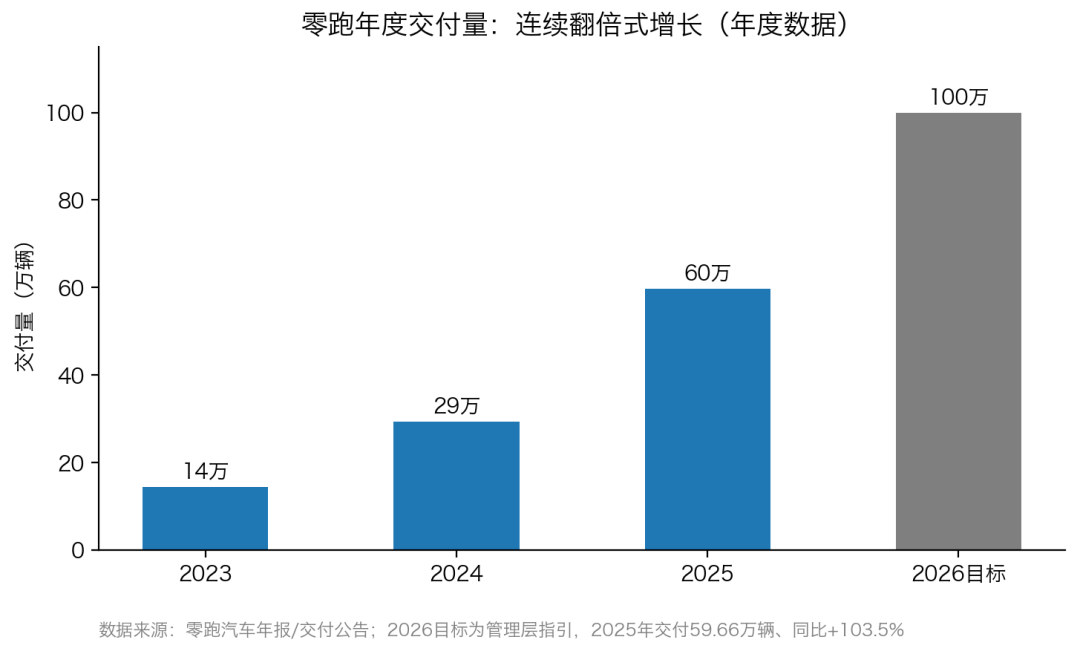
In 2020, Leapmotor’s monthly sales were only 879 units; by October 2024, cumulative deliveries surpassed 500,000 units; by October 2025, they exceeded 1 million units; and by June 2026, they surpassed 1.5 million units.
It took only 8 months to go from 1 million to 1.5 million units.
Zhu Jiangming, Chairman of Leapmotor, said, ‘From 879 monthly sales to 100,000 units, Leapmotor has taken six years.’
Data Source: ifind
Why Leapmotor?
Extreme cost-effectiveness.
Leapmotor’s product lineup covers the mainstream price range of 60,000 to 300,000 yuan: the A-series (A10) sells nearly 30,000 units monthly, forming the sales base; the C-series (C10, C11, C16) has cumulative global sales exceeding 850,000 units; the B-series sold over 20,000 units in July, with cumulative global sales exceeding 250,000 units; the D19 exceeded 10,000 deliveries, and the first MPV model, D99, began deliveries, with the first batch of orders averaging over 300,000 yuan.
Data Source: ifind
Xingkong Jun notes that Leapmotor’s ‘cost-effectiveness’ is not simply about low prices but about offering the configurations of a 200,000-yuan model within a 100,000-yuan price range.
Full-stack in-house research and development provide Leapmotor with cost advantages in batteries, electric drives, and intelligent driving, which are then passed on to consumers.
This is the essence of Leapmotor’s success: not about failing to make money but using scale to reduce costs, using costs to boost sales, and using sales to feed back into scale.
In the first half of 2026, Leapmotor delivered a cumulative total of 356,500 units, a 60.8% increase year-on-year, ranking first among emerging forces and surpassing NIO, Li Auto, and XPeng.
This brand, once ridiculed for ‘not understanding car-making,’ has now become the top player among emerging forces.
From a financial perspective, Leapmotor’s ‘cost-effectiveness’ model is shifting from ‘burning money for scale’ to ‘scale for profit.’
In Q1 2026, Leapmotor delivered 110,155 units globally, including 40,901 overseas exports, with revenue reaching 10.82 billion yuan, an 8% increase year-on-year.
While profitability remains under pressure, rapid scale expansion has given Leapmotor greater bargaining power and lower unit costs.
Thus, Leapmotor’s value lies not in per-unit profit but in proving that the ‘cost-effectiveness + scale’ approach works in the Chinese market.
2. Li Auto: The Three Consecutive Declines
In stark contrast to Leapmotor’s surge is Li Auto.
Li Auto delivered 30,468 units in July, marking a 0.86% year-on-year decrease and a 1.38% month-on-month decline, signaling three consecutive months of both year-on-year and month-on-month decreases. In the first half of the year, Li Auto delivered approximately 193,500 units, a 5.1% decrease year-on-year, making it one of the few emerging forces with a year-on-year decline among the top players.
Data Source: ifind
Why has Li Auto stumbled?

Xingkong Jun believes the core reasons are ‘reliance on a single model’ and ‘growing pains during transition periods.’
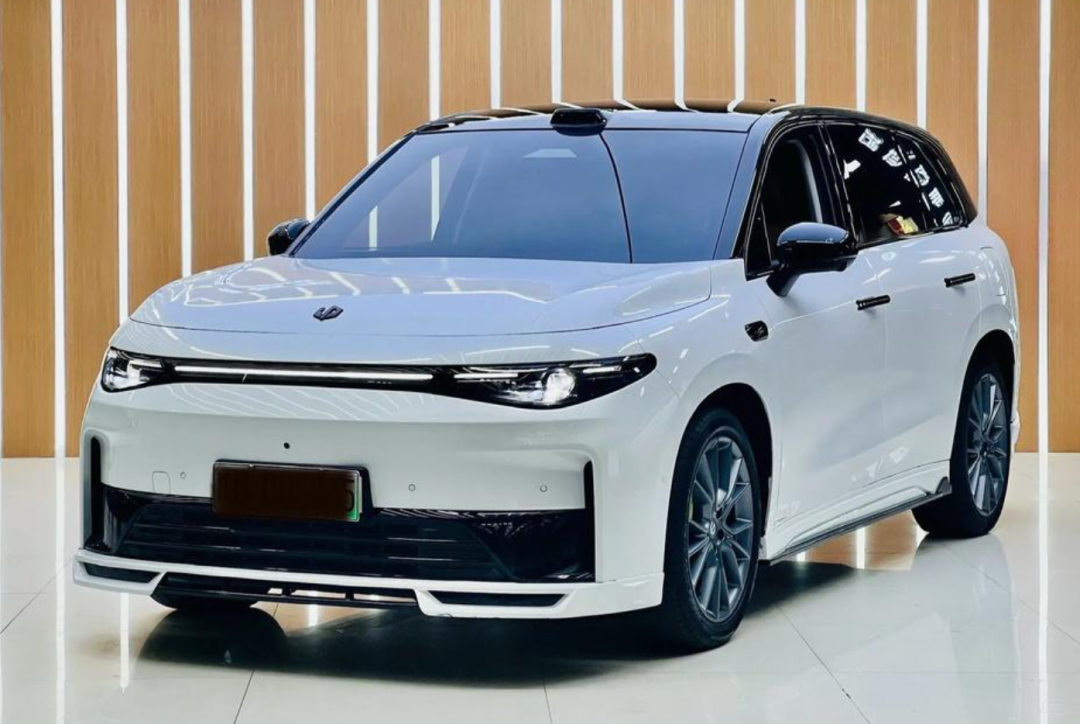
Li Auto’s sales pillar is the pure electric SUV, the Li i6.
In the first half of the year, the i6 sold a cumulative total of 120,400 units, contributing over 60% of the brand’s total sales, with monthly sales exceeding 20,000 units for four consecutive months, making it the absolute core of the brand. However, the i6’s starting price is only 249,800 yuan, which Li Auto CEO Li Xiang himself called ‘the model with the lowest gross margin.’
Meanwhile, the extended-range electric vehicle (EREV) Li L6, which once contributed significantly to Li Auto’s success, saw sales plummet 69.4% year-on-year in the first half of the year, dropping from a blockbuster with over 10,000 monthly sales to just 915 units sold in June.
With the decline of old blockbusters and the low gross margin of the new blockbuster (i6), Li Auto is in the midst of a product transition pain.
However, in mid-to-late July, the i6’s production was reduced by about 4,000 units due to supply fluctuations in headlight components.
Although Li Auto stated that supply has resumed, this incident exposed the risk of ‘reliance on a single model,’ where supply chain fluctuations in one model can significantly impact the brand’s monthly performance.
Li Auto’s predicament is, in fact, the dilemma of all automakers ‘betting on a single blockbuster.’ When the market shifts from growth to maturity, the dividend of blockbusters quickly fades, and if new models fail to take over in time, sales will stumble.
A deeper issue is that Li Auto’s EREV base is being eroded.
More players are entering the EREV market, with Seres, Leapmotor, and Xiaomi all using similar product logic to compete. When EREVs are no longer scarce, Li Auto’s brand premium will be diluted. While the pure electric i6 sells well, its low gross margin and fierce competition make it difficult to sustain Li Auto’s original profit structure. Li Auto needs to find a new balance between ‘defending its EREV base’ and ‘attacking with pure electrics,’ a balance that has yet to emerge.
3. NIO and XPeng: Stabilized but Lacking Growth
NIO delivered 35,934 units in July, a 71% increase year-on-year and an 11.49% decrease month-on-month. Among them, the NIO brand delivered 20,008 units, Ledao delivered 10,155 units, and Firefly delivered 5,771 units. From January to July, cumulative deliveries reached 227,057 units, a 68% increase year-on-year, a record high.
XPeng delivered 38,027 units in July, about a 4% increase year-on-year. In the first half of the year, deliveries reached 166,000 units, a 15.83% decrease year-on-year.
XPeng’s predicament lies in resource dispersion, with simultaneous progress on multiple platforms and new models, diluting R&D investment and failing to create a new dominant blockbuster.
In the second half of the year, XPeng is pinning its hopes on the production ramp-up of the large six-seater SUV, XPeng GX, the global launch of MONA L03, and accelerated overseas expansion.
The commonality between NIO and XPeng is that they have stabilized but lack explosive growth.
Compared to Leapmotor and Zeekr, which are doubling their growth, monthly deliveries of 30,000-40,000 units, while respectable, no longer qualify as ‘high growth.’
4. The Intensifying Competition Enters the Elimination Race
Looking at the July data together, China’s auto market is undergoing a brutal elimination race.
On one hand, there is the Matthew effect among the top players.
BYD sold 419,200 units in July, nearly equivalent to the sum of the second to fifth-place players. Traditional giants like Chery and Geely are achieving counter-trend growth through exports, while emerging forces like Leapmotor and Zeekr are breaking through with cost-effectiveness.
On the other hand, the middle tier is under collective pressure.
In the first half of 2026, nationwide new energy passenger vehicle retail sales reached 4.704 million units, a 14% decrease year-on-year; narrow passenger vehicle retail sales reached about 8.75 million units, about a 20% decrease year-on-year. In this shrinking market, Seres went from a first-half profit of 2.941 billion yuan to a projected loss of 1.5 to 1.8 billion yuan, GAC projected a loss of 4.06 to 4.57 billion yuan, and Great Wall Motors' profit dropped by sixfold.
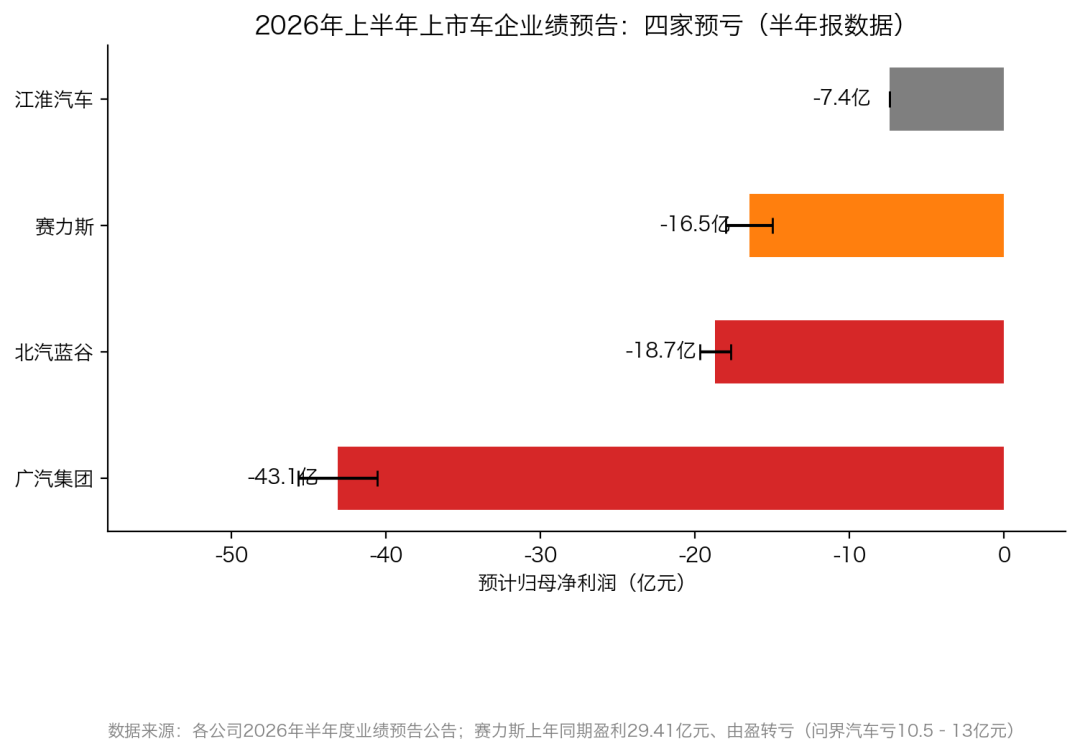
Data Source: ifind
Xingkong Jun believes that the essence of the elimination race is that when the pie stops growing, the way to divide it becomes ‘if you eat more, I eat less.’ In this landscape, automakers without differentiation, scale advantages, or overseas channels will be quickly forced out of the game.
The first half of 2026 has already provided the answer: the sales targets of 13 mainstream automakers or brands total 24.55 million units, but the industry’s overall growth forecast is only 1% to 3%.
The gap between targets and reality is the space for the elimination race.
-END-
Disclaimer: This article is based on the public company attributes of listed companies and core analysis and research derived from information disclosed in accordance with their legal obligations (including but not limited to interim announcements, periodic reports, and official interaction platforms). Shiyu Xingkong strives for fairness in the content and viewpoints presented in the article but does not guarantee its accuracy, completeness, or timeliness. The information or opinions expressed in this article do not constitute any investment
-
![]()
Ten Years of Feishu: Answers from an Email
-
![]()
Ten Years of Feishu: Answers from an Email
-
![]()
300084 Sets Up Intelligent Computing Tech Firm, Embracing AI Ventures
-
![]()
Unveiling Yin Tongyue's 'No Involution' Stance: Chery's Strategic Maneuvers
-
STO Express Faces Scrutiny: Franchise Model’s Safety Gaps Under the Microscope
-
![]()
The Richest Woman is Going Public Again! Valued at 22.5 Billion, Building an 'Optical Empire' with Her Brother
-
![]()
Buying More GPUs is No Longer Enough: Divergence in Monetization Progress Among the Top Four Cloud Providers
-
![]()
Leapmotor Exceeds 100,000 Units, Li Auto Faces Three Straight Months of Decline: China’s Auto Market Competition Intensifies in the Second Half