Unveiling Yin Tongyue's 'No Involution' Stance: Chery's Strategic Maneuvers
 08/05 2026
 529
529
By Bishan
Source: Bowang Finance
On July 25, Chery Group's cumulative global sales officially exceeded 20 million vehicles. The Fengyun A9, marking the 20 millionth vehicle milestone, made its debut on the same day. At the launch event, Chairman Yin Tongyue made a bold declaration: 'Having sold 20 million vehicles, we will no longer engage in involution. Our focus will shift from merely chasing sales volume to elevating our brand and creating greater value.'
This wasn't Yin's first anti-involution statement. During the 2025 Two Sessions, he remarked, 'Downward involution-style competition holds no future.' This year, he intensified his stance, stating, 'Involution contradicts the entrepreneurial spirit.' While previous remarks might have seemed like mere rhetoric, this time—with the 20 million milestone freshly achieved—the timing and tone were impeccably strategic.
The question remains: Is this a statement of industry responsibility or a calculated move?
Sina Finance: On July 25, Chery Group's cumulative global sales surpassed 20 million vehicles, with the Fengyun A9 marking the milestone. Yin Tongyue announced at the launch event, 'We will no longer participate in involution after selling 20 million vehicles.'
01 Post-20 Million: Yin Tongyue's 'No Involution' Pledge
A subtle yet significant detail in Yin's original statement: 'This year has been challenging for the industry; everyone is under pressure. Chery reduced domestic shipments by 150,000 units this year, resulting in a noticeable decline. However, we proactively reduced inventory levels for dealers in the first half.'
In simpler terms: Chery didn't passively lose the domestic market but strategically withdrew—reducing shipments by 150,000 units, equivalent to nearly three months of domestic sales. This figure reflects a deliberate subtraction. How did the passenger vehicle market fare in the first half? Data from the China Association of Automobile Manufacturers (CAAM) shows that domestic passenger vehicle retail sales fell by 20.2% year-on-year, with average vehicle manufacturing profit margins plummeting to 1.5%, a decade low. Price cuts of 13-14% failed to boost sales but eroded profits more rapidly. A vehicle sold for RMB 200,000 yielded automakers just RMB 3,000 in profit—less than bank fixed deposits.
Pursuing volume in such a climate is self-destructive. Yin's decision: Instead of sacrificing margins for domestic market share, he redirected capacity to exports. Chery exported 943,800 vehicles in the first half of 2026 (a 71.5% YoY increase), including a record 191,062 units in June (a 79.7% YoY increase), breaking China's monthly export record for four consecutive months. Export profit margins far exceed the cutthroat domestic competition, avoiding price wars.
'No involution' requires an escape route. Chery's is overseas markets. While domestic automakers struggle over single-digit market share gains, nearly three out of every four Chery vehicles are sold abroad. This isn't nobility but post-calculation pragmatism.
02 Only 1 in 4 Vehicles Sold Domestically: Exports Sustain Growth
Chery's export performance is impressive but raises concerns.
In June, Chery sold 256,612 vehicles globally, with exports accounting for 74.5% (191,062 units). First-half exports reached 943,800 units (a 71.5% YoY increase), setting records. Yet domestic sales? Yin admitted to 'reducing shipments by 150,000 units.' With the domestic market down over 20% in the first half, Chery couldn't remain unscathed. A deeper issue: Overreliance on exports suggests Chery's brand and product strength in China are weaker than claimed.
Sub-brand data underscores this. Huawei-partnered Seres sold just 44,929 units in the first half (a 56.9% YoY decrease)—less than NIO or XPeng's monthly sales. Premium brand Exeed sold 60,208 units (a 44.9% YoY decrease). Combined, their new energy vehicle sales barely exceeded 100,000 units, while domestic NEV penetration surpassed 60% for three straight months. Chery lags in the NEV transition.
The Fengyun A9 carries high hopes—priced at RMB 109,900-129,900, featuring a 70kWh Rhino battery, 3nm Lingxi smart cockpit, and Red Dot Design Award. Yet its pricing strategy is telling: The final price is RMB 6,000 lower than pre-sales, a classic 'involution' tactic. For a pure electric sedan in a saturated market, price wars are unavoidable—despite Yin's words.
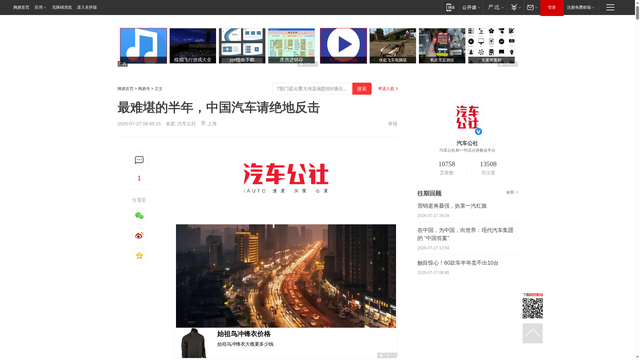
NetEase (Auto Community): In the first half of 2026, the average profit margin for vehicle manufacturing fell to 1.5%, a decade low. At an average vehicle price of RMB 202,000, automakers retained just RMB 3,000 in net profit per unit.
03 1.5% Profit Margins: Industry-Wide Struggles Post-Price Wars
Chery isn't alone. The entire industry is suffering.
CAAM Deputy Secretary-General Chen Shihua revealed alarming data at an industry forum: In the first half of 2026, domestic vehicle manufacturing profit margins averaged 1.5%—a decade low. The auto industry's overall profit margin hit 3.4%, a five-year low for the period. Lithium carbonate prices surged from RMB 75,000/ton in January to RMB 200,000/ton in May (a 160% YoY increase). Automakers are squeezed between 'smart taxes' (chips, ADAS solutions) and 'battery taxes' (power batteries accounting for ~40% of vehicle costs), with profits siphoned off by upstream and downstream players.
Losses are widening rapidly. Seres forecast first-half losses of RMB 1.5-1.8 billion (compared to a RMB 2.94 billion profit YoY). GAC Group expects losses of RMB 4.06-4.57 billion. BAIC BluePark projects losses of RMB 1.77-1.97 billion. JAC Motors expects losses of ~RMB 740 million. Great Wall Motor's net profit is estimated at RMB 2.35-2.6 billion (a 59-63% YoY decrease). Among 13 listed automakers with earnings previews, six expect losses. Ironically, price wars have failed—a 13-14% price cut led to an 18.1% decline in domestic retail sales. Consumer fear of 'immediate post-purchase price cuts' is suppressing demand, with 57.4% of dealerships reporting increased customer hesitancy.
In this environment, Yin's 'no involution' stance is less a moral stance than a survival strategy. When further price cuts lose money and scare away buyers, halting involution becomes the only rational choice. Chery merely calculated this sooner than others.
Tencent News (Economic Observer): In the first half of 2026, China's auto industry chain saw profit redistribution—upstream lithium miners' net profits surged 30-fold, while downstream automakers bled heavily. GAC, Seres, BAIC BluePark, and JAC collectively forecast losses of RMB 8.07-9.08 billion.
Reaching 20 million vehicles is a proud milestone. Yet looking back, exports dominate Chery's growth story, while domestic performance lags and the NEV transition remains a weakness. Yin's 'no involution' declaration is less about cooling the industry than giving Chery an excuse to retreat domestically.
This approach is clever but not worthy of excessive praise. CAAM data shows over 500 new models launched in the first half of 2026, with homogenization worsening. The real issue isn't 'whether to involve' but 'why involution is the only path.' When every model competes on price, specs, and ADAS but fails to differentiate on brand, experience, or service, exiting involution merely means lying flat in a different posture.
Yin claims the Fengyun A9 will 'boost performance' in the second half. Its RMB 109,900 starting price, 70kWh battery, and 3nm chip are competitive. But in a 1.5% margin industry, can one model reverse fortunes? After all, as Yin himself admitted, 'We are a cautious company—always following others in both good and bad decisions.'
-
![]()
Ten Years of Feishu: Answers from an Email
-
![]()
Ten Years of Feishu: Answers from an Email
-
![]()
300084 Sets Up Intelligent Computing Tech Firm, Embracing AI Ventures
-
![]()
Unveiling Yin Tongyue's 'No Involution' Stance: Chery's Strategic Maneuvers
-
STO Express Faces Scrutiny: Franchise Model’s Safety Gaps Under the Microscope
-
![]()
The Richest Woman is Going Public Again! Valued at 22.5 Billion, Building an 'Optical Empire' with Her Brother
-
![]()
Buying More GPUs is No Longer Enough: Divergence in Monetization Progress Among the Top Four Cloud Providers
-
![]()
Leapmotor Exceeds 100,000 Units, Li Auto Faces Three Straight Months of Decline: China’s Auto Market Competition Intensifies in the Second Half