The Evolution Direction of Intelligent Headlights: From "Illumination" to "Active Driving Participation"
 12/22 2025
 716
716
Produced by Zhineng Zhixin
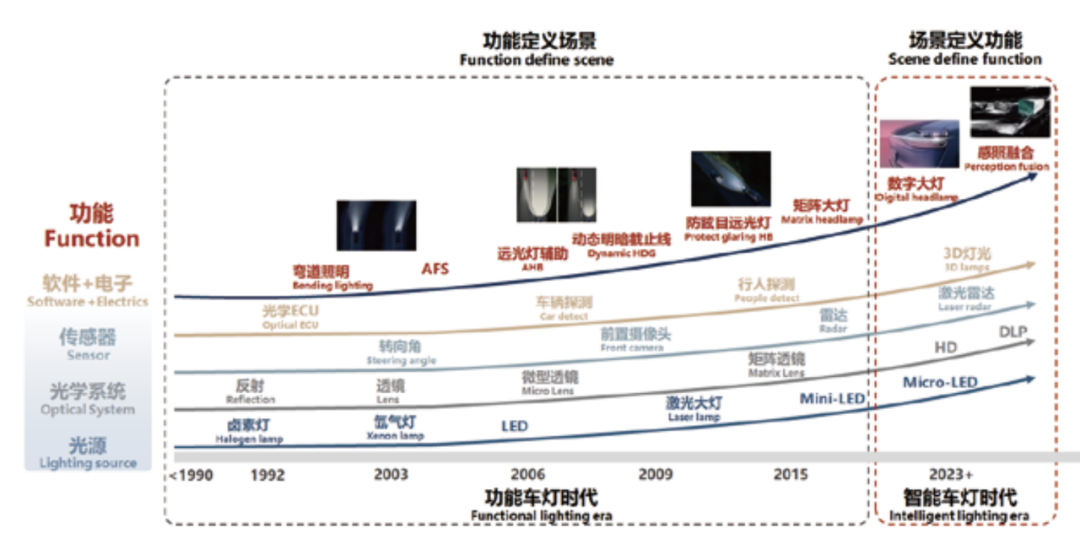
In the automotive industry's journey of continuous innovation, headlights have transformed from fundamental vehicle components to elements that offer emotional value, evolving from purely functional parts. Traditionally, headlights were quintessential "hardware products," where brightness, range, and durability were the sole determinants of their worth.
Today, intelligent headlights represent electronic systems redefined by software, algorithms, and networking, transitioning from mere "lighting tools" to integral "components of vehicle perception and interaction." The technical essence of headlights now hinges on whether the light source is controllable, the intelligence of the control, and its ability to collaborate seamlessly with the entire vehicle system.
Part 1: Pixelated Light Sources: The Core Transformation of Headlights
The true catalyst for the evolution of intelligent headlights lies in the advent of pixel-level light sources.
In the era of traditional LEDs, headlight patterns were largely "fixed," with mechanical blocking or simple matrices enabling at most far-near light switching. The essence of pixelated light sources lies in breaking down "a beam of light" into tens of thousands of independently controllable light points, allowing for digital management of light patterns akin to a screen. From a technical standpoint, three distinct paths have emerged.

● The first path is the ten-thousand-pixel solution, exemplified by Micro-LED.
Its advantages are evident: high brightness, rapid response, and a relatively simple structure, making it easier to meet automotive reliability and cost standards.
For consumers, the most tangible benefit of these headlights is more precise shielding during nighttime encounters, greater consideration for pedestrians and non-motorized vehicles, clearer lane-level illumination, and well-defined boundaries. They lean more towards "fine illumination" rather than complex projections.
● The second path is the million-pixel solution, represented by DLP.
This currently represents the technological pinnacle for "digital headlights." Ultra-high resolution endows headlights with true "imaging capabilities" for the first time, enabling not only precise control of light patterns but also the projection of symbols, patterns, and even information onto the road surface.
This solution elevates headlights from merely "being visible" to "being able to communicate." However, the costs are substantial: complex systems, high expenses, and a strong reliance on heat dissipation and supply chains. Consequently, it is currently limited to flagship models.
● The third path is the LCoS route, which remains a more forward-looking exploration.
It holds promise in terms of light efficiency and volume but still requires validation in automotive reliability and long-term stability. In the short term, it serves more as a technological reserve.
Pixel-level sources excel at illuminating the road, while million-pixel solutions enable interactive projections. These are not substitutes but cater to different price points and stages of vehicle intelligence.
Part 2: Algorithms and Networks: The Key to Determining "How Intelligent the Lights Are"
When headlights possess sufficient "pixels," the true differentiator shifts from hardware to the algorithms and network architectures that control them.
Intelligent headlights have entered a typical "perception-decision-execution" closed-loop system. Cameras, radars, navigation, and maps provide environmental information, algorithms assess scenarios, and headlights execute light pattern adjustments.
Algorithms are evolving from rule-based to intelligence-driven.
Early intelligent lighting relied heavily on fixed logic: shielding when a preceding vehicle is detected, dimming when a pedestrian is detected. Now, AI models are intervening, learning from diverse road conditions, weather patterns, and driving behaviors to make lighting strategies more natural and intuitive, akin to human perception.
You may not need to understand the intricacies of how the lights operate, but you'll undoubtedly feel "they understand you better."
Headlights are becoming integral to the vehicle's electronic and electrical architecture.
Headlight control, once a highly independent ECU with dedicated control, is now being integrated into central computing and Ethernet systems. The benefits of a centralized architecture are clear: faster response, enhanced linkage, and the continuous unlocking of new functions through OTA updates.
Nowadays, more and more lighting functions can be upgraded post-purchase, and headlights have evolved from "actuators" to "software-defined hardware."
Part 3: Cross-Domain Collaboration: Headlights Begin to "Actively Participate in Driving"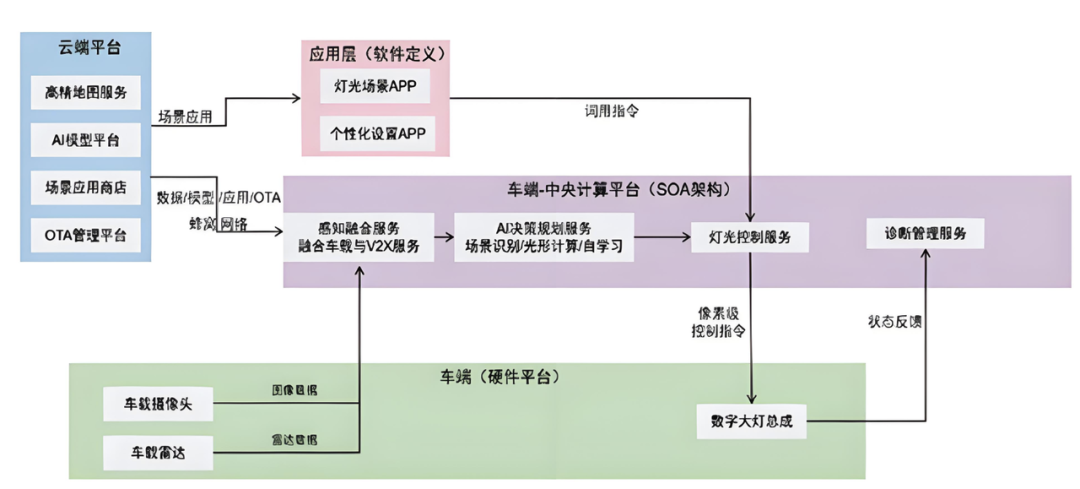
Equipped with perception, computing, and networking capabilities, intelligent headlights no longer merely illuminate the road ahead but actively participate in vehicle decision-making and information expression.
◎ First is collaboration with autonomous driving systems. Headlights can proactively optimize light patterns based on navigation paths and ADAS states, using different light effects to convey vehicle intentions on highways, construction zones, or in autonomous driving modes. This "visual language" is crucial for surrounding traffic participants.
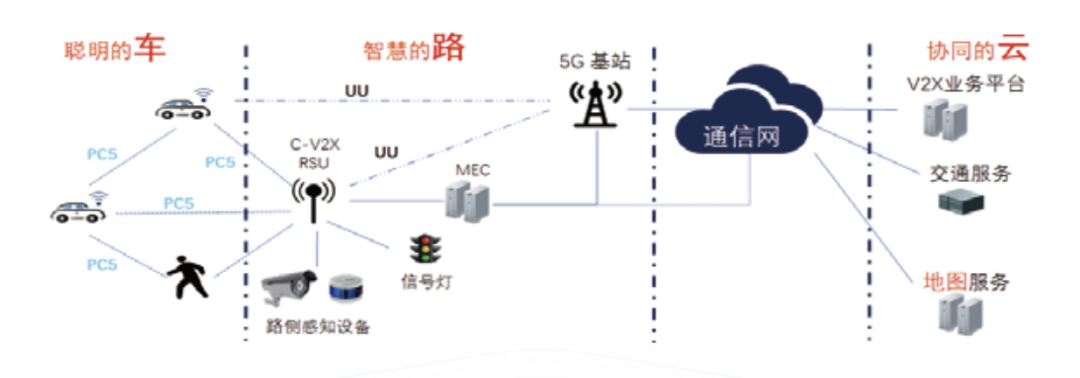
◎ Second is integration with vehicle-road collaboration systems. Within the V2X framework, headlights may serve as an "intuitive output terminal," using light effects to indicate road risks, turning intentions, and even assist in traffic organization at complex intersections.
◎ Third is linkage with the cabin and vehicle-cloud ecosystems. Welcome and farewell functions are just the beginning. In the future, lighting may become a customizable, extensible experience module, akin to audio and screens, even venturing into entertainment and interaction scenarios.
The technological evolution of intelligent headlights is not a linear progression. Pixel technology is advancing bidirectionally, aiming for "higher resolution and lower cost." Million-pixel solutions will gradually become more accessible, while Micro-LED continues to enhance its imaging capabilities and even explores hybrid architectures to strike a balance between performance and cost. Software and architecture determine long-term value.
The experience gap is bridged by algorithmic capabilities, system collaboration, and OTA sustainability. From light source chips to controllers, from algorithms to system solutions, the domestic supply chain is progressively filling in key links, which will directly drive intelligent headlights from high-end options to broader adoption.
Summary
For consumers, intelligent headlights enhance nighttime safety and make driving feel more "intuitive and understood." They are also evolving into a highly integrated, hardware-software deeply fused system within automotive electronics.
-
On the Eve of Its IPO, Avatr Finds Itself Embroiled in a 'Farce of Controversy and Belittlement'
-
![]()
Yutong Optics' Japanese Subsidiary Unveiled in Tokyo, Shifting Strategic Focus to Technology-Driven Growth
-
![]()
Half-Year Revenue Outstrips Last Year’s Total! Zhongrun Optics Forecasts 80.2% H1 Revenue Growth
-
![]()
Why Does AI Competition Start with Computing Power?
-
![]()
Apple AI Finally Makes Its Debut in China, Yet iPhone's 'AI Autonomy' Faces Uncertainty
-
![]()
Apple AI and QianWen Make Up Lessons: Alibaba Has Its Own 'Doubao Phone'
-
![]()
QianWen Joins Apple, Signal for Large Models to ‘Fade into the Background’
-
![]()
The ‘Anchor’ Strategy of Google Hidden Behind the Bleeding Financial Report