First Performance Express! Landte Optical's Net Profit Soars 76% in 2025
 02/26 2026
 659
659
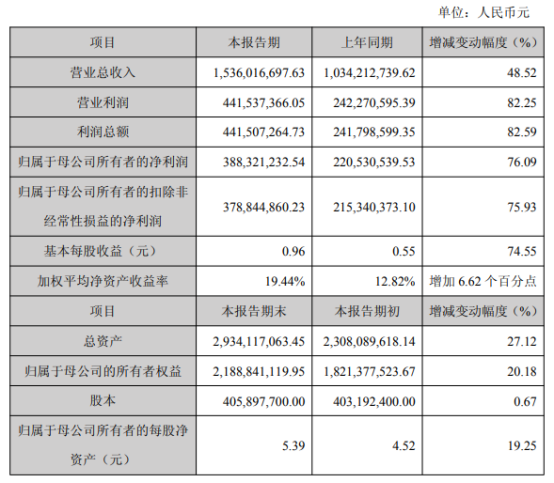
On February 25, Landte Optical released its performance express, reporting an annual revenue of 1.536 billion yuan in 2025, a year-on-year increase of 48.52%; net profit attributable to shareholders was 388 million yuan, up 76.09% year-on-year; and net profit excluding non-recurring items was 379 million yuan, a year-on-year increase of 75.93%.
The financial data shows that Landte Optical delivered an impressive performance, with profit growth in 2025 far outpacing revenue growth, indicating the release of scale effects and continuous optimization of profit quality.
Behind the high-performance growth lies the synergistic efforts of Landte Optical's three major product lines. In the optical prism business, the demand for micro-prism products used in smartphone periscope camera modules continued to expand, bringing significant performance increments to the company. The glass aspherical lens business showed a multi-pronged growth trend, benefiting from the simultaneous expansion of market spaces in multiple application areas such as automotive electronics, optical communications, smartphones, and handheld imaging creation devices, leading to substantial growth in sales volume. The glass wafer business also achieved rapid growth, with the company further deepening its strategic partnerships with major clients, and downstream demand continuing to rise with the expansion of cutting-edge technology applications such as AR and semiconductors.
On January 5, Landte Optical announced plans to invest no more than $60 million (approximately 420 million yuan) to establish a subsidiary in Singapore and a grandchild company in Malaysia. The company defined this as a strategic layout to "deepen international industrial chain collaboration and actively integrate into the global supply chain of precision optical components."
Against the backdrop of global supply chain restructuring, this move signifies Landte's upgrade from local manufacturing and export to a global operational system, enhancing response speed by staying close to overseas end markets and forming deeper synergies with downstream clients.
Immediately following, on January 14, the company held a board meeting to approve the 2026 private placement plan for issuing A-shares to specific objects, aiming to raise a total of no more than 1.0546 billion yuan. This private placement is not a simple capacity expansion but a systematic strategic positioning for the future.
Among them, the AR optical product industrialization construction project, with a planned investment of 500.5 million yuan, is the highlight of this private placement. Although the company stated in August 2025 that "AR glasses have not yet reached the stage of mass production and currently contribute little to the company's performance," this substantial investment sends a clear signal: the industrialization turning point for AR is approaching. Landte is targeting core components of light waveguides, such as 12-inch high-refractive-index glass wafers and crystalline wafers, which are key bottlenecks for achieving lightweight and high-definition experiences in AR glasses. Completing capacity positioning before industry mass production reflects the company's forward-looking judgment on the industrial chain rhythm.
Reviewing Landte Optical's various business moves, a clear strategic logic emerges: short-term performance is supported by micro-prisms and aspherical lenses, ensuring cash flow and profitability; medium-term growth is driven by capacity expansion and overseas layout (layout), capturing market share in automotive optics and globally; and long-term vision is carried by AR optical products and micro-nano optical R&D, reserve (stockpiling) solutions for the technological iteration of next-generation smart terminals. This tiered layout enables the company to have stronger risk resistance capabilities in the face of industry fluctuations.
Landte Optical's series of moves also hold significant benchmarking value for the entire optical industry. The era of single components is ending, and only enterprises capable of providing solutions simultaneously in the three major areas of imaging, sensing, and display can deeply bind major clients and increase the value per unit.
As the gateway to information interaction, the value of optics is far from reaching its peak. In the future, with the integration and implementation of technologies such as AR, AI, and intelligent driving, precision optical enterprises with core technological depth and global layouts may usher in (usher in) even broader growth spaces.
-
On the Eve of Its IPO, Avatr Finds Itself Embroiled in a 'Farce of Controversy and Belittlement'
-
![]()
Yutong Optics' Japanese Subsidiary Unveiled in Tokyo, Shifting Strategic Focus to Technology-Driven Growth
-
![]()
Half-Year Revenue Outstrips Last Year’s Total! Zhongrun Optics Forecasts 80.2% H1 Revenue Growth
-
![]()
Why Does AI Competition Start with Computing Power?
-
![]()
Apple AI Finally Makes Its Debut in China, Yet iPhone's 'AI Autonomy' Faces Uncertainty
-
![]()
Apple AI and QianWen Make Up Lessons: Alibaba Has Its Own 'Doubao Phone'
-
![]()
QianWen Joins Apple, Signal for Large Models to ‘Fade into the Background’
-
![]()
The ‘Anchor’ Strategy of Google Hidden Behind the Bleeding Financial Report