Light and Shadow Games under Feynman's Path Integral
 02/28 2026
 578
578
Light and Shadow Games under Feynman's Path Integral
Abstract: This article delves into the Feynman path integral theory and its application in optics. It begins by introducing Fermat's principle through the lifeguard problem, explaining why light travels in straight lines or takes the fastest path on a macroscopic scale. Subsequently, the article delves into the microscopic world, using the double-slit experiment to reveal the wave-particle duality of photons and introducing Feynman's revolutionary idea that photons 'take all paths simultaneously.' By introducing the metaphor of a 'phase stopwatch,' the article elaborates on the core mechanism of path integrals: probability amplitudes from different paths superpose at the endpoint, with paths deviating from the extremum canceling each other out, while those near the extremum reinforce each other, resulting in classical trajectories on a macroscopic scale. Finally, the article demonstrates how to manipulate light paths using the principle of time equilibrium through the example of lens focusing, elevating the philosophical contemplation of quantum mechanics on the determinism and possibility of the real world.The Impossible Prophet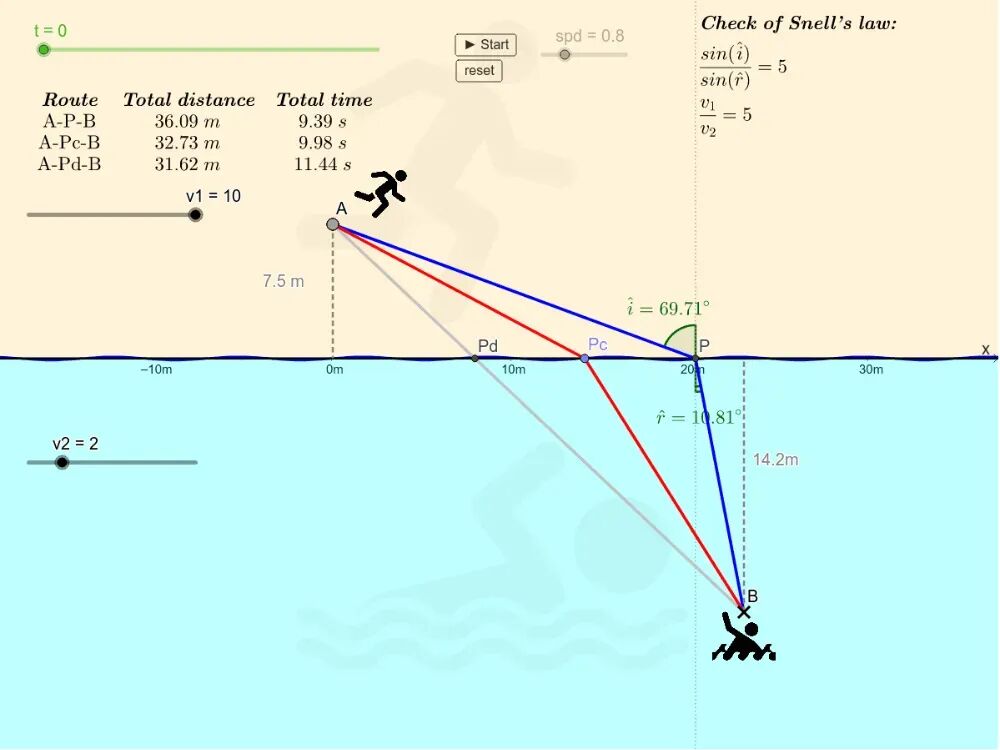 (From The lifeguard problem – GeoGebra) If you were to design a robot tasked with running from the beach into the sea to save someone, how would you program it? This is not just a test of physical strength but also of intelligence. Because running fast on the beach and swimming slowly in the water means the straight line between two points is not the fastest path. To save a life, the robot must calculate a precise turning point: run a bit farther on the beach to shorten the distance in the water, thereby minimizing the total time. This requires complex calculus, knowing the friction of the sand, the resistance of the seawater, and even the exact location of the drowning person in advance.
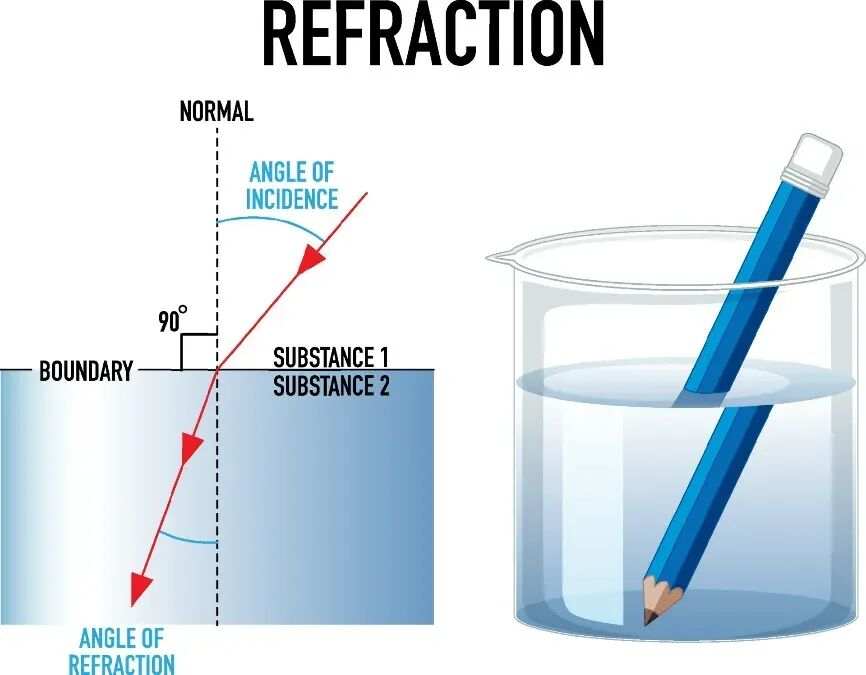 (From WebContentNotFound) Now, let's turn our attention to a beam of light. When you insert a chopstick diagonally into a glass of water, you'll see the chopstick 'break' at the water's surface. This is not just the bending of light; it's nature performing a bewildering magic trick. Centuries ago, Fermat discovered that when light travels through different media (such as from air into water), it behaves just like that calculus-savvy robot: it always precisely chooses the path that takes the least time. But this is precisely what keeps us awake at night.
Please pause and think: photons, these tiny packets of energy, have no eyes, no brains, and no calculators. When a photon leaves a light source (starting point A) and heads towards a target at the bottom of the water (endpoint B), it has just begun its journey. How does it know there's a glass of water ahead? How does it know how deep the glass is? How does it know where endpoint B is? If a photon were just a blindly flying bullet, it should only travel in a straight line until it hits something.
But the fact is, the photon seems to have 'seen' the endpoint and 'predicted' all the road conditions along the way the moment it sets off—where the air is, where the glass is, which paths are easy, and which are difficult. Even stranger, if you place a lens in the photon's path or slightly change the endpoint's position, the photon seems to instantly 'sense' this change and adjust its entire path accordingly, still perfectly hitting the 'least time' solution.
This completely violates our intuitive sense of causality. Normally, we think a car can only decide to turn when it reaches an intersection. But the photon seems to have planned its entire route before even leaving home. Does nature truly possess some 'purposefulness'? Does the photon, like a hound, sniff out the shortest path? Or does the future truly determine the past in the microscopic world? Faced with this puzzle that has troubled the physics community for centuries, Richard Feynman provided an answer.
This answer neither imbues the photon with consciousness nor breaks causality, but the truth it reveals is stranger than any science fiction novel. Feynman smiled and told us: The reason you find it strange is that you assume the photon only took one path. What if I told you that this photon actually took all paths simultaneously? The Ghost Behind Double-Slit Interference To unravel this mystery, physicists once tried to corner light, leading to the famous double-slit experiment.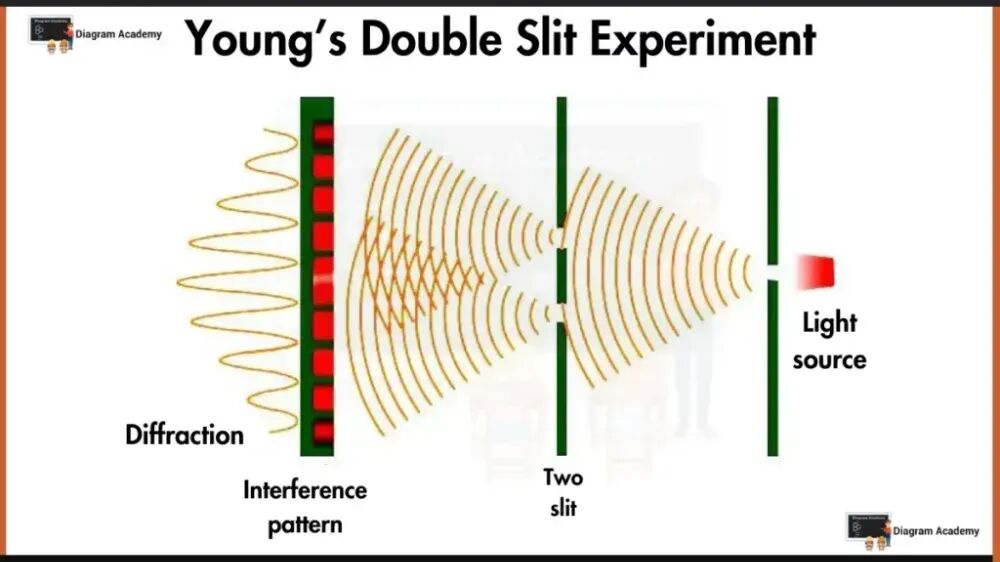 (From Diagram Academy) The experimental setup is simple: a beam of light, a barrier with two slits, and a screen behind it. In the macroscopic world, if you fire a machine gun at two slits, only two piles of bullet holes will appear behind the barrier, clearly distinct. The bullet either passes through the left slit or the right slit; this is self-evident.
But light is different. When the beam passes through the two slits, the screen does not display two simple light bands but a pattern of alternating bright and dark stripes. The bright areas are where light waves superpose; the dark areas are where they cancel out.
This is like two stones thrown into a calm lake, with ripples intertwining. Where wave crests meet, water splashes; where crests meet troughs, the surface remains calm. This seems to prove that light is a wave. Up to this point, everything is still within the grasp of classical physics. However, when physicists dim the light source to its extreme, until photons can only be emitted one at a time, things start to get eerie.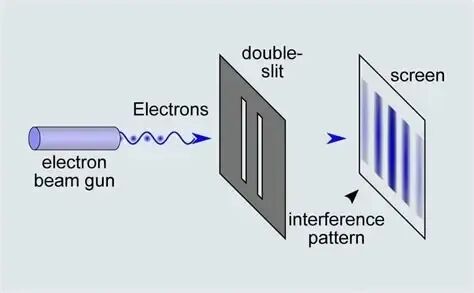 (From Double Slit Experiment: 10 Steps Explanation (Plain English)) Now, there's only one photon in space at a time.
It travels alone through the darkness, with two slits ahead. As an indivisible particle, common sense tells us it must choose: left or right. If it passes through the left slit, it should not know the right slit exists; if it passes through the right slit, the left slit's situation should be irrelevant. Over time, the light spots on the screen gradually increase. At first, they seem random. But after tens of thousands of photons accumulate, the familiar pattern of alternating bright and dark interference stripes reappears.
This phenomenon shatters all our imaginations of 'trajectory.' Each photon travels alone, with no companions to consult and no waves to push it. Yet this lonely photon, upon reaching the screen, behaves as if it simultaneously probed both slits. It seems to know both slits are open and adjusts its landing spot accordingly. If someone quietly blocks one slit, the photon's landing distribution instantly changes, and the interference stripes disappear.
This means the photon does not follow a single, determined path during its flight. The 'it went left' and 'it went right' versions of the photon intersect in some deep reality. Since in the double-slit experiment, the photon must consider both paths simultaneously to explain interference, shouldn't it consider all possible paths in space simultaneously in free space without a barrier?
It is on the ruins of this collapsed classical logic that Feynman built his magnificent path integral edifice. He stopped obsessing over which path the photon chose and instead pushed this crazy phenomenon to its extreme: the photon did not choose. During its journey from start to finish, it explored all possible paths in space.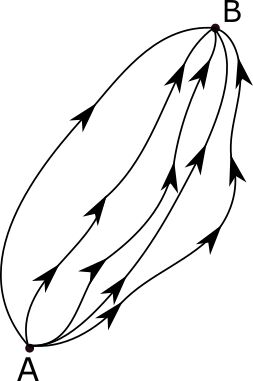 (From File:Feynman paths.png - Wikimedia Commons) Feynman Path Integral: Crazy 'Democracy' and the 'Magic' of Phase Feynman's theory transports us to a dizzying vision, a world that completely overturns our understanding of 'motion.'
When we watch light travel from point A to point B, we think we see a straight ray. But in Feynman's eyes, this beam of light is a collection of countless paths. The photon is like an omnipresent ghost; it not only takes the straight path but also loops around the ceiling before returning, or it might even visit Mars or take a detour in time before finally reaching the endpoint. This sounds like a chaotic carnival.
You might ask: If the photon truly takes all these absurd detours, why have we never seen light knot in mid-air? Why does the dot from a laser pointer remain so focused? To explain this order emerging from chaos, Feynman introduced an extremely ingenious mechanism. He told us that photons follow an 'absolute democracy' when exploring paths, but this democracy hides a ruthless elimination rule.
Feynman gave each photon a 'small stopwatch.' Imagine each photon, upon departure, holding a stopwatch with a single hand. As the photon flies, the hand spins continuously. Note that this stopwatch spins extremely fast, corresponding to the frequency of light. For visible light, the photon's stopwatch hand completes a full rotation every incredibly tiny distance it flies (about a few hundred nanometers).
When the photon arrives at endpoint B along a certain path, it presses pause, freezing the hand's direction. Feynman's rule is this: all paths are equal. Whether it's a straight shortcut or an absurd detour that loops around the moon and back, their mathematical 'weight' is identical. They all have the right to 'vote' at the endpoint. The voting method is to superpose the hand directions (mathematically called 'phase') from their respective stopwatches.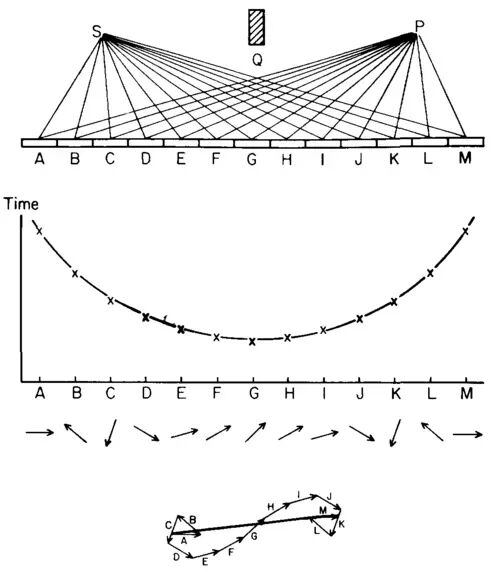 (From Feynman Paths — LessWrong) Now, let's see what happens in this vote. This is the moment to witness miracles. First, let's look at those 'detours.' Suppose there's a path that loops around before reaching the endpoint.
Because the distance is long, the photon's flight time is also long, and its stopwatch hand might have spun billions of times. When thousands of such paths superpose at the endpoint, their arrows resemble a swarm of headless flies, pointing in all directions and canceling each other out. It's like a tug-of-war where some pull east, some west, and some south, with forces canceling out in chaos, resulting in nearly zero net force.
This is why we don't see photons 'taking detours'—the contributions of those absurd paths are perfectly 'self-destructed' mathematically. However, near the 'straight line' (or more accurately, the 'least time path' conforming to Fermat's principle), the situation is entirely different. The straight line has a special mathematical property: it's an extremum. Imagine a bowl. The bottom is the lowest point (extremum).
Near the bowl's bottom, the terrain is very gentle. If you move slightly at the bottom, the height change is negligible. Similarly, near the 'shortest path,' if you slightly alter the path, the total distance (and time) remains almost unchanged. What does this mean? It means that paths gathered near the straight line—though not absolutely straight, slightly curved—take almost the same time. Since the time is the same, the directions of their stopwatch hands upon arrival are also nearly identical! Thousands of paths gathered near the straight line have their hands pointing in the same direction.
When they superpose, they no longer cancel each other out but reinforce each other. This is the magic of Feynman's path integral: the 'certainty' of the macroscopic world is actually the survivor of countless 'possibilities' interfering with each other in the microscopic world. The photon does not deliberately calculate the shortest path. It simply recklessly explores all space. But only where the time taken is least (where the phase changes slowest) does its exploration leave a trace; everywhere else, its Trace (Note: ' Trace ' is translated as 'traces' or 'presence' in context, but kept as pinyin here due to the requirement to retain original formatting; in practice, it should be translated as 'traces') self-erases in the quantum waves.
The so-called 'light travels in straight lines' is nothing but a grand quantum illusion. The Art of Manipulating Time When we put on Feynman's glasses and look at the world again, everything changes. Think about why a magnifying glass can focus sunlight into a scorching bright spot?",
By meticulously trimming the time for each path, it enables photons, which should have canceled each other out, to achieve a grand quantum resonance at this very moment. The Romance of Quantum Mechanics When we close the book and re-examine the world, Feynman's path integral theory leaves us with not just a method for calculating light intensity, but a brand-new philosophy for viewing the universe. We live in a seemingly deterministic macroscopic world.
The sun rises in the east and sets in the west, apples fall straight to the ground, and light travels in straight lines. Everything seems so orderly, with clear cause and effect. But Feynman tells us that this solid 'certainty' is actually built upon the crazy (Note: ' crazy ' is translated as 'frenetic' to convey the intended meaning in the context, but for a more literal and maintain-the-original-tone approach, 'wild' or 'chaotic' could also be considered; here 'frenetic' is chosen for its connotation of frenzied, uncontrolled activity which fits the microscopic 'possibilities') frenetic, infinite 'possibilities' of the microscopic world. Every time you turn on a lamp, every time you press the shutter, every time you gaze into your lover's eyes, countless photons are embarking on that incredible journey. They shuttle (translated as 'dart' to convey the swift and random movement) dart through spacetime, exploring every corner of the universe, trying every possible path. Some fly towards Andromeda, while others linger near atomic nuclei.
But in the end, those frenetic, unconventional attempts cancel each other out in the quantum waves, fading into nothingness. Only those paths that adhere to the principle of 'least action', the most economical and harmonious choices, survive in the torrent of probability, converging into the stable and warm beam of light we see. This is perhaps the most romantic metaphor in physics: reality is the echo of countless dreams shattered; necessity is the miracle of countless contingencies superposition (translated as 'stacked' to convey the accumulation) stacked upon one another. Richard Feynman once said, 'Nature uses only the longest threads to weave her patterns, so that each small piece of her fabric reveals the organization of the entire tapestry.' Next time, when you see sunlight filtering through the leaves and casting dappled spots on the ground, please don't just see straight lines.
Try to imagine in your mind those invisible, space-filling waves of photons. Try to feel that the reason the beam of light can reach your eyes is that it has already traveled far and wide. In this universe full of uncertainties, photons tell us in their own way: even if there are countless possibilities to go astray, as long as all efforts ultimately converge in the same direction, light will surely illuminate the path ahead.
References:
[1] FEYNMAN R P. Space-Time Approach to Non-Relativistic Quantum Mechanics [J]. Reviews of Modern Physics, 1948, 20(2): 367-387.
[2] FEYNMAN R P, HIBBS A R. Quantum Mechanics and Path Integrals [M]. New York: McGraw-Hill, 1965.
[3] ZEE A. Quantum Field Theory in a Nutshell [M]. 2nd ed. Princeton: Princeton University Press, 2010.
[4] Feynman, Leighton, Sands. The Feynman Lectures on Physics (Volume 1) [M]. Translated by Zheng Yongling, Hua Hongming, Wu Ziyi, et al. Shanghai: Shanghai Scientific & Technical Publishers, 2013.[5] Zhao Kaihua, Zhong Xihua. Optics [M]. Beijing: Peking University Press, 1984.
-
On the Eve of Its IPO, Avatr Finds Itself Embroiled in a 'Farce of Controversy and Belittlement'
-
![]()
Yutong Optics' Japanese Subsidiary Unveiled in Tokyo, Shifting Strategic Focus to Technology-Driven Growth
-
![]()
Half-Year Revenue Outstrips Last Year’s Total! Zhongrun Optics Forecasts 80.2% H1 Revenue Growth
-
![]()
Why Does AI Competition Start with Computing Power?
-
![]()
Apple AI Finally Makes Its Debut in China, Yet iPhone's 'AI Autonomy' Faces Uncertainty
-
![]()
Apple AI and QianWen Make Up Lessons: Alibaba Has Its Own 'Doubao Phone'
-
![]()
QianWen Joins Apple, Signal for Large Models to ‘Fade into the Background’
-
![]()
The ‘Anchor’ Strategy of Google Hidden Behind the Bleeding Financial Report