AI Glasses: Between Cheating and Covert Photography—Exploring Their 'Unconventional' Uses
 03/03 2026
 551
551
Who Unleashed the Potential for Misuse?
Written by / Li Xuanqi
Edited by / Li Jinlin
Layout by / Annalee
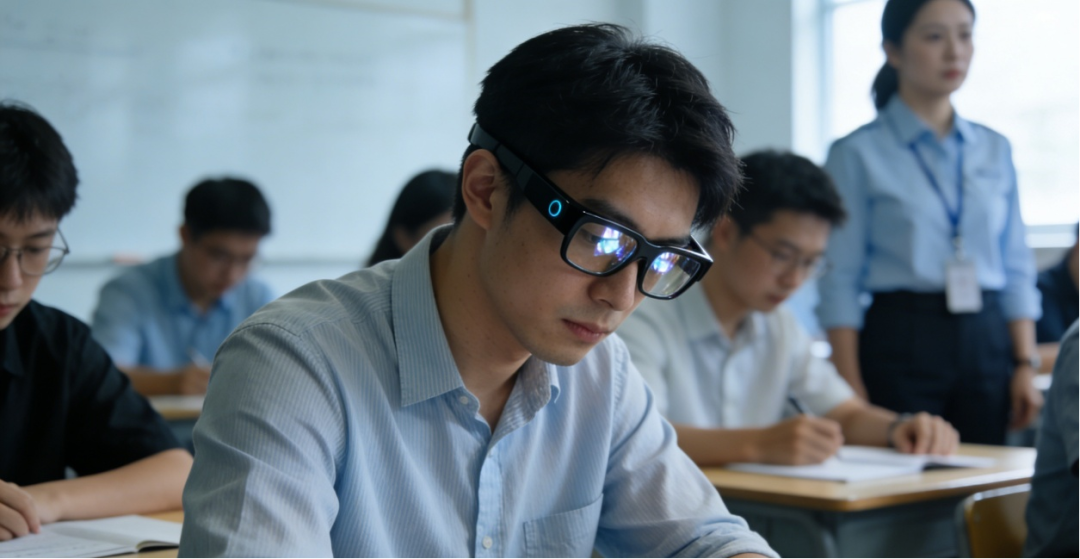
At the final exam for the undergraduate course "Principles of Computer Networks" at the Hong Kong University of Science and Technology, a pair of seemingly ordinary black-framed glasses transformed into a 'secret weapon.' The student donning these glasses completed their paper in just 30 minutes, achieving a remarkable score of 92.5 points and ranking among the top five out of over a hundred participants, easily surpassing more than 95% of their peers...
This scenario is not plucked from the pages of a science fiction novel; rather, it's the outcome of an experiment conducted by Professor Zhang Jun and Professor Meng Zili from the Hong Kong University of Science and Technology. Their aim was to investigate whether AI glasses, when integrated with advanced large models, could effectively 'cheat' and secure high scores.
While the prospect of AI glasses being used for cheating raises eyebrows in academic circles, their potential for covert photography in public spaces is even more disconcerting.
As AI glasses evolve into tools for exam cheating and surreptitious photography, the gray areas surrounding their misuse continue to widen. This begs the question: Are these glasses, which are reshaping our interaction with the world, a gateway to the future or a Pandora's box in dire need of regulation?
Behind the thin lenses of these glasses, a complex interplay of technological ethics, privacy concerns, and industrial growth unfolds quietly, spanning from exam halls to city streets.
Who's Exploiting AI Glasses for Cheating?
How Exactly Does Cheating Occur with AI Glasses?
According to the WeChat public account 'QbitAI,' in the 'human-machine co-exam' experiment at the Hong Kong University of Science and Technology, students would glance down at their exam papers while the AI glasses swiftly captured images of the questions via an inbuilt camera. These images were then transmitted through a 'glasses-phone-cloud' pathway to a remote large model for processing. The generated answers were sent back along the same route and displayed on the glasses' screen, allowing students to copy them.
During the hardware selection phase, the project team meticulously evaluated 12 mainstream commercial smart glasses available in the market, including models from Meta, Xiaomi, and Rokid. Ultimately, they opted for the Rokid AI glasses, which were equipped with the ChatGPT-5.2 large model.
In the end, the Rokid AI glasses excelled in multiple-choice and single-page short-answer questions, scoring full marks, and even performed well in more challenging cross-page short-answer questions (SAQs), earning most of the available points.
If the use of AI glasses for cheating were confined to the realm of experiments, people might simply marvel at the strides made in AI technology. However, the reality is that there have been numerous instances of genuine cheating using AI glasses in universities.
As early as 2024, according to Xinhua News Agency, an 18-year-old man in Japan was suspected of using smart glasses to photograph chemistry exam papers during the entrance exam for Waseda University's Faculty of Science and Engineering. He transmitted the photos to a smartphone, uploaded them to the social media platform X, sought answers from multiple contacts, and filled in the answers based on the responses, leading to his referral to prosecutors.
Such incidents are not isolated to Japan; they have also occurred in China.
For instance, a university in Hubei recently announced on its information bulletin board that a student from the 2023 cohort 'used smart glasses to obtain information related to the exam content during the 'Probability Theory and Mathematical Statistics B' exam on January 22, 2026, and was found to be cheating.'
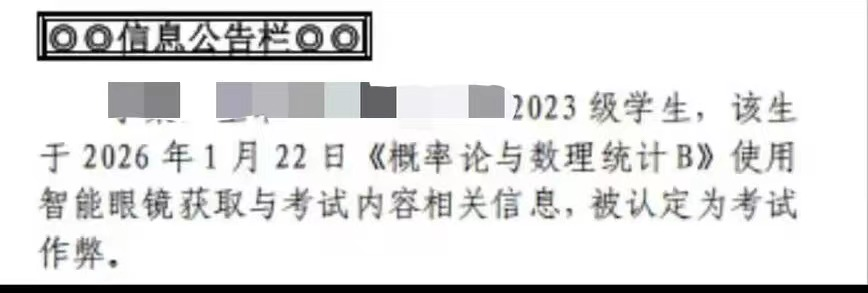
On social media platforms like Xiaohongshu and Weibo, numerous netizens have reported that their schools have issued announcements or notifications regarding students using smart glasses to cheat. Some netizens shared images from class group chats where teachers issued notifications about exam discipline violations, stating that a student 'brought smart glasses in violation of exam rules' and reminded students 'not to bring devices with communication capabilities (smartwatches, bracelets, smart glasses, phones, etc.) during exams.'
Cheating with AI glasses is not limited to universities; it has also surfaced in various vocational qualification exams. Previously, at a tour guide qualification exam in Fuzhou, an individual was caught cheating using smart glasses. Such exams are directly linked to professional qualifications, and some candidates apparently take significant risks.
Moreover, Zincode observed that on major social media platforms, some netizens have inquired whether 'AI glasses can be used for cheating' and 'if wearing AI glasses to the exam site will be detected.' These discussions highlight the fact that cheating methods involving AI glasses have gained a certain level of awareness and dissemination among student groups.
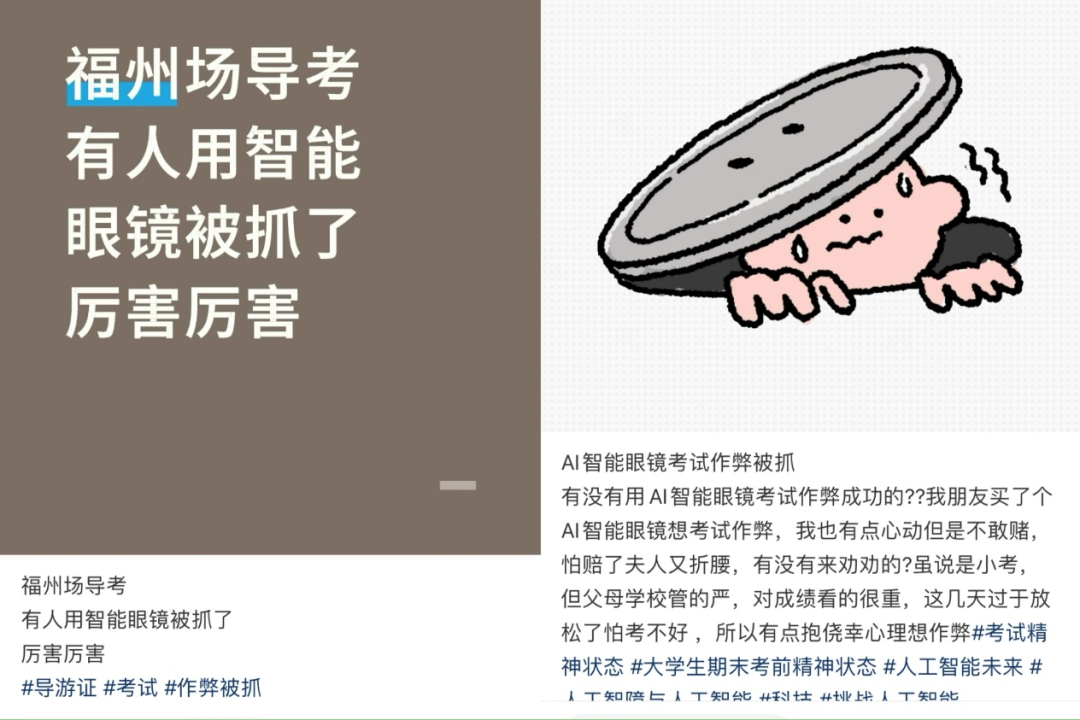
Image source: Xiaohongshu
It's worth noting that AI glasses have previously sparked multiple controversies over cheating. From amateur Go competitions where players faced scrutiny for wearing AI glasses to a seemingly ordinary pair of glasses igniting intense online debates about 'tech cheating' at the National Games table tennis competition...
Faced with the multifaceted challenges posed by AI glasses, various stakeholders are seeking solutions. Zincode learned that many universities have explicitly banned the use of smart glasses and other devices in exam halls. The 'Smart Campus Device Usage Specifications' issued by the Ministry of Education in collaboration with multiple departments in 2025 also emphasize that standardized exams explicitly prohibit the use of any devices capable of taking photos, recording videos, or connecting to the internet.
Recently, the College Board in the United States also updated the rules for the SAT exam, explicitly listing smart glasses as prohibited devices. This regulation will come into effect in the 2026 SAT exams.
The 'Special Demands' Surrounding AI Glasses
Currently, AI glasses on the market closely resemble ordinary glasses in appearance, but their 'special demands' extend far beyond cheating.
In 2025, AI glasses from companies like Google, Lawaken, Rayneo, Xiaomi, Meta, and ByteDance continued to be launched and updated, marking the beginning of the 'Hundred Glasses Battle 2.0.'
According to CNN, several victims have previously disclosed to reporters that they suspected they were secretly photographed by unknown individuals using AI glasses without their knowledge.
In fact, leading domestic and international brands apparently take this issue into account when designing AI glasses. For example, Meta's AI glasses feature a lighting indicator that activates during recording. On Bilibili, the blogger 'Dianwan Keji AK' conducted a review and found that if the indicator light is covered with a sticker, the recording function cannot be used normally. However, he also mentioned that there are ways to circumvent this limitation.
Similarly, although Xiaomi's official website advertises that an orange light turns on as a recording indicator when the glasses are in use, it is difficult for the person being photographed to notice if the photographer slightly conceals the glasses or if the shooting occurs outdoors in bright daylight, or if the subject is far away. This is especially true for individuals who are highly focused on studying or working. Moreover, on Bilibili, blogger 'Guiji JOJO' posted a video claiming, 'A 3-yuan marker pen can blacken the indicator light, directly bypassing the anti-secret photography design.' In the video, after blackening the indicator light on Xiaomi's AI glasses, the system did not emit a warning sound, and normal recording could still occur.
On social media platforms like Xiaohongshu, some bloggers employed similar physical blocking methods, directly applying a black marker or covering the indicator light with a transparent film made of special material. The video demonstrated that the glasses could still record normally without any functional interruptions.
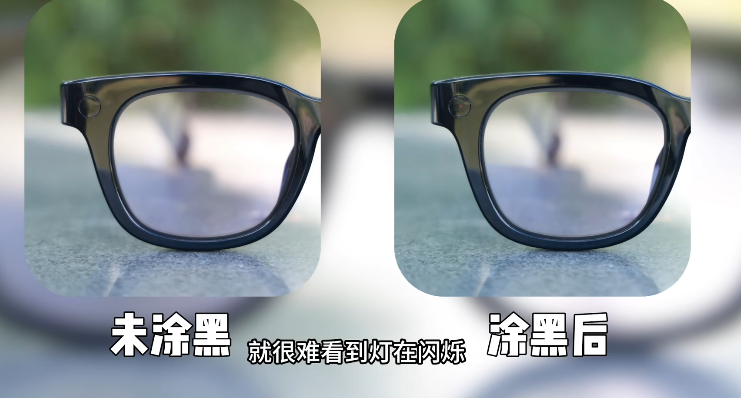
Image source: Screenshot from Bilibili video by 'Guiji JOJO'
If leading brands' AI glasses at least attempt to mitigate secret photography risks in their design, many cheaper alternatives are even more reckless. A stroll through Shenzhen's Huaqiang Electronics World and SEG Electronics Market reveals a plethora of AI glasses from unknown brands, categorized into subcategories like 'AI translation glasses' and 'AI photography glasses.' Their prices are often a fraction of those from leading brands, mostly ranging from 100 to 400 yuan. Notably, the recording indicator lights on most of these AI glasses can be turned off with a single button press on the frame.
On e-commerce and social media platforms, many AI glasses are labeled as 'Huaqiangbei top-tier,' 'same model as Xiaomi,' or 'factory direct sales.' These glasses often boast functions like music playback, calling, photography, video recording, translation, and image recognition. When Zincode inquired with sellers about whether the recording function had any indicators, customer service representatives typically replied that it 'can be turned off' or avoided direct answers, stating that they 'support legal use.'
According to 'Yicai Business School,' a seller named Yueya mentioned that their best-selling product is currently an AI photography glasses priced around 280 yuan, equipped with a 5-megapixel camera and 32GB of storage. 'Including both physical and online sales, we can sell twenty to thirty units a day.'
The 'secret photography risks' associated with these unbranded and affordable AI glasses are glaring. On Bilibili, blogger 'Tangdaoya' purchased a pair of affordable AI camera glasses from an e-commerce platform for a review and successfully conducted 'secret photography without anyone noticing.'
Undeniably, the illegal sale of secret photography devices has long been a concern, and the emergence of AI glasses provides new cover for such activities.
Technology itself is neither inherently good nor evil, but the complexity of human nature ensures that every groundbreaking technology will face the temptation of misuse. From precise cheating in exam halls to concealed secret photography on city streets, these are merely the tip of the iceberg regarding AI glasses' misuse. This urgently calls for timely intervention from laws and standards, requiring clear technological boundaries, traceable production responsibilities, and more deterrent punishment mechanisms to minimize gray areas.
-
On the Eve of Its IPO, Avatr Finds Itself Embroiled in a 'Farce of Controversy and Belittlement'
-
![]()
Yutong Optics' Japanese Subsidiary Unveiled in Tokyo, Shifting Strategic Focus to Technology-Driven Growth
-
![]()
Half-Year Revenue Outstrips Last Year’s Total! Zhongrun Optics Forecasts 80.2% H1 Revenue Growth
-
![]()
Why Does AI Competition Start with Computing Power?
-
![]()
Apple AI Finally Makes Its Debut in China, Yet iPhone's 'AI Autonomy' Faces Uncertainty
-
![]()
Apple AI and QianWen Make Up Lessons: Alibaba Has Its Own 'Doubao Phone'
-
![]()
QianWen Joins Apple, Signal for Large Models to ‘Fade into the Background’
-
![]()
The ‘Anchor’ Strategy of Google Hidden Behind the Bleeding Financial Report